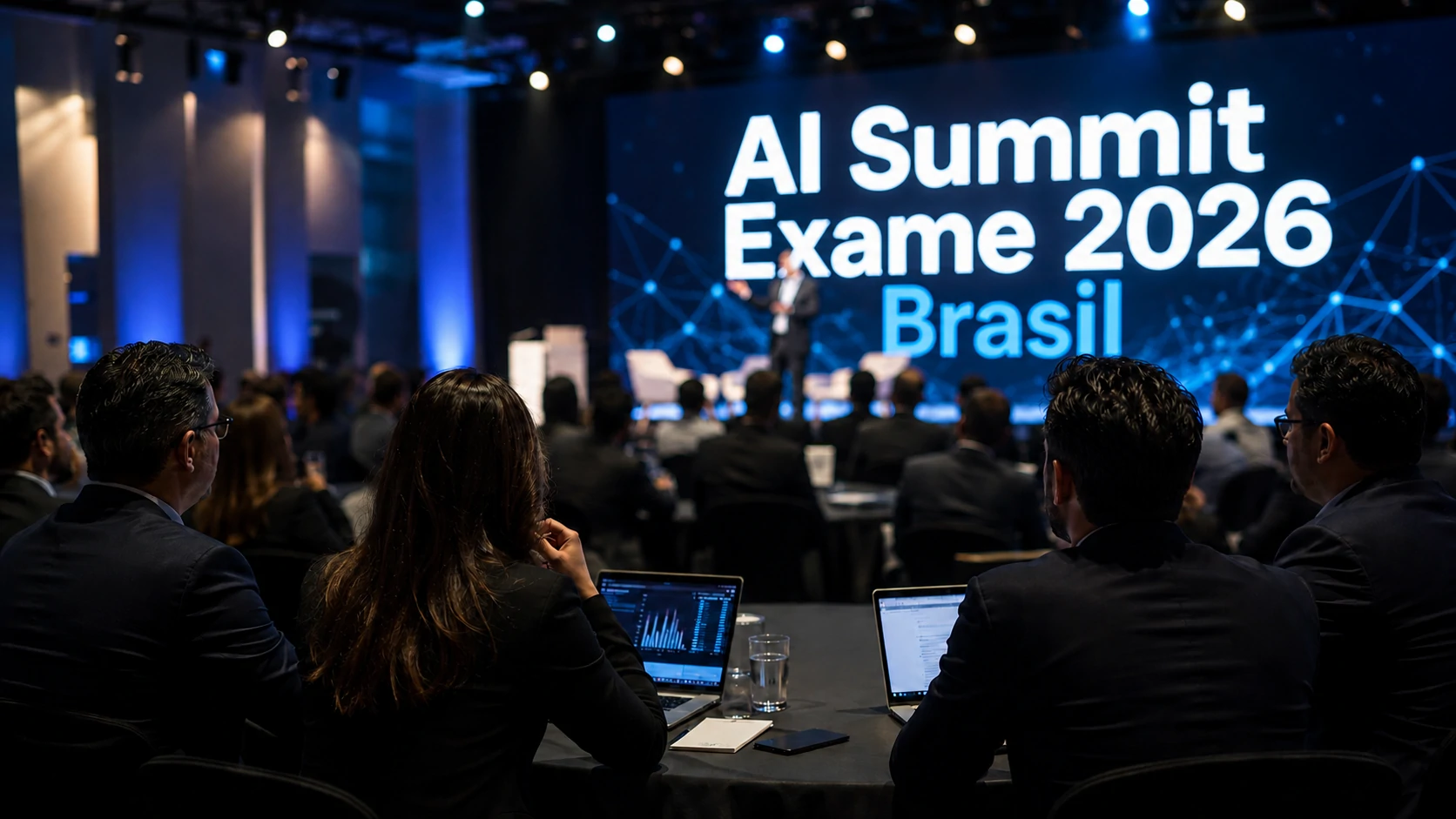
For years, artificial intelligence was presented as a promise of transformation. At AI Summit Exame 2026, however, the message was different: the experimentation phase is coming to an end. The new priority is scaling AI initiatives, integrating intelligent agents into business processes, and turning AI into a tangible competitive advantage.
AI Summit Exame 2026: What the Event Reveals About the Next Phase of Enterprise AI Adoption in Brazil
Artificial Intelligence Is No Longer a Pilot Project
Companies across industries are increasingly treating Artificial Intelligence as a strategic layer of their operations rather than an isolated innovation initiative.

Executives discuss how artificial intelligence is moving from innovation labs into the core of business operations.
The most significant signal emerging from AI Summit Exame 2026 was the shift in executive conversations. Discussions moved away from the potential of the technology and focused instead on implementation, governance, and return on investment.
The End of the Experimental Phase
Over the past two years, many organizations established AI labs to test generative AI tools and models.
Today, the challenge is different.
Business leaders want to understand how AI can be integrated into critical workflows, increase productivity, and create sustainable competitive advantages.
The Focus Has Shifted to Results
The question is no longer “Should we adopt AI?”
The question is now “How do we scale AI securely and efficiently?”
This shift brings the Brazilian market closer to trends already visible among global enterprises.
To better understand this movement, it is worth exploring the concept of AI First, which is increasingly influencing corporate strategy worldwide.
AI Agents Are Emerging as the Next Enterprise Frontier
Intelligent agents were among the most discussed topics at the event.

Autonomous agents are emerging as the next stage in the evolution of business automation.
Market expectations suggest that AI agents will be capable of executing complete tasks, making decisions within predefined boundaries, and interacting with multiple enterprise systems.
What Differentiates Agents from Chatbots
Chatbots answer questions.
Agents execute processes.
This distinction is critical for understanding the next stage of digital transformation.
While conversational assistants typically operate reactively, agents can function proactively and autonomously.
MCP Gains Strategic Relevance
Another major topic connected to AI agents was the growing importance of MCP (Model Context Protocol).
Many industry leaders see MCP as one of the most promising frameworks for connecting AI models to enterprise systems.
Organizations interested in the topic can explore How MCP Works: A Complete Guide for AI Agents and How to Implement MCP in Enterprises.
Governance and Control Become Top Priorities
The rapid adoption of AI has also introduced new concerns for executives and corporate boards.

Governance, security, and compliance are becoming central priorities as AI adoption expands across enterprises.
As AI initiatives scale, organizations face increasing risks related to security, privacy, regulatory compliance, and misuse of technology.
Shadow AI Becomes a Growing Concern
Many organizations have discovered that employees are already using AI tools without formal approval from IT departments.
This phenomenon is known as Shadow AI.
Beyond operational risks, it creates governance challenges and raises concerns about data protection.
Organizations seeking deeper insights can explore What Is Shadow AI? A Complete Guide.
The Rise of AI Operations
Another concept gaining traction is AI Operations.
The goal is to establish processes, metrics, and governance frameworks capable of monitoring AI models, autonomous agents, and automated workflows at scale.
What AI Summit Exame Reveals About the Future of Business
The event’s most important takeaway is that the AI race is entering a new stage.
Success will not belong to companies that merely experiment.
It will belong to organizations capable of transforming technology into operational capability.
Competition Will Be Organizational
Competitive advantages will not be determined solely by the AI models companies choose.
They will be defined by the ability to integrate technology, data, processes, and people into a unified operating model.
Organizations with greater operational maturity are likely to capture significantly more value from AI investments.
Brazil Is Entering a New Phase of Digital Transformation
AI Summit Exame 2026 demonstrated that Brazil’s AI conversation is becoming increasingly aligned with the most advanced global discussions.
Topics such as autonomous agents, AI infrastructure, governance, integration protocols, and enterprise productivity are now part of the agenda of corporate leaders.
From this point forward, artificial intelligence is no longer a distant trend. It is becoming a central pillar of growth, efficiency, and competitiveness for Brazilian companies. For organizations that want to remain relevant over the next decade, the question is no longer whether AI will be adopted, but how quickly adoption will occur and who will execute it most effectively.
Comentários
Os comentários utilizam autenticação via GitHub para manter um ambiente mais qualificado, seguro e livre de spam.
Entrar ou criar conta no GitHub