For years, the main promise of AI models with open weights was straightforward: give companies and developers greater freedom to use the technology while reducing dependence on major platforms. Alibaba’s new strategy puts that logic against a question that could reshape the market: how open can an AI model be when its provider also wants a share of the money generated from it?
Alibaba wants to turn Qwen’s commercial success into revenue
Alibaba is preparing a new way to monetize its next generation of Qwen models. According to information reported by Reuters, the company plans to require large commercial users of the upcoming Qwen3.8-Max to share a portion of the revenue generated by services built using the model.
The percentage has not yet been determined. What is under discussion is a new licensing structure that could accompany the release of the model’s weights, which is expected to happen soon.
This matters because Qwen occupies a different position from a conventional commercial API. Models with open weights can give organizations greater control over the technology and, depending on the license and implementation, allow them to run the models on their own infrastructure.
What is changing in Alibaba’s strategy
The key issue is not simply that Alibaba wants to start charging for Qwen. The broader change is the company’s attempt to capture part of the economic value created by businesses that use the model to build products and services.
In practice, a company could use Qwen as one of the technological foundations of a commercial application. If that product generates significant revenue, the new license could establish a financial relationship between the company that built the service and Alibaba.
This approach resembles a revenue-sharing model. Instead of relying exclusively on infrastructure, APIs or subscriptions to make money, the technology provider seeks to participate in the commercial results generated by its technology.
Why the move matters
The strategy comes at a time when the AI industry is facing a fundamental challenge: how to turn increasingly expensive AI models into sustainable businesses.
Training a large language model requires massive amounts of data, computing infrastructure and engineering resources. Once the model has been trained, there are still significant costs involved in making it available to millions of users and businesses.
Alibaba already operates across several layers of this ecosystem, including AI models, cloud computing and AI services. Its latest annual report said external revenue from its Cloud Intelligence Group grew 40% in the final quarter of fiscal 2026, while AI-related products accounted for 30% of that revenue.
Alibaba’s new Qwen strategy can be understood within this broader movement: the company wants to turn model adoption into recurring economic value, even when the model is distributed outside its own cloud infrastructure.
Qwen can remain open while still being subject to commercial charges
The apparent contradiction disappears when separating the concept of an open-weight model from the idea of unrestricted commercial use. A model can make its weights available for execution while still establishing specific conditions for certain types of commercial use.
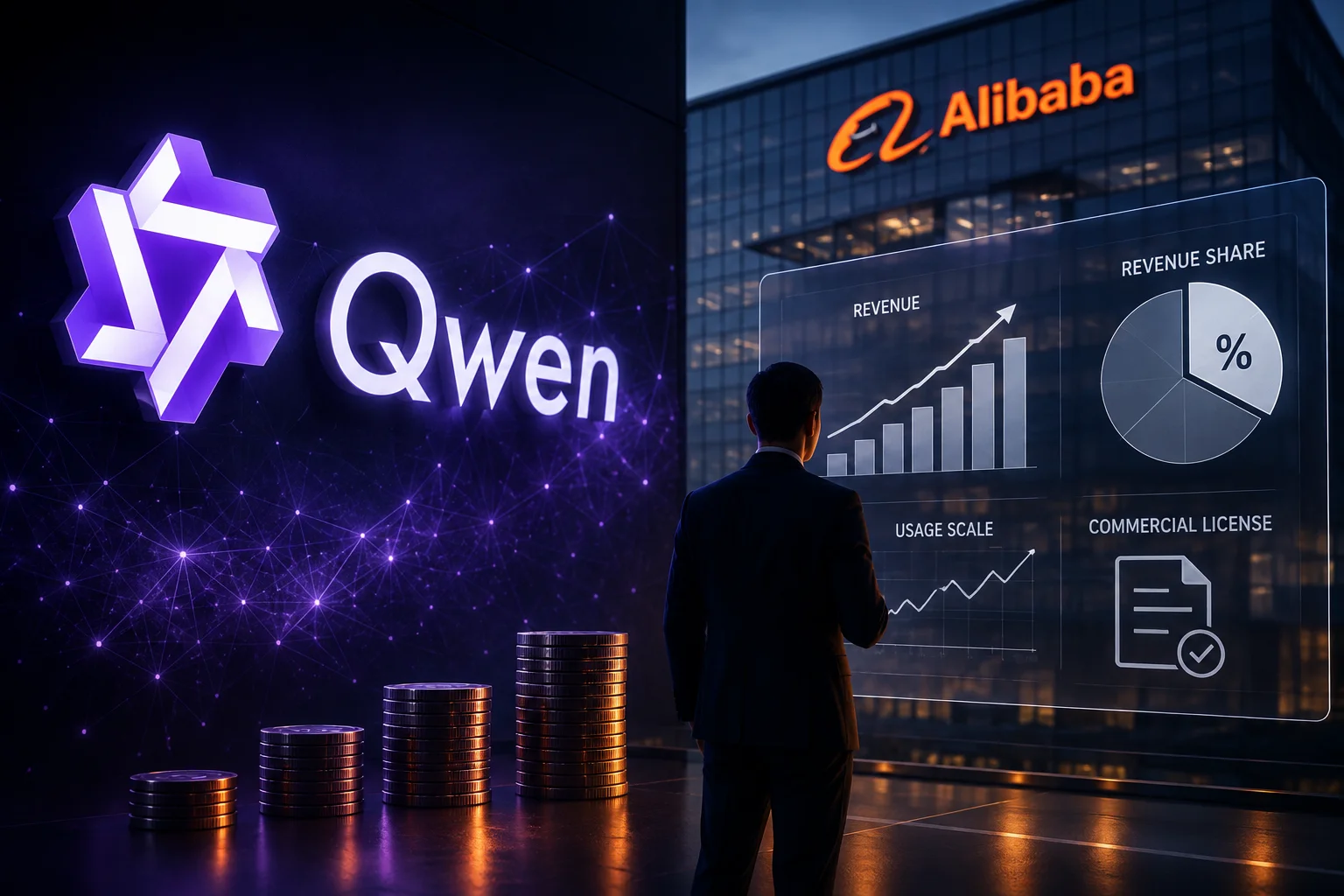
The expansion of open-weight models is creating a new battle: who develops the technology and who captures the economic value generated by it.
What an open-weight model actually means
Weights are the numerical parameters a model learns during training. They largely determine how the system transforms an input into a response.
When those weights are made available, companies can have greater freedom to run the model on their own servers or adapt it to their needs instead of depending exclusively on an interface controlled by the provider.
That is one reason models such as Qwen have attracted developers and organizations looking for alternatives to proprietary systems offered by companies such as OpenAI, Anthropic and Google.
This openness can also reduce a strategic barrier: companies may gain more control over where the AI runs, how data is processed and how the technology is integrated into their systems.
Openness does not eliminate the monetization problem
For the model provider, however, there is a challenge.
If a company downloads the weights, runs the model on its own infrastructure and builds a highly profitable product, the original developer may receive nothing directly from that commercial activity.
That is precisely the gap Alibaba’s new strategy is trying to address.
The company can allow broad model distribution to accelerate adoption while establishing a commercial relationship with users who turn the technology into large-scale businesses.
This creates a delicate balance. The more open the technology is, the greater its potential distribution. But the stricter the commercial conditions become, the greater the provider’s ability to capture revenue and the stronger the incentive for companies to consider alternatives.
The precedent that helps explain the decision
Alibaba’s strategy did not emerge in isolation.
Chinese AI startup Moonshot AI, the company behind the Kimi K3 model, has adopted a similar approach. According to Reuters, Kimi K3’s terms require companies that commercialize the model as a service and exceed a certain revenue threshold to negotiate a commercial agreement with Moonshot.
The case is relevant because it shows that Chinese AI companies are experimenting with a different approach to the traditional competition between free models and paid APIs.
The broader question becomes: how can a technology be distributed widely enough to gain market share while still preserving a way for its creator to capture the economic value generated by that distribution?
That could become one of the defining debates of the next phase of artificial intelligence.
The AI battle is no longer just about performance but also about money
Alibaba’s new strategy could have consequences beyond Qwen itself because it introduces a variable companies usually consider alongside performance, price and technical capabilities: the licensing model.
An organization that chooses an AI model to support a product can spend years building processes, integrations and data around that technology. If the commercial structure changes after the product reaches scale, the original technology decision can become a strategic problem.
Companies will have to look beyond the cost per token
Today, comparing AI models often means looking at factors such as response quality, speed, reasoning capabilities, inference costs and available tools.
Inference is the stage in which a model uses what it learned during training to generate a response to a new request. In large-scale enterprise applications, the cost of running those operations can represent a significant part of an AI budget.
With new revenue-based licensing models, however, the calculation becomes more complex.
A company may need to compare:
- infrastructure costs;
- inference costs;
- model capabilities;
- licensing conditions;
- the ability to run the AI internally;
- the percentage of revenue that may have to be shared;
- technology dependency risk.
That changes the nature of the decision. Choosing an AI model is no longer only an engineering question. It increasingly involves finance, legal, product and corporate strategy.
The impact could reach Alibaba’s competitors
The move also increases pressure on other companies developing open-weight models.
If Alibaba succeeds in combining broad Qwen distribution with a revenue-sharing structure, other providers may attempt to reproduce the model.
That would create a new competitive landscape.
On one side are proprietary models, where companies such as OpenAI, Anthropic and Google control access and monetize usage directly.
On the other are open-weight models that can run across different infrastructures but are beginning to experiment with their own forms of commercial monetization.
The result could be a less obvious competition than simply asking which model produces the best answer.
The next battle may be over who controls the economic layer created after AI reaches businesses.
The biggest impact may appear in companies’ long-term decisions
The main consequence for companies may not be the amount Alibaba eventually charges, but the change in logic behind the license. When a company chooses an AI model to support a product, it is also choosing the economic rules that may accompany that technology.

The cost of enterprise AI may involve not only infrastructure and processing, but also the commercial terms attached to the model.
Choosing an AI model could become a financial decision
Consider a company developing automated customer service, a document analysis platform or software powered by AI agents. If the product grows and begins generating millions of dollars in revenue, a revenue-based license could significantly change the total cost of the underlying technology.
That creates an important difference from traditional usage-based pricing.
Under a conventional model, a company knows how much it pays for a certain amount of processing. With a license tied to revenue, the cost can increase as the commercial success of the product grows. For companies scaling rapidly, that difference could matter when projecting margins and evaluating the long-term sustainability of an AI product.
For that reason, organizations adopting open-weight models in commercial products will need to examine licensing terms carefully before building long-term dependencies around them.
Technology lock-in also becomes part of the calculation
Another important factor is technology lock-in, a situation in which a company becomes dependent on a particular technology and faces significant costs or difficulties when trying to switch to another provider.
Open-weight models can reduce part of this risk because they give companies greater control over infrastructure and model execution. However, a commercial license can introduce a different layer of dependency.
A company may have the technical freedom to run Qwen on its own servers while still being subject to conditions established by the provider for certain commercial uses.
That means technical openness and economic freedom are not necessarily the same thing.
Alibaba’s strategy could accelerate a new battle over open AI models
The change could also reshape competition among model providers. The market is moving beyond the question of who offers the smartest or cheapest model and toward another question: who offers the most attractive licensing structure?
This is particularly important for companies seeking alternatives to proprietary AI systems. Interest in open-weight models has grown because they can offer greater control, customization and independence from individual vendors.
Qwen is entering a much larger competition
Qwen is already one of Alibaba’s main bets for competing in the global artificial intelligence market. The company has positioned Qwen3.8-Max as its largest model to date, with 2.4 trillion parameters, while its architecture uses fewer parameters per request to reduce computing costs.
That combination helps explain why Alibaba is simultaneously betting on technical capability, openness and infrastructure.
The goal is not simply to build a competitive model. It is to create an ecosystem in which companies can adopt Qwen at different levels and eventually have reasons to remain within Alibaba’s broader technology platform.
The move also reinforces China’s growing role in the global race to develop high-performance, lower-cost AI models.
Companies will have more options but more contracts to examine
For enterprise users, greater competition can be positive.
The more providers compete for business customers, the greater the pressure tends to be for competitive pricing, better performance and more flexible commercial terms.
But comparisons will also become more complicated.
A company may have to choose between a proprietary model with predictable usage-based pricing, an open model with no revenue-sharing requirement, or an alternative such as Qwen that combines technical openness with potential commercial obligations for large users.
This shift favors companies that treat artificial intelligence as strategic infrastructure rather than simply another feature added to a product.
The broader debate over technological independence is also visible in moves such as AI companies developing their own chips. The move by Anthropic to develop custom chips for Claude shows how AI providers are trying to control more layers of the technology value chain.
The next phase of AI may be a battle over who captures the value created by models
Alibaba’s planned change points to a broader trend: the artificial intelligence market is moving beyond the stage where the main question was who had the best model and into a phase where the competition also involves who can turn computing capabilities into sustainable revenue.
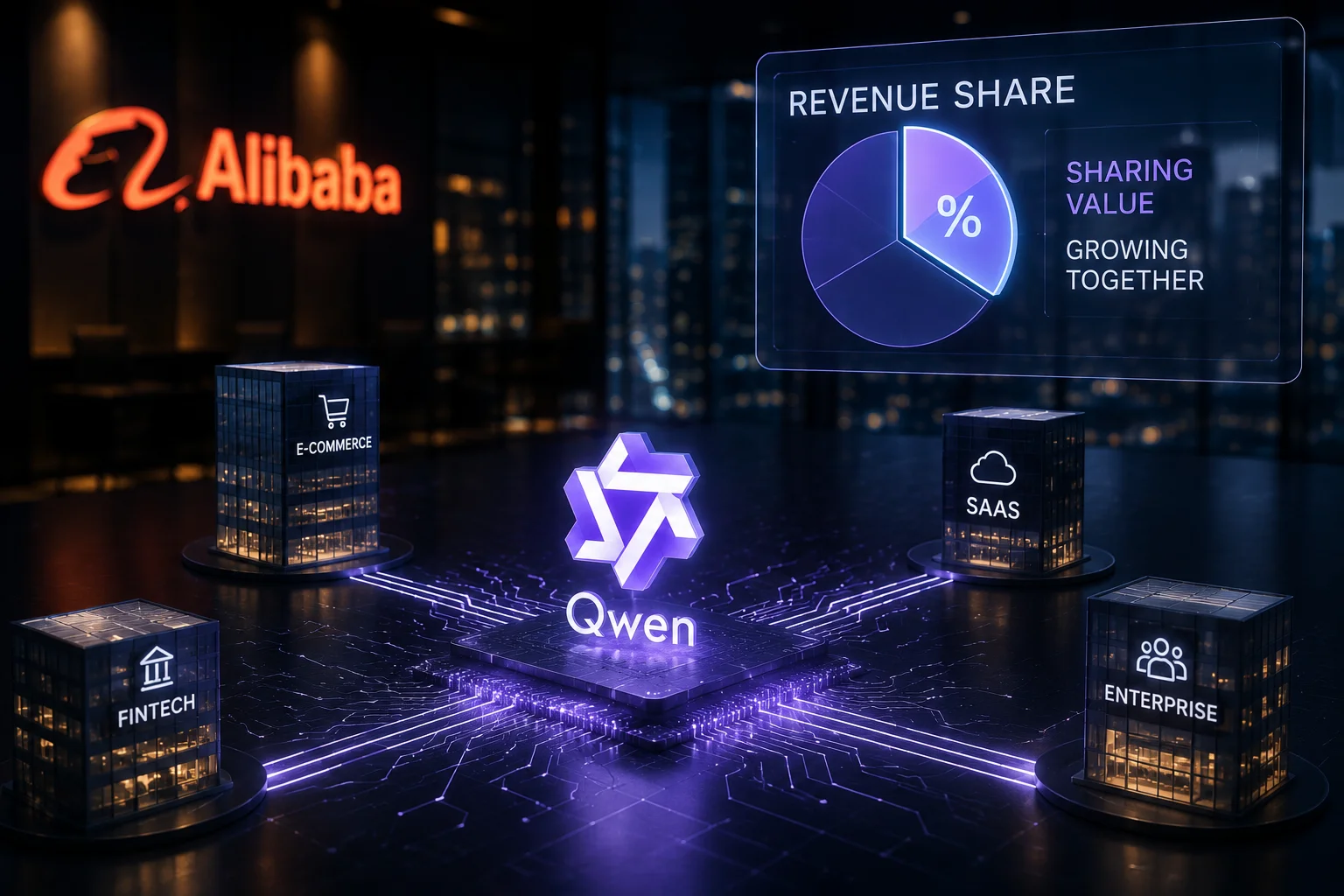
The next competitive battleground in artificial intelligence may involve less about owning the model and more about capturing the value created by commercial applications.
Open AI models may take on a new meaning
During the expansion of generative AI, the difference between proprietary and open models appeared relatively straightforward.
Proprietary models were controlled by their providers, while open-weight models offered greater freedom to run and adapt the technology.
Alibaba’s strategy shows that this distinction may become more nuanced.
A model can be technically open while still imposing specific rules on certain levels of commercial exploitation. That means companies will need to examine the license with the same attention they give to the model’s technical capabilities.
The question is no longer simply, “Can I use this AI?” It becomes, “Under what conditions can I turn this AI into a business?”
What could happen in the coming months
If Alibaba manages to maintain Qwen adoption despite a revenue-sharing structure, other companies could begin testing similar mechanisms.
That could create something resembling a freemium model for artificial intelligence: broad initial access to attract developers, followed by monetization once the technology reaches a certain level of commercial use.
The strategy adopted by Chinese startup Moonshot AI with Kimi K3 suggests that this possibility is already being explored in the Chinese market.
For businesses, the most important consequence will be the need to evaluate AI as an infrastructure, intellectual property and financial decision at the same time.
It could also increase interest in multi-model strategies, in which an organization uses different AI models depending on the task. A company might use a proprietary model for certain operations and an open-weight model for processes where control and cost matter more.
This approach reduces dependence on a single provider and could become more common as licensing differences become more significant.
Alibaba’s move, therefore, goes beyond a new way of charging for Qwen. It raises a question that is likely to shape the next phase of artificial intelligence: if companies build businesses on top of AI models, who should capture most of the economic value generated by those businesses?
The answer could determine not only the future of Qwen, but also how open AI models are commercialized across the broader artificial intelligence market.
Comentários
Os comentários utilizam autenticação via GitHub para manter um ambiente mais qualificado, seguro e livre de spam.
Entrar ou criar conta no GitHub