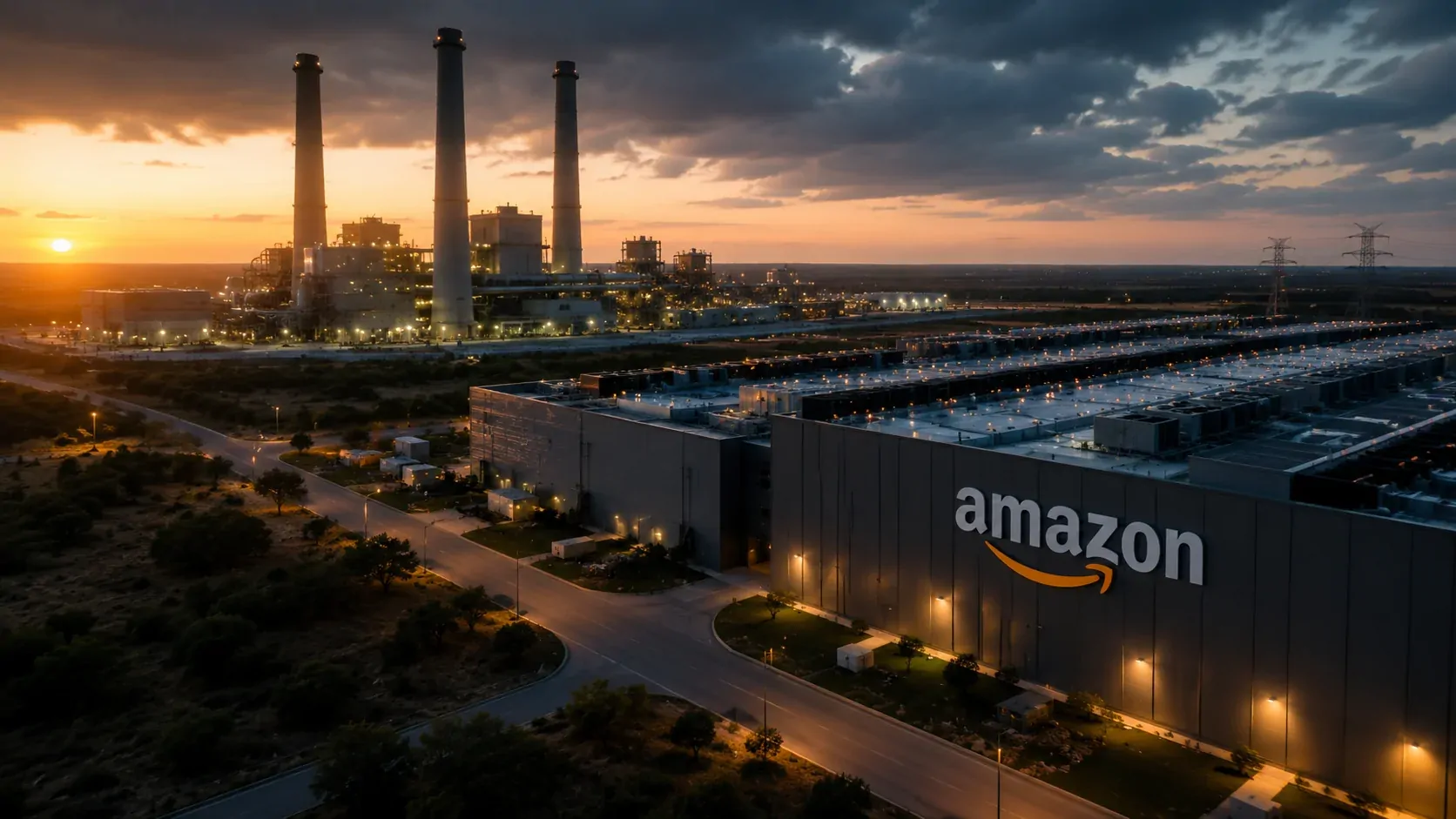
The artificial intelligence boom is creating a race that goes far beyond models, chips and applications. To put more computing capacity into operation, major technology companies must solve a more basic question: where will the electricity come from to keep these systems running?
Amazon is building new energy infrastructure to support the expansion of AI
Amazon is associated with the construction of a massive power generation facility in Pecos County, Texas, designed to supply electricity to a new data center campus focused on artificial intelligence workloads. Planned capacity reaches 7.65 gigawatts, a scale that illustrates just how large the new computing race is becoming.
The project involves 35 natural gas-fired turbines and was initially designed as an installation operating independently from the conventional power grid. The logic is straightforward: if grid capacity cannot grow as quickly as data center demand, directly controlling power generation can accelerate the deployment of new computing clusters.
The move reveals an important shift in the economics of AI. The infrastructure required to run increasingly capable models does not end at the server. It starts with land, moves through electricity and cooling, and ultimately reaches the chips performing the computations.
Why has electricity become part of AI infrastructure?
Artificial intelligence models require enormous amounts of processing. During training, AI systems analyze vast amounts of data to adjust their parameters. During inference, when a model responds to a request, thousands or millions of operations can be performed continuously.
These calculations are largely handled by specialized accelerators such as GPUs, processors capable of performing many mathematical operations in parallel. As the number of users and AI applications grows, the need for computing capacity tends to grow with it.
The problem is that every new group of servers also requires electricity and cooling. In high-density data centers, the heat generated by computing equipment becomes an engineering challenge nearly as important as processing capacity itself.
The size of the project reveals the scale of the new race
A capacity of 7.65 GW does not simply represent another data center. It points to infrastructure designed for an exceptionally large scale of computing.
The figure also helps explain why companies such as Amazon, Microsoft, Google and Meta are treating infrastructure as a strategic issue. The AI race depends on putting more computing capacity into operation, and that requires electricity, land, networks, cooling systems and capital.
This is happening as data center expansion is already putting pressure on electricity systems in several regions. The growth of AI computing is turning data center power demand into an increasingly important issue for energy planning.
The hidden problem behind AI data centers is electricity
The most important consequence of Amazon’s project is not simply the number of servers it may be able to power. It shows that electricity is becoming one of the main physical bottlenecks limiting artificial intelligence expansion.
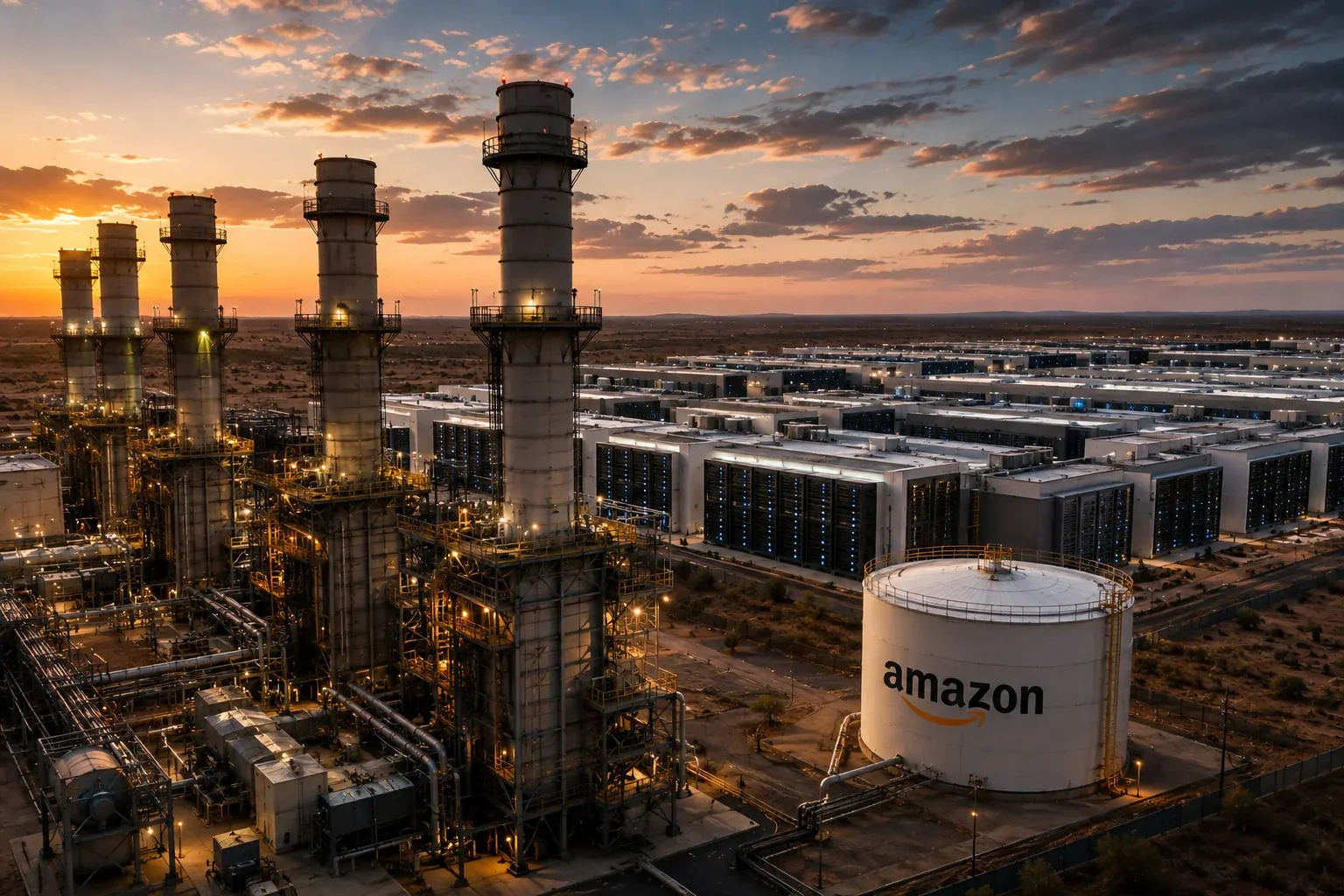
The energy infrastructure supporting AI is beginning to scale alongside the new generation of data centers.
Why would a technology company need its own power plant?
Traditional data centers can rely on existing electricity infrastructure. The situation changes when a facility requires an extraordinary amount of power within a relatively short period.
Building or expanding transmission lines, substations and grid connections can take time. At the same time, technology companies are trying to bring new AI systems online quickly to meet growing demand for computing.
In this context, on-site generation can reduce part of that dependence. For Amazon, the energy infrastructure associated with the campus gives the company a power source directly connected to the computing project.
This model is known in the industry as behind-the-meter generation. In practice, it means producing electricity close to where it is consumed instead of relying exclusively on power supplied through the public grid.
Natural gas gained ground because it can deliver scale quickly
The use of natural gas is not accidental. Gas-fired plants can be deployed at large scale and provide continuous generation, an important characteristic for data centers that need to operate around the clock.
That creates an operational advantage for projects that need power quickly, but it also creates a significant environmental consequence.
The GW Ranch project received authorization for emissions of up to 33 million metric tons of greenhouse gases per year, according to licensing data reported about the facility. The amount drew attention because it places the project at an emissions scale potentially larger than that of many conventional power plants.
It is important to distinguish between authorized emissions and actual emissions. A permit limit represents the maximum allowed under established conditions, not necessarily the amount that will be emitted every year.
Even so, the figure illustrates the scale of the conflict emerging between computing expansion and decarbonization.
The AI race is creating a race for electricity
The strategic issue extends beyond Amazon.
If technology companies continue increasing the capacity of AI models and services, every new expansion cycle will require more servers, more accelerators, more storage and more cooling.
That creates a chain of dependencies:
more AI → more computing → more data centers → more electricity → more energy infrastructure.
The result is that electricity becomes part of the competitive strategy of technology companies.
This shift connects directly to the broader pressure created by the expansion of AI data centers. The difference now is that the problem is materializing in a specific project, with a global technology company attempting to secure a power source at its own scale.
Amazon’s decision exposes a new trade-off between speed and sustainability
Amazon’s strategy also reveals a tension likely to follow the industry for years: the faster AI grows, the greater the pressure to build infrastructure before lower-emission energy solutions are available at sufficient scale.
The challenge is not only environmental. It is economic as well.
Companies that control energy, land and computing capacity may be able to expand AI services faster. Companies dependent on regions with constrained power grids, meanwhile, could face delays in bringing new data centers online.
Energy could become a competitive advantage for AI companies
During the first phase of the AI race, the main differentiator was the model. Then chips moved to the center of the competition, particularly as companies raced for GPUs and specialized accelerators.
Now physical infrastructure is beginning to carry similar strategic weight.
The expansion of companies such as Anthropic shows how billion-dollar infrastructure investments have become part of the competitive strategy of the AI market.
Amazon’s project adds another layer to that competition: having access to computing is not enough. Companies also need to secure the electricity required to power that computing at scale.
The impact could reach the cost of AI services
Electricity is only one component of the cost of operating a data center, but its importance may increase as AI systems become larger and more computationally intensive.
That can directly affect cloud providers and companies offering AI models through subscriptions or usage-based pricing.
For enterprise customers, the consequences could appear in several ways: processing prices, capacity availability, server location and the speed at which new AI capabilities can be deployed.
That is why Amazon’s energy expansion is not simply a story about a power plant in Texas. It is a signal that the AI economy increasingly depends on physical assets that were often outside the software conversation.
The next phase of AI could be decided far from research labs
The expansion of data centers is changing the map of the technology industry. Locations with abundant power, available land, strong connectivity and favorable regulations may become more important to AI than regions traditionally associated with software development.
Texas is a particularly relevant example of this transformation.
The state already hosts large-scale computing projects and has conditions that favor further energy expansion. In this environment, infrastructure stops being merely a support layer for technology and starts determining where technology can grow.
For companies that depend on generative AI, this means the next competitive advantage may be less visible than it appears. While the market focuses on new models and AI agents, some of the largest investments may be taking place in land, power plants, electricity networks, cooling systems and data centers.
Amazon’s decision makes that shift clear: the artificial intelligence race is beginning to turn energy into computing capacity.
Companies that rely on AI will also feel the effects of the energy race
The expansion of energy infrastructure may seem distant from a company that simply uses ChatGPT, Copilot, Claude or another AI service in its daily operations.
But the connection is direct.
Every artificial intelligence application running in the cloud depends on physical servers.
Those servers require electricity, cooling, storage and connectivity.
As usage of these services increases, the amount of infrastructure required to meet demand is also likely to grow.
What does this change for businesses?
For companies using AI for customer service, data analysis, automation or software development, the first effect will probably not be an immediate change to daily operations.
The impact is more likely to appear in the economics of computing services.
Cloud providers must balance massive infrastructure investments with the need to offer computing capacity at competitive prices.
If electricity, land, cooling and grid connections become more expensive, some of that pressure could eventually reach the price of computing services.
At the same time, larger investments could increase available capacity and reduce bottlenecks in certain regions.
It is a complex equation:
more infrastructure can increase AI supply, but building that infrastructure can also raise the cost of bringing it online.
Technology professionals also need to follow this shift
The issue is particularly relevant to professionals working with systems architecture, cloud computing, data and artificial intelligence.
That is because the next generation of AI applications will increasingly depend on infrastructure decisions.
A company planning to run models locally, for example, must evaluate not only the cost of accelerators but also power consumption, cooling and physical capacity.
Likewise, companies using cloud services need to consider regional availability, latency, processing costs and provider capacity.
Infrastructure is no longer an invisible layer.
It is beginning to directly influence technology strategy.
End users may also notice the transformation
For ordinary users, the change may appear indirectly.
AI services could introduce new capacity limitations, change pricing, create different subscription tiers or route computing workloads to regions where more electricity is available.
Infrastructure expansion could also make it possible for more sophisticated models to be offered at greater scale.
In other words, the same energy race could produce two seemingly opposite effects:
more pressure on costs and more capacity for AI services.
The outcome will depend on how companies, governments and energy operators manage to expand the infrastructure.
The race for electricity could reshape where the next AI data centers are built
The location of a data center already depends on factors such as connectivity, available land, taxes and proximity to users.
With AI expansion, access to electricity is becoming even more important.
Regions capable of supplying large amounts of power quickly could attract billions of dollars in investment.
Texas has become one of the most important examples of this transformation, with dozens of data center projects and massive energy expansion plans. A MUFG analysis identifies GW Ranch as one of the state’s major planned campuses, with 7.65 GW of capacity and a design intended to support more than 1 million GPUs.
The location of computing could become an energy decision
For years, technology companies selected data center regions primarily based on factors such as connectivity and proximity to markets.
Now, the question is beginning to change:
where is there enough electricity to run the next generation of AI?
That question could favor regions with abundant generation capacity, large amounts of available land and relatively fast infrastructure deployment processes.
It could also encourage local governments to offer incentives to attract new projects.
The potential economic impact is significant.
A large AI campus can drive activity across construction, power generation, electrical equipment, telecommunications, security, cooling and specialized services.
That is why data center expansion is no longer simply a technology-sector issue.
It is becoming an industrial issue.
The risk is creating a new concentration of infrastructure
There is, however, a side effect.
If only a few states or regions can provide enough electricity for large AI clusters, infrastructure could become even more concentrated in certain markets.
That increases the importance of public policies involving power transmission, environmental permitting, water and land use.
It also creates risks for companies that become overly dependent on a single region.
Geographic diversification of data centers could become as important a strategy as server redundancy.
The next AI competitive advantage could be the ability to generate power
The artificial intelligence race started with models.
Then it moved to chips.
Now it is reaching the physical infrastructure that keeps these systems running.
Amazon’s project makes this shift particularly clear because it places massive power generation infrastructure almost on the same strategic level as the data center it is designed to supply.
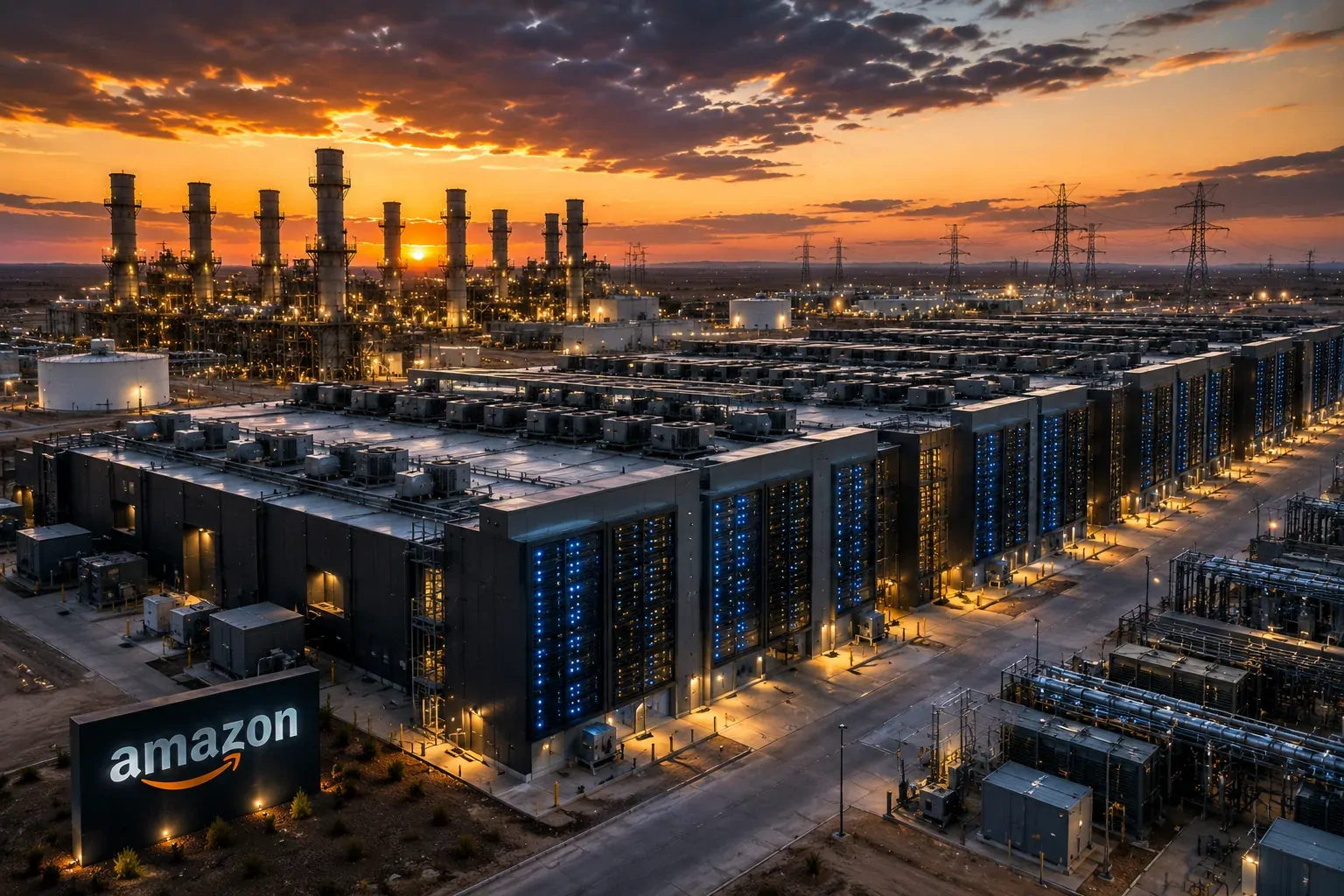
The next phase of the AI race requires computing, energy and physical infrastructure to be combined at industrial scale.
What could happen in the coming months?
The most important trend will likely be the multiplication of projects seeking to solve the energy bottleneck in different ways.
Some companies will likely continue turning to natural gas because of its speed and generation capacity.
Others will accelerate renewable energy contracts, battery storage and nuclear projects.
Hybrid systems combining different energy sources to ensure continuous availability are also likely to grow.
The objective will remain the same: bring computing capacity online without waiting years for the full expansion of the electrical grid.
Energy could become one of the strategic assets of the AI economy
If this trend continues, competition between technology companies could involve a much broader list of assets.
Proprietary models will remain important.
GPUs will remain essential.
Data will remain strategic.
But energy, land and data center capacity could determine who is able to turn those assets into services available to millions of users.
That is why Amazon’s project deserves attention.
What may initially look like nothing more than a massive power plant in Texas is actually a portrait of the next phase of the artificial intelligence industry.
Digital technology is encountering a physical limit.
And as AI expands, the ability to produce and manage energy could become as strategic as the ability to develop the next major model.
This development also reinforces a trend already visible in the expansion of AI infrastructure: companies are no longer competing only for the best software, but for the ability to control the entire chain required to bring artificial intelligence to scale.
For the enterprise market, the message is straightforward: AI expansion will continue creating new opportunities, but it will increasingly depend on physical infrastructure, energy and capital.
The next chapter of the artificial intelligence race may not be decided solely in research laboratories.
It could be decided in power plants, electricity grids and data centers.
Comentários
Os comentários utilizam autenticação via GitHub para manter um ambiente mais qualificado, seguro e livre de spam.
Entrar ou criar conta no GitHub