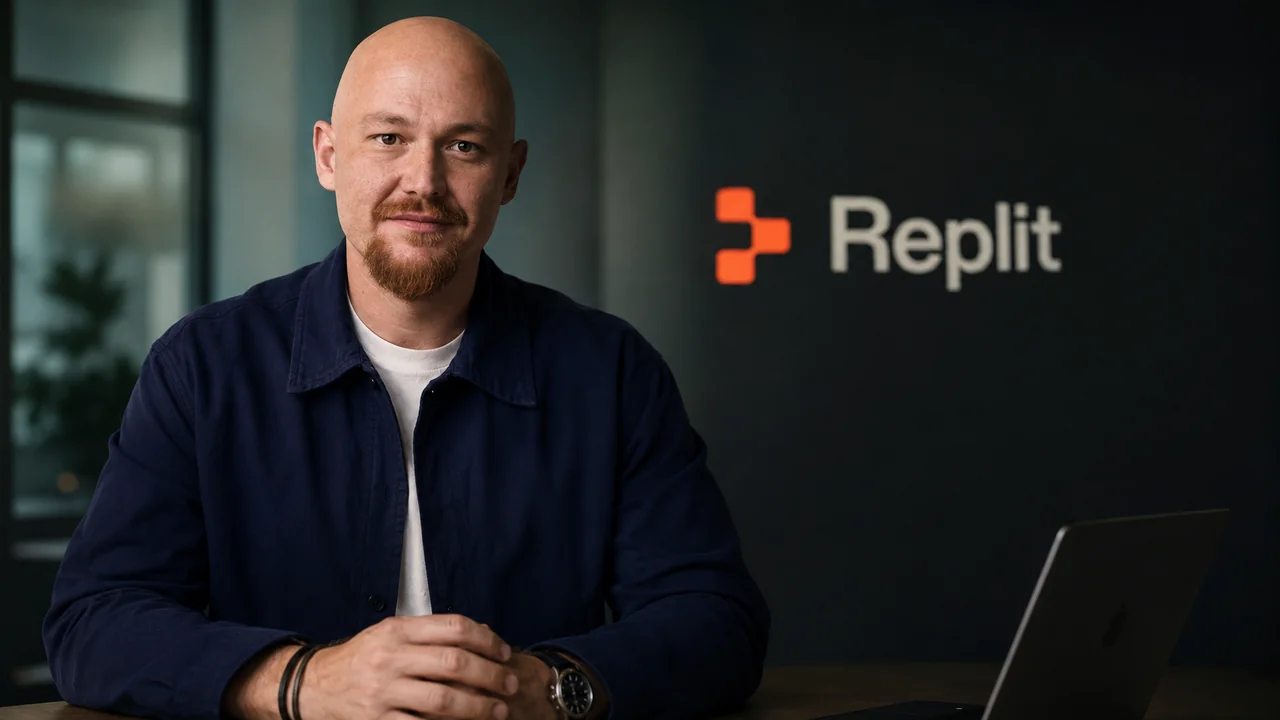
The debate over artificial intelligence in software development has entered a new phase. Instead of asking only whether machines can write code, the market is beginning to confront a deeper question: what happens to human work when programming is no longer the center of software engineering?
Amjad Masad sees a shift in the work of software engineers
Amjad Masad, CEO and co-founder of Replit, argues that artificial intelligence could be making software engineering more human by removing some of the mechanical work from professionals’ daily routines. The statement stands out because it comes as the market debates whether AI agents could reduce the need for engineers and put pressure on the traditional software-as-a-service model.
Replit is at the center of this transformation. The company began as a browser-based programming environment and has moved toward making artificial intelligence agents central to application development. These agents are systems that can receive instructions in natural language, plan steps, write code, and perform development-related tasks.
For Amjad Masad, the result does not necessarily have to be the elimination of engineers. The nature of the job may change instead. Rather than spending hours focused on writing individual lines of code, professionals can devote more time to defining problems, creating solutions, making decisions, and evaluating what AI produces.
What changed with coding agents?
Coding agents are AI systems that go beyond simply suggesting snippets of code. They can interpret a request, break a task into steps, generate code, test parts of an application, and fix problems identified during the process.
That distinction matters because it turns AI from an assistive tool into an active participant in software development. Engineers are no longer necessarily the only people responsible for turning an idea into code. Their role increasingly involves directing, checking, and making decisions about what the system produces.
Replit itself reports that its engineers nearly tripled code output over a six-month period while review times remained stable and quality indicators did not show a corresponding deterioration. The figure helps explain why the company sees agents as an operational shift rather than simply another software feature.
Why does this view challenge part of the market?
A dominant concern across parts of the industry is that agents capable of programming could reduce the amount of work required to build applications. If a team can deliver more software with less effort, the logical consequence could be lower demand for certain roles.
But that interpretation focuses primarily on the amount of code produced. Masad’s view shifts the discussion toward another question: if writing code takes less time, professionals can spend more of their capacity deciding what should be built and why.
That is precisely what makes the statement relevant to B2B companies. AI’s impact may not be limited to replacing tasks. It could also change where economic value is created inside a technology team.
Replit is betting that AI can change the software development model itself
Replit is not simply adding artificial intelligence to a code editor. The company has been reshaping its platform so users can describe what they want to build and allow agents to participate in a significant portion of the execution.
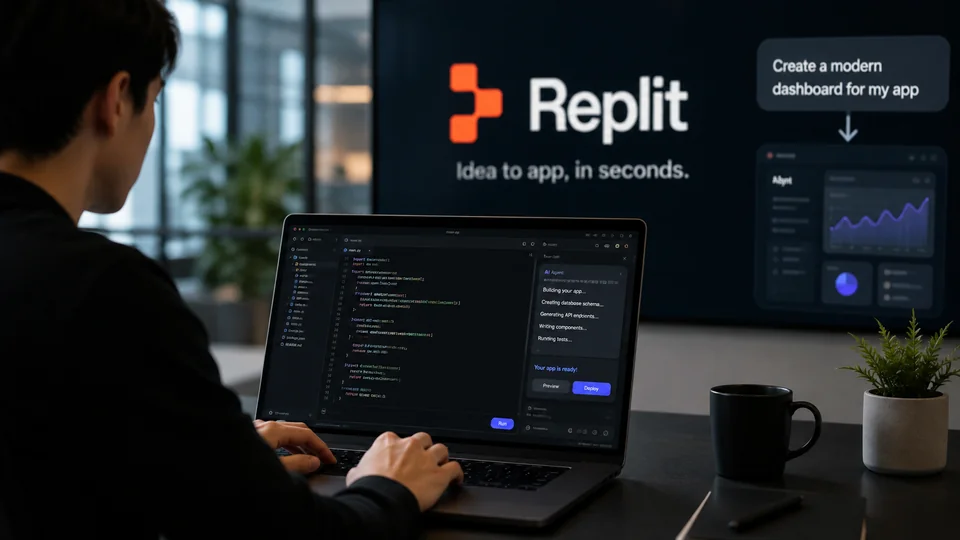
AI agents put Replit at the center of the shift toward natural-language-driven software development.
This change brings software development closer to a conversational interface. A user can describe an application, a feature, or a modification and receive an implementation that previously would have required specialized technical knowledge and multiple manual steps.
That does not mean code has become irrelevant. Code remains the underlying structure that makes software work. The difference is that the ability to produce it may no longer be the main bottleneck in certain projects.
What does this change mean for SaaS?
SaaS, short for Software as a Service, is a model in which companies deliver software over the internet, typically through subscriptions or other recurring payments. CRM, financial management, collaboration, and automation platforms are examples of categories built around this model.
The rise of agents creates an uncomfortable possibility for the industry: if AI can directly perform a task that previously required opening and operating several software applications, users may need traditional software interfaces less often.
That discussion is closely connected to the so-called SaaSpocalypse, a term used to describe fears that AI agents could reduce the value of some traditional software products. It does not mean SaaS is disappearing, but it suggests that the unit of value could shift from “software the user operates” to “an intelligent system that executes a task.”
Is programming becoming less of a competitive advantage?
The answer is not definitive yet, but the signals point toward a shift. The ability to write code quickly could become less differentiated as AI models and agents become more capable.
The competitive advantage may instead move toward other layers: understanding the customer’s problem, defining requirements, choosing the right architecture, validating results, protecting data, and ensuring that the software actually delivers the expected outcome.
This helps explain why AI-assisted development tools have attracted so much attention. Notícia Tech has already examined how platforms such as Cursor, Windsurf, and GitHub Copilot are changing software development, but the new discussion around Replit expands the issue into a more strategic question: if AI changes how software is built, could it also change the economics of the companies that sell that software?
This transformation is also connected to the rise of AI agents that are beginning to replace traditional software, a movement that could change how companies buy and use technology.
Replit’s pivot shows why the market is changing so quickly
The transformation at Replit accelerated as AI models made significant advances in their ability to write and understand code. According to Amjad Masad, improvements in models from Anthropic, particularly the Claude family, were among the factors that accelerated the company’s strategic shift.
The key point is that model improvements did not happen in isolation. When an AI becomes better at programming, companies such as Replit can build products that delegate a larger portion of software development to AI systems themselves.
That creates a competitive cycle. Better models enable better agents; better agents increase platform productivity; platforms with more users accumulate operational experience; and that experience can pressure other software companies to accelerate their own AI integration.
What does this change for professionals?
For software engineers, the shift is likely to increase the importance of skills that go beyond simply writing code.
As agents take over parts of implementation, professionals need stronger capabilities in architecture, product thinking, security, testing, result evaluation, and system integration. The ability to review and direct AI-generated work may become as important as the ability to produce code manually.
For entry-level professionals, however, there is a more difficult question. If basic tasks become automated, the traditional entry point into the profession could change. The market may demand experience solving complex problems before giving newcomers the opportunity to build experience through simpler tasks.
What does this change for companies?
For companies, the potential gain is speed. A team that can turn an idea into a prototype or functional application more quickly can test products, automate internal processes, and respond to customer demands in shorter cycles.
But greater productivity does not eliminate the risks. AI-generated code still needs to be reviewed, tested, and secured. An agent can produce a functional application while simultaneously introducing security, logic, or maintenance problems.
That is why the competitive advantage will probably not come simply from having access to a coding agent. It will come from the ability to organize work between people and agents, establish validation mechanisms, and turn development speed into measurable business outcomes.
The race is now about the next software model
Amjad Masad’s statement carries weight because the discussion has moved beyond developer productivity. What is at stake is a possible change in the relationship between people, companies, and software.
If agents become capable of building increasingly complete applications, the distance between identifying a business need and creating a technological solution could shrink. A small company, for example, could potentially build an internal tool that previously would have required hiring a development team or purchasing a specialized SaaS product.
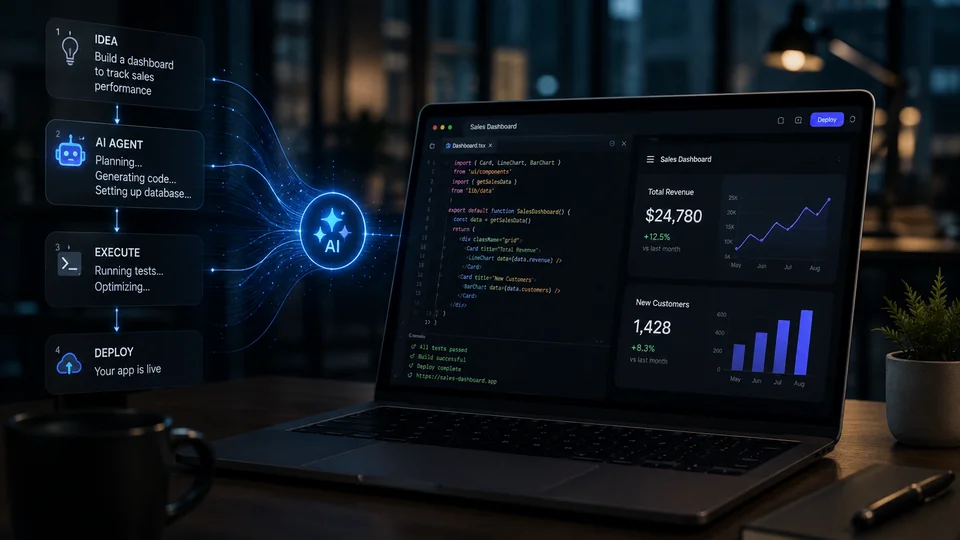
The rise of AI agents could bring business decisions closer to direct software creation.
This could put pressure on traditional software companies, but it also creates new opportunities. Platforms that provide infrastructure, data, security, distribution, and specialized agents could capture value precisely because they are no longer dependent solely on the traditional application interface.
Could software become more personalized?
This is one of the most important consequences of the shift. Instead of forcing a company to adapt its processes to the way an off-the-shelf application works, agents could allow parts of the software to be shaped around the organization’s specific workflow.
That does not mean every company will necessarily build its own systems. Established products will continue to provide infrastructure, integrations, and capabilities that would be expensive to reproduce internally.
The difference is that the boundary between buying software and building software could become less rigid. AI reduces the effort required to turn a specific business need into a functional application.
Why does this matter to the B2B market?
The B2B market could feel this shift particularly strongly because companies buy software to solve concrete business processes. If an agent can directly execute one of those processes, value may begin moving from the tool itself to the outcome it produces.
This movement is already appearing across other areas of enterprise technology. Notícia Tech is also tracking the rise of agents that could negotiate corporate contracts and reshape the B2B software market, showing that the current discussion is not limited to software development.
The question emerging now is larger: if AI can participate in both creating and executing software, who will control the most valuable layer of the digital economy?
The human role may become more strategic, not less important
The idea that AI could make software engineering more human may sound contradictory at first. If machines are taking over more programming tasks, it would be reasonable to assume that human participation should decrease.
But that is not necessarily the direction suggested by the transformation.
When repetitive work is automated, the value of human involvement can move toward activities that require context, judgment, creativity, and responsibility. In software development, this includes deciding what problem deserves to be solved, understanding the customer, defining priorities, evaluating trade-offs, and determining whether the result is actually useful.
What remains difficult for AI?
Writing functional code is only one part of software engineering.
A successful product also needs to solve the right problem, work reliably, protect user data, integrate with existing systems, and remain maintainable as the company grows.
Those requirements involve decisions that are not always reducible to generating code.
An AI agent can build a feature based on an instruction, but the company still needs people capable of determining whether that feature should exist, whether it creates business value, and whether the risks are acceptable.
This distinction becomes particularly important in enterprise environments, where software decisions can affect finances, customers, employees, compliance, and security.
Does this mean fewer developers?
Possibly, in some contexts. But the more immediate change may be an increase in the productivity expected from each professional.
If an engineer can supervise several AI agents while maintaining responsibility for architecture and quality, a smaller team may accomplish work that previously required significantly more people.
That could change hiring patterns, team structures, and the economics of software development.
However, higher productivity does not automatically mean that companies will stop hiring developers. Lower development costs can also encourage companies to build more software, experiment with more products, and automate processes that were previously considered too expensive.
The result could therefore be a combination of smaller teams for certain projects and greater demand for software overall.
The SaaSpocalypse debate becomes more relevant
The term “SaaSpocalypse” gained attention because AI agents challenge an assumption that has supported the software industry for decades: that users need to interact directly with an application to accomplish a task.
Traditional SaaS generally places the application interface between the user and the desired outcome.
An employee opens a CRM, searches for information, updates a record, generates a report, or starts an automation.
An AI agent could potentially perform several of those steps directly.
That does not necessarily eliminate the underlying software. The CRM, database, APIs, permissions, and infrastructure may still be essential. What changes is the interface through which the user accesses those capabilities.
From applications to outcomes
This distinction could become one of the most important strategic shifts in enterprise software.
Instead of asking:
“Which software should I use?”
Companies may increasingly ask:
“Which system can perform this task for me?”
That is a different purchasing logic.
The value of a product may increasingly depend on how effectively it can provide capabilities to AI agents, integrate with other systems, and execute business processes.
This could favor platforms with strong APIs, structured data, reliable integrations, and automation capabilities.
Traditional SaaS is not necessarily disappearing
The SaaSpocalypse scenario should not be interpreted as proof that SaaS companies are about to disappear.
Enterprise software has advantages that agents alone cannot easily reproduce, including mature infrastructure, security controls, specialized workflows, compliance features, support, and accumulated organizational data.
The more likely scenario is a gradual transformation.
Some interfaces may become less important. Some features may be absorbed into broader agentic systems. Other applications may become infrastructure layers that agents use in the background.
In that environment, the strongest software companies may be those capable of adapting their products to an agent-driven ecosystem.
What Replit’s strategy reveals about the next phase of AI
The transformation underway at Replit illustrates a broader pattern across the technology industry.
AI companies are no longer competing only on model performance. They are increasingly competing on how effectively their models can perform real work.
For software development, that means moving from chat-based assistance toward systems capable of planning, executing, testing, and iterating.
The distinction is important because productivity gains become much larger when AI can operate across multiple steps instead of generating isolated suggestions.
Why agents are different from traditional AI assistants
A conventional AI assistant generally responds to a request and waits for the next instruction.
An agent can operate through a sequence of actions.
It can interpret a goal, determine what needs to happen, use available tools, execute tasks, inspect the result, and continue working.
That makes agents particularly relevant to business automation.
In software development, the process can involve creating files, modifying code, running tests, identifying errors, and making corrections.
The human remains responsible for the overall objective and final decisions, but the execution layer becomes increasingly automated.
The software development workflow is changing
This shift can compress the traditional development cycle.
An idea that once moved through product requirements, design, development, testing, and deployment as separate stages can increasingly involve AI systems participating across several of those steps.
That does not eliminate the need for process discipline.
In fact, the faster software can be produced, the more important validation becomes.
Companies need mechanisms to verify generated code, protect credentials, monitor changes, test applications, and prevent agents from taking actions outside their intended scope.
The challenge is therefore not simply making AI more capable.
It is making AI capable and controllable.
What companies should watch from here
The discussion around Amjad Masad and Replit is ultimately less about one company and more about a structural change taking place across the technology market.
Three developments deserve particular attention.
1. The cost of creating software could fall
If AI agents continue increasing developer productivity, the cost of producing applications could decline.
That could make custom software accessible to smaller companies and allow larger organizations to build more internal tools.
2. The software interface could become less important
Users may increasingly interact with AI agents rather than opening individual applications for every task.
Software could remain essential in the background while the agent becomes the primary interface.
3. Human judgment could become more valuable
As implementation becomes easier, deciding what to build and how to evaluate the result may become more important.
The most valuable professionals may increasingly be those who combine technical knowledge with business understanding.
The real question is no longer whether AI can code
The debate has moved beyond the question of whether artificial intelligence can write software.
It clearly can.
The more consequential question is what happens when AI can participate in enough of the software lifecycle to change how companies organize technology work.
That is where Amjad Masad’s argument becomes particularly relevant.
If AI agents remove part of the mechanical burden of programming, software engineers may spend less time acting as code producers and more time acting as architects, problem solvers, reviewers, and decision-makers.
For companies, the consequence could be even broader.
The distinction between buying software and building software may become less clear. A business could increasingly describe a problem and rely on AI-powered systems to create the technology needed to solve it.
That would represent a significant change in the economics of software.
The SaaS market would not necessarily disappear, but its center of gravity could shift from applications that people operate toward intelligent systems that perform work.
And that is why the statement from the Replit CEO matters.
The future of software may not be defined by humans versus artificial intelligence.
It may be defined by how effectively humans use artificial intelligence to decide, create, and execute.
Frequently Asked Questions
What did Amjad Masad say about artificial intelligence in software engineering?
Amjad Masad said AI could make software engineering more human by reducing the mechanical work involved in programming.
The Replit CEO argues that coding agents allow engineers to spend more time on ideation, problem-solving, and product decisions instead of spending much of their day writing code.
Why did Replit change its strategy around artificial intelligence?
Replit began prioritizing AI agents that can directly participate in software creation.
The company recognized that AI models were becoming significantly better at programming and reorganized its platform around agents capable of turning instructions into functional software, changing the nature of work inside the company.
What is the so-called SaaSpocalypse?
SaaSpocalypse describes fears that AI agents could reduce the need for traditional SaaS software.
The term emerged from a debate over a possible structural shift in the software-as-a-service market if companies begin using AI agents that can directly perform tasks that previously required multiple applications, systems, and interfaces.
Will artificial intelligence replace software engineers?
Amjad Masad’s comments point more toward a transformation of the job than immediate replacement.
AI already automates parts of programming, but the Replit CEO’s view is that human work can shift toward higher-value activities such as problem definition, architecture, validation, product decisions, and strategic judgment.
What changes for companies that develop software?
Companies may be able to produce software with smaller teams and faster development cycles.
The growth of coding agents could change costs, team structures, release speed, and even the economics of SaaS, while also increasing the importance of review, security, quality, and human oversight.
Why does the Replit CEO’s statement matter to the B2B market?
Because Replit is directly exposed to the transformation AI agents are bringing to software development.
Replit operates at the intersection of software development, AI, and application creation. Its CEO’s view therefore offers a relevant signal about how software companies may adapt to an economy in which AI participates directly in technology production.
What could happen to the SaaS market in the coming months?
The market could move toward smarter software, autonomous agents, and smaller teams.
If agents continue becoming better at creating and operating applications, some of the value currently concentrated in traditional software could shift toward platforms capable of executing tasks directly. That could pressure existing SaaS models and favor companies that put AI at the core of their products.
Comentários
Os comentários utilizam autenticação via GitHub para manter um ambiente mais qualificado, seguro e livre de spam.
Entrar ou criar conta no GitHub