The artificial intelligence race is entering a new phase. After years focused on model development, technology companies are now competing for an even scarcer resource: computational infrastructure. Anthropic’s announcement of a roughly $35 billion expansion suggests that the next battle in AI will be defined by the ability to build, finance and operate data centers, chips and networks at global scale.
Anthropic Is Betting on Infrastructure to Sustain AI Growth
Data centers and computing capacity have become strategic assets in the new artificial intelligence economy.
Anthropic has announced a major initiative aimed at expanding its computational capacity through a partnership involving Apollo, Blackstone, Broadcom and infrastructure operator Fluidstack.
The project is expected to add an initial gigawatt of computing capacity, creating one of the largest infrastructure expansions ever associated with an artificial intelligence laboratory.
The move reinforces a growing industry shift: competitive advantage is no longer determined solely by the quality of AI models, but by the ability to operate them efficiently at scale.
The End of Model-Only Competition
During the first wave of generative AI, competition centered on model performance.
Companies such as OpenAI, Anthropic, Google and Meta competed through improvements in reasoning, context windows and overall capabilities.
Today, the challenge is increasingly about securing enough computing resources to sustain the growing demand for training and inference.
Infrastructure Becomes a Competitive Advantage
The global shortage of computing capacity has transformed data centers, energy supply and chips into strategic assets.
Organizations that secure these resources will be better positioned to accelerate product launches, lower operational costs and respond faster to market demand.
This trend expands on themes already discussed in Google Prepares $80 Billion Bet on AI and Transforms Computing Infrastructure in the New Digital Market War, where infrastructure emerged as a core pillar of long-term AI strategy.
Institutional Capital Enters the AI Economy

Major investors increasingly view AI infrastructure as a long-term strategic asset class.
One of the most significant aspects of the initiative is the participation of major financial institutions.
Apollo and Blackstone are not investing directly in AI models.
Instead, they are financing the physical infrastructure required to support artificial intelligence operations for years to come.
The move highlights how AI is now viewed as a structural economic opportunity rather than a short-term technology trend.
Data Centers Become Strategic Assets
Historically, infrastructure funds focused on sectors such as energy, telecommunications and transportation.
Today, AI-focused data centers are beginning to occupy the same strategic category.
Demand for computing power is expected to continue rising as AI agents and enterprise AI systems become increasingly widespread.
A New Computing-Based Economy
The growth of artificial intelligence is making technology resemble other capital-intensive industries.
Computing capacity is becoming a fundamental input for value creation.
This creates a new economic layer in which access to infrastructure may become just as important as access to software.
Broadcom Increases Pressure on Nvidia’s Dominance
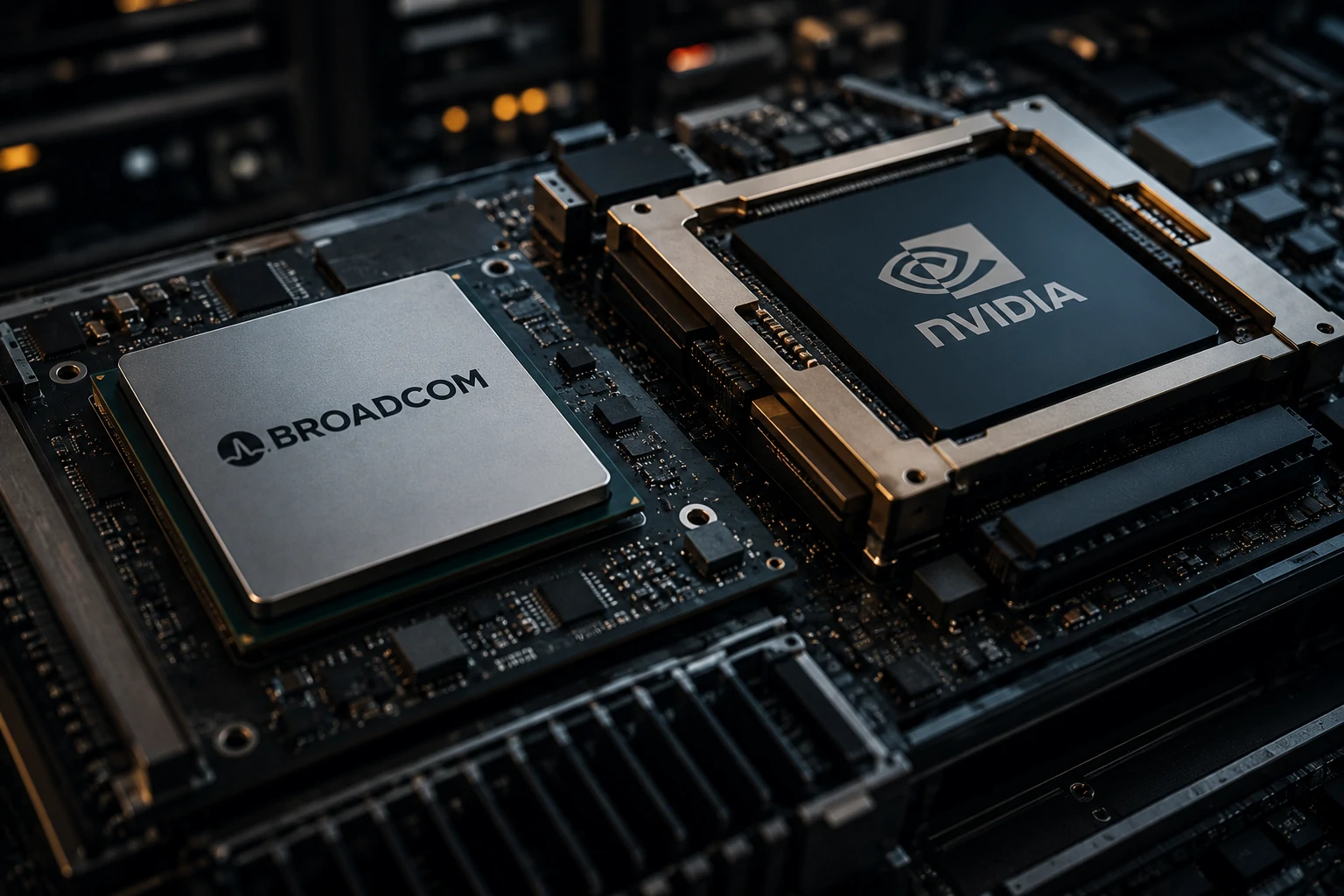
Chip manufacturers are competing for a larger role in the infrastructure powering the next generation of AI models.
Another strategic element of the initiative involves Broadcom.
The company is expected to expand the use of custom chips designed for artificial intelligence workloads.
This approach seeks to reduce dependence on Nvidia, which currently dominates the AI hardware market.
The Search for Alternatives
The rapid growth of AI has dramatically increased demand for specialized hardware.
As a result, companies are exploring alternative architectures capable of delivering greater efficiency and more predictable operating costs.
Custom silicon is emerging as one of the leading solutions to meet these objectives.
Toward a More Distributed Ecosystem
If this strategy succeeds, the market could become less dependent on a single supplier.
That would encourage the development of a more diversified and resilient ecosystem.
For AI laboratories, supplier diversification may provide greater operational security and flexibility for future expansion.
What Anthropic’s Expansion Reveals About the Future of Artificial Intelligence
Anthropic’s expansion is more than another multibillion-dollar investment announcement.
It signals a structural transformation in how the market views artificial intelligence.
The next stage of competition will likely be determined by the ability to finance and operate infrastructure at global scale.
The Data Center Race Is Just Beginning
The largest AI laboratories are expanding investments in dedicated infrastructure.
Dependence on third-party providers is increasingly viewed as a strategic vulnerability.
Controlling computing capacity may soon become as important as developing advanced AI models.
The Next AI Battleground
Over the past few years, the central question was who had the best model.
In the years ahead, the question may become different: who owns the infrastructure required to operate the best models at global scale?
Anthropic’s $35 billion expansion suggests that artificial intelligence is entering a new phase. A phase in which energy, chips, data centers and computational capacity may determine the winners of the next decade just as much as breakthroughs in algorithms themselves.
Comentários
Os comentários utilizam autenticação via GitHub para manter um ambiente mais qualificado, seguro e livre de spam.
Entrar ou criar conta no GitHub