
The launch of Claude Fable 5.1 shows an important shift in the competition between AI models: beyond seeking greater capabilities, Anthropic is attacking one of the main barriers to agent adoption, the cost of keeping them working for long periods.
Anthropic launches Claude Fable 5.1 and cuts AI agent costs by up to 45%
The Claude Fable 5.1 is the new version of Anthropic’s model designed for coding, knowledge work and complex tasks that can run for hours. The launch took place on September 1 and expands the company’s strategy around systems capable of performing work with less human supervision.
What changed in the new model
The main economic change involves cache reads, a feature used when the model needs to reuse inputs that have already been processed and stored. With Fable 5.1, this component now costs $0.25 per million tokens, a 75% reduction compared with Fable 5.
Input pricing remains at $10 per million tokens, while output pricing is $50 per million tokens. The difference lies in how reused context is charged, which is particularly relevant for applications that maintain large amounts of information throughout an extended execution.
Why the reduction matters
According to Anthropic, the new pricing can reduce the cost of typical workloads by approximately 25%. For highly agentic tasks, where the system performs many steps and repeatedly reuses context, savings can reach approximately 45%.
The distinction is strategic because an AI agent does not necessarily work like a conventional chatbot. Instead of answering a single question, it can plan steps, use tools, retrieve information and continue working until it completes an objective.
Anthropic is targeting the operating cost of AI agents
The price reduction becomes more significant when considered alongside how Anthropic positions Fable 5.1. The model was designed for work that can last for hours, span different applications and require recovery when a step fails.

Fable 5.1 focuses on long-running tasks in which agents need to maintain context and execute multiple steps.
Agents work differently
An AI agent is a system capable of using a model to plan and execute steps in a task, relying on external tools and information when necessary. This increases the number of operations performed during a single activity.
In an enterprise workflow, for example, an agent can receive a request, consult documents, analyze data, use an application and produce a final result. The longer this sequence becomes, the greater the amount of context that may need to be reused.
Cache becomes part of the economics
This is where the reduction in cache read pricing becomes important. If an application needs to repeatedly provide the model with information that has already been processed, the cost of that reuse can accumulate throughout an extended execution.
The 75% reduction in this component does not mean that every application will become 45% cheaper. Anthropic itself distinguishes between typical workloads and highly agentic workloads. The final savings will depend on how each system uses tokens, context, tools and execution cycles.
Claude Fable 5.1 expands the focus on long-running tasks
Fable 5.1 was not presented simply as a performance update. Anthropic positions it for work that requires continuity, the ability to solve complex problems and less constant supervision.
Coding is at the center of the strategy
In coding, the model is designed for projects that span entire codebases, code review, performance work and extended autonomous sessions. The goal is for the system to execute steps, create tests and verify the results of its own work.
This positioning brings the model closer to an operational role in software development. Instead of acting only as an assistant for a single line of code, AI can participate in processes involving investigation, implementation, testing and verification.
The same concept reaches knowledge work
The strategy also extends to research, analysis and other business activities. Anthropic describes Fable 5.1 as capable of handling complex, multi-step work, allowing teams to assign larger projects to the model while focusing their own efforts on reviewing the results.
This helps explain why cost has become such an important part of the launch. If AI begins taking on longer tasks, the price of execution is no longer simply an infrastructure issue. It directly influences the economic viability of the process.
A 45% reduction could change the economics for businesses
For companies experimenting with AI agents, the central question is not simply which model delivers the best performance. The challenge is determining whether the productivity gain justifies the cost of repeatedly running the system.
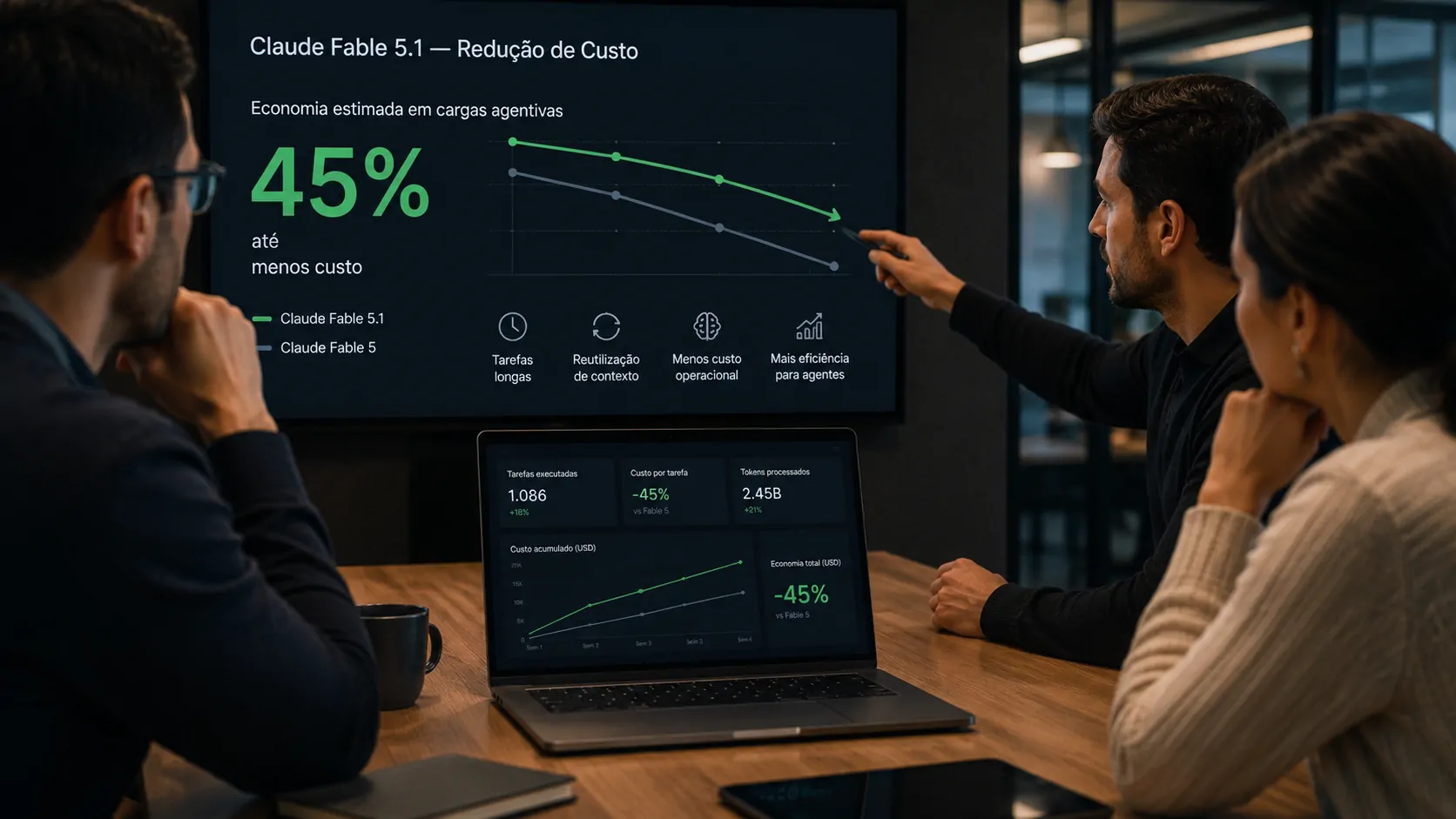
For enterprise applications, the cost per completed task becomes an important variable when deciding whether to deploy agents in production.
Cost per task becomes more important
In a traditional application, a company may measure the cost of a query or an API call. In an agentic system, however, a single request can trigger multiple calls, tool usage and context processing.
This changes the relevant metric. The more useful indicator becomes the cost of completing a task, rather than simply the isolated price of one million tokens. A cache reduction can have a larger impact in workflows that repeatedly reuse context.
Lower costs could make experimentation easier
The reduction could also lower a barrier for companies that are still testing agents. Experimental projects often need to run many tasks before an organization can evaluate productivity, reliability and return on investment.
If execution costs fall without requiring an equivalent reduction in model capabilities, there is more room to experiment with longer automations. This does not guarantee financial returns, but it can change the equation that determines which projects are economically acceptable.
This discussion is directly connected to the growing concern around enterprise AI governance. The expansion of autonomous systems is already forcing companies to rethink how they control these technologies, as discussed in our analysis of why AI agents require new governance in businesses.
The move puts efficiency at the center of the model competition
The launch comes at a time when capability, speed and price are increasingly interconnected. The competition is no longer simply about which model can produce the best response, but also which one can perform complex work at an acceptable operating cost.
More intelligence alone does not solve the problem
Models capable of executing tasks for hours can significantly expand the scope of automation. But if every long-running task generates a high bill, enterprise adoption may remain limited to high-value use cases.
That is why Anthropic’s pricing reduction matters even though it does not represent a universal 45% price cut. The apparent goal is to reduce a specific part of the cost that becomes more significant as agents repeatedly reuse context and remain active for longer periods.
The market is starting to measure efficiency by outcomes
This shift also changes how companies may compare models. Traditional benchmarks remain important, but enterprise applications need to consider metrics such as cost per completed task, the number of human interventions and the ability to maintain quality throughout long-running processes.
In this scenario, competitive advantage may come from the combination of capability, cost and autonomy. The most powerful model will not always be the most attractive option for an operation if another system can deliver a similar result using fewer tokens or requiring less human intervention.
Claude Fable 5.1 points to a competition beyond intelligence
The main message behind Claude Fable 5.1 is less about the version number and more about the economics of agents. Anthropic is attempting to make a category of systems more accessible by reducing the cost of repeatedly processing context during longer-running tasks.

More economical AI agents could expand the range of automations that currently require constant human supervision.
The next test will be production
The announced reduction is significant, but its real impact will depend on applications. Companies will need to determine whether lower execution costs come with consistent results, less supervision and enough productivity gains to justify changes to existing processes.
The availability of Fable 5.1 across different development environments and enterprise platforms will also make this a practical test. As more companies use the model in real operations, it will become easier to determine where the announced savings create a measurable difference.
Economics is becoming a competitive advantage
The launch suggests an important direction for the AI market. As models move from assistants that answer questions to agents that execute entire workflows, the cost of each completed task becomes almost as strategic as the model’s capabilities.
It is still too early to say that a reduction of up to 45% will reshape the AI agent market. But Anthropic’s move signals that the next phase of competition may not be decided solely by who builds the most capable AI. It may also be decided by who can make that AI work for longer while keeping the bill within a range businesses are willing to pay.
Comentários
Os comentários utilizam autenticação via GitHub para manter um ambiente mais qualificado, seguro e livre de spam.
Entrar ou criar conta no GitHub