ChatGPT is moving beyond a tool used to retrieve and generate information and becoming a software layer capable of executing tasks inside the systems businesses already use. Its integration with Google Drive shows why this shift could be more significant than a simple productivity update.
What changed in ChatGPT’s Google Drive integration
ChatGPT moves from retrieval to action
ChatGPT could already work with information stored in connected services. The more significant change is its ability to take actions directly on Google Drive files, including operations involving Google Docs, Sheets, and Slides.
OpenAI documentation describes actions that can create, update, share, move, send, copy, or delete files across the Drive ecosystem. That puts ChatGPT in a different position from a tool that simply reads documents and answers questions.
The integration brings Docs, Sheets, and Slides together
OpenAI has also brought Docs, Sheets, and Slides actions together under the Google Drive app. For businesses, this simplifies the integration architecture, but it also concentrates a broader set of permissions into a single connection.
That detail matters because the productivity gains now come with an operational question: how much authority should a business allow AI to have over its own data?
Why this changes the role of AI at work
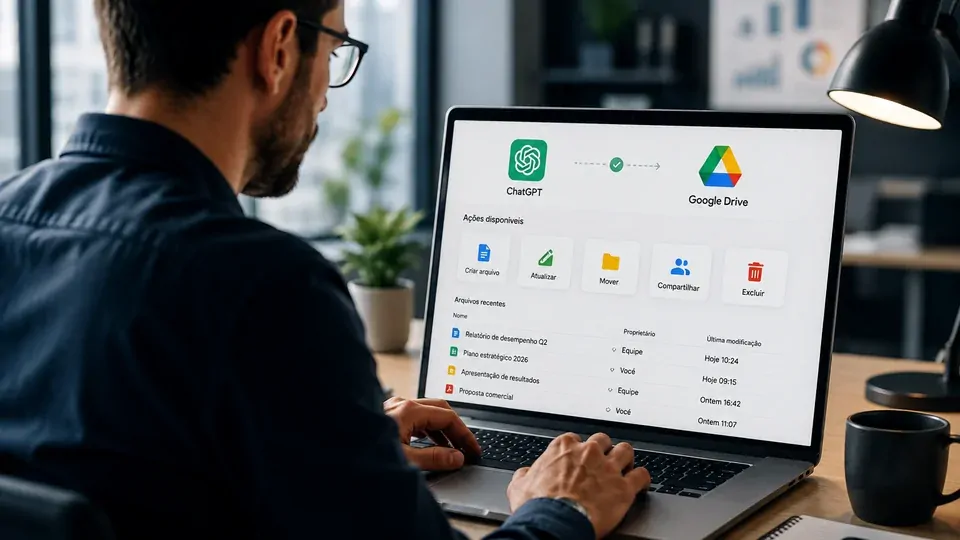
The most important development is not simply access to files, but the ability for AI to take actions on them.
From information assistant to work agent
For much of the evolution of generative AI, the workflow was relatively simple: an employee asked a question, the model produced an answer, and the person carried out the work inside the company’s systems.
The integration with Google Drive reduces that separation. The model can receive a task involving documents and, depending on the permissions available, perform part of the operation directly inside the file environment.
That brings ChatGPT closer to the concept of an AI agent: a system that does not merely generate content, but also uses tools to execute steps within a task.
Productivity is becoming less conversational
This changes the way AI can be used in business. Instead of asking an employee to copy an AI-generated response into a document, the goal becomes allowing the AI itself to participate in the workflow.
In practice, the boundary between talking to an AI and operating software is starting to disappear. The chat interface is no longer just a place for answers. It can become an access layer to the tools a company uses.
This shift also helps explain why the market is paying increasing attention to AI agents and automation.
To understand how this shift fits into enterprise infrastructure, see the Notícia Tech guide to enterprise AI architecture, including AI agents, MCP, APIs, workflows, and copilots.
The new challenge is controlling what AI can do
Permissions become a strategic issue
For a business, allowing AI to read a document is different from allowing it to modify the content. Allowing modifications is different again from authorizing file sharing, movement, or deletion.
OpenAI states that the new Google Drive actions require additional authorization scopes in Google Workspace. Administrators can review which actions are enabled and which permissions will be granted.
That means enterprise AI adoption should not begin only with the question, “What can AI do?” It should also ask, “What are we willing to let AI do?”
Risk grows with capability
The more autonomy a system has, the greater the potential impact of an incorrect action.
An incorrect answer in a chat can simply be ignored. An instruction executed on a corporate file can change information, expose data to the wrong people, or alter a business process.
That is why the expansion of ChatGPT actions reinforces a trend businesses are already confronting: AI governance is no longer only about models. It increasingly involves permissions, processes, and operational accountability.
The Notícia Tech has already examined this issue in why AI agents create a new problem for businesses: responsibility for autonomous actions.
What this means for businesses
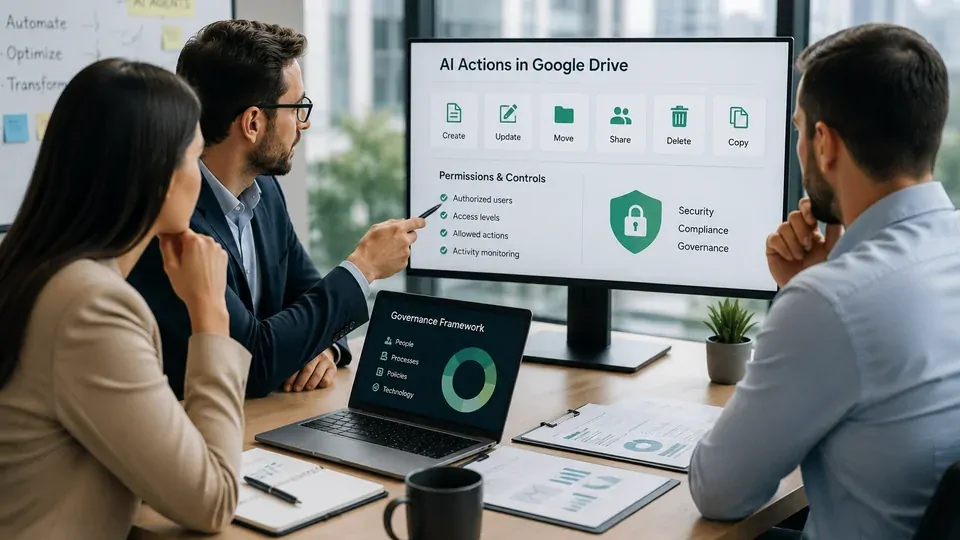
As AI gains the ability to act, security and governance become part of the adoption decision.
The potential gain is fewer manual steps
The main benefit is not simply “using ChatGPT inside Drive.” The real value comes from reducing the manual steps between information and execution.
A team could, for example, work with documents, spreadsheets, and presentations without constantly switching between different tools for each stage of a task.
This model could reduce operational work and accelerate processes that previously depended on copying information from one system to another.
Adoption requires clearer policies
At the same time, businesses will need to define which users can access these actions, which files can be accessed, and which operations should require approval.
This becomes particularly important for organizations handling contracts, financial information, customer data, or internal documents.
The goal, therefore, is not to prevent AI adoption. It is to establish limits that match the risk associated with each operation.
ChatGPT and Gemini are entering a different kind of competition
Google still has a structural advantage
The expansion of ChatGPT inside Google Drive is happening in an environment where Google Gemini has an obvious structural advantage: Workspace.
Gemini is integrated into Google’s products and continues to gain capabilities across Docs, Drive, Gmail, Sheets, and other services. This means Google is competing not only on model quality, but also for control of the workplace experience.
ChatGPT’s deeper entry into this environment makes the competition more interesting because the battle is also moving into the execution layer.
The battle will be over the workplace interface
If different AI models can access the same files and perform similar tasks, differentiation may shift toward integration quality, reliability, security, permissions, and the ability to coordinate workflows.
In that environment, users may stop choosing an AI only because of the quality of the answers it produces.
The decision may increasingly depend on which system can complete an entire task with less human intervention while staying within an organization’s rules.
Google Drive may only be the beginning
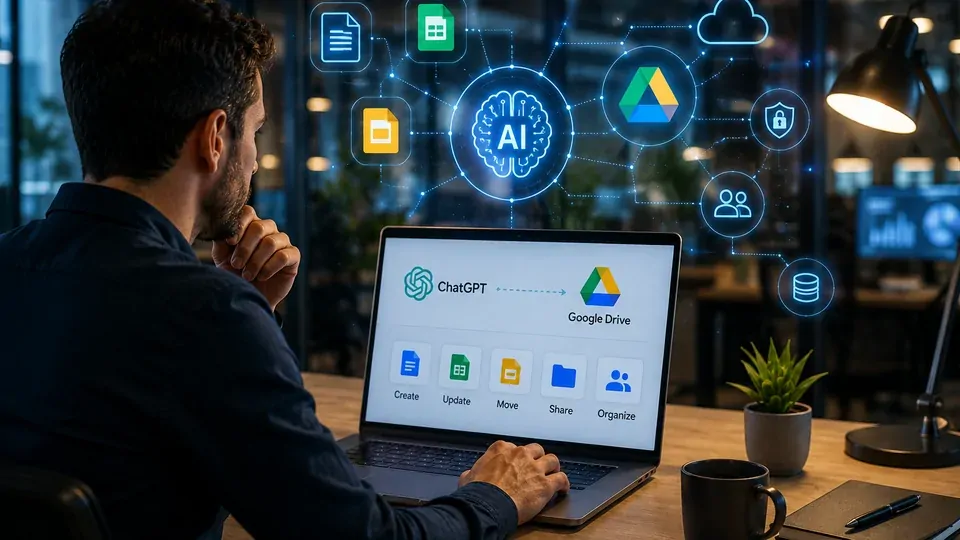
The expansion of AI integrations points toward systems that are increasingly connected to the tools where work actually happens.
The trend points toward more connected systems
The expansion of ChatGPT actions shows a clear direction: AI models are moving beyond isolated environments and becoming connected to external tools.
This is particularly important in business because the most valuable data is rarely stored inside the model itself. It is spread across documents, CRM systems, databases, email, and internal platforms.
The greater AI’s ability to access and modify these environments, the greater its potential for automation.
The next differentiator will be autonomy with control
The market does not simply need AI systems capable of performing more tasks. It needs systems that can perform those tasks within predictable boundaries.
That is why the discussion around AI agents and enterprise governance becomes more important as tools such as ChatGPT gain permissions to act on real systems.
The Google Drive expansion points to a broader shift: enterprise AI is moving beyond content generation and beginning to take on functions inside business workflows.
For businesses, the challenge in the coming months will be finding the right balance between two forces that were previously treated separately: autonomy and control.
Comentários
Os comentários utilizam autenticação via GitHub para manter um ambiente mais qualificado, seguro e livre de spam.
Entrar ou criar conta no GitHub