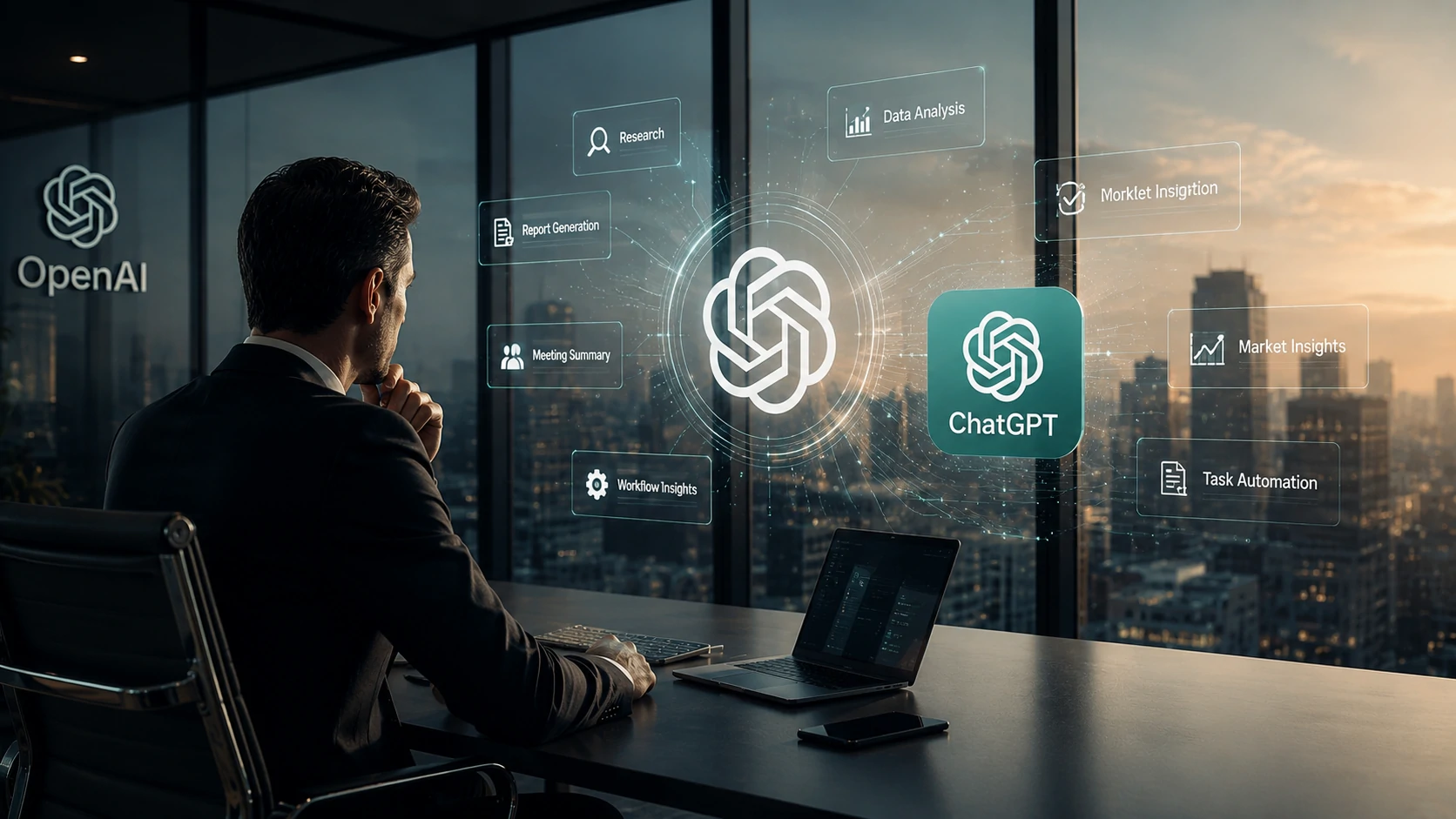
For decades, companies expanded their technology stack by purchasing more software. That strategy is beginning to change. The rapid growth of ChatGPT Work suggests the future may rely on intelligent agents capable of completing entire workflows while reducing dependence on traditional enterprise applications. Rather than a simple product update, this represents a structural shift that could reshape the global business software industry.
ChatGPT Work changes the way enterprise software is used
Businesses are beginning to view AI agents as a new operational layer capable of replacing much of the direct interaction employees have with traditional business software.
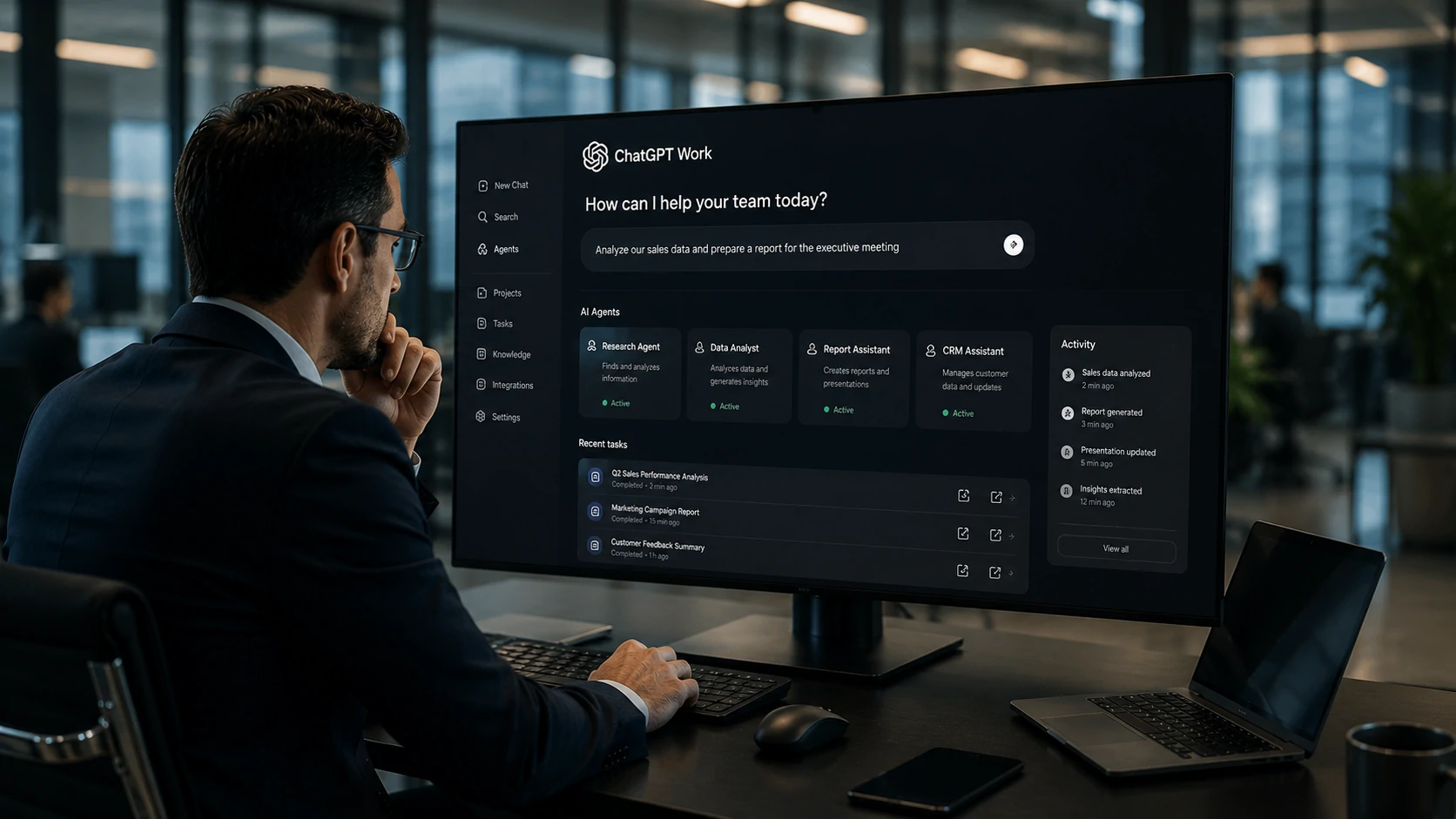
AI agents increasingly perform tasks that previously required employees to manually navigate multiple enterprise platforms.
For years, professionals switched between CRM systems, spreadsheets, collaboration tools and business applications to complete a single project. With ChatGPT Work, the workflow changes dramatically: users describe the desired outcome while the AI agent performs much of the execution.
The focus shifts from software to outcomes
Business value increasingly comes from completing objectives rather than operating individual applications.
Instead of asking which software should be opened first, employees ask which result they need to achieve. This shift has the potential to redefine enterprise productivity.
OpenAI accelerates the AI agent race
The continued expansion of OpenAI’s enterprise platform strengthens its strategy of making AI agents the primary interface for knowledge work.
This evolution builds upon a trend previously explored by Notícia Tech in its analysis of the beginning of the AI agent era for enterprise productivity, but now with greater emphasis on how it could transform the enterprise software market.
Microsoft, Google and Salesforce enter a new competitive landscape
Competition is no longer centered solely on language models. It is increasingly about controlling the complete AI-powered workplace experience.
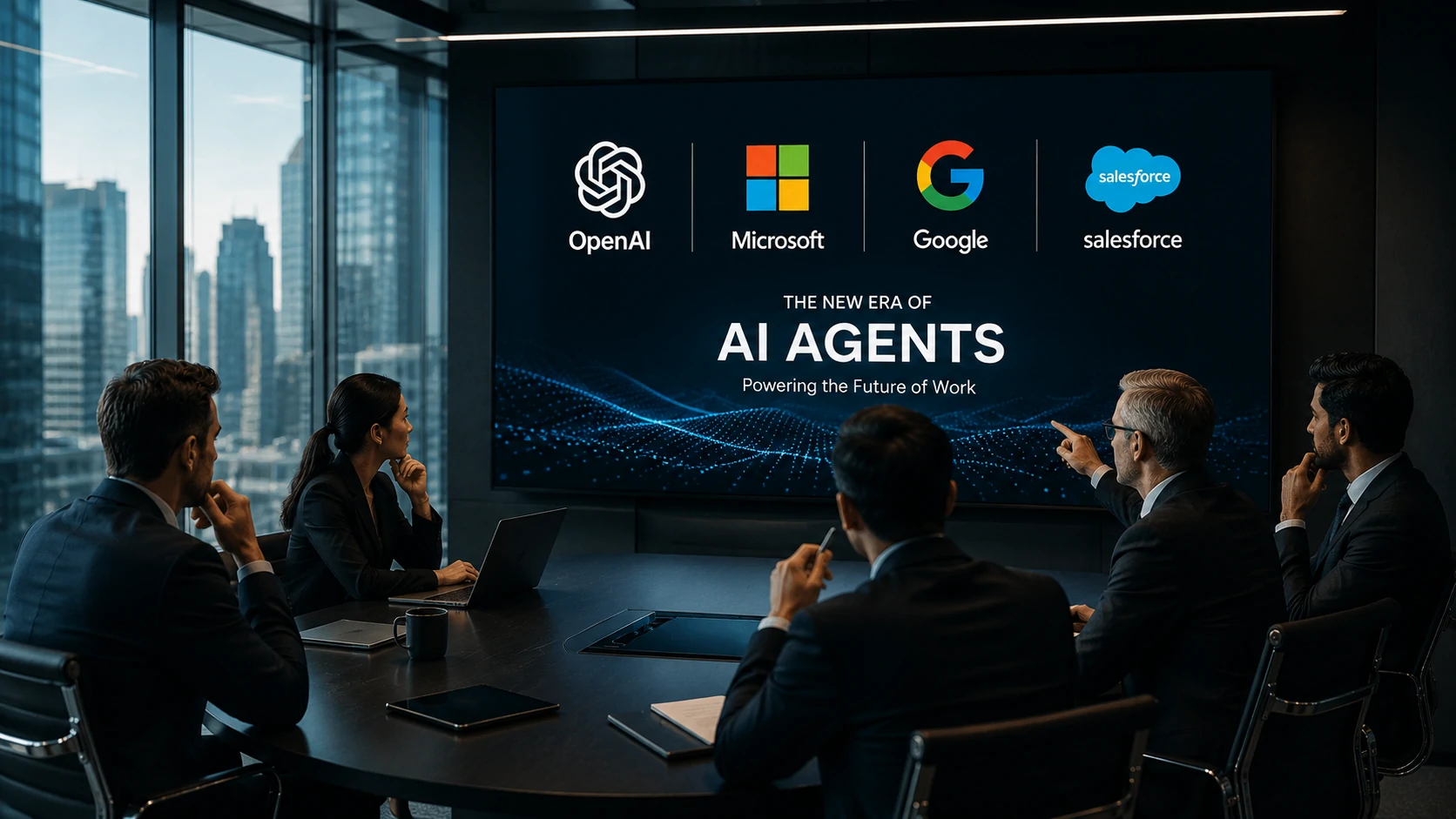
Major technology companies continue investing heavily as AI agents become the next enterprise computing platform.
Microsoft, Google, Salesforce and other enterprise software vendors have rapidly integrated Artificial Intelligence into their products, but intelligent agents significantly raise the competitive stakes.
Software becomes less visible
Instead of navigating menus and complex interfaces, users increasingly describe business goals in natural language.
AI agents interpret requests, access multiple enterprise systems, generate reports, organize information and deliver completed work with far less manual effort.
The impact goes beyond productivity
Organizations can reduce operational costs, simplify employee training and eliminate repetitive workflows.
At the same time, traditional software vendors face growing pressure to redesign their products for an enterprise environment increasingly driven by Artificial Intelligence.
Businesses must rethink their digital transformation strategy
Adopting AI agents is not simply about replacing one application with another. It represents a fundamental shift in how organizations design, automate and manage business processes.

Digital transformation is shifting from software deployment to intelligent, goal-oriented automation.
Organizations that previously relied on dozens of specialized applications are increasingly evaluating platforms capable of connecting multiple business systems through Artificial Intelligence.
Integration becomes more valuable than the number of tools
Companies that successfully connect enterprise systems through intelligent agents can reduce repetitive work, eliminate operational bottlenecks and accelerate decision-making.
In this context, technologies such as MCP (Model Context Protocol) become increasingly important because they enable secure communication between AI models and enterprise applications. This topic is explored further in our article about how to build an MCP server to connect AI with enterprise systems.
Enterprise software enters a new era
The traditional software licensing model is gradually evolving toward outcome-oriented platforms.
Instead of selling isolated features, software providers will increasingly compete by delivering specialized AI agents capable of completing complex business workflows while orchestrating information across multiple enterprise systems.
ChatGPT Work signals where the enterprise AI market is heading
The rapid adoption of ChatGPT Work suggests that the next phase of competition among major technology companies will take place at the operational layer of Artificial Intelligence, where AI agents evolve beyond answering questions to executing complete business processes.
OpenAI continues expanding its presence inside enterprises while Microsoft, Google, Salesforce and other technology providers accelerate investments to remain competitive in this emerging market.
For executives, entrepreneurs and technology leaders, the message is becoming increasingly clear: competitive advantage will no longer depend solely on adopting AI, but on redesigning business operations around intelligent agents capable of collaborating across multiple enterprise systems.
Over the next several years, organizations may stop asking which software is best for a specific task and instead focus on which AI agent consistently delivers the best business outcome. That transition has the potential to redefine enterprise software purchasing decisions, digital transformation strategies and the future of corporate productivity.
Comentários
Os comentários utilizam autenticação via GitHub para manter um ambiente mais qualificado, seguro e livre de spam.
Entrar ou criar conta no GitHub