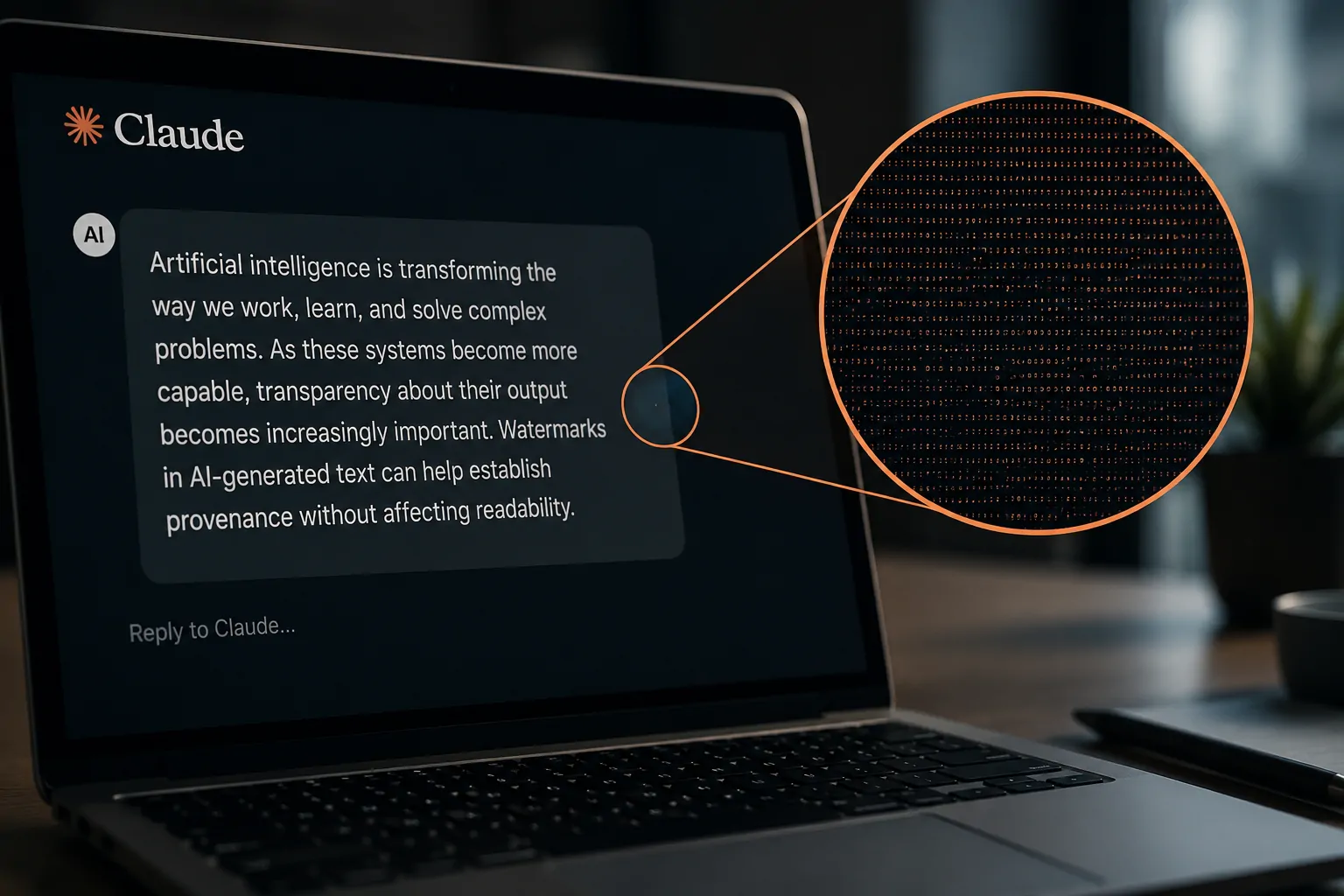
Content produced by artificial intelligence has always been difficult to distinguish from material written by a person. Now, Anthropic is trying to change that relationship in a quiet way: Claude has started embedding a mark that users cannot see but machines can potentially identify.
The move comes as governments and technology companies increase pressure for greater transparency around artificial intelligence. The question is no longer simply whether a piece of text looks AI-generated. It is increasingly about whether its origin can be technically established.
What Anthropic changed in Claude
Anthropic has started embedding an invisible watermark into text produced by compatible Claude models, its generative artificial intelligence system. The signal is inserted directly into the text during generation and is designed not to change the meaning, readability or appearance of the response.
This is different from a traditional label. Readers will not see a message saying that the content was created by AI. Instead, the watermark works as a statistical signal that can later be searched for by systems designed to recognize it.
The change affects different ways of using Claude, including consumer products and enterprise environments. The strategy also follows a broader industry move toward digital provenance, in which files and other forms of content can carry information about where they came from.
Why the mark is hidden
Choosing an invisible watermark addresses an important problem: a visible identification label could be removed simply by deleting it.
By embedding the signal into the generation process itself, Anthropic is attempting to make it travel with the content even when text is copied into another document. The company says the watermark can survive common forms of manipulation, although there are limitations when content undergoes deeper changes.
This distinction matters because watermarking, AI detection and metadata are not the same thing. A watermark is a signal deliberately created by the generating system. An AI detector, by contrast, attempts to estimate whether content was produced by AI by analyzing statistical characteristics. Metadata consists of information associated with a file that can record details about its provenance.
The change does not mean every Claude text will be identifiable forever
There is an important limitation to this strategy. The presence of a signal may help indicate that content was produced by Claude, but it does not turn the technology into a universal proof of authorship.
Deep rewrites, translations and other transformations can reduce or eliminate the ability to detect the watermark. Likewise, the absence of a signal does not necessarily mean that no AI system participated in creating the content.
That distinction will matter for businesses considering the technology for auditing or internal control processes. The watermark is a layer of provenance, not an infallible mechanism for determining who actually wrote a piece of text.
Why Claude started doing this now
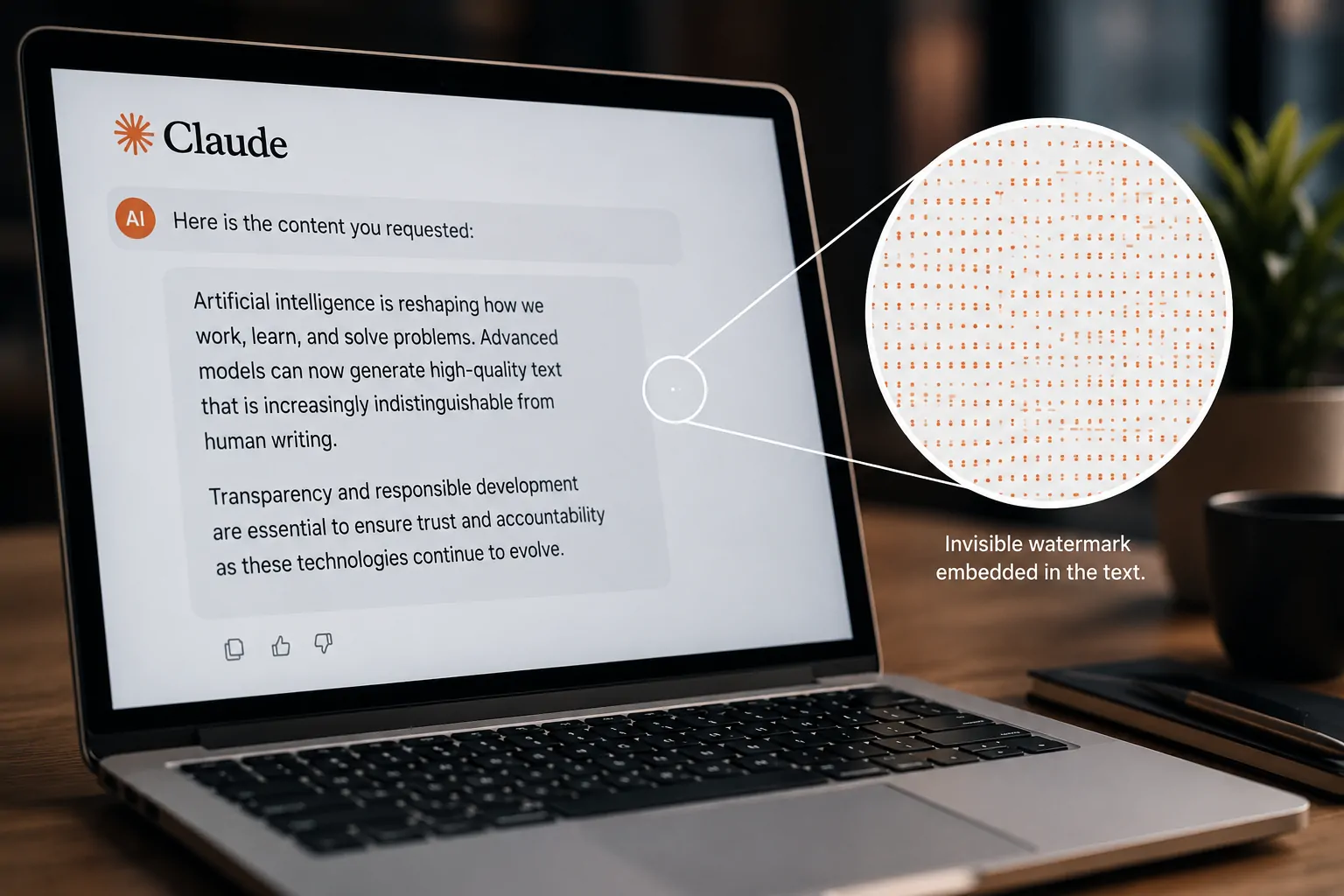
Claude’s watermark is embedded into the text in a way that is imperceptible to readers but can be identified by systems designed to detect the signal.
The main reason is the changing regulatory environment in Europe. The European Union AI Act introduced new transparency requirements for content generated or manipulated by artificial intelligence, increasing pressure on companies to develop mechanisms that can indicate where such content came from.
The new rules are part of a broader transformation in how the industry approaches content provenance. For years, the debate focused primarily on the ability of AI models to generate increasingly convincing text, images, audio and video. Now the discussion is shifting toward a different question: How can we know where the content we are seeing came from?
Anthropic is responding to that pressure by embedding the watermark directly into the generation process. According to coverage published on Wednesday, August 12, models launched in the European Union from August 2, 2026 are part of the move, while earlier models are being transitioned.
The role of the AI Act in the change
The AI Act is the European Union’s regulatory framework for artificial intelligence. Among its objectives is to increase transparency around AI systems and establish responsibilities that are proportionate to the risks associated with different technologies.
For readers unfamiliar with the regulation, the key point in this story is simple: Europe wants people and organizations to have better ways of knowing when content has been generated or manipulated by artificial intelligence.
Anthropic’s move can be understood in that context. The company is not simply adding another feature to Claude. It is adapting part of the model’s infrastructure to a reality in which provenance and transparency are becoming part of the product itself.
Notícia Tech has already examined how the AI Act is changing the strategies of companies such as OpenAI and Anthropic, and this new decision shows how regulation is moving beyond legal requirements and into the way AI tools actually operate: How the European Union AI Act is reshaping the AI market.
Why other companies are moving in the same direction
Anthropic’s initiative did not emerge in isolation. Google already uses SynthID to embed digital watermarks into content generated by its AI systems, including text produced by Gemini. The technology was designed to make the signal imperceptible to people while allowing systems built to detect it to identify the mark.
OpenAI has also been developing a provenance architecture based on different signals, including Content Credentials, standards such as C2PA and digital watermarking technologies. The company has emphasized that no single method is sufficient to determine the origin of every piece of content.
This suggests that the industry may be moving toward a scenario in which AI-generated content is no longer completely anonymous from a technical standpoint.
What an invisible watermark changes for Claude users
The most important change is that content produced by Claude may carry a characteristic that users cannot perceive but that could matter to verification systems and corporate policies.
For professionals who use AI every day, the change could primarily affect the relationship between production and provenance. A piece of text created with Claude can move through emails, documents, reports, websites or internal systems without displaying any visual indication that AI was involved.
At the same time, organizations may begin incorporating provenance into their AI governance policies. Instead of asking only which tools employees are using, businesses may need to consider how AI-generated content is identified, stored and audited.
Businesses gain transparency but also new responsibilities
For a business, the watermark could be useful when there is a legitimate need to distinguish machine-generated content from material created without AI involvement.
This could apply to internal documentation, communications, customer service, marketing, software development and review processes. The ability to identify origin could make audits easier and help governance teams map how artificial intelligence is being used across an organization.
But there is an important limitation: detecting Claude’s involvement does not automatically determine the quality, accuracy or accountability of the content.
A report may have been generated with AI and then thoroughly reviewed by specialists. Likewise, a text without a watermark should not automatically be treated as entirely human-written. Provenance is only one part of the assessment.
The market is beginning to treat provenance as part of AI infrastructure
This change is bigger than Claude itself. What is happening is the transformation of provenance into a layer of artificial intelligence infrastructure.
Just as APIs allow different systems to communicate and authentication mechanisms control access, watermarks and provenance credentials could increasingly record where a piece of content came from.
This evolution also reinforces the importance of AI security for businesses. Notícia Tech has already examined why security is no longer an exclusively technical concern and has become part of the broader strategy for adopting artificial intelligence: Why AI security is becoming a business priority.
The most significant consequences may emerge in the coming months, as companies, platforms and regulators decide what should be done with provenance information. The technology for marking content is advancing; the next debate will be about how those marks should be interpreted, who should have access to them and how far they should be used to make decisions about people and organizations.
What changes for businesses and professionals using AI
Claude’s change could have a particularly significant effect inside businesses. Today, many organizations already use artificial intelligence to produce reports, summarize documents, respond to customers, create campaigns, analyze information and support development teams.
Until now, control over this use has depended mainly on internal policies and records maintained by the platforms themselves. An invisible watermark creates an additional possibility: identifying later that specific content was produced by a Claude system.
This could help companies establish clearer AI governance processes, meaning the policies and controls used to determine how artificial intelligence can be adopted within an organization.
In practice, a company could begin distinguishing content produced entirely by professionals from material that involved AI systems. That does not mean marked text should automatically be considered less trustworthy. Information about provenance simply gives the organization more context about how the material was produced and helps determine what review processes may be necessary.
AI-generated content could gain a form of digital provenance
The concept of provenance is important because the discussion around artificial intelligence is changing.
In the past, the main concern was whether a machine could produce convincing content. Now, with models capable of generating text that can be almost indistinguishable from human-written material, a second question is emerging: how can the origin of that content be identified after it leaves the platform?
Claude’s watermark is an attempt to address precisely that problem.
Imagine a company using Claude to create a first draft of hundreds of product descriptions. Employees can review the texts before publication. If a question about the origin of a particular piece of content arises later, a detection technology could provide an indication that the material passed through Claude.
That does not replace human auditing, but it adds another layer of information to the process.
The change also affects professionals who work with content
For journalists, writers, marketing professionals and communications teams, the development could increase the importance of transparency around AI use.
A professional might use Claude to organize information, create a first draft or review a text and then make substantial changes. In that scenario, the existence of a watermark does not answer the question of authorship by itself.
As a result, the market will increasingly need to discuss what authorship means when humans and AI systems work together.
The question will not simply be “Was this written by a person or by a machine?” In many professional environments, it will be necessary to understand how much of the production came from AI, how much came from a human and what review processes were applied before publication.
The invisible watermark does not solve the AI detection problem
It is important not to interpret the development as if Anthropic had created a definitive way to identify every piece of text produced by artificial intelligence.
The technology has a more specific purpose.
A watermark works best when the content retains enough characteristics for the signal to be recognized. If someone simply copies and pastes the text, the mark may remain present. However, deeper transformations can make identification more difficult.
Someone could, for example, completely rewrite a piece of content, change its structure or translate it into another language. Depending on the transformation, the original signal could become weaker.
This creates a fundamental difference between provenance and universal AI detection.
Provenance attempts to answer:
“Does this content carry a signal associated with a particular origin?”
Detection attempts to answer:
“Does this content appear to have been produced by artificial intelligence?”
These are different problems.
Why this matters to people who publish content
This distinction will be particularly important for websites, media companies and digital platforms.
A system that finds a Claude watermark may have additional evidence about the origin of a piece of text. But it should not automatically conclude that the content is false, low quality or produced without human supervision.
Likewise, a text without a watermark should not automatically be considered human-written.
This caution will be essential to prevent false positives and incorrect decisions based solely on automated tools.
The evolution of these technologies suggests that the market will need to combine watermarks, metadata, content credentials and human review, rather than relying on a single method.
What this change reveals about the future of artificial intelligence
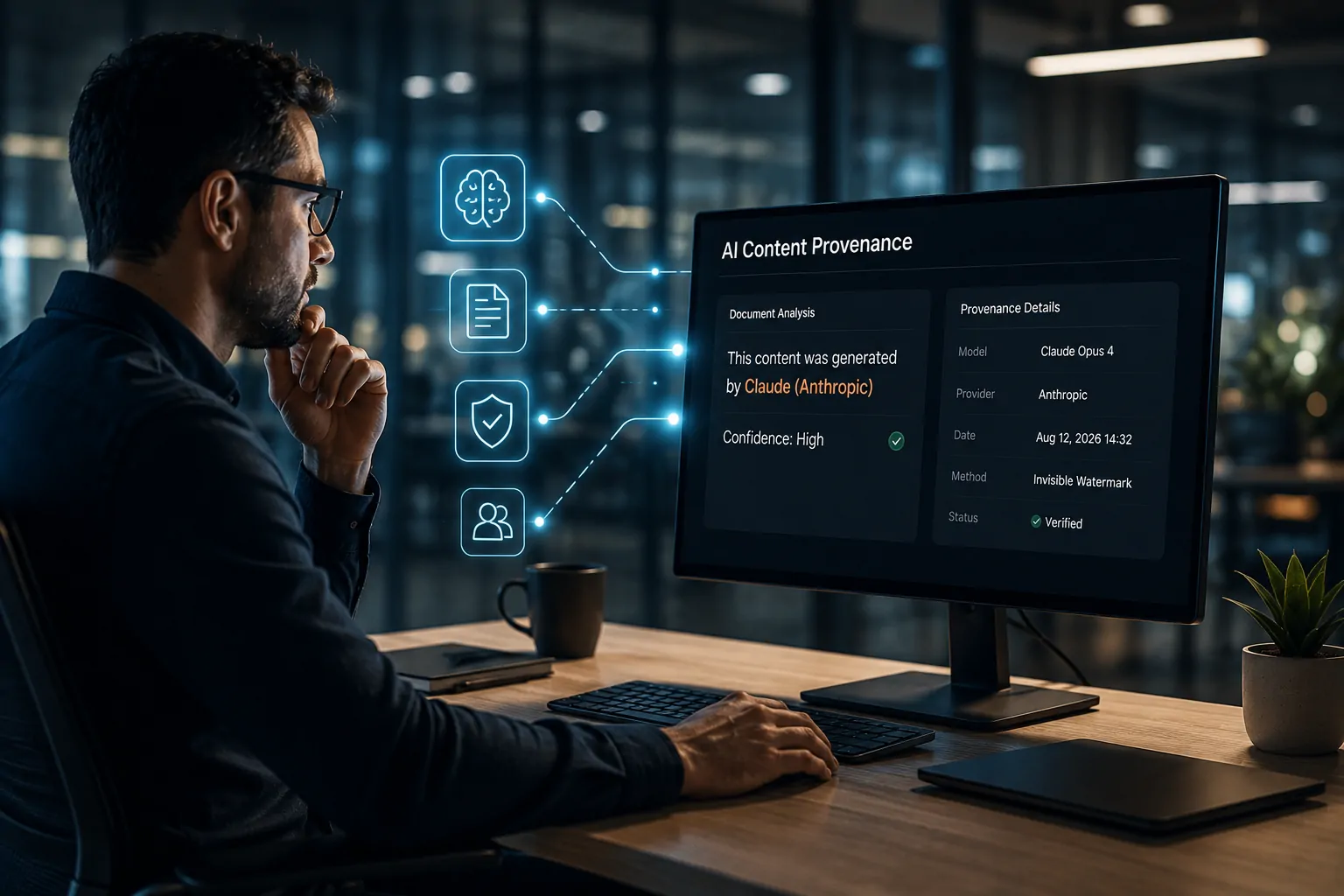
Identifying the origin of AI-generated content could become a permanent layer of platform infrastructure.
This means that, in the future, content produced by an AI system could carry more information about its origin from the moment it is created.
Text could contain invisible marks. Images could include provenance credentials. Videos could carry information about how they were created and edited. Corporate documents could record which systems participated in their production.
This scenario changes the relationship between artificial intelligence and digital trust itself.
The competition could shift from generation to trust
During the first phase of the generative AI race, companies competed primarily on model quality.
Who produced the best text?
Who generated the most realistic image?
Who could program better?
Who had the fastest model?
Now a new area of competition is emerging: who can provide greater control and transparency over the content produced?
For businesses, this question could become as important as the quality of the response.
An organization using AI at scale needs to know not only whether the model works, but also how to control its outputs, track its use and demonstrate compliance with internal and external rules.
This is where AI governance stops being merely a legal or administrative discussion and becomes part of the architecture of AI products themselves.
The market could enter a new era of AI traceability
Anthropic’s initiative may look like a small change to someone who simply chats with Claude. Its significance for the market, however, is much larger.
If other companies adopt similar mechanisms, content produced by different models could begin carrying specific provenance signals.
That could create a kind of traceability layer for generative artificial intelligence.
A company could know that a particular document passed through Claude. Another platform could identify content produced by a different tool. Publishing systems could use this information to automatically apply internal policies.
Technical and regulatory obstacles still exist. There is no guarantee that a watermark will remain identifiable after every possible transformation applied to content. It will also be necessary to determine who can access this information and for what purposes.
But the direction is becoming clear: the industry is beginning to treat the origin of content as information worth preserving.
The impact could be greater on enterprise AI adoption
For the business market, this change could help address one of the concerns surrounding AI adoption: limited visibility into how content was produced.
This could be particularly relevant in regulated industries, legal departments, corporate communications, education, customer service and documentation workflows.
Instead of simply banning AI because of concerns about losing control, companies could create mechanisms that allow employees to use it within defined rules.
The watermark does not solve every AI governance problem, but it could become part of that ecosystem.
And as more AI systems become embedded in corporate processes, it will become increasingly important to know where AI participated, which model was used and what controls were applied after generation.
What to expect in the coming months
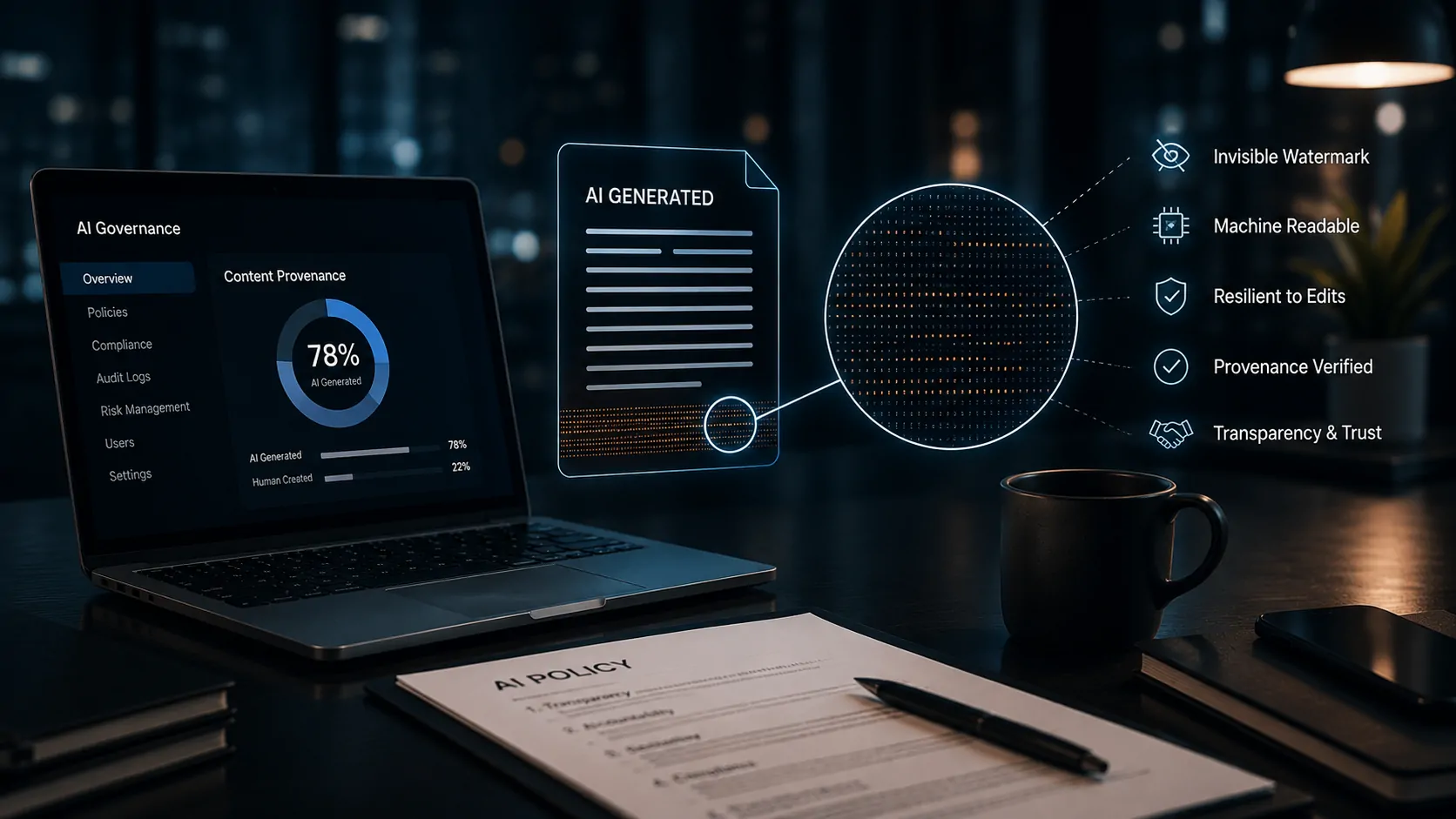
The combination of watermarks, metadata and provenance credentials could turn origin tracking into an important layer of AI infrastructure.
Anthropic’s decision is unlikely to end this discussion. On the contrary, it could accelerate a trend that is already advancing among major technology companies.
The next step could be the integration of different provenance mechanisms. Watermarks may work alongside metadata, digital credentials and open standards to provide more complete information about the origin of content.
This could also increase pressure on companies that do not yet have similar mechanisms.
As transparency rules expand in Europe and corporate AI adoption grows, the ability to identify the involvement of generative systems could stop being an optional feature and become part of the basic infrastructure of these platforms.
For ordinary users, the change will be almost invisible. For businesses, however, it could represent an important shift in how AI-generated content is managed.
The central point is that AI is no longer simply a tool that generates content. It is beginning to carry information about how that content came into existence.
And that could change the relationship between artificial intelligence, transparency and digital trust in the years ahead.
Conclusion
Claude’s invisible watermark does not mean Anthropic has found a perfect way to identify every piece of content produced by artificial intelligence. The development is more specific, but it is also strategically important.
The company is attempting to incorporate provenance into the content generated by its model at a time when regulation, governance and trust are becoming increasingly important factors in AI adoption decisions.
For users, the change will be almost imperceptible. For businesses, it could provide a new tool for governing AI use. And for the market, it signals a possible paradigm shift: the next competition in artificial intelligence will not be only about who generates the best content, but also about who can prove where that content came from.
In the coming months, the key question will be whether other platforms follow the same path and whether watermarks and provenance mechanisms evolve from experimental features into common components of generative artificial intelligence systems.
Comentários
Os comentários utilizam autenticação via GitHub para manter um ambiente mais qualificado, seguro e livre de spam.
Entrar ou criar conta no GitHub