Over the past two years, competition among leading artificial intelligence companies has focused primarily on building better language models. That race is now entering a new phase: creating AI systems capable of performing real work on a computer instead of simply generating answers. Anthropic’s latest strategy places Claude at the center of this shift, increasing pressure on ChatGPT in the enterprise AI market.
Claude’s ability to operate a computer represents a significant shift in Anthropic’s enterprise strategy. Instead of acting solely as a conversational assistant, the platform can now interact with graphical interfaces, web browsers and business applications, moving closer to the vision of intelligent agents capable of completing real-world tasks with minimal human intervention.
For businesses, this evolution removes important barriers between artificial intelligence and the software already used across daily operations. Workflows that once required custom integrations or dedicated development teams may now be executed directly by AI using existing applications.
Claude moves beyond conversations to execute real business tasks
Claude’s latest capabilities transform the model into an AI system that can interact directly with computers, dramatically expanding its value for enterprise environments.
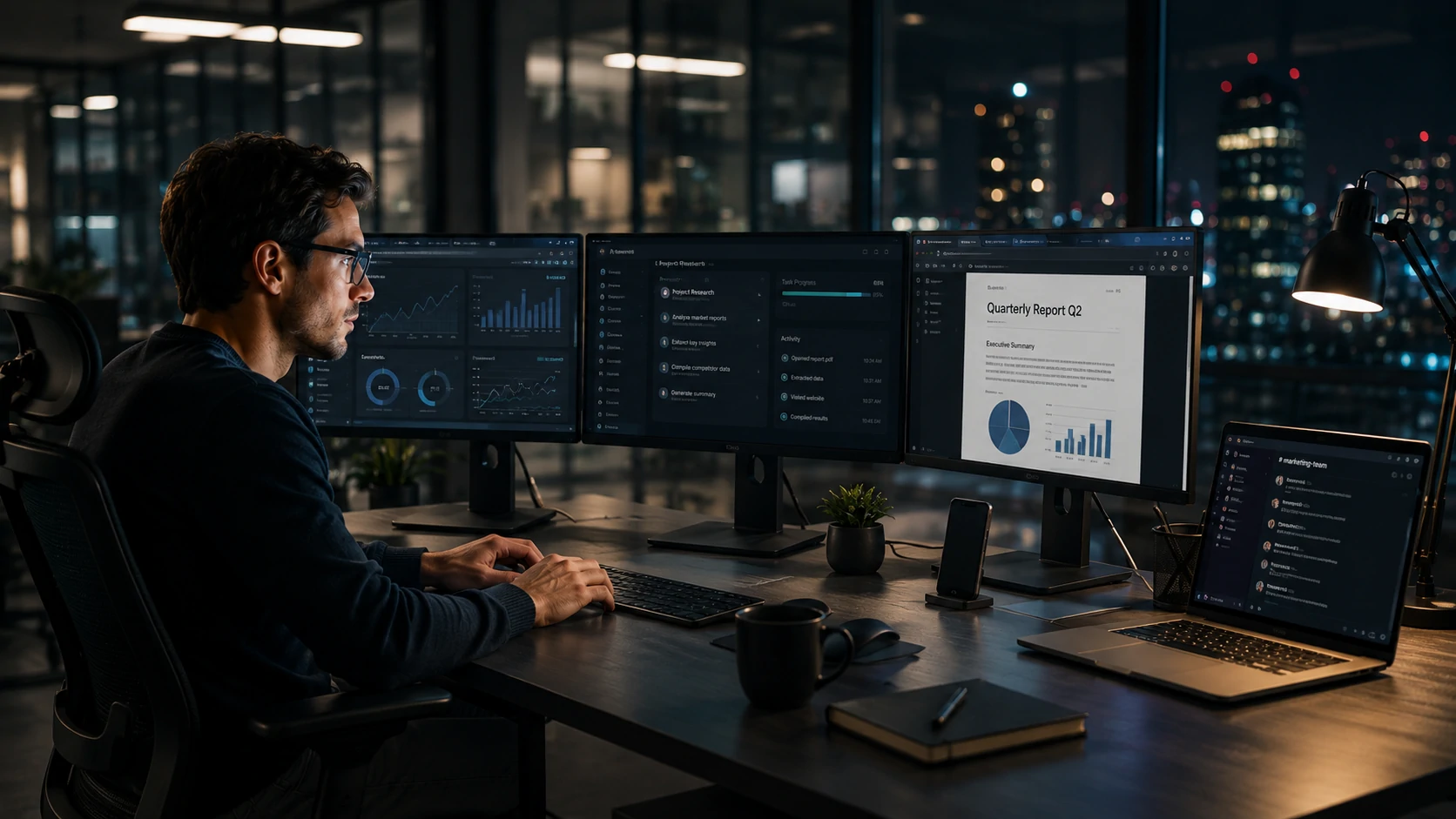
Claude’s new computer interaction capabilities allow AI agents to work directly with graphical interfaces and enterprise software.
Rather than limiting itself to text generation, Anthropic is pushing artificial intelligence toward operational automation. Claude can interpret visual information displayed on screen, navigate applications and complete workflows that traditionally required human employees.
Beyond traditional chatbots
This development represents an important milestone in the evolution of AI Agents. The focus is no longer limited to producing accurate responses but extends to carrying out meaningful business activities.
In practical terms, organizations can automate processes such as completing forms, navigating enterprise systems, retrieving information from web platforms and managing repetitive operational workflows.
Businesses can automate without rebuilding existing software
One of the biggest advantages for enterprises is the ability to work with current technology stacks instead of replacing them.
Rather than investing heavily in custom APIs and integrations, companies can deploy intelligent agents capable of operating the same interfaces employees already use, reducing implementation time while lowering development costs.
This trend complements other topics explored by Notícia Tech, including the complete guide to Enterprise AI Architecture and the analysis of AI Orchestration for Businesses.
Competition between Claude and ChatGPT enters a new stage
Claude’s new computer capabilities significantly raise the competitive stakes between Anthropic and OpenAI, shifting the conversation beyond language model performance alone.
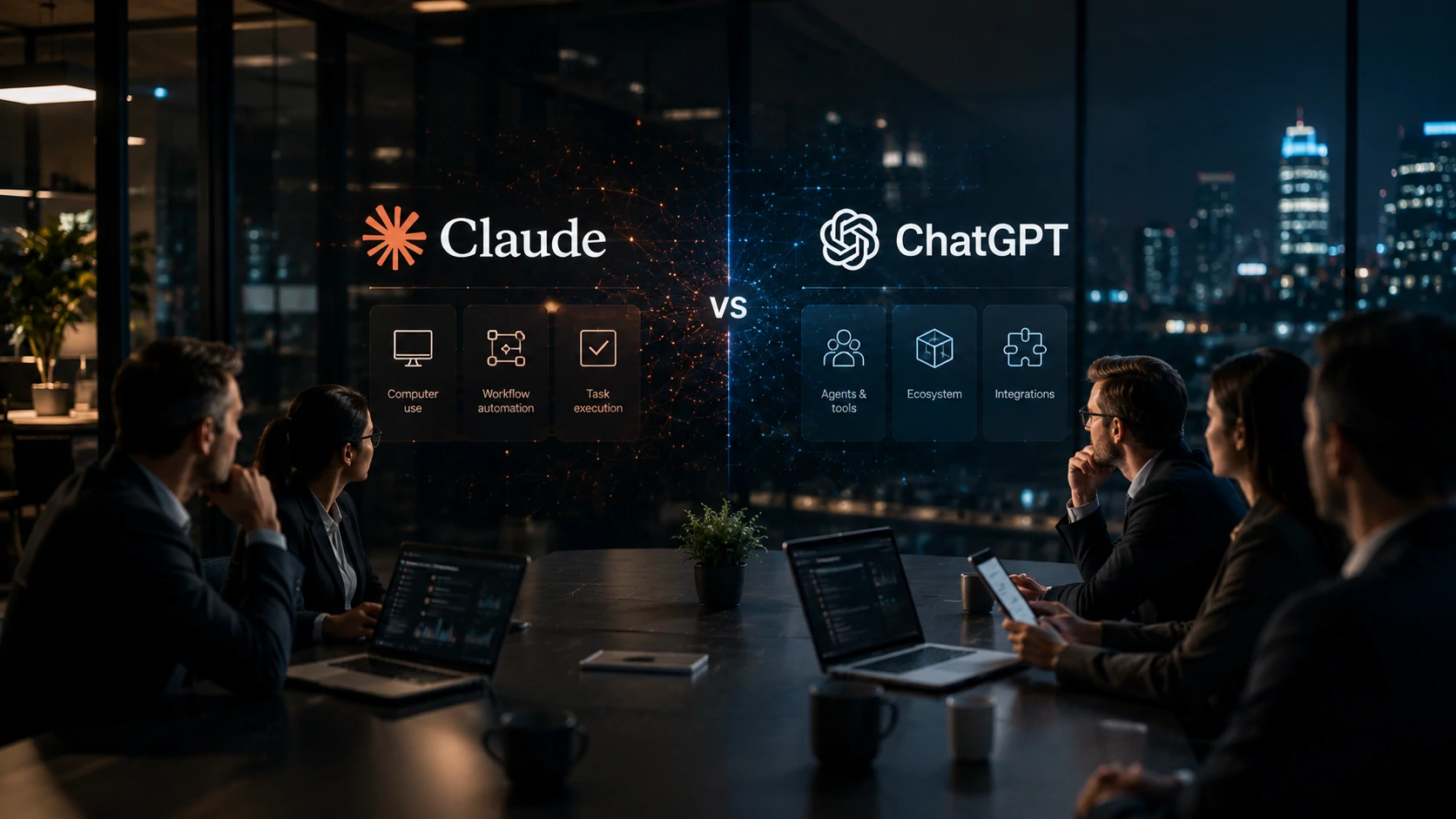
Competition between Claude and ChatGPT is increasingly centered on autonomous execution rather than conversational quality alone.
Enterprise customers are beginning to evaluate AI platforms based on productivity, workflow automation and operational execution. The key differentiator is becoming each platform’s ability to complete real business tasks securely, reliably and with minimal supervision.
The industry is moving toward action-oriented AI agents
Nearly every major AI company has shifted its long-term strategy toward intelligent agents.
OpenAI, Google, Microsoft and Anthropic all recognize that the next competitive advantage will not simply come from generating better answers, but from delivering AI systems capable of performing complete business workflows.
This broader movement also reinforces the growing importance of technologies such as MCP, RAG, multi-agent architectures and enterprise AI orchestration.
The long-term impact could reshape enterprise software
As organizations adopt computer-operating AI agents, they may automate complex workflows without replacing their existing software ecosystems.
That approach can reduce digital transformation costs, accelerate AI adoption and improve returns on enterprise automation investments. It also explains why competition among Claude, ChatGPT, Gemini and other leading AI platforms is expected to intensify over the coming months.
The trend aligns with Notícia Tech’s analysis of how ChatGPT Work is changing enterprise software, highlighting a market increasingly driven by autonomous AI platforms rather than traditional productivity tools.
AI agents capable of operating computers could redefine digital transformation
Claude’s latest evolution demonstrates that the next phase of artificial intelligence will not be measured solely by the quality of generated responses, but by its ability to complete real business tasks autonomously.

The next generation of AI agents brings artificial intelligence closer to executing real business operations instead of simply assisting employees.
Organizations adopting this new class of AI systems could reduce repetitive work, improve productivity and accelerate digital transformation initiatives without replacing their existing software infrastructure.
By enabling an AI agent to operate applications already used by employees, Anthropic lowers one of the biggest barriers to enterprise automation: the need for expensive custom integrations.
Security will remain a critical factor
As AI agents gain greater autonomy, governance and cybersecurity become increasingly important.
Businesses will need clear permission controls, monitoring mechanisms, audit logs and operational safeguards to ensure AI systems execute tasks responsibly while protecting sensitive corporate information.
This growing need for governance reinforces concepts discussed in Notícia Tech’s guide to AI Security for Businesses, where security is presented as one of the pillars of successful enterprise AI adoption.
The enterprise AI race is only beginning
Competition among Anthropic, OpenAI, Google, Microsoft and other technology companies clearly shows that enterprise AI is moving toward platforms capable of completing entire workflows rather than simply assisting with isolated tasks.
Over the next several years, competitive advantage is likely to depend less on language model quality and more on a platform’s ability to integrate enterprise systems, understand business context and execute complex operations safely, reliably and at scale.
As a result, intelligent AI agents are evolving from experimental technologies into strategic assets for organizations pursuing long-term digital transformation.
What businesses should evaluate before adopting computer-operating AI agents
Organizations interested in deploying autonomous AI systems should evaluate much more than benchmark performance. Security, governance, regulatory compliance and compatibility with existing enterprise software will all play critical roles in successful implementation.
Key evaluation criteria
Before deploying AI agents capable of operating computers, organizations should carefully assess several factors:
- auditability of AI actions;
- permission and identity management;
- compatibility with existing enterprise software;
- integration with current business workflows;
- protection of sensitive business data;
- operational costs and long-term scalability.
Together, these considerations are likely to become more important than raw model performance when enterprises choose between competing AI platforms.
Enterprise AI competition is entering a new era
Anthropic’s latest announcement reinforces a broader industry trend: the competition is no longer about building the smartest chatbot.
Instead, technology leaders are racing to deliver AI systems capable of executing meaningful work inside real business environments.
For CIOs, technology leaders and business decision-makers, following this transition will become increasingly important. Companies that understand the potential of autonomous AI agents early will be better positioned to reduce operational costs, improve workforce productivity and build sustainable competitive advantages as artificial intelligence becomes an active participant in everyday business operations.
Comentários
Os comentários utilizam autenticação via GitHub para manter um ambiente mais qualificado, seguro e livre de spam.
Entrar ou criar conta no GitHub