For months, the leadership battle in Artificial Intelligence has largely centered around OpenAI and Google. The arrival of Claude Opus 5, however, signals that Anthropic intends to become a much stronger competitor. More than just another language model, the launch represents a strategic move that could reshape how enterprises choose their AI platforms over the coming years.
Claude Opus 5 marks a new stage in the battle among leading AI companies
Claude Opus 5 strengthens Anthropic’s strategy to gain a larger share of the enterprise artificial intelligence market.
The launch of Claude Opus 5 comes at a time when competition between Anthropic, OpenAI and Google has never been more intense.
Anthropic is positioning the model as a stronger option for software development, advanced reasoning and AI agent execution, three areas receiving massive investment across the technology industry.
Rather than simply introducing a more capable model, the company is trying to convince organizations that its platform can become the foundation for enterprise-grade AI applications.
The competition is no longer about chatbots
Over the past two years, the AI race has evolved dramatically.
Today, the industry’s focus is building platforms capable of completing complex tasks, automating workflows and acting as intelligent digital coworkers rather than simply answering prompts.
Enterprises are looking for productivity
Business leaders increasingly demand AI systems that reduce operational costs, automate repetitive work and accelerate software development.
That shift explains why virtually every major AI lab is investing heavily in intelligent autonomous agents.
In this context, it is also worth following the evolution of ChatGPT Work, which marked the beginning of a new generation of enterprise AI agents.
Why ChatGPT Work Marks the Beginning of the AI Agent Era for Enterprise Productivity
Claude Opus 5 shows that the competition is now about complete AI ecosystems
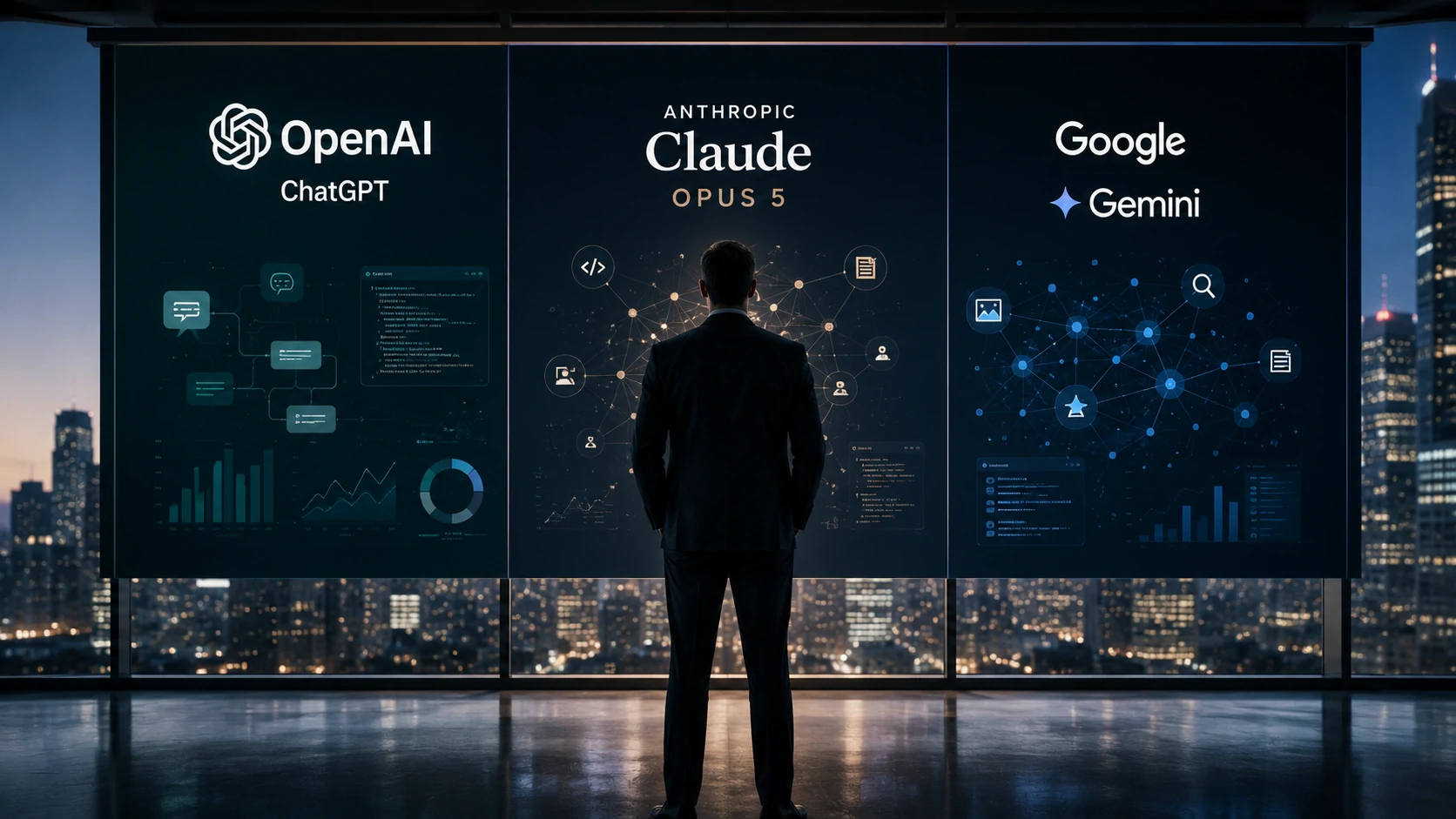
OpenAI, Anthropic and Google are no longer competing only with language models. They are building complete enterprise AI ecosystems.
The competition between Claude, ChatGPT and Gemini has evolved far beyond comparing answer quality.
Today, every major AI company is racing to build comprehensive platforms that combine AI agents, software development, workflow automation, enterprise search, productivity tools and business intelligence.
This explains why major releases now arrive at a much faster pace and increasingly focus on enterprise use cases rather than consumer applications.
Artificial intelligence is becoming business infrastructure
Just as cloud computing became the foundation of modern IT, AI models are quickly evolving into core enterprise infrastructure.
Organizations are no longer searching for a better chatbot.
Instead, they want intelligent systems capable of automating complete business processes while integrating with existing enterprise software.
This trend also explains the rapid growth of AI Agents and AI Orchestration, two technologies that are becoming essential components of digital transformation strategies.
To better understand this shift, it’s worth exploring how multiple AI agents can work together through orchestration.
What Is AI Orchestration and Why Businesses Using Multiple AI Agents Need It
Lower costs become a competitive advantage
Pricing is becoming just as important as model quality.
According to Anthropic, Claude Opus 5 delivers performance close to its most advanced systems while significantly reducing operational costs, making enterprise-scale AI deployments more accessible.
The impact on businesses goes far beyond comparing ChatGPT and Claude

Organizations are increasingly evaluating complete AI platforms rather than individual language models.
For enterprises, the biggest consequence of this new competitive landscape is having more strategic options.
The stronger the competition between Anthropic, OpenAI and Google, the faster innovation is likely to accelerate.
Choosing an AI platform is about more than model performance
Companies are now evaluating factors such as:
- enterprise integrations;
- security and compliance;
- governance capabilities;
- operating costs;
- software development efficiency;
- autonomous AI agent capabilities.
As a result, selecting between Claude, ChatGPT and Gemini is becoming less about benchmark scores and more about long-term technology strategy.
The AI leadership race is only beginning
The release of Claude Opus 5 demonstrates that the AI industry has entered a new phase.
Instead of waiting for annual breakthroughs, businesses should expect continuous improvements, lower deployment costs and increasingly capable intelligent agents.
For organizations investing in digital transformation, this creates new opportunities to automate operations, improve productivity and gain competitive advantages.
For the broader market, it signals that the battle among Anthropic, OpenAI and Google is entering one of its most important stages yet, with enterprise artificial intelligence becoming one of the defining technologies of the next decade.
Comentários
Os comentários utilizam autenticação via GitHub para manter um ambiente mais qualificado, seguro e livre de spam.
Entrar ou criar conta no GitHub