
The corporate market has officially entered the consolidation phase of artificial intelligence. After the initial race for generative tools, autonomous agents and intelligent automation, companies now face a new reality: having access to AI is no longer a competitive differentiator. The real challenge became transforming artificial intelligence into real productivity, operational efficiency and sustainable growth.
Reports released in recent weeks show that Brazil is experiencing a technological paradox. While executives accelerate investments in AI, most organizations still operate with low strategic maturity, limited integration and difficulty in generating a concrete return on investments made.
The corporate race for AI has entered a new phase

The adoption of Artificial Intelligence is no longer an experimental initiative to become an operational priority in companies from different sectors.
According to recent studies on maturity in corporate AI, Brazilian organizations have already made progress in accessing tools, but are still far from deep integration into core business processes.
The main movement observed in 2026 is the migration from the so-called “individual productivity AI” to “corporate operational AI”.
In practice, this means that companies have begun to realize that simply making tools such as generative assistants available to employees does not produce a relevant impact without integration with:
- internal flows;
- corporate data;
- process automation;
- legacy systems;
- operational governance.
This scenario marks an important change within the global technology market.
Over the past two years, companies have invested heavily in rapid testing with generative AI. Now, the pressure has turned to measurable financial returns.
According to recent analyzes of AI trends for companies, the corporate focus is no longer “experimenting AI” and has become “operationalizing AI”.
This movement also strengthens the growth of new technological categories, including:
- autonomous agents;
- multimodal automation;
- Contextual AI;
- predictive analysis;
- corporate copilots;
- AI integration with ERPs and CRMs.
Within this new scenario, companies that manage to integrate artificial intelligence into central processes tend to increase productivity and reduce operational costs in a structural way.
To deepen the advancement of corporate automation in Brazil, it is also worth checking out:
The biggest problem for companies is not access to AI — it is strategic maturity

Despite the explosion of interest in AI, the most recent studies reveal a critical problem: most companies still don’t know how to structure the technology internally.
Research released in May shows that more than 60% of Brazilian companies still operate below the intermediate level of maturity in corporate AI.
This means that many organizations:
- use AI in isolation;
- do not have governance;
- did not structure internal processes;
- lack integration between departments;
- have not yet transformed data into operational intelligence.
The problem is no longer the availability of technology.
Today, advanced tools are accessible to companies of virtually any size.
The real difficulty lies in:
Integration with legacy systems
Many companies still operate in old structures that make integration with modern AI models difficult.
Data quality
Without organized, reliable and structured data, AI systems produce inconsistent and unhelpful responses.
Internal training
Companies face a lack of professionals prepared to operate artificial intelligence at a strategic level.
Governance and security
With the growth of generative AI, concerns about compliance, privacy and corporate data leakage are also growing.
This scenario explains why many companies have announced AI initiatives in recent years, but few have managed to generate profound operational transformation.
The new corporate dispute now takes place around organizational maturity — and not just technological adoption.
The next wave will be dominated by autonomous agents and operational AI
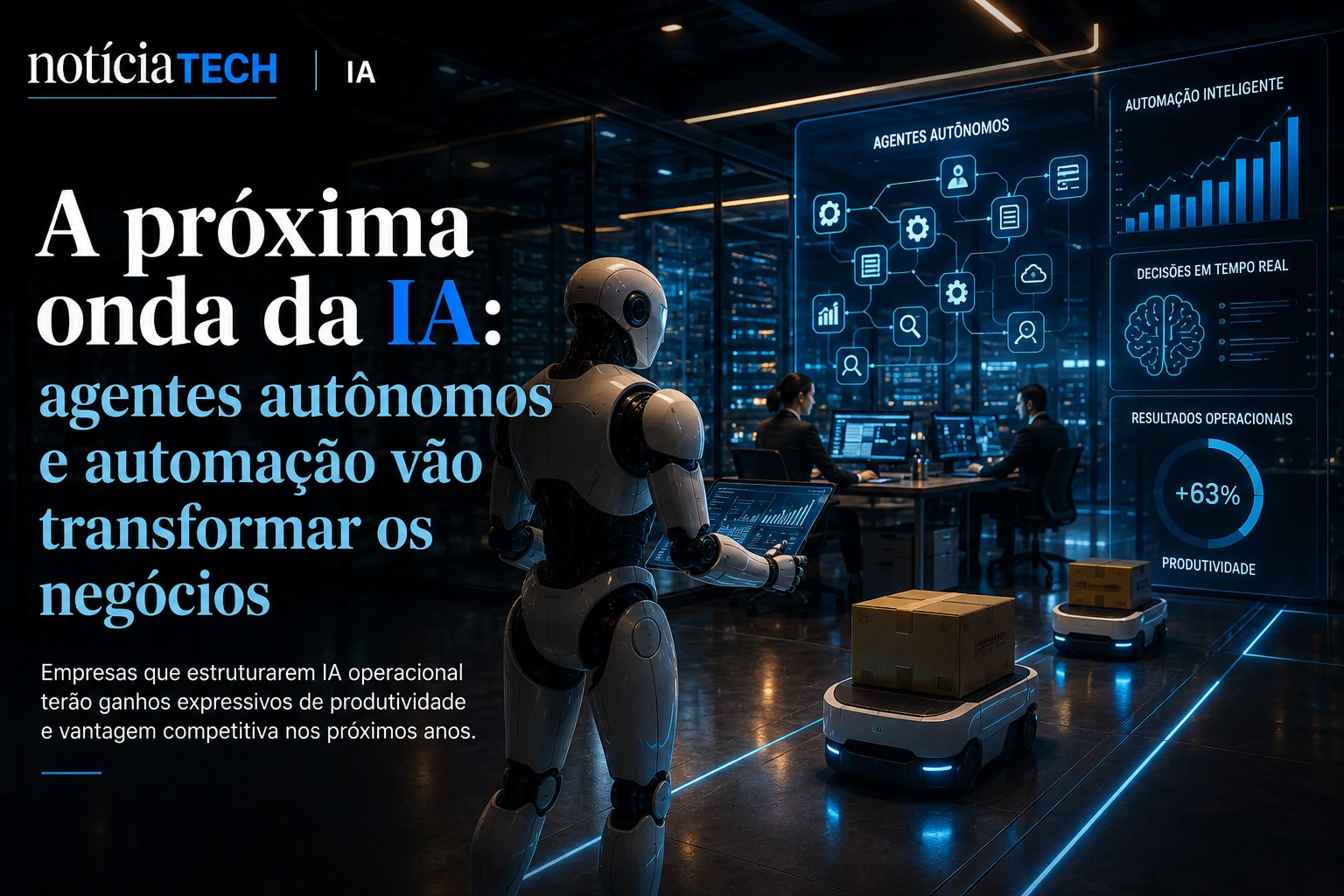
The next cycles of digital transformation must be led by so-called “operational AI”.
Experts point out that 2026 marks the beginning of the massive expansion of autonomous agents within companies.
Unlike traditional chatbots, these systems can:
- perform complete tasks;
- analyze multiple contexts;
- interact between platforms;
- make operational decisions;
- automate complex flows.
This completely changes the role of AI within organizations.
Artificial intelligence no longer functions only as an auxiliary tool and starts to act as an operational layer integrated into the business.
According to recent predictions, companies that manage to structure AI efficiently will be able to achieve significant productivity gains by the end of the decade.
At the same time, the debate about impacts on the job market is growing.
Recent reports show that some companies still overestimate the current capacity of AI to justify operational cuts.
In practice, the most likely scenario in the short term is not a total replacement of professionals, but a profound transformation of corporate functions.
Professionals who learn to operate with AI tend to gain productivity, while companies that take time to structure governance, data and automation can quickly lose competitiveness.
The new digital economy is beginning to be shaped not only by those who have access to artificial intelligence, but by those who can transform AI into a scalable operational advantage.
Comentários
Os comentários utilizam autenticação via GitHub para manter um ambiente mais qualificado, seguro e livre de spam.
Entrar ou criar conta no GitHub