
After years of testing and experimental use of artificial intelligence tools, companies began to migrate to a new phase: the structured adoption of corporate AI integrated into internal processes. The movement is already impacting large Brazilian companies, startups and even small companies seeking greater productivity, automation and operational efficiency.
Companies are abandoning “experimental” use of AI
The new phase of artificial intelligence in companies

Automation and artificial intelligence panels have started to become part of the routine of Brazilian companies.
The race for artificial intelligence has entered a new stage in the corporate market. If in recent years many companies used tools like ChatGPT, productivity copilots and automations in an isolated and experimental way, now the scenario has changed.
Companies started to invest in:
- paid AI platforms;
- integration with internal systems;
- operational automation;
- autonomous agents;
- data security;
- corporate productivity;
- AI applied to customer service, marketing and sales.
The movement takes place in several sectors:
- retail;
- financial;
- technology;
- logistics;
- education;
- health;
- industry.
The main reason is simple: AI is no longer just a technological curiosity and has started to generate real financial impact.
Today, many companies are able to:
- reduce operating costs;
- automate repetitive tasks;
- accelerate content production;
- improve customer support;
- increase team productivity;
- create more scalable operations.
This change is also happening in Brazil.
Brazilian companies have begun to realize that relying solely on manual processes could represent a loss of competitiveness in the coming years.
Why companies are increasing investments in AI
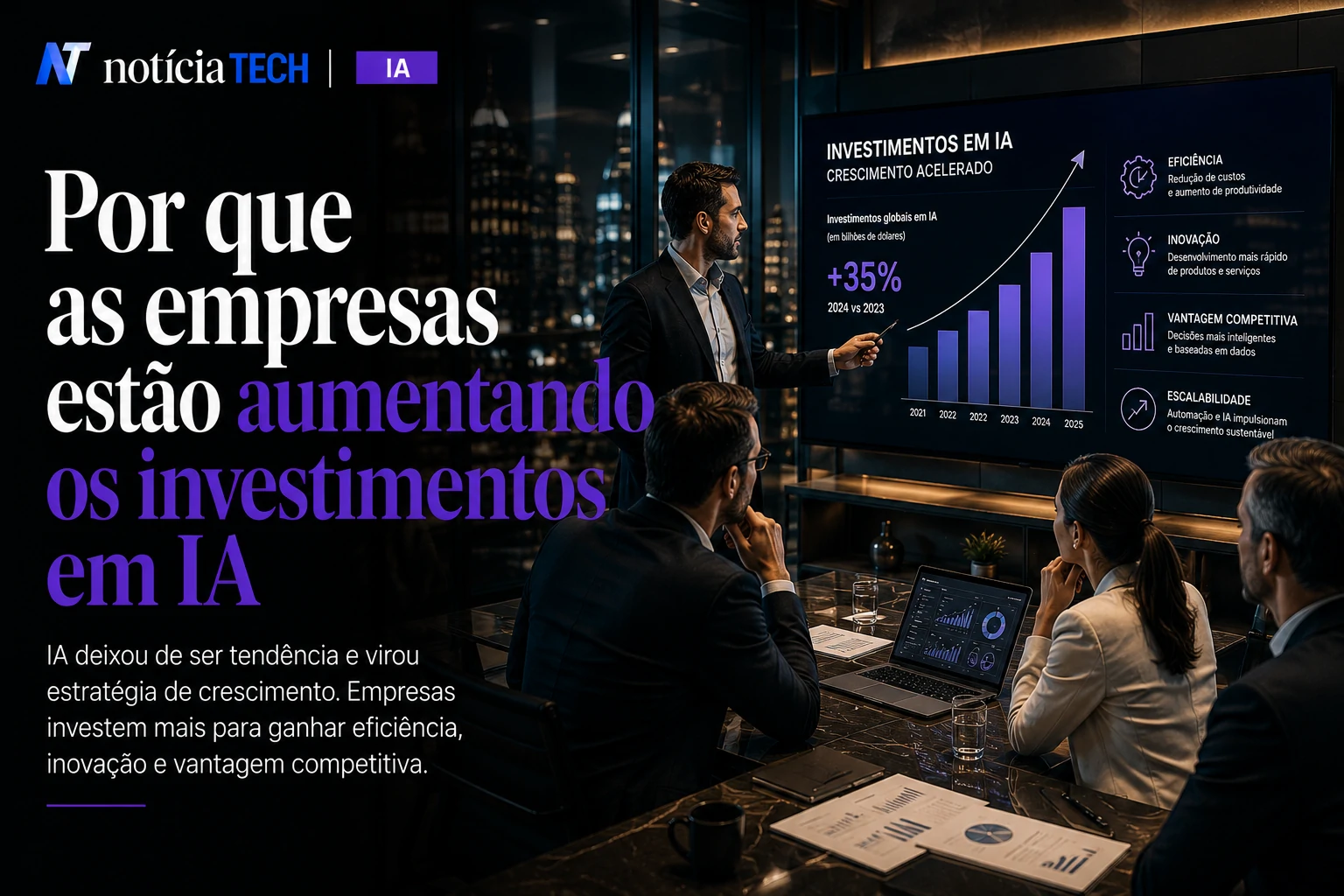
Companies started to integrate AI directly into internal operations, service and productivity.
The explosion of generative AI in 2023 and 2024 created a curious phenomenon in the market: almost all companies started testing AI tools, but few had a real implementation strategy.
Now the situation has changed.
Investments began to grow because companies understood that technology can now generate practical returns in critical areas of the business.
Among the main factors that accelerate adoption are:
1. Operational productivity
AI tools can perform tasks in seconds that previously consumed hours of human work.
This includes:
- reports;
- data analysis;
- initial service;
- marketing automation;
- organization of documents;
- internal research;
- technical support;
- content production.
In many cases, AI does not replace employees, but it dramatically increases team productivity.
2. Competitive pressure
Companies have begun to realize that competitors are already automating operations.
This creates an effect similar to what happened with:
- cloud computing;
- e-commerce;
- digital marketing;
- mobile transformation.
Those who delay in adopting tend to lose efficiency.
In the B2B market, for example, companies that use intelligent automation are able to respond to customers faster, personalize proposals and reduce commercial costs.
3. Growth of AI agents
One of the most important movements of 2026 is the advancement of so-called AI agents.
Unlike traditional chatbots, these systems can:
- perform tasks;
- make simple decisions;
- access systems;
- organize flows;
- interpret information;
- automate entire processes.
In practice, companies began to create:
- customer service agents;
- commercial agents;
- financial agents;
- HR agents;
- internal productivity agents.
This is completely changing the concept of business automation.
Brazil has started to accelerate adoption of corporate AI
Brazilian market is still at the beginning of transformation

Brazilian companies have begun to accelerate the adoption of artificial intelligence to increase productivity and competitiveness.
Despite accelerated growth, Brazil is still in the early stages of AI-based corporate transformation.
Most Brazilian companies still face obstacles such as:
- lack of specialized professionals;
- difficulty of integration;
- cultural resistance;
- concern about security;
- implementation costs;
- strategic lack of knowledge.
Even so, the advance began.
In recent months, the Brazilian market has recorded significant growth in:
- hiring AI platforms;
- search for automation;
- corporate training;
- specialized consultancies;
- adoption of corporate copilots;
- AI productivity tools.
Small and medium-sized companies have also started to join the movement.
This happens because many current tools have:
- affordable plans;
- simplified implementation;
- cloud integration;
- low operating cost.
In practice, corporate AI is no longer exclusive to large companies.
Security has become a priority in AI adoption
Fear of data leaks has accelerated corporate platforms
One of the biggest problems with the first wave of enterprise AI was the disorganized use of free tools by employees.
Many companies discovered that employees were:
- sending internal documents;
- sharing sensitive data;
- using uncontrolled platforms;
- exposing strategic information.
This made the market quickly migrate to enterprise solutions with:
- administrative control;
- compliance;
- encryption;
- permissions management;
- private integration;
- secure storage.
Today, security has become one of the most important factors in enterprise AI adoption.
Large companies have already started to create:
- internal AI policies;
- rules of use;
- data governance;
- training for teams.
This movement should grow strongly in Brazil in the coming years.
How AI can impact Brazilian companies
Small businesses can scale faster
Artificial intelligence has begun to reduce operational barriers that previously limited small businesses.
Today, a small company can:
- automate service;
- produce campaigns;
- organize support;
- generate reports;
- create presentations;
- structure sales funnels;
- automate communication.
This creates an important shift in the market: Small operations can compete with much larger structures.
This scenario should accelerate:
- digitization;
- productivity;
- process automation;
- growth of the SaaS market;
- adoption of intelligent agents.
Furthermore, AI is beginning to change the profile of teams.
Professionals begin to work more in:
- supervision;
- strategy;
- creativity;
- decision making;
- human validation.
Meanwhile, repetitive tasks tend to be automated.
The future of enterprise AI must go beyond chatbots
The market is beginning to enter a phase where AI stops being just a conversation tool and starts to function as companies’ operational infrastructure.
In the coming years, the trend is for companies to use:
- multiple AI agents;
- integrated automations;
- autonomous systems;
- predictive analysis;
- specialized copilots;
- AI connected to internal data.
Companies that learn to strategically integrate artificial intelligence can gain:
- speed;
- efficiency;
- scalability;
- cost reduction;
- competitive advantage.
At the same time, the Brazilian market is still at the beginning of this transformation.
This means many companies still have room to build competitive advantage before adoption becomes standard across industries.
Comentários
Os comentários utilizam autenticação via GitHub para manter um ambiente mais qualificado, seguro e livre de spam.
Entrar ou criar conta no GitHub