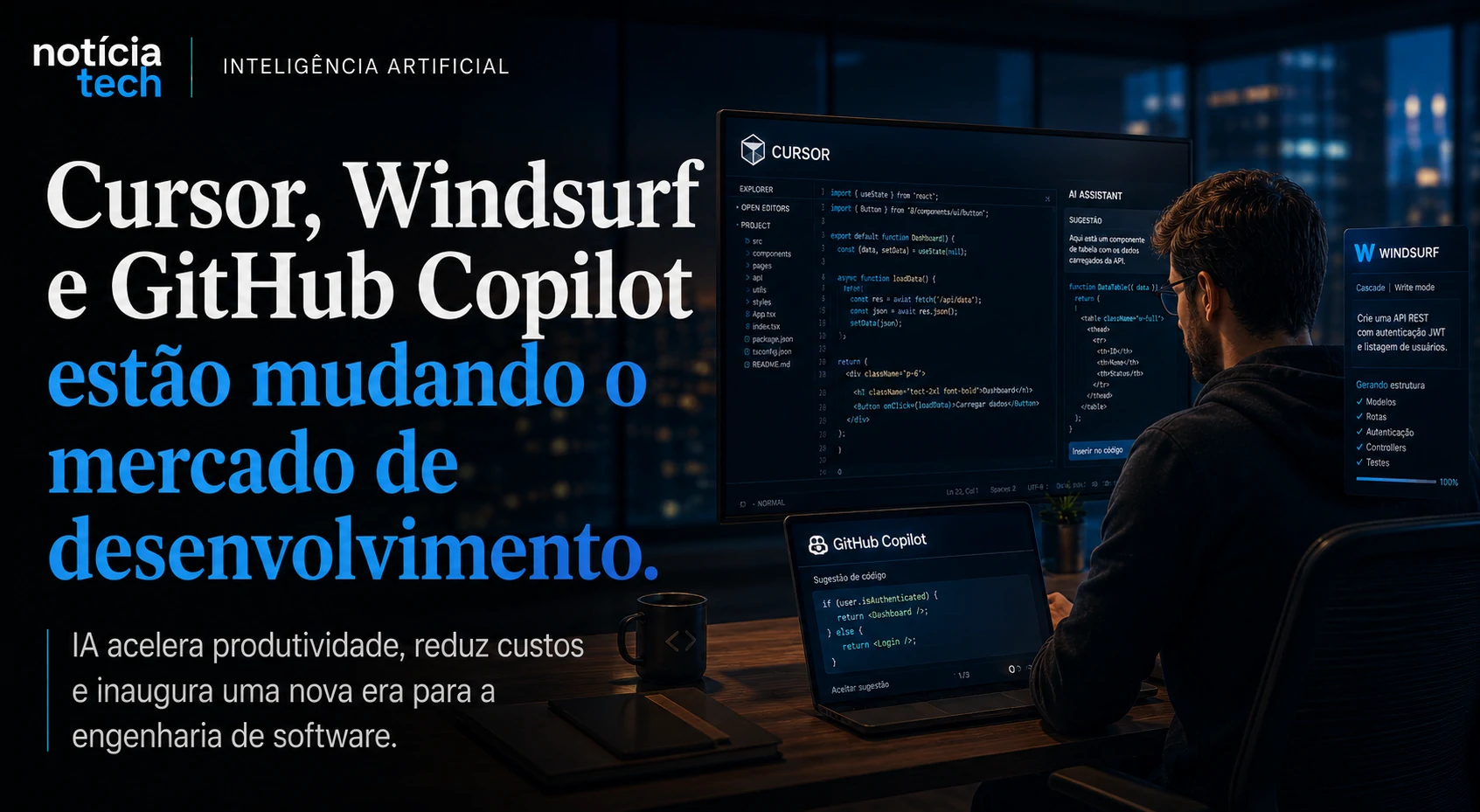
For decades, software development was a process highly dependent on specialized manual work. Now, platforms based on artificial intelligence are beginning to change this dynamic at a speed that few technological transformations have been able to produce in the technology industry. Tools like Cursor, Windsurf, and GitHub Copilot are accelerating productivity, automating complex tasks, and ushering in a new phase of software engineering driven by intelligent agents.
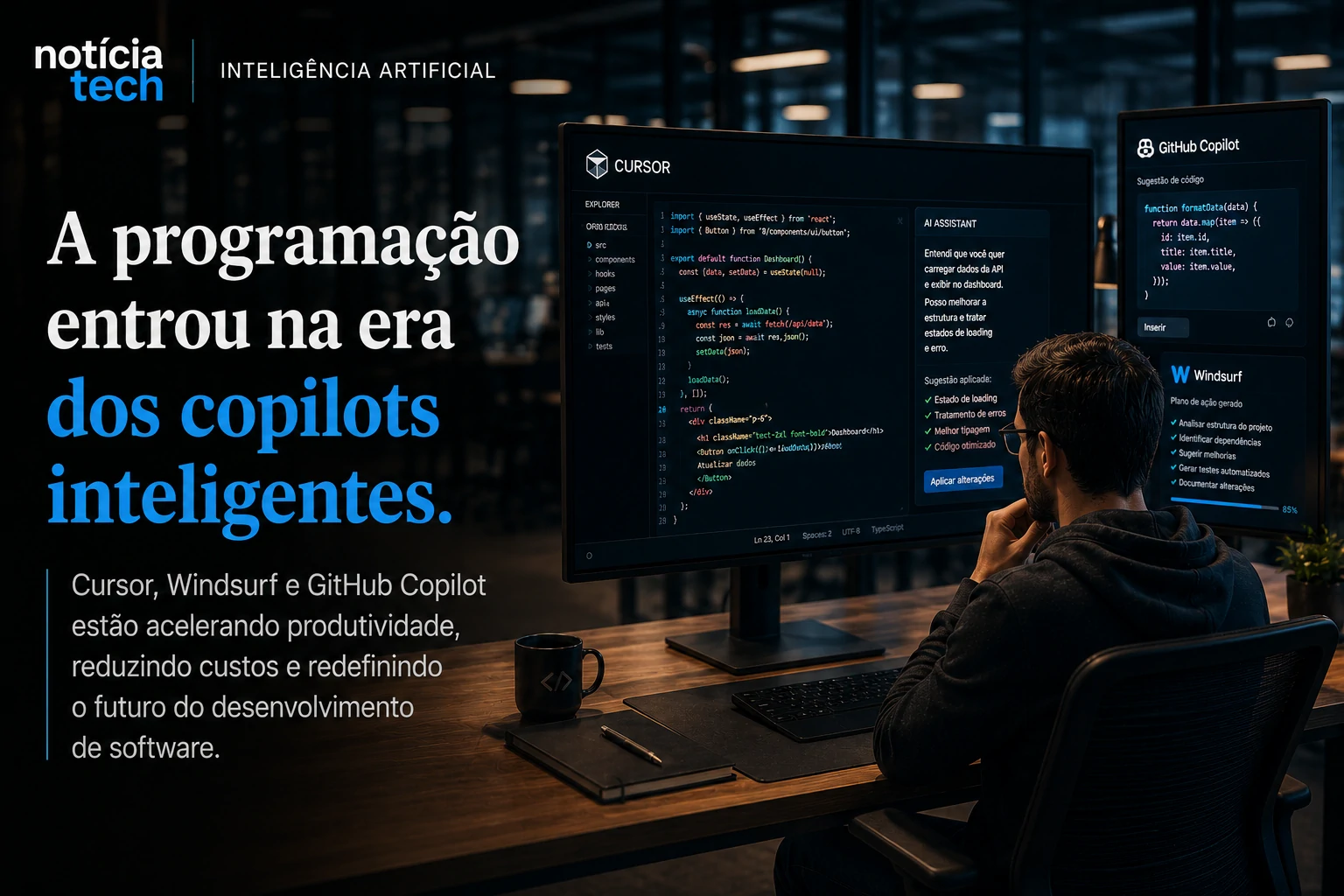
Programming has officially entered the era of intelligent copilots
Artificial intelligence was already having an impact:
- marketing;
- automation;
- service;
- data analysis;
- corporate productivity.
Now, software development is beginning to enter the center of this transformation.
AI tools are changing the operational flow of software engineering
Platforms such as Cursor, GitHub Copilot and Windsurf no longer work only as advanced autocomplete.
The new systems can:
- interpret context;
- analyze multiple files;
- suggest architectures;
- generate complete components;
- identify faults;
- automate refactorings;
- create entire flows from natural language.
In practice, part of the operational development work begins to migrate to intelligent agents.
This movement directly connects to the advancement of corporate AI that Notícia Tech has previously analyzed:
Companies double investments in corporate AI and Brazil accelerates adoption of intelligent agents
Now, the creation of software itself is impacted by the logic of intelligent automation.
VS Code has become the center of the new AI dispute
Most of these platforms operate on the VS Code ecosystem.
This turns Microsoft’s editor into a kind of operational layer of the new AI economy.
Instead of just writing code manually, developers start to coordinate:
- agents;
- copilots;
- automations;
- intelligent validations;
- systems capable of interpreting intention.
This scenario has already started to gain strength within OpenAI itself.
Notícia Tech recently analyzed how the advancement of Codex and programming agents can transform VS Code into one of the most strategic platforms in the technology industry:
OpenAI begins to reduce dependence on Microsoft and the AI market enters a new billion-dollar war
Productivity begins to grow at unprecedented speed
The promise of these platforms is simple:
- less operational time;
- fewer repetitive tasks;
- shorter development cycles;
- faster delivery speed.
This creates a direct economic impact.
Companies can accelerate:
- prototyping;
- validation;
- product launch;
- systems maintenance;
- integration of functionalities.
At the same time, small teams start to compete with much larger structures.
The economic logic of development begins to change
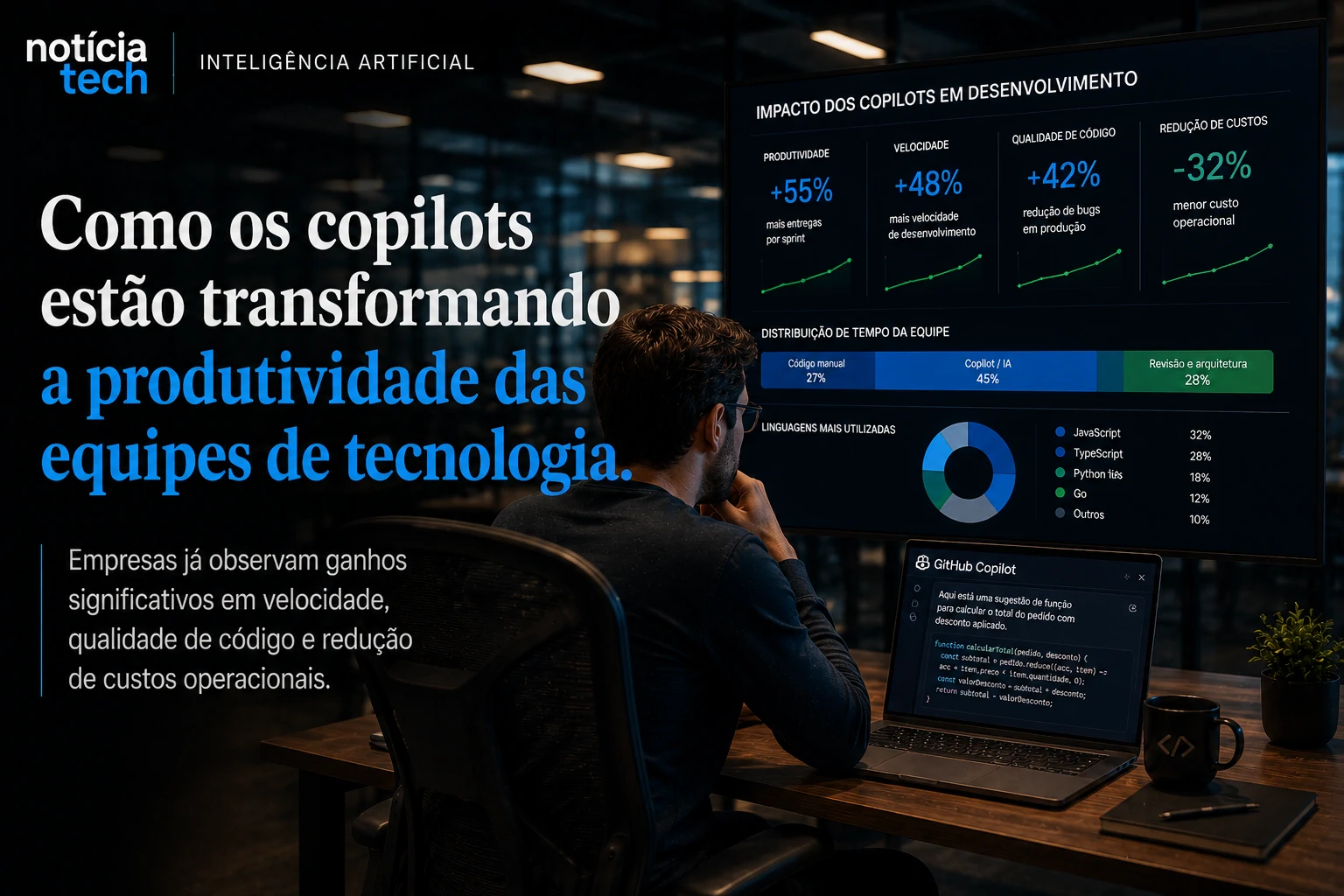
The impact of AI on development goes far beyond individual productivity.
The change begins to affect the very economic structure of technology companies.
Smaller startups can gain a competitive advantage
Historically, creating software required:
- large teams;
- long cycles;
- high operating cost;
- specialized hiring;
- large volume of technical hours.
With AI assisting development, part of this barrier begins to decrease.
Today, smaller teams can:
- launch MVPs faster;
- test products in less time;
- automate technical tasks;
- reduce operational effort;
- accelerate growth.
This can profoundly change the competitive dynamics of the market.
The marginal cost of creating software begins to fall
Automating software engineering reduces some of the operational cost associated with traditional development.
In practice:
- fewer tasks need to be done manually;
- part of the documentation can be automated;
- tests can be accelerated;
- integrations are faster;
- maintenance becomes more efficient.
This movement is directly connected to the advancement of AI industrialization analyzed by Notícia Tech:
2026 became the year of AI industrialization in Brazil
The difference is that now software production itself is beginning to become automated.
The role of the developer begins to change
AI doesn’t eliminate developers.
But it begins to profoundly transform its functions.
Repetitive operational work tends to decrease.
Meanwhile, the importance of:
- architecture;
- systemic vision;
- validation;
- creativity;
- coordination of intelligent agents.
The developer gradually begins to act less as a code typist and more as a strategic operator of intelligent systems.
The future of software can be built by much smaller teams
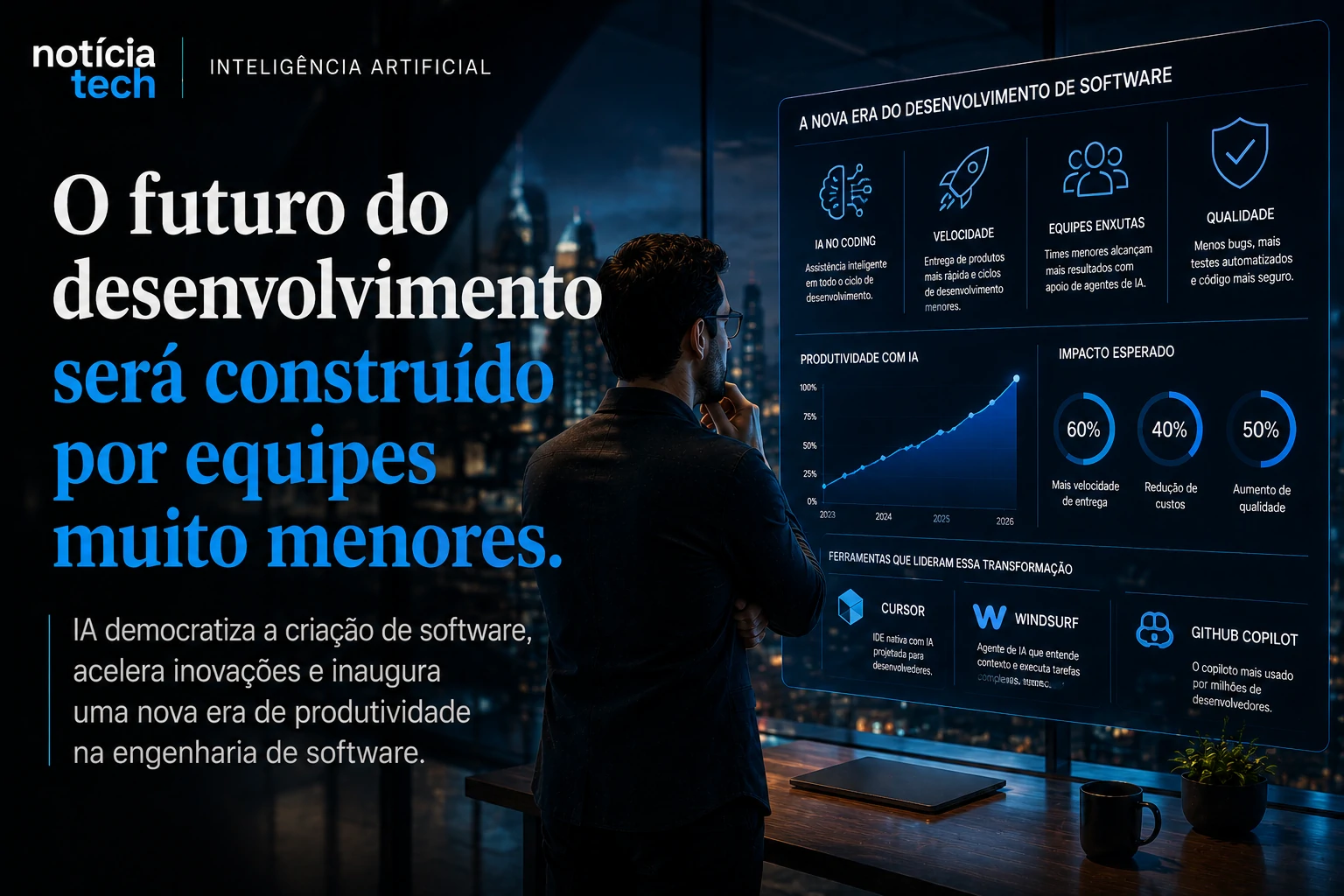
The transformation brought about by AI copilots is still in its infancy.
But the potential impact is already beginning to worry and excite companies in the technology sector.
AI could accelerate the internet’s next software explosion
If the operational cost of development continues to fall, the market could see an explosion in the creation of new digital products.
This happens because:
- more people can build software;
- small teams become more efficient;
- validation of ideas becomes cheaper;
- automation reduces technical barriers.
In practice, creating software could become much more accessible in the coming years.
Companies enter a new race for extreme productivity
The technology market has always competed:
- infrastructure;
- distribution;
- data;
- users.
Now, the new dispute begins to involve operational productivity.
Anyone who can develop software faster will be able to:
- launch products earlier;
- iterate faster;
- reduce costs;
- respond faster to the market.
This transforms platforms like Cursor, Windsurf and GitHub Copilot into increasingly strategic pieces within the digital economy.
Software development could enter a new industrial era
The rise of intelligent copilots represents perhaps one of the biggest changes in the history of software engineering.
The sector begins to migrate from a purely manual model to a hybrid structure between:
- humans;
- intelligent agents;
- operational automation;
- coordination by AI.
In the coming years, companies capable of integrating AI directly into the development flow will be able to operate at a competitive speed much higher than the previous generation of software.
The artificial intelligence race no longer happens only in foundational models and starts to directly reach the environment where the software of the future will be created.
Comentários
Os comentários utilizam autenticação via GitHub para manter um ambiente mais qualificado, seguro e livre de spam.
Entrar ou criar conta no GitHub