
While many organizations continue debating which artificial intelligence model produces the best answers, the real competitive advantage lies in the architecture that connects models, enterprise data, and business systems. Understanding how MCP, RAG, APIs, workflows, AI copilots, and AI agents operate together has become a strategic capability for companies seeking to transform productivity into sustainable competitive advantage.
Modern enterprise AI is no longer defined solely by the quality of a language model. Today, performance depends on how effectively organizations integrate intelligence, business context, automation, and governance into a scalable architecture capable of supporting real-world operations across the enterprise.
How Modern Enterprise AI Architecture Works
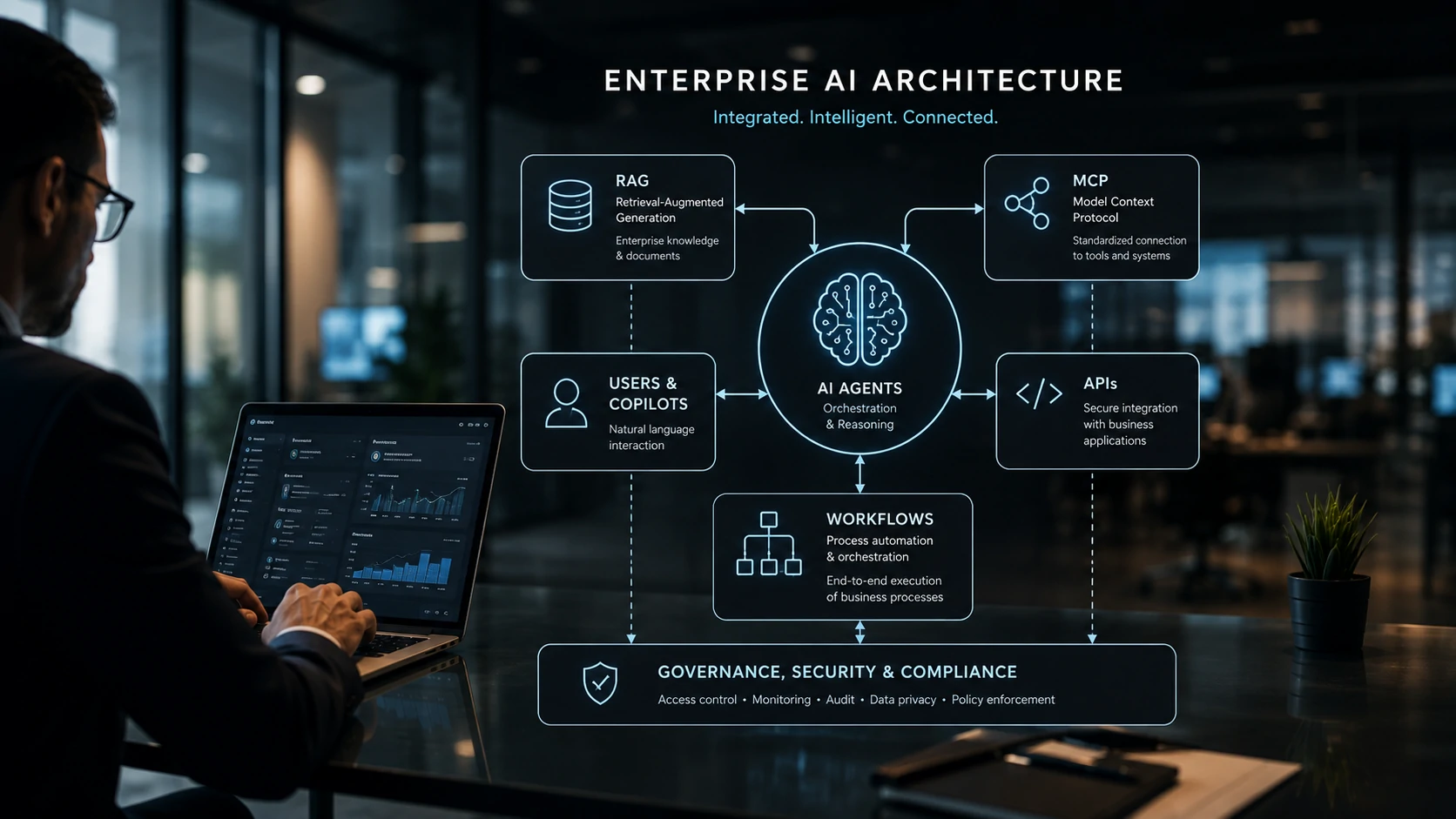
Modern enterprise AI architectures connect language models, enterprise knowledge bases, APIs, and business applications into a unified intelligent ecosystem.
During the early years of Generative AI, many organizations believed that simply adopting a model such as ChatGPT, Claude, or Gemini would be enough to transform their business operations. Experience quickly proved otherwise.
Large language models are remarkably capable of reasoning and generating content, but they do not automatically understand an organization’s internal processes, access proprietary databases, or execute business-critical operations without the appropriate integration layer.
This is where Enterprise AI Architecture becomes essential. Rather than focusing on a single AI model, it defines the framework that allows artificial intelligence to operate as part of a company’s broader technology ecosystem.
Artificial intelligence is no longer just a chatbot
In modern enterprises, AI functions as an intelligence layer built on top of existing business systems.
Instead of replacing ERP, CRM, financial platforms, or customer service applications, AI connects them, interprets enterprise data, automates decisions, and coordinates workflows across multiple departments.
This shift explains why the industry increasingly discusses concepts such as MCP, RAG, AI Orchestration, intelligent agents, and AI governance instead of simply comparing language models.
Every component serves a different purpose
A modern enterprise AI architecture combines multiple technologies that operate together.
These typically include:
- Large Language Models (LLMs) for reasoning and decision support.
- RAG for retrieving enterprise knowledge.
- MCP for connecting AI models to business systems.
- APIs for software communication.
- Workflows for process automation.
- AI Agents for autonomous task execution.
- Security, governance, and auditing layers.
Competitive advantage no longer comes from selecting a single AI model. It comes from designing an architecture where every layer complements the others.
To better understand how multiple intelligent agents are coordinated across an enterprise environment, read What Is AI Orchestration? Why It Is Replacing the Competition Between AI Models in Business, which explores the orchestration layer that enables AI systems to collaborate efficiently.
The Core Components of Enterprise AI Architecture
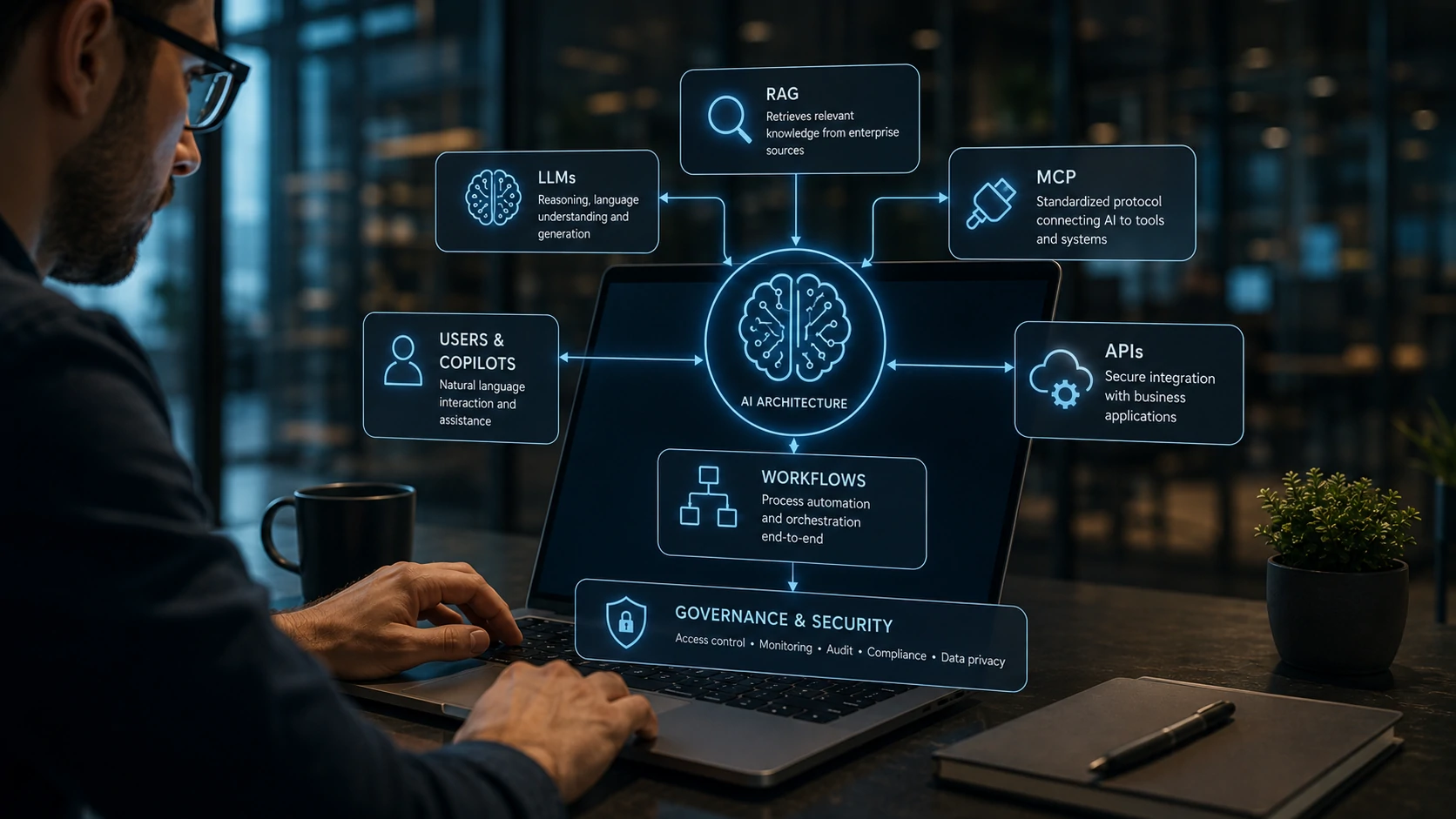
Every component solves a specific business challenge. The real value emerges from how they work together as a unified architecture.
Although enterprise AI ecosystems may involve dozens of technologies, most modern architectures can be understood through six fundamental building blocks.
Large Language Models (LLMs)
The LLM serves as the reasoning engine of the architecture.
It understands natural language, generates responses, analyzes context, and supports decision-making.
However, without additional technologies, an LLM has no direct access to enterprise knowledge or operational systems.
Retrieval-Augmented Generation (RAG)
RAG extends the knowledge available to AI models.
Before generating an answer, it retrieves relevant documents, technical manuals, contracts, internal policies, and knowledge base articles, significantly improving factual accuracy while reducing hallucinations.
This capability is especially valuable for organizations whose information changes continuously.
To explore the next evolution of retrieval systems, read What Is GraphRAG and Why It Outperforms Traditional RAG for Enterprises, where we explain how graph-based retrieval provides richer contextual understanding.
Model Context Protocol (MCP)
The Model Context Protocol (MCP) standardizes communication between AI models and external business applications.
Instead of building custom integrations for every software platform, MCP provides a common interface that enables AI models to interact with enterprise tools, databases, and services more efficiently.
This standardized approach simplifies maintenance, improves interoperability, and reduces development complexity.
APIs
APIs remain the communication backbone of enterprise software.
Whenever an AI agent updates a CRM record, retrieves customer information, or triggers an external service, APIs handle the underlying communication.
Even in highly autonomous AI systems, APIs continue to be one of the most critical infrastructure layers.
Intelligent Workflows
Workflows define how information flows across the architecture.
A typical process follows this sequence:
- A user submits a request.
- The workflow triggers the automation.
- The AI agent retrieves enterprise knowledge through RAG.
- The LLM analyzes the context.
- MCP connects the necessary business tools.
- APIs execute the requested actions.
- The final response is delivered to the user.
This orchestration reduces operational errors while making enterprise processes more scalable and repeatable.
AI Agents
AI agents represent the latest evolution of enterprise artificial intelligence.
Rather than simply answering questions, they pursue objectives, coordinate multiple tools, make contextual decisions, and adapt dynamically as new information becomes available.
The interaction between LLMs, RAG, MCP, APIs, and workflows explains why enterprise architecture has become significantly more important than choosing a single AI model.
Governance, Security, and Human Oversight Are the Foundations of Enterprise AI

An effective AI architecture depends not only on advanced language models but also on governance, auditability, and continuous human supervision.
As Artificial Intelligence becomes responsible for increasingly critical business processes, organizations must ensure that AI-driven decisions remain secure, transparent, and accountable.
A modern enterprise AI architecture extends far beyond integrating LLMs, MCP, RAG, and APIs. It also includes governance mechanisms that provide security controls, compliance, traceability, and operational oversight.
Companies that overlook this layer expose themselves to greater risks, including inaccurate responses, unauthorized data access, regulatory violations, and unreliable automated decisions.
For this reason, AI governance has become one of the most important strategic priorities for organizations implementing enterprise artificial intelligence.
Human-in-the-Loop remains essential
Even the most advanced AI models can still generate hallucinations, misinterpret instructions, or rely on incomplete information.
Because of this, high-impact business processes should always include human validation before irreversible actions are executed.
Rather than replacing professionals, enterprise AI changes their role.
Employees increasingly act as supervisors, validating recommendations, reviewing automated decisions, and ensuring that AI systems remain aligned with business objectives and organizational policies.
This combination of automation and human expertise significantly reduces operational risks while preserving productivity gains.
To better understand why protecting enterprise data has become a strategic priority, read What Is AI Security and Why It Will Become a Business Priority.
How a complete enterprise AI workflow operates
A typical enterprise AI architecture follows a sequence similar to the one below:
- A user submits a request in natural language.
- An AI agent interprets the objective using an LLM.
- RAG retrieves the most relevant enterprise knowledge.
- MCP determines which business systems should be accessed.
- APIs execute the required operations.
- The workflow coordinates every stage of the process.
- Human validation is performed whenever necessary.
- Every action is logged for auditing, governance, and continuous improvement.
This workflow illustrates that no single technology creates value on its own. Business results emerge from the coordinated interaction of every architectural layer.
Example prompt for an enterprise AI agent
Providing structured context is one of the most effective ways to improve the quality and consistency of AI-generated responses.
Example:
You are an enterprise operations consultant.

Objective:
Review company purchasing requests.

Context:
Use only information retrieved from the enterprise knowledge base through RAG.

Evaluation criteria:
- Verify available budget.
- Confirm approved suppliers.
- Identify operational risks.
- Recommend approval or rejection.

Output format:
Executive Summary
Detailed Analysis
Risk Assessment
Final Recommendation
Well-structured prompts reduce ambiguity and improve response reliability, particularly when AI agents operate within automated enterprise workflows.
The Future of Enterprise AI Architecture Will Be Defined by Integration, Not by Models
Over the coming years, competitive advantage will no longer depend primarily on which large language model an organization adopts.
Instead, success will belong to companies capable of integrating Artificial Intelligence, enterprise knowledge, business systems, automation platforms, governance, and intelligent agents into a flexible, scalable architecture.
Language models will continue evolving at an extraordinary pace, but organizations that invest in interoperable AI architectures will be able to replace providers, adopt emerging technologies, and expand their capabilities without rebuilding their entire technology stack.
This shift is already visible across the technology industry. Leading vendors are investing far more heavily in interoperability, open protocols, intelligent agents, orchestration platforms, and enterprise integration than in individual proprietary models.
For executives, technology leaders, and business decision-makers, understanding enterprise AI architecture is no longer simply a technical skill. It has become a strategic capability that enables organizations to identify new opportunities, minimize operational risk, and prepare for a future in which Artificial Intelligence becomes embedded in virtually every business process.
Ultimately, organizations that understand how these technologies work together will be far better positioned than those that focus solely on choosing the latest AI model.
Comentários
Os comentários utilizam autenticação via GitHub para manter um ambiente mais qualificado, seguro e livre de spam.
Entrar ou criar conta no GitHub