
Over the last two years, Artificial Intelligence has evolved far beyond conversational chatbots. Organizations are now building complete AI ecosystems capable of retrieving enterprise knowledge, accessing internal systems, executing business operations, and coordinating multiple intelligent agents. As a result, one question has become increasingly common: how do all these technologies actually work together?
The adoption of Enterprise AI has entered a new phase. Instead of relying exclusively on a single Large Language Model (LLM), companies are combining multiple technologies that complement one another.
Modern AI platforms no longer generate answers alone. They retrieve corporate knowledge, interact with enterprise software, execute business workflows, and coordinate specialized AI agents capable of solving increasingly complex operational tasks.
Concepts such as RAG, MCP, AI Agents, and AI Orchestration are often presented independently, yet they represent different layers of the same enterprise architecture.
This guide explains how these technologies complement each other and why understanding their roles has become essential for organizations seeking scalable, secure, and governance-ready AI initiatives.
What Is a Modern Enterprise AI Architecture?
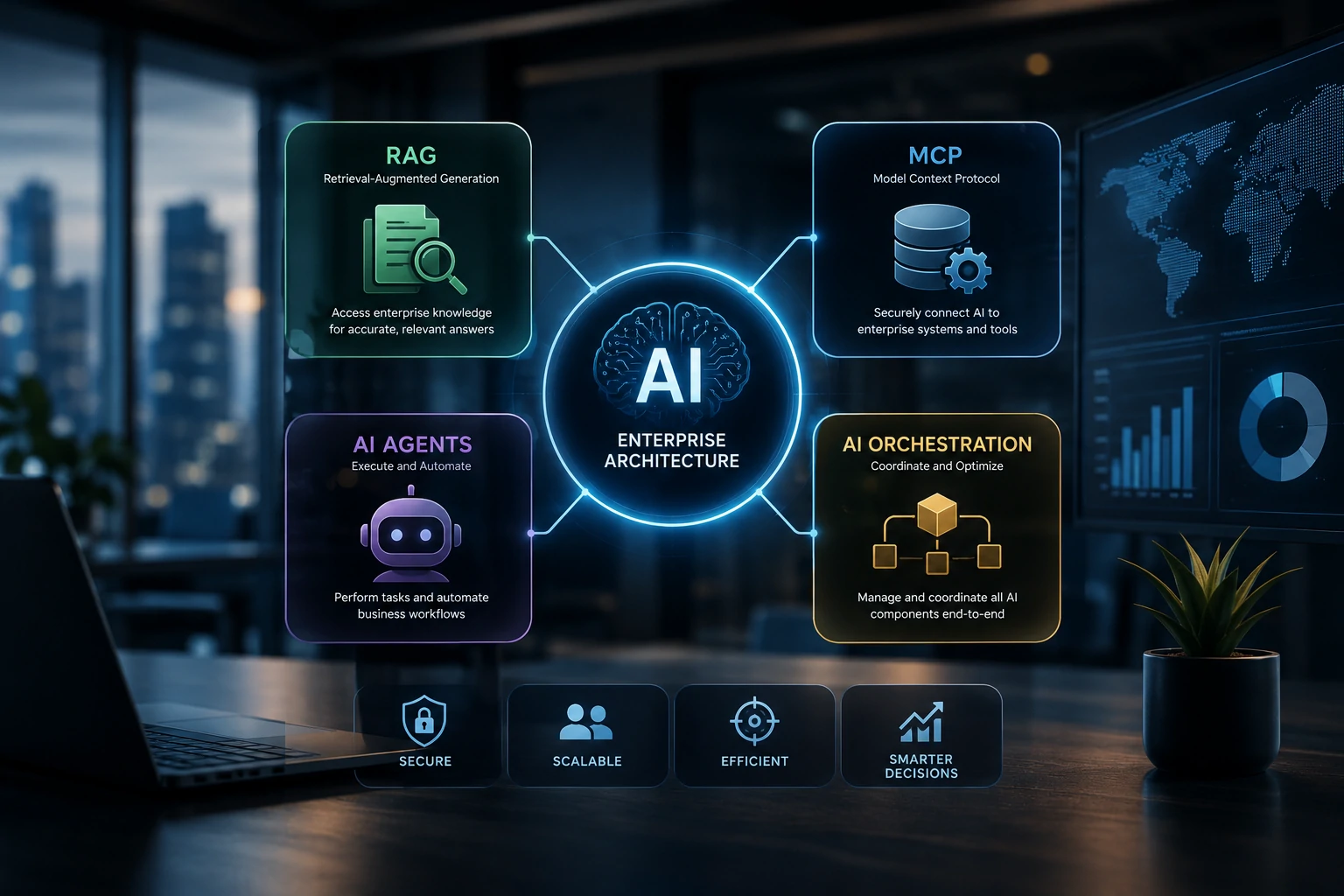
Modern AI architectures combine language models, enterprise knowledge, system integrations, and intelligent automation into a unified business platform.
A modern Enterprise AI Architecture can be compared to the structure of a large organization.
The Large Language Model functions as the brain, while additional technologies provide memory, operational capabilities, and secure access to enterprise systems.
Although today’s LLMs excel at reasoning, summarization, and natural language generation, they still have important limitations. By themselves, they cannot access private corporate information, retrieve real-time business data, or perform operational actions inside enterprise software.
This is precisely why complementary technologies have become essential components of modern AI platforms.
The Role of the Language Model
The language model is responsible for understanding context, interpreting user intent, and generating responses.
However, every meaningful enterprise application depends on additional architectural layers capable of providing updated information and secure operational capabilities.
Without those layers, even the most advanced AI model remains limited to general knowledge.
The Four Core Layers
Most enterprise AI architectures combine four fundamental components:
- LLMs for reasoning and natural language generation;
- RAG for retrieving enterprise knowledge;
- MCP for securely connecting enterprise systems;
- AI Agents for executing operational workflows.
Together, these technologies significantly improve reliability, security, scalability, and practical business value.
How RAG, MCP, and AI Agents Work Together
Retrieval-Augmented Generation (RAG) enriches language models by retrieving information from internal documents, technical manuals, corporate policies, contracts, and knowledge bases before generating an answer.
Model Context Protocol (MCP) serves an entirely different purpose.
Instead of supplying knowledge, MCP enables AI systems to securely communicate with enterprise software such as CRMs, ERPs, databases, APIs, and other operational platforms.
The actual execution of business processes is performed by AI Agents, which combine information obtained through RAG with real-time enterprise data accessed via MCP.
Organizations looking for more advanced contextual retrieval should also explore GraphRAG, which extends traditional RAG by leveraging relationships between connected pieces of information instead of isolated documents.
What Is GraphRAG and Why It Could Surpass Traditional RAG for Enterprise AI
Companies interested in integrating AI with enterprise systems can also learn more about Model Context Protocol in this detailed guide published by Notícia Tech:
How to Build an MCP Server for Businesses and Connect AI to Enterprise Systems
Practical Example
Imagine a sales manager asking:
“Which customers have contracts expiring within the next 30 days, and which ones have the highest renewal potential?”
The workflow looks like this:
- An AI Agent receives the request.
- MCP queries the CRM.
- RAG retrieves the company’s renewal policies.
- The language model analyzes every piece of information.
- The AI Agent generates the report and recommends the next actions.
Where Human-in-the-Loop Fits
Even with sophisticated automation, critical business decisions still require human validation.
Human supervision minimizes hallucinations, improves regulatory compliance, and prevents operational risks caused by incomplete or inaccurate information.
The Role of AI Orchestration in Enterprise AI Architecture
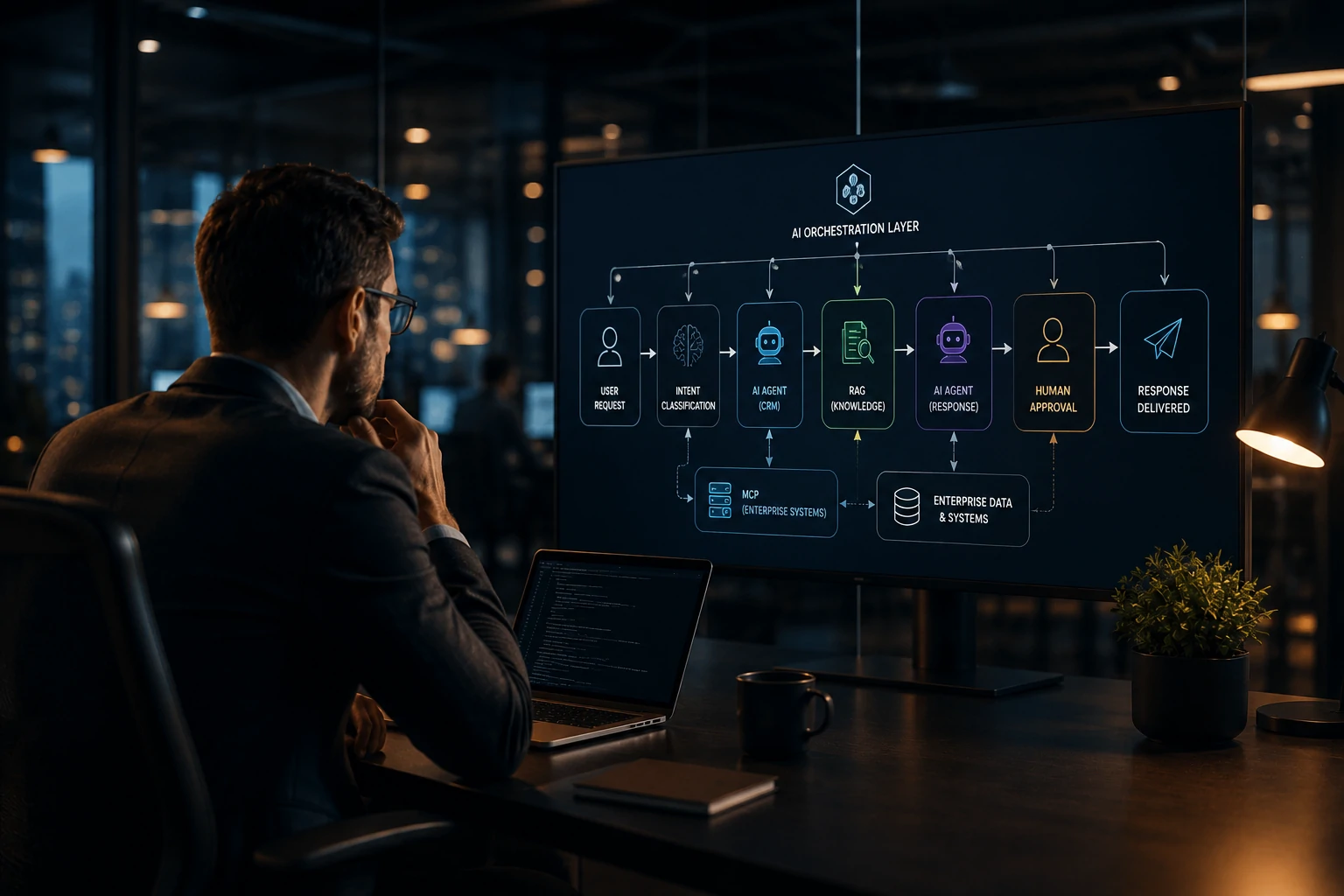
AI Orchestration coordinates language models, AI agents, enterprise systems, and business workflows, enabling multiple intelligent components to operate as a unified platform.
As organizations deploy more AI models, AI Agents, and enterprise integrations, a new challenge emerges: coordinating the entire ecosystem efficiently.
This is where AI Orchestration becomes essential.
While individual agents specialize in executing specific tasks, the orchestration layer determines which agent should act, which enterprise tools should be used, what information should be retrieved, and how each step should be executed.
In practice, AI Orchestration functions like a conductor leading an orchestra.
Each component performs a specialized role, but the overall business process only succeeds when every participant acts in the correct sequence.
Without orchestration, organizations risk duplicated tasks, inconsistent responses, conflicting decisions, and inefficient resource utilization.
A Complete Enterprise Workflow
Consider a typical B2B customer support scenario.
- A customer submits a support request.
- The orchestration layer classifies the request.
- An AI Agent accesses the CRM through MCP.
- Another agent retrieves internal procedures using RAG.
- A third agent prepares the response.
- A manager reviews the recommendation.
- After human approval, the response is delivered to the customer.
Instead of isolated AI interactions, companies obtain a coordinated workflow capable of combining enterprise knowledge, operational data, automation, and human oversight.
Organizations interested in expanding this topic can also explore the following guide published by Notícia Tech:
What Is AI Orchestration and Why It Will Become Essential for Businesses Using Multiple AI Agents
Example Prompt for an Enterprise AI Agent
You are an enterprise customer support AI agent.

Objective:
Answer customer requests using only approved internal documentation.

Workflow:
1. Query the RAG knowledge base.
2. If customer-specific information is required, access enterprise systems through MCP.
3. Never generate unsupported information.
4. Escalate uncertain situations for human review.
5. Respond using professional business language.
Structured prompts like this establish operational boundaries, reduce hallucinations, and improve governance across enterprise AI systems.
How to Choose the Right Enterprise AI Architecture

There is no universal AI architecture. The right combination of technologies depends on business maturity, operational complexity, and strategic objectives.
One of the biggest misconceptions surrounding Enterprise AI is the belief that every organization must immediately deploy multiple AI agents and dozens of system integrations.
In reality, the ideal architecture depends on digital maturity, data quality, existing infrastructure, and business priorities.
Smaller organizations often achieve excellent results by combining an LLM with RAG, allowing employees to search internal documentation and improve productivity without major infrastructure changes.
Companies with mature business systems typically expand by implementing MCP, enabling secure communication between AI models and enterprise platforms such as CRMs, ERPs, and databases.
Organizations seeking end-to-end automation usually adopt AI Agents together with AI Orchestration, creating autonomous workflows that span multiple departments while maintaining governance and human supervision.
Recommended Adoption Roadmap
Most successful Enterprise AI initiatives evolve through six stages:
- Deploy a Large Language Model.
- Add RAG to access enterprise knowledge.
- Integrate enterprise software through MCP.
- Introduce specialized AI Agents.
- Implement AI Orchestration.
- Strengthen governance, monitoring, and Human-in-the-Loop validation.
This gradual approach minimizes operational risks while maximizing long-term return on investment.
The Future of Enterprise AI Architecture
Over the next several years, organizations will likely stop competing based solely on whether they use ChatGPT, Claude, Gemini, or Mistral.
Competitive advantage will increasingly depend on the architecture surrounding those models.
Businesses capable of combining enterprise knowledge, secure integrations, specialized AI agents, orchestration, and human governance will build more resilient, scalable, and productive AI ecosystems.
Rather than asking which AI model is the most powerful, technology leaders are beginning to ask a far more strategic question: how should the entire Enterprise AI architecture be designed?
That architectural perspective is expected to become one of the defining competitive advantages of the next generation of digital transformation.
Comentários
Os comentários utilizam autenticação via GitHub para manter um ambiente mais qualificado, seguro e livre de spam.
Entrar ou criar conta no GitHub