
Gemini has surpassed 1 billion monthly users, putting Google much closer to OpenAI in the race for AI assistants. The number is striking because of its scale, but its most important implication is how the competitive landscape is changing: the next battle will not be fought only over users, but over usage frequency, distribution, agents and revenue.
Gemini Reaches a Scale That Changes the Competition
The 1 Billion User Milestone
Google reported that Gemini surpassed 1 billion monthly users in August 2026. The milestone makes the AI assistant one of the company’s largest-scale products and represents a sharp acceleration from the 950 million users disclosed only a few weeks earlier.
The pace of growth is just as significant. In February, Gemini had surpassed 750 million monthly users. Within months, the service advanced to a scale comparable to ChatGPT.
What the Number Actually Represents
The 1 billion figure refers to the Gemini app, including its web and mobile experiences. It does not mean that everyone using AI features inside Google Search, Workspace or other services is automatically included in the same metric.
That distinction matters because Google’s AI ecosystem is larger than the Gemini app itself. The milestone nevertheless shows that Gemini has built an enormous audience of its own, rather than relying solely on exposure through Google’s other products.
ChatGPT and Gemini Reach a New Balance
Gemini and ChatGPT have reached a user scale that makes the competition between Google and OpenAI more evenly matched.
ChatGPT’s Historical Lead Is Narrowing
ChatGPT was the product that brought generative AI assistants to a global audience and established an early lead that was difficult to ignore. Gemini reaching the 1 billion-user level, however, reduces one of the most visible gaps between the two platforms.
The competition is no longer simply a story of a pioneer facing a fast-growing challenger. OpenAI and Google now have products capable of reaching a truly global audience.
User Count Alone Does Not Determine Leadership
That does not mean Gemini and ChatGPT have exactly the same level of engagement or economic value. Monthly users show reach, but they do not reveal usage frequency, retention, session duration, professional use or how much revenue each user generates.
That is where the next stage of the competition becomes more important. The winner will not necessarily be the company with the most users, but the one that can turn that audience into recurring usage and sustainable business.
Distribution Is Google’s Biggest Advantage
Android Expands Gemini’s Reach
Google has a structural advantage that OpenAI cannot easily replicate: distribution. Gemini is connected to the Android ecosystem and can reach users through devices and services that are already part of the daily routine of billions of people.
The app has also expanded on iPhone, showing that its growth does not depend exclusively on Google’s operating system. That expansion reduces reliance on a single channel and increases the product’s potential reach.
Search and Workspace Expand the Ecosystem
Google also controls properties such as Search, Chrome, Gmail, Drive, YouTube and Workspace. Integrating AI across these environments creates multiple touchpoints between users and Gemini.
The difference is strategic. While OpenAI has to expand the ChatGPT ecosystem through products, partnerships and devices, Google already has a global distribution infrastructure. The challenge is turning that advantage into genuine user preference for Gemini.
Gemini Is Growing Beyond the Chatbot
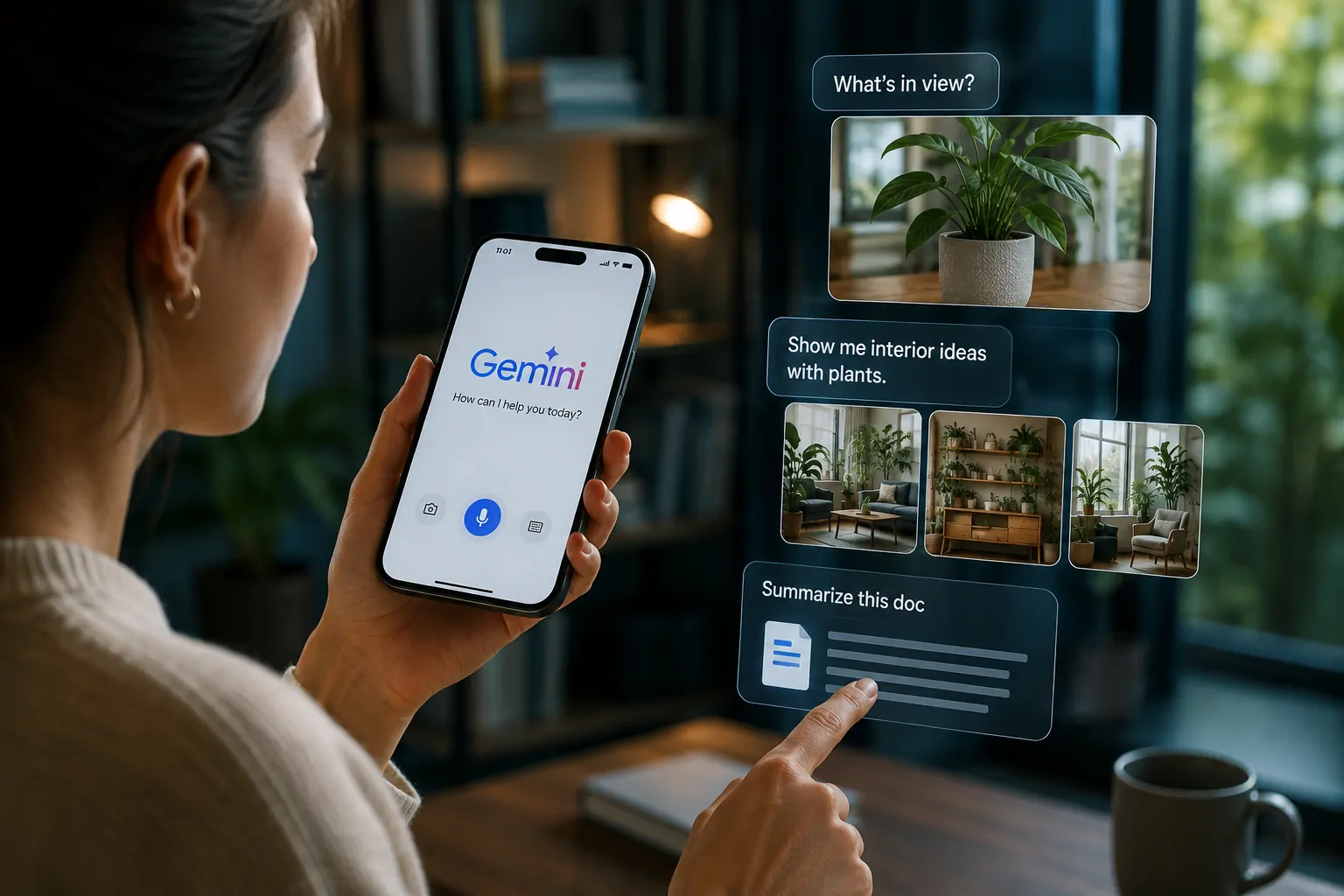
Gemini’s growth is tied to an experience that combines text, voice, images and multimodal interaction.
Voice and Multimodal Features Are Gaining Ground
Google said that 63% of Gemini users interact directly through voice. The company also reported that the service generates more than 150 million images per day, showing that usage is expanding beyond the traditional question-and-answer model.
Another important development is the use of multimodal features. Some interactions involve cameras and screen sharing, bringing the assistant closer to tasks performed in the real world.
The Strategy Points Toward AI Agents
The shift is also connected to the evolution of AI agents. Instead of simply answering a question, assistants are increasingly expected to execute tasks, interpret context and interact with different services.
This change matters for businesses because AI is moving beyond being a query interface and starting to operate inside workflows. The trend is already visible in enterprise products, including ChatGPT Work, which reflects OpenAI’s move toward an era of AI agents for workplace productivity.
ChatGPT Work and the era of AI agents for enterprise productivity
The Next Battle Will Be Over Retention and Revenue
1 Billion Users Does Not Guarantee Leadership
Reaching 1 billion users is a distribution milestone, but it does not settle the economic question. For Google and OpenAI, the next challenge is determining how much of that audience can be converted into frequent users and paying customers.
The difference between a popular AI platform and a business platform may come down to retention. A user who relies on an assistant every day for work, research, programming or automation has far greater strategic value than someone who only experiments with the technology occasionally.
Businesses Could Define the Next Phase
In the enterprise market, the competition is likely to become even more complex. Gemini can leverage its integration with Workspace, while ChatGPT is seeking to expand its presence directly into business workflows.
That turns the competition into a battle over the infrastructure of work. The platform that becomes embedded in daily processes will have a greater chance of capturing recurring revenue and creating switching costs for customers.
This transformation is also connected to the rise of AI agents in business process automation, which expands the role of AI models beyond conversation and brings the technology closer to operational tasks.
How AI agents are transforming business process automation beyond ChatGPT Work
The Next Battlefield Will Be AI That Executes Tasks
Chatbots Are No Longer the Main Differentiator
The 1 billion-user milestone shows that the AI assistant market has reached a scale that few expected at the beginning of the generative AI race. As a result, simply offering an interface for talking to a model is no longer enough to differentiate the leading competitors.
The next differentiator will be the ability to turn artificial intelligence into an operational layer. That means connecting models to applications, data, tools, devices and processes that allow them to take action.
Google and OpenAI Enter a Broader Competition
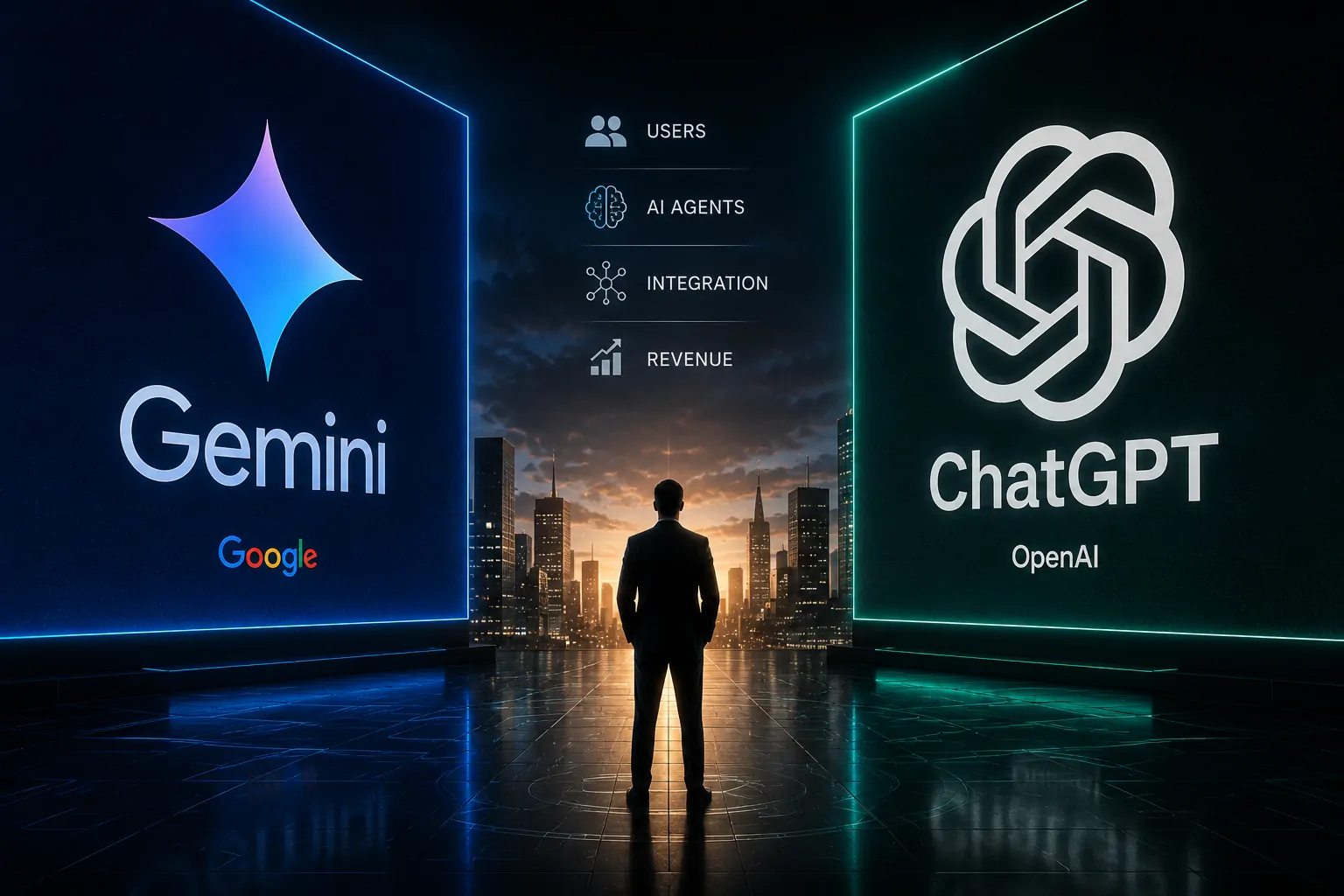
With Gemini and ChatGPT reaching a similar scale, competition is expanding toward agents, integration and monetization.
Google enters this new phase with a distribution advantage that is difficult to match. OpenAI, on the other hand, has a brand built directly around artificial intelligence and a massive ChatGPT user base.
The competition has therefore become more balanced precisely as the market itself begins to change. User numbers remain important, but the next measure of leadership will be the ability to turn those users into a platform that is indispensable for work, productivity and task execution.
Gemini reaching 1 billion users does not mean that ChatGPT has lost its leadership. It means something more significant: the difference in scale is no longer enough to explain who is winning the AI race.
From this point forward, Google and OpenAI will have to prove which company can turn an audience of billions into a dominant position in the next layer of computing.
Comentários
Os comentários utilizam autenticação via GitHub para manter um ambiente mais qualificado, seguro e livre de spam.
Entrar ou criar conta no GitHub