
Artificial intelligence agents have evolved beyond a technology trend to become one of the biggest strategic priorities for the world’s leading technology companies. The launch of Gemini Spark demonstrates that Google intends to compete directly in a market currently shaped by OpenAI, Anthropic and Microsoft, delivering AI capabilities designed for enterprise productivity and large-scale automation.
Google Expands Its AI Agent Strategy with Gemini Spark
Gemini Spark marks another major step in Google’s strategy to transform its large language models into intelligent agents capable of handling increasingly sophisticated tasks.

Gemini Spark strengthens Google’s strategy to build AI agents focused on enterprise productivity.
Unlike a conventional chatbot, an intelligent agent can understand objectives, break complex work into multiple steps, interact with external tools and deliver meaningful results with significantly less human supervision.
Greater autonomy for complex business tasks
The announcement highlights a major shift taking place across the artificial intelligence industry.
Over the past several years, companies concentrated on building models capable of generating more accurate responses.
Today, the competition has entered a new phase.
Instead of simply producing answers, AI platforms are now expected to execute complete workflows using multiple applications, documents and enterprise services.
Competition is no longer only about language models
Gemini Spark shows that organizations are evaluating much more than raw model performance.
Businesses increasingly compare AI platforms based on factors such as:
- planning capabilities;
- application integration;
- contextual memory;
- response speed;
- operational cost;
- enterprise security.
This evolution brings intelligent agents much closer to real-world enterprise adoption while reinforcing concepts previously explored by Notícia Tech in How to Implement MCP in Enterprises: Architecture and AI Agent Integration.
The AI Agent Market Enters a New Competitive Phase
Leadership is no longer determined solely by language models such as GPT, Claude or Gemini.
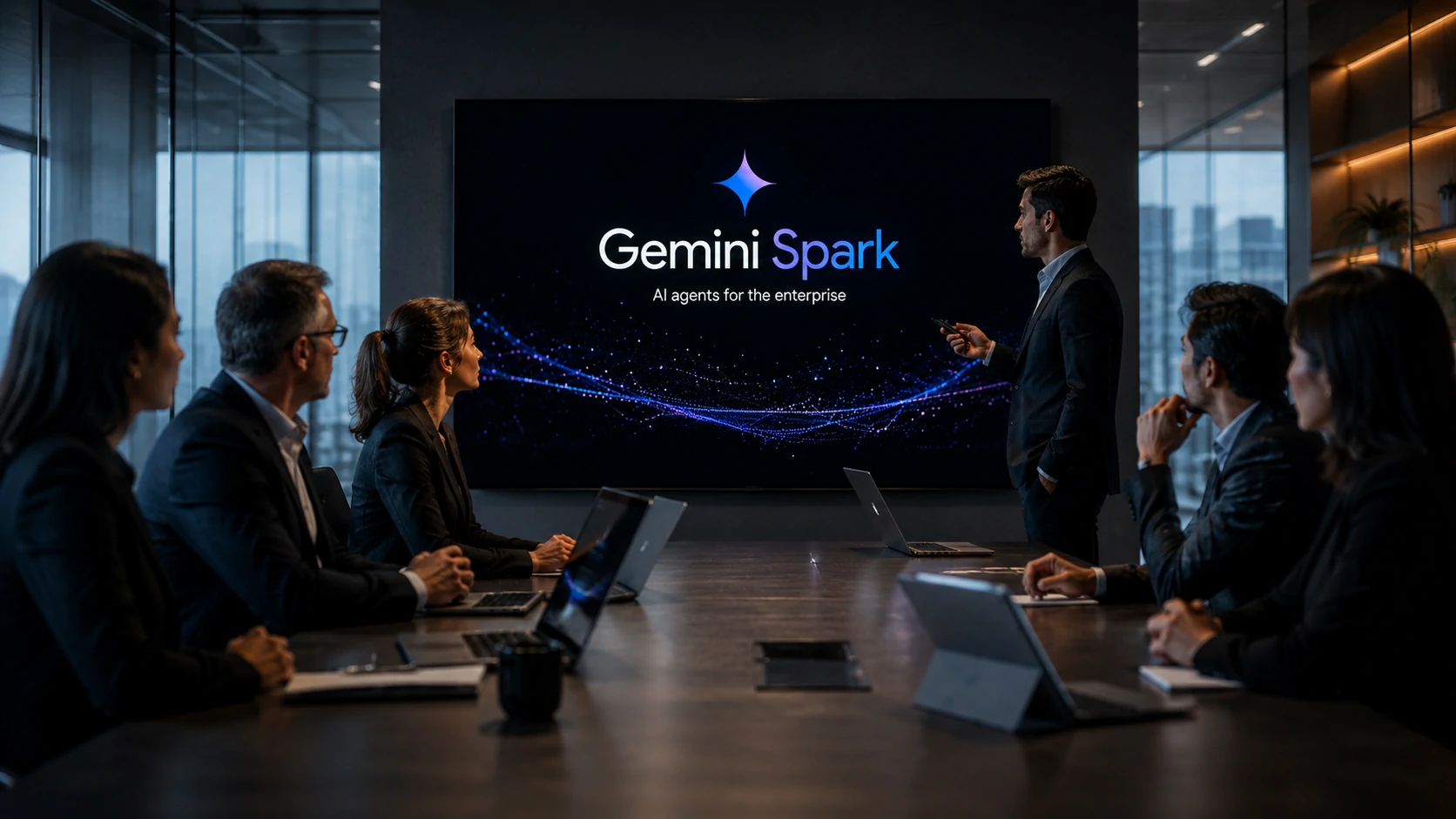
Google, OpenAI, Anthropic and Microsoft are competing to lead the next generation of intelligent AI agents.
Instead, every major technology company is attempting to build a complete ecosystem capable of executing entire business processes through artificial intelligence.
The focus has shifted from conversation to execution
This transformation explains why enterprise investment in AI agents has accelerated so quickly.
While a traditional chatbot mainly answers isolated questions, an AI agent can:
- organize information;
- research documents;
- generate presentations;
- summarize meetings;
- execute workflows;
- interact with multiple enterprise systems.
These capabilities significantly expand the automation potential available to organizations.
Businesses are prioritizing productivity and lower operational costs
Financial return has become another decisive factor.
Organizations increasingly seek AI solutions capable of reducing repetitive work, accelerating internal operations and improving employee productivity without proportionally increasing operating expenses.
This trend also reinforces technologies such as the Model Context Protocol (MCP), which enables AI agents to communicate with enterprise systems more efficiently. You can explore this topic further in How MCP Works: A Complete Guide to AI Agents.
How Gemini Spark Could Impact Businesses and Professionals
Gemini Spark has the potential to accelerate enterprise adoption of intelligent AI agents by narrowing the gap between language models and the productivity tools employees use every day.

AI agents are expected to take over repetitive operational tasks while allowing professionals to focus on strategic decision-making.
Organizations already relying on Google Workspace may soon integrate AI agents capable of automating workflows, supporting business decisions and reducing repetitive administrative work.
Key enterprise use cases
Some of the most promising applications include:
- automated internal support;
- document creation;
- presentation generation;
- meeting organization;
- large-scale information analysis;
- decision support;
- workflow automation.
These capabilities demonstrate that the next stage of artificial intelligence is becoming less about generating content and more about executing complete business processes.
Integration will become a competitive advantage
Another critical factor will be the ability of AI agents to access multiple enterprise systems.
Businesses are unlikely to rely on isolated AI assistants.
Instead, organizations will increasingly connect CRM platforms, ERP systems, databases, financial software and collaboration tools so that a single AI agent can perform tasks that currently require coordination across multiple employees and departments.
The broader the integration, the greater the productivity gains are likely to become.
The Competition Between Google, OpenAI and Anthropic Is Only Beginning
The introduction of Gemini Spark reinforces that the AI race is no longer centered solely on building the most capable language model.
The new objective is to develop complete AI platforms capable of executing real business tasks with increasing autonomy.
AI agents are becoming the industry’s next battleground
Over the coming months, Google, OpenAI, Anthropic, Microsoft, Mistral AI and other developers are expected to accelerate investments in increasingly specialized intelligent agents.
This competition is likely to drive advances in:
- autonomous task execution;
- enterprise system integration;
- contextual memory;
- security;
- AI governance;
- lower operational costs.
For businesses, this means more vendor choices, stronger competition among AI providers and faster technological innovation.
Turning innovation into measurable business value
Although artificial intelligence is evolving rapidly, long-term competitive advantage will depend on how organizations implement these technologies.
Companies that adopt AI agents simply because they are trending may struggle with governance, security and system integration.
On the other hand, organizations that establish clear business objectives, well-defined processes and responsible AI policies will be in a much stronger position to generate sustainable productivity gains.
The arrival of Gemini Spark signals that the artificial intelligence industry has entered a new chapter. The market is no longer competing only to build the most powerful language model, but to deliver the most capable, integrated and practical AI agent for real-world enterprise operations. For technology leaders and business executives, following this transformation is no longer just about innovation—it is becoming an essential part of maintaining long-term competitiveness in the AI era.
Comentários
Os comentários utilizam autenticação via GitHub para manter um ambiente mais qualificado, seguro e livre de spam.
Entrar ou criar conta no GitHub