The artificial intelligence race is often measured by new models and breakthrough capabilities, but another metric reveals an even bigger story: user adoption. The number of people actively using each platform shows which ecosystems are attracting businesses, developers, and consumers, ultimately shaping billions of dollars in investment and defining the next phase of the AI industry.
User growth has become the clearest indicator of AI leadership
User adoption is no longer just a popularity metric. It has become one of the strongest indicators of a platform’s ability to build a sustainable innovation ecosystem.
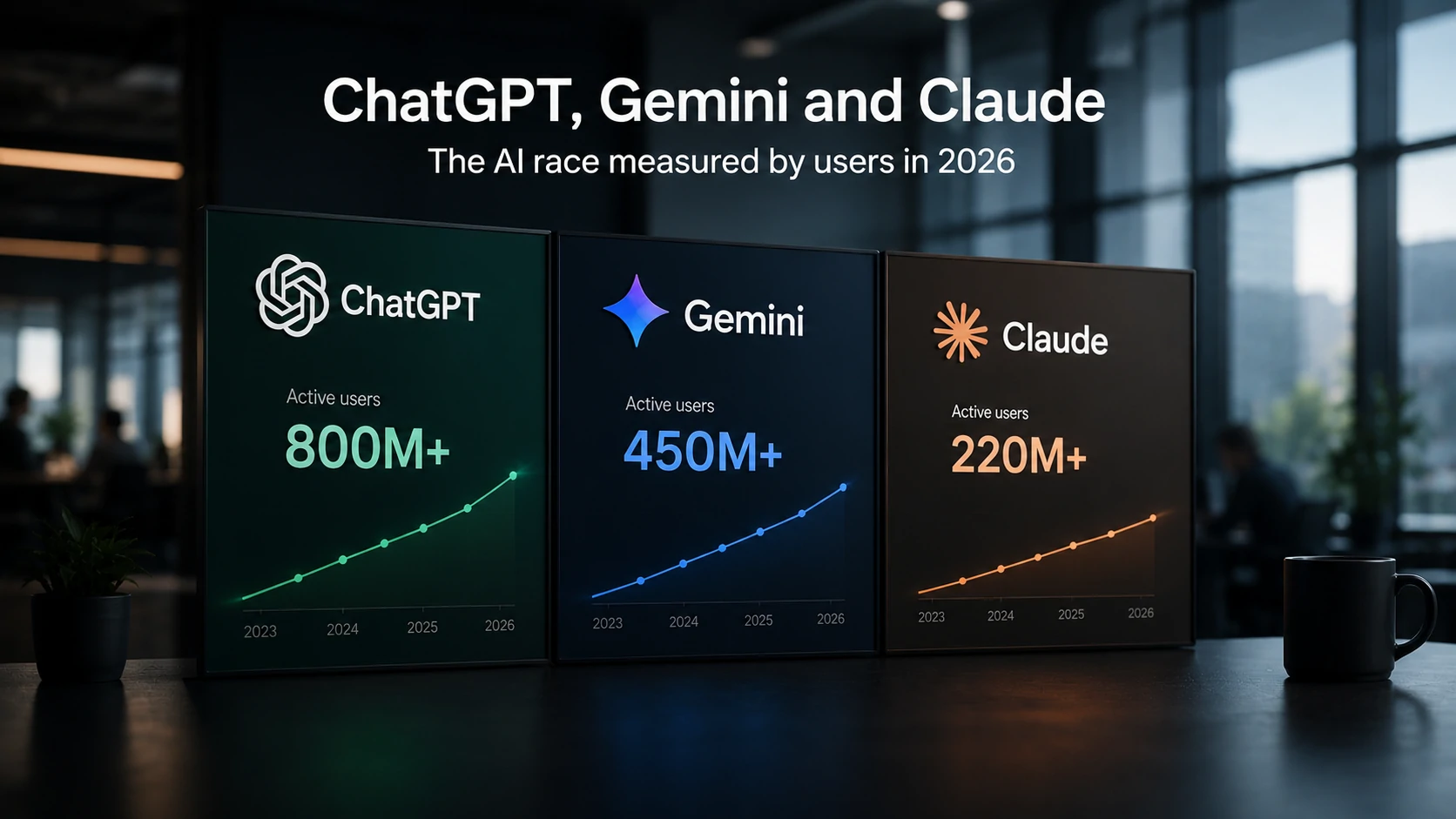
Growing user adoption accelerates investment, integrations, and the pace of innovation across artificial intelligence platforms.
When millions of people rely on platforms such as ChatGPT, Gemini, and Claude every day, a powerful network effect begins to emerge. Larger user communities generate more feedback, attract developers, encourage enterprise software integrations, and justify even greater investments in infrastructure.
This helps explain why competition among leading AI companies has evolved beyond model performance alone. Today’s battle revolves around distribution, ecosystem strength, and enterprise adoption.
ChatGPT remains the industry’s benchmark
ChatGPT continues to lead global adoption thanks to its ease of use, broad model portfolio, and expanding integration with professional tools.
Despite increasingly aggressive competition, OpenAI’s platform remains the default choice for individual users, software developers, and organizations looking to accelerate workflows through generative AI.
Its market leadership also strengthens OpenAI’s ability to attract investment while expanding its ecosystem through complementary products and services.
Gemini expands through Google’s ecosystem
Gemini follows a different growth strategy. Rather than relying solely on its chatbot interface, Google continues integrating the model into products already used by billions of people, including Google Workspace, Android, and Google Search.
This distribution strategy creates enormous growth potential, particularly among organizations already operating within Google’s productivity ecosystem.
This trend reinforces previous Notícia Tech coverage of Google’s expanding AI ecosystem:
Larger user bases create stronger ecosystems, not just greater popularity
Growing user communities reinforce a continuous cycle of innovation, investment, and new product development, making AI platforms increasingly attractive to enterprise customers.

The larger an AI ecosystem becomes, the faster innovation and enterprise integrations tend to evolve.
For businesses, selecting an AI platform involves much more than evaluating language model quality. Organizations also consider developer ecosystems, APIs, documentation, security, governance capabilities, partner availability, and the speed of product evolution.
The stronger the ecosystem, the greater the availability of these critical enterprise resources.
Claude continues gaining traction among enterprises
Although Claude serves fewer overall users than ChatGPT and Gemini, it continues expanding rapidly across enterprise markets.
Anthropic’s strategy emphasizes safety, governance, reliability, and enterprise-grade AI, qualities increasingly valued by organizations deploying artificial intelligence in mission-critical operations.
As a result, Claude continues appearing in enterprise deployments, research organizations, and large corporate environments.
The impact extends far beyond AI chatbots
The expansion of these AI platforms is also accelerating adjacent markets, including AI agents, business automation, CRM integrations, and intelligent application development.
As user adoption continues to grow, new opportunities emerge for software vendors, consulting firms, SaaS providers, and organizations building AI-powered business solutions.
A related trend previously analyzed by Notícia Tech explores how increasingly capable AI models are transforming enterprise adoption:
The battle for AI leadership has shifted from technology to market strategy
User adoption has become one of the strongest indicators of each company’s ability to build a competitive and sustainable AI ecosystem. Leadership in artificial intelligence is no longer determined solely by model performance, but also by how quickly businesses and consumers embrace a platform.

The expansion of AI user communities has become one of the strongest indicators of long-term competitive advantage.
The competition between OpenAI, Google, and Anthropic demonstrates that the race is being fought on multiple fronts simultaneously. While one company focuses on broader distribution, another invests in enterprise security, productivity, or platform integration.
This dynamic makes it increasingly unlikely that a single AI provider will dominate the entire market. Instead, the industry appears to be evolving toward a multi-platform ecosystem where different models excel in different business scenarios.
Businesses are choosing ecosystems rather than individual AI models
Selecting an AI platform has become a strategic business decision rather than a simple comparison of model quality.
Organizations increasingly evaluate API availability, compatibility with existing enterprise software, governance capabilities, regulatory compliance, operational costs, developer communities, and each platform’s long-term roadmap.
These considerations explain why platforms with consistently growing user bases continue attracting additional investments, partners, and developers, reinforcing a powerful cycle of ecosystem expansion.
What comes next in the AI competition
The next phase of the AI race will likely revolve around intelligent AI agents, enterprise automation, multimodal models, and seamless integration across business platforms.
Rather than relying on a single AI assistant, many organizations are expected to adopt multiple models simultaneously. One platform may be used for software development, another for research, another for customer support, and another for business process automation.
In this environment, interoperability and integration capabilities may become just as important as model intelligence itself.
This broader industry transformation reinforces previous Notícia Tech analysis on how enterprise AI adoption continues accelerating, including:
https://noticiatech.com.br/en/tools/chatgpt-gemini-or-claude-best-ai-comparison-2026/
The continued growth of ChatGPT, Gemini, and Claude demonstrates that the artificial intelligence race has entered a new stage. Instead of competing solely by releasing increasingly capable models, AI companies are now building comprehensive ecosystems designed to attract users, developers, enterprise customers, and strategic partners.
For technology leaders, business executives, and decision-makers, monitoring these adoption trends is no longer simply an interesting statistic. User growth increasingly signals which AI ecosystems are most likely to concentrate innovation, investment, and business opportunities throughout the coming years.
Comentários
Os comentários utilizam autenticação via GitHub para manter um ambiente mais qualificado, seguro e livre de spam.
Entrar ou criar conta no GitHub