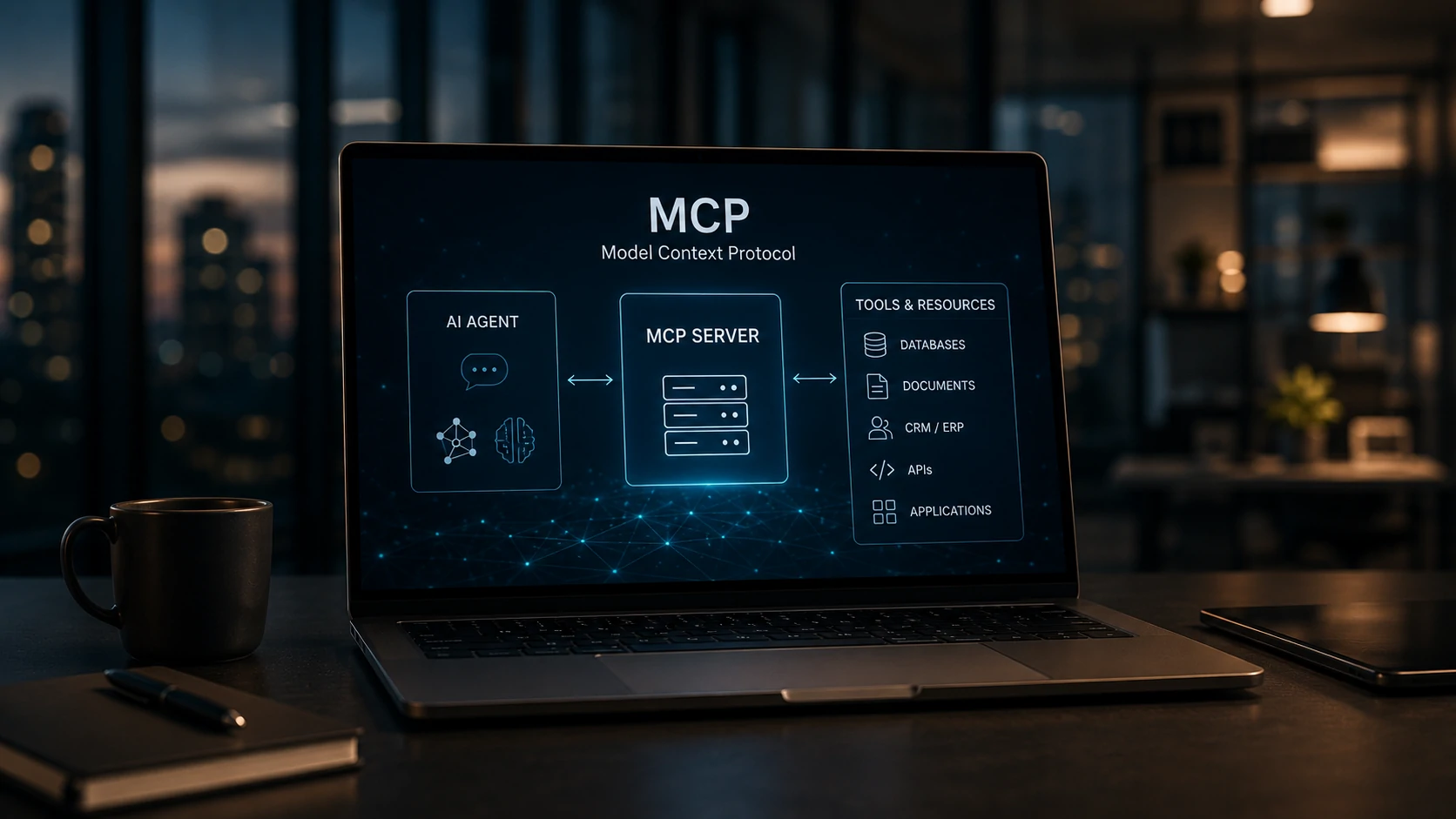
As AI agents evolve beyond conversational interfaces and begin performing real business tasks, a new challenge emerges: connecting models to enterprise systems in a secure, scalable, and standardized way. In this environment, MCP is becoming one of the most important technologies shaping the next phase of enterprise artificial intelligence.
How MCP works in practice
MCP (Model Context Protocol) functions as a standardized communication layer between AI models and external tools.
Instead of building custom integrations for every application, the protocol establishes a common language that allows agents to discover resources, access information, and perform actions across different systems.
This approach reduces technical complexity while creating a more scalable architecture for enterprise environments.
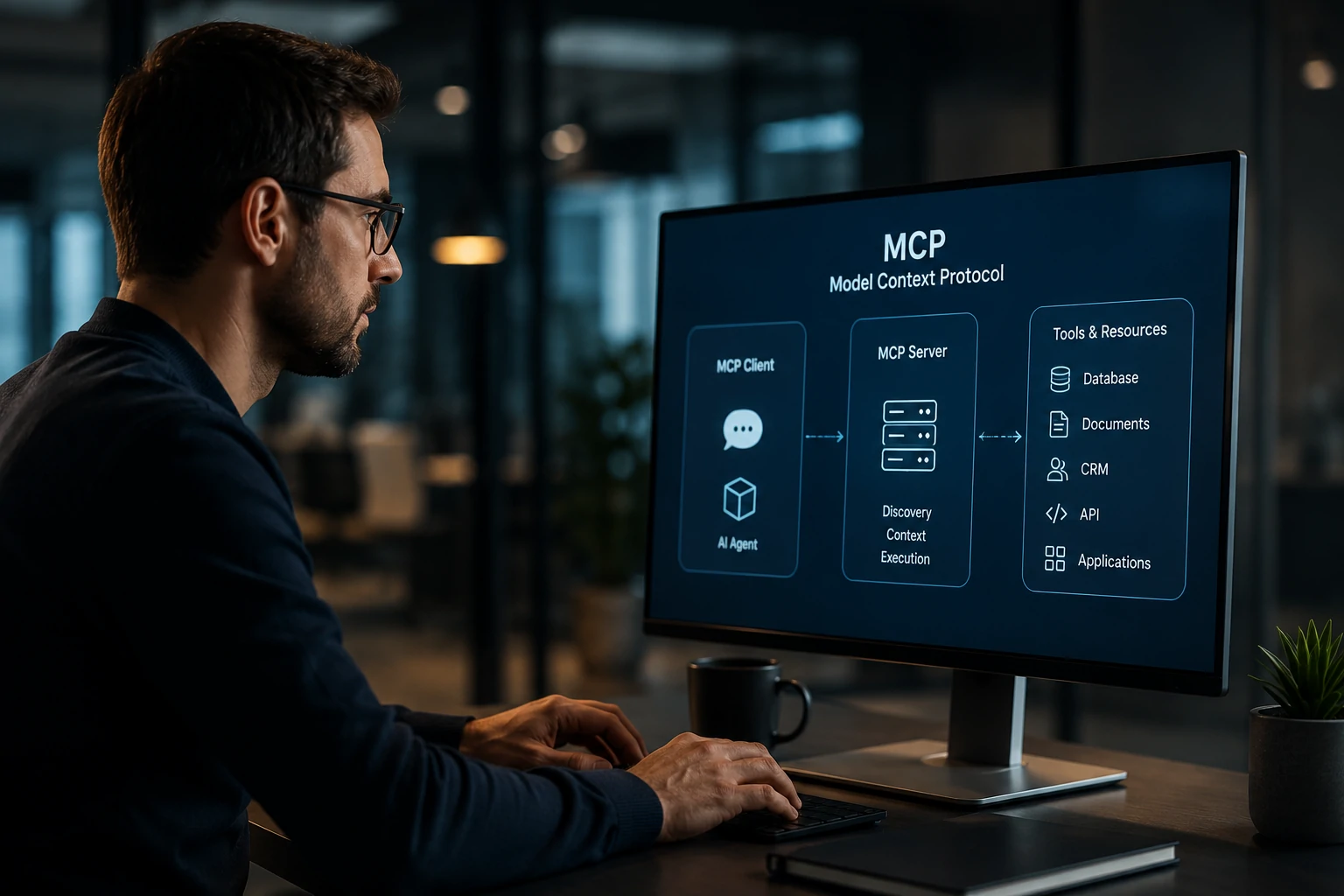
MCP creates a standardized bridge between AI agents and enterprise systems.
What problem does MCP solve?
Before MCP, every integration required custom development.
A company that wanted to connect an agent to Salesforce, Google Drive, Microsoft 365, and internal databases had to create multiple independent integrations.
The protocol addresses this challenge by introducing a unified communication standard.
Why does this matter for AI agents?
Agents depend on context and access to tools.
Without integrations, an AI model can only respond based on its internal knowledge.
With MCP, agents can access documents, retrieve updated information, interact with enterprise systems, and execute operational tasks.
What are the core components of the MCP architecture?
The MCP architecture is built around three primary elements: clients, servers, and tools.
Each component serves a distinct role within the ecosystem.
This separation improves governance, maintainability, and scalability.

Clients, servers, and tools form the foundation of the Model Context Protocol.
MCP clients
The client represents the system that uses the AI model.
This can be an enterprise chatbot, an internal assistant, or an autonomous agent.
Clients send requests and receive responses from compatible MCP servers.
MCP servers
The server acts as an intermediary layer between AI systems and external tools.
It exposes resources that can be accessed by agents.
These resources may include databases, APIs, documents, CRMs, ERPs, and SaaS platforms.
Tools and resources
Tools represent the systems that agents actually interact with.
Common examples include:
- CRMs;
- ERPs;
- customer support platforms;
- document repositories;
- financial systems;
- enterprise databases.
Why MCP is becoming strategically important for businesses
MCP is gaining strategic importance because it addresses one of the biggest barriers to enterprise AI adoption: integration.
Organizations do not want AI systems that only answer questions.
They want AI that can perform meaningful business tasks.

The value of AI agents increases significantly when they can interact with real business data and processes.
Lower integration costs
Enterprise AI initiatives often spend more time connecting systems than building models.
By standardizing connectivity, MCP reduces technical effort and accelerates deployment.
Over time, this can lower both development and maintenance costs.
Operational scalability
When new tools are introduced into the enterprise environment, MCP makes them easier to expose to multiple agents.
This creates a platform effect.
Instead of maintaining numerous isolated integrations, organizations can operate through a standardized architecture.
Governance and security
Governance becomes easier when access is managed through a centralized layer.
Permissions, auditing, and access controls can be applied consistently.
This capability is particularly important in highly regulated industries.
What is the relationship between MCP, RAG, and AI agents?
MCP does not replace RAG or AI agents.
In practice, these technologies are highly complementary.
Each solves a different challenge within the enterprise AI stack.
To better understand the knowledge retrieval layer, see What Is RAG? A Complete Guide for Enterprise AI Agents.
MCP and RAG
RAG enables AI models to retrieve external information before generating responses.
MCP, on the other hand, provides a standardized method for accessing those resources and tools.
While RAG enhances contextual knowledge, MCP expands operational connectivity.
MCP and AI Operations
As agents gain access to enterprise systems, governance becomes increasingly important.
That is why concepts such as AI Operations Governance for Enterprise AI Agents complement the MCP ecosystem.
MCP and the future of AI agents
The future of enterprise agents depends on their ability to interact with digital environments.
Isolated agents provide limited value.
Connected agents can execute workflows, generate analyses, update systems, and support operational decision-making.
What changes for businesses in the coming years?
MCP represents a structural shift in how AI systems connect to enterprise environments.
Just as APIs became essential to digital transformation over the last decade, agent-focused protocols are likely to play a similar role in the next stage of artificial intelligence adoption.
Organizations that build integration capabilities today will be better positioned to scale AI agents, automate processes, and transform enterprise knowledge into competitive advantage.
More than a specific technology, MCP represents a new layer of digital infrastructure. As agents increasingly become operational interfaces for businesses, the ability to connect models, data, and systems may become one of the defining competitive advantages of the next generation of AI-driven enterprises.
Comentários
Os comentários utilizam autenticação via GitHub para manter um ambiente mais qualificado, seguro e livre de spam.
Entrar ou criar conta no GitHub