
As AI agents evolve from simple assistants into systems capable of executing complex tasks, a critical challenge emerges: connecting artificial intelligence to the real operational environment of enterprises. This is precisely where MCP is gaining momentum as one of the most important integration layers for the next generation of enterprise automation.
How to Implement MCP in Enterprises
Implementing MCP (Model Context Protocol) means creating a framework capable of connecting AI agents to the systems that store information and execute business processes.

An MCP architecture connecting AI agents to multiple enterprise systems.
While large language models possess advanced reasoning capabilities, they do not have native access to an organization’s internal systems and data.
The role of MCP is to serve as a bridge between the intelligence of the model and enterprise applications.
Organizations exploring Agentic AI, advanced automation, and intelligent assistants are adopting this architecture to reduce technology fragmentation.
To understand the fundamentals of the protocol, readers can explore Notícia Tech’s guide on How MCP Works.
Core Components of an MCP Architecture
A typical enterprise implementation includes:
- AI agent
- MCP client
- MCP servers
- Enterprise APIs
- Databases
- Business systems
This architecture enables agents to retrieve information, execute actions, and interact with external tools through a standardized interface.
What Changes Compared to Traditional Integrations
Historically, each integration required custom development.
With MCP, access logic becomes reusable.
This reduces maintenance costs and accelerates the deployment of new intelligent agents.
Which Systems Can Be Connected to MCP
MCP was designed to function as a universal layer for accessing data and services.
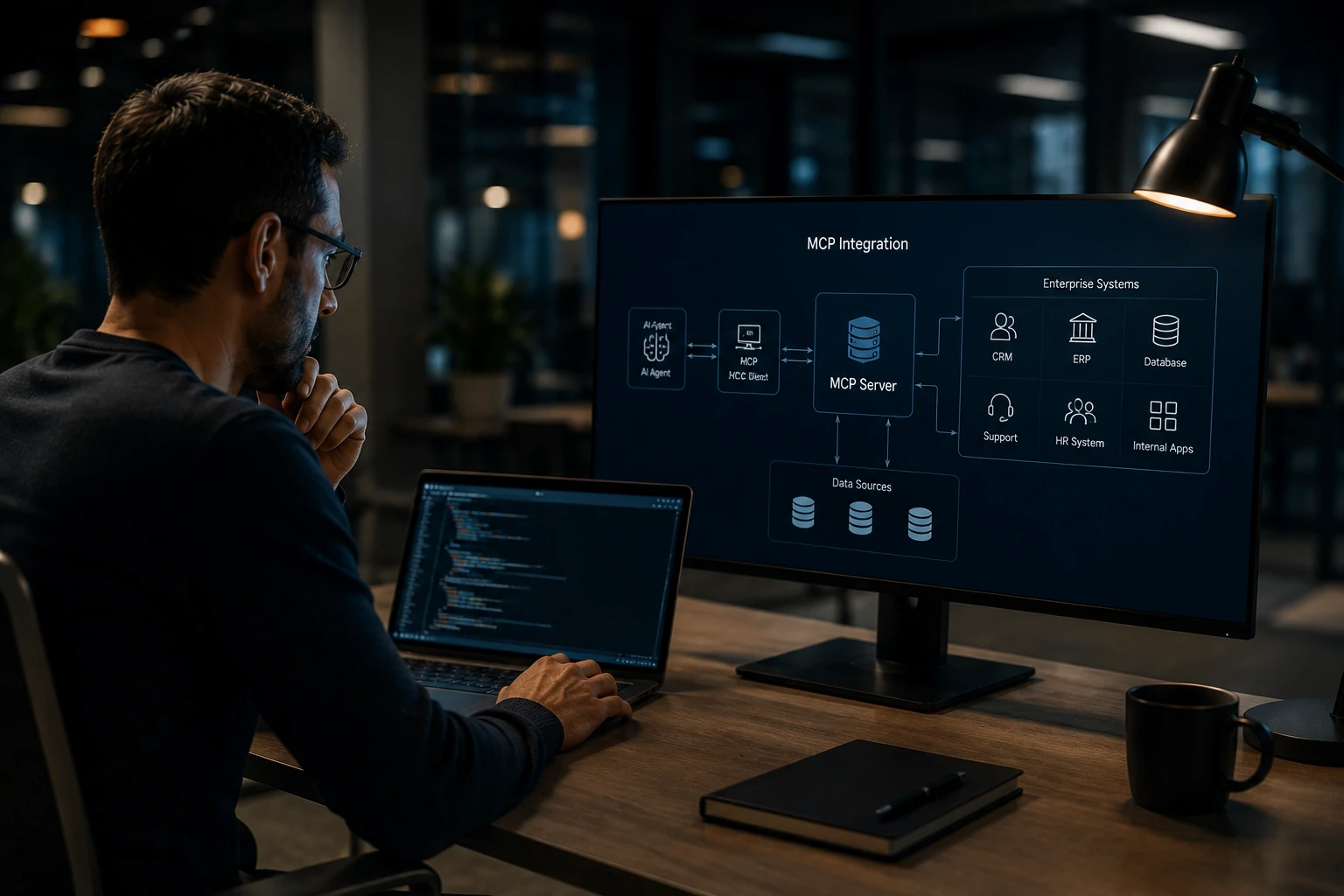
The protocol enables multiple platforms to operate within a single AI agent ecosystem.
In practice, nearly any enterprise system can participate in the MCP ecosystem.
Common examples include:
- Salesforce
- HubSpot
- SAP
- Oracle
- SQL databases
- Internal applications
- Customer support platforms
- Human resources systems
The goal is to allow agents to access distributed information without needing to understand the technical complexity of each environment.
MCP and CRM Platforms
One of the most promising applications involves sales and customer relationship management systems.
Companies are already using agents to review customer records, update opportunities, and generate reports automatically.
MCP and Legacy Systems
Another important benefit is the ability to connect legacy environments.
Many organizations rely on critical systems that cannot be replaced overnight.
MCP allows companies to modernize workflows without requiring a complete infrastructure overhaul.
MCP Use Cases for AI Agents
MCP is rapidly becoming a foundational layer in enterprise agent architectures.

AI agents connected through MCP can access data and execute processes in real time.
The primary advantage is transforming language models into systems capable of taking action.
Intelligent Enterprise Support
An AI agent can:
- Access customer history
- Verify contracts
- Open support tickets
- Update records
All within a single conversation.
Operations and Productivity
Teams can leverage agents to:
- Generate reports
- Query business metrics
- Monitor operations
- Retrieve information from multiple systems
This significantly reduces the time spent on repetitive tasks.
AI Operations and Governance
MCP also strengthens governance initiatives.
By centralizing integrations and access points, organizations gain better control over permissions, auditing, and activity monitoring.
Challenges of Implementing MCP in Enterprises
Despite its enormous potential, successful adoption requires planning.
The main challenge is not the protocol itself.
Instead, organizations often struggle with data organization and system complexity.
Companies with information scattered across multiple platforms typically need a preparation phase before deploying enterprise-grade AI agents.
Security and Access Control
Every connection created by an AI agent represents a potential access point.
As a result, authentication, authorization, and auditing policies must become top priorities.
Governance becomes just as important as the technology itself.
Data Quality
An agent can only deliver reliable results when the underlying data is reliable.
Inconsistent information may lead to inaccurate decisions and negatively impact critical business processes.
Future Scalability
Organizations that begin with small AI initiatives often discover new automation opportunities over time.
An architecture built around MCP allows these projects to scale without rebuilding integrations for every new use case.
For this reason, many experts view MCP as one of the foundational technologies behind the next generation of agent-driven enterprise systems. As companies advance their investments in Agentic AI, intelligent automation, and digital transformation, the ability to connect AI models directly to operational environments may become just as important as the models themselves.
Comentários
Os comentários utilizam autenticação via GitHub para manter um ambiente mais qualificado, seguro e livre de spam.
Entrar ou criar conta no GitHub