Jensen Huang is putting $12.93 billion into a company that, at first glance, appears far removed from Nvidia’s traditional business. But the acquisition of Hugging Face reveals a broader strategy: controlling not only the infrastructure that runs artificial intelligence, but also one of the platforms where developers discover and work with the models powering the new AI economy.
Jensen Huang is taking Nvidia beyond AI chips
Nvidia announced an agreement to acquire Hugging Face for $12.93 billion, in a transaction that represents an important shift in Jensen Huang’s strategy. Nvidia remains a powerhouse in chips and infrastructure, but the acquisition takes its presence into a different layer of the AI market.
Hugging Face is primarily known among developers and researchers. The platform brings together models, datasets, and artificial intelligence applications and has become an important meeting point for people working with open and open-weight models.
That developer community is what makes the acquisition strategic. Nvidia already provides a significant share of the computing capacity required to train and run AI. With Hugging Face, Huang moves closer to a platform where developers decide which models to use and how to deploy them in production.
Huang’s strategy goes beyond selling GPUs
During the artificial intelligence boom, Nvidia became one of the biggest beneficiaries of growing demand for computing capacity. But Jensen Huang is looking at a market that could be much larger than accelerator sales.
As companies adopt AI, they need to choose models, test alternatives, customize systems, and put them into operation. This creates opportunities across software, services, inference, and infrastructure.
Hugging Face sits directly at this intersection. The acquisition gives Nvidia closer access to a community that directly influences which technologies will power the next generation of AI applications.
The target is the ecosystem growing around AI
Nvidia does not necessarily need to turn Hugging Face into an exclusive platform for its own products. Its strategic value may actually come from keeping the ecosystem open and making Nvidia an increasingly important infrastructure provider within it.
That logic is different from simply buying a software company. Huang is trying to expand Nvidia’s reach throughout the artificial intelligence value chain.
The move also comes as major technology companies develop their own chips and alternatives across the AI infrastructure stack. This makes it even more important for Nvidia to maintain a broad ecosystem of developers and models.
What Jensen Huang saw in Hugging Face

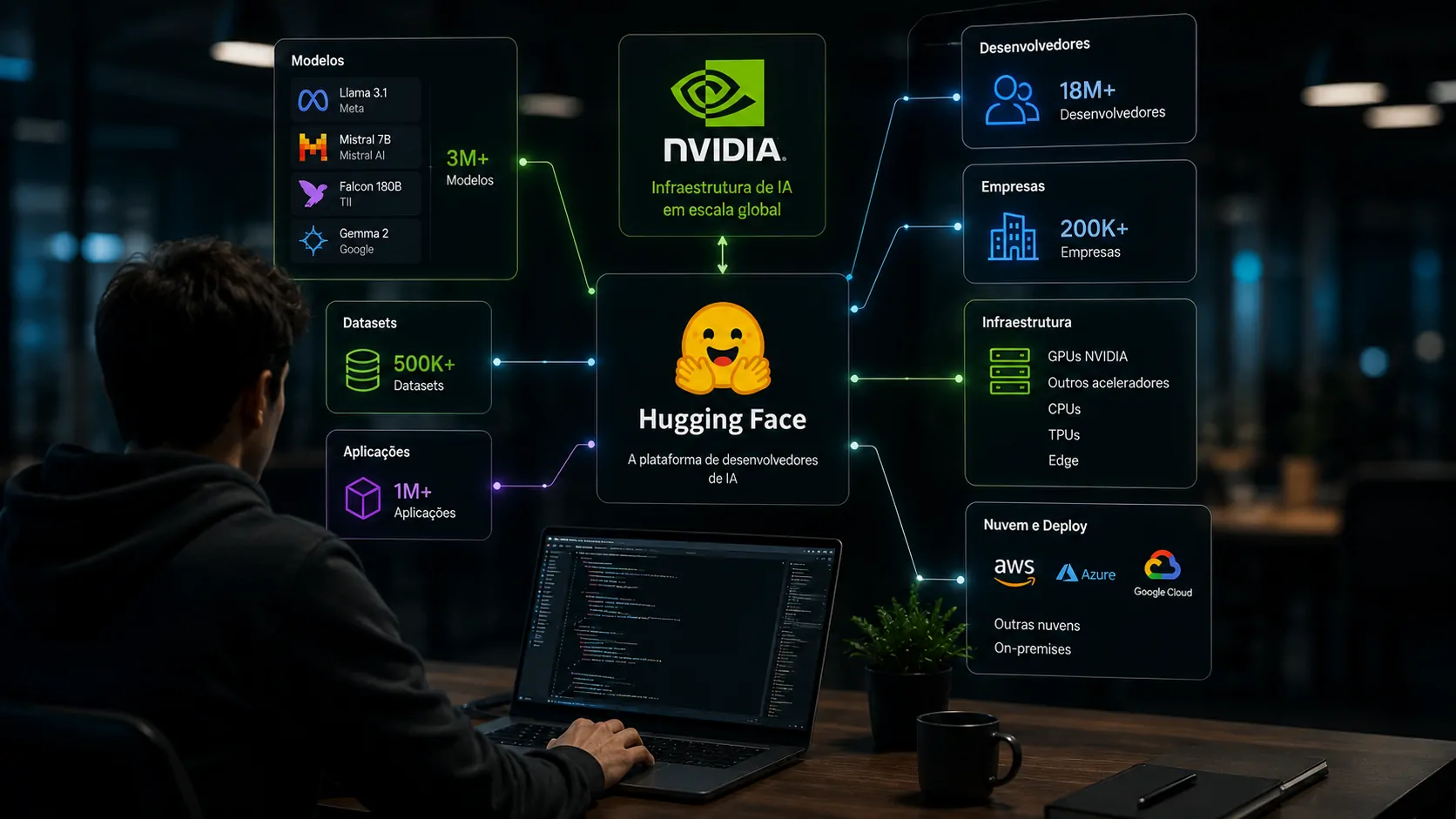
Hugging Face brings together models, datasets, and applications and has become an important gateway for developers working with artificial intelligence.
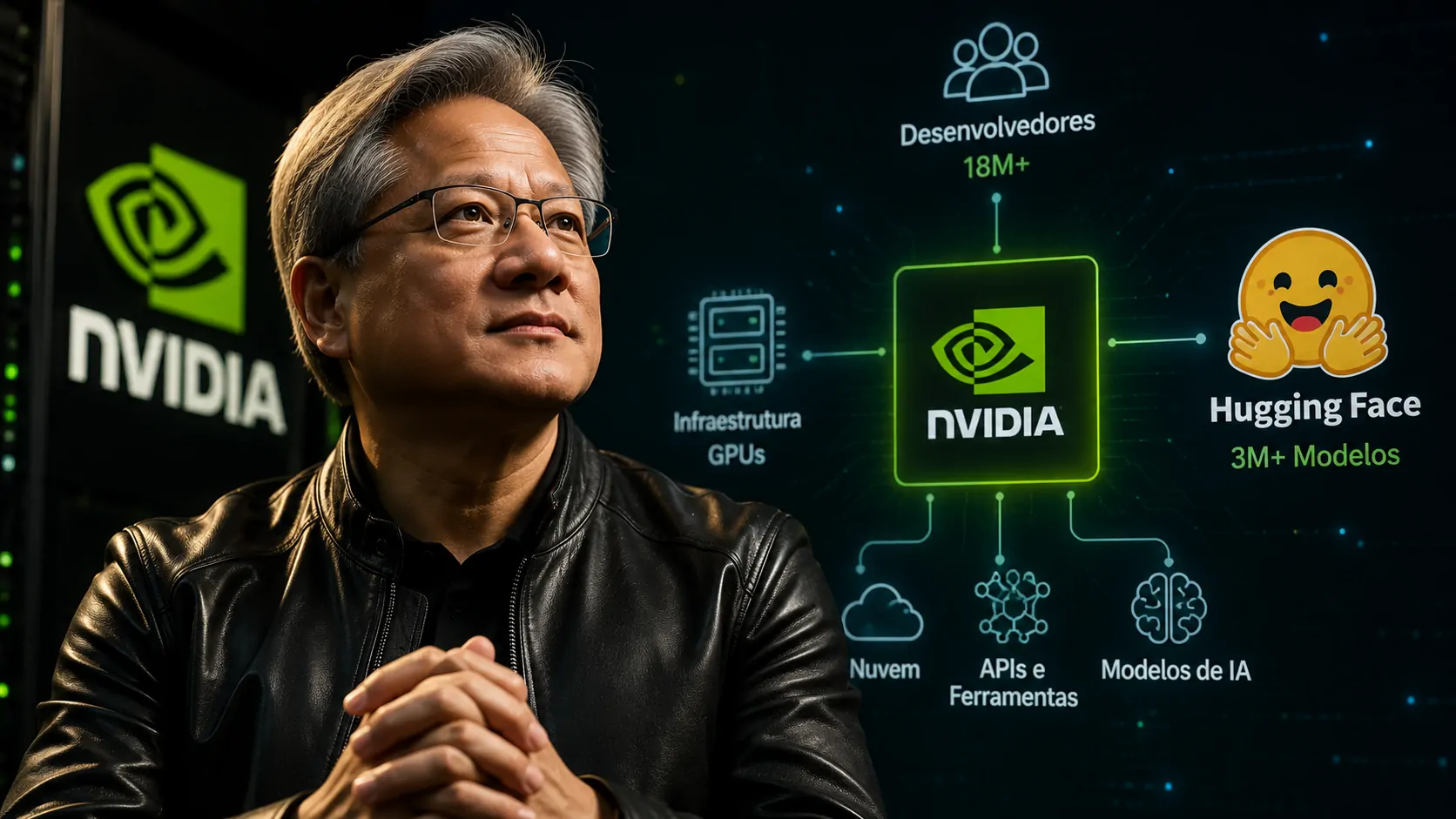
The scale of Hugging Face helps explain why Huang agreed to pay nearly $13 billion for the platform. According to figures released by Nvidia, the ecosystem includes more than 3 million models, 500,000 datasets, and 1 million applications.
The platform is also used by more than 18 million developers, researchers, and creators, as well as more than 200,000 companies. Those numbers make Hugging Face much more than a simple model repository.
For Nvidia, that reach represents a direct connection to a community helping define how the next generation of AI applications will be built.
Nvidia was already part of the ecosystem
The relationship between the two companies did not begin with the acquisition. Nvidia had already been contributing to Hugging Face and had published hundreds of models and datasets on the platform.
That previous presence matters because it shows that Huang is not entering a completely unfamiliar market. Nvidia had already been tracking the evolution of open models and investing in the development of its own ecosystem.
The acquisition turns that participation into strategic control, assuming the deal is completed.
Open models can increase demand for computing
There is a direct relationship between the expansion of open models and Nvidia’s core business. The more models are created, adapted, and deployed, the greater the potential demand for computing capacity.
That demand does not need to be concentrated among a few major AI laboratories. Companies of different sizes can use open models to build specialized applications, automate processes, and develop their own systems.
This is where the acquisition takes on a broader business dimension. Huang may be betting that the future of AI will be built around thousands or millions of specialized applications, rather than only a handful of giant models controlled by major laboratories.
Nvidia wants a position closer to AI developers
The acquisition also needs to be viewed within a broader transformation of the market. The competition in artificial intelligence is no longer only about creating the most powerful model.
Companies are now competing across models, hardware, cloud services, development tools, and the environments where AI systems are deployed.
This shift favors a strategy like Huang’s. Nvidia already has a powerful position in infrastructure. Hugging Face adds a bridge to developers and organizations choosing which models to use.
The battleground has moved
In the early stages of the generative AI race, attention was concentrated on companies such as OpenAI, Google, and Anthropic. The main measure of strength was model performance.
Now the market is fragmenting across multiple layers. There are proprietary models, open models, custom chips, inference services, AI agents, and development platforms.
The movements of major companies toward their own chips also increase pressure on Nvidia. Huang’s response appears to be expanding the number of strategic positions occupied by the company.
This transformation also helps explain why technology architecture has become so important for companies adopting AI. The integration of models, APIs, agents, data, and infrastructure has become a central technology decision. The subject was analyzed by Notícia Tech in an analysis of enterprise AI architecture.
Huang does not need to turn Hugging Face into Nvidia
One of the most interesting aspects of the strategy is precisely the stated commitment to keeping the platform open.
Jensen Huang said developers will continue to be able to choose the models, frameworks, cloud providers, inference services, and computing platforms they want.
This means Nvidia can potentially capture value without closing the ecosystem. The larger the number of models and developers using the platform, the greater Nvidia’s potential influence over the infrastructure supporting that market.
The $13 billion bet carries an important risk
The acquisition could expand Nvidia’s influence, but the independence of a platform used by different companies and communities will be an important issue to watch.
The size of the transaction makes one question unavoidable: how much is it worth to control one of the main gateways to open artificial intelligence models?
Hugging Face was valued at $4.5 billion in its last known funding round in 2023. The new valuation represents a significant increase and shows how much the market has come to value platforms positioned between AI models and their users.
For Huang, however, the value may have less to do with Hugging Face’s current revenue and more to do with its strategic position in the future of AI.
Openness will be the key test
Nvidia says its hardware will not be required to develop or deploy solutions through Hugging Face. That commitment will be important for preserving trust within the developer community.
The platform brings together models from different organizations and serves companies with different requirements. A noticeable shift toward proprietary infrastructure could create resistance among developers.
For that reason, maintaining neutrality may be economically valuable for Nvidia itself. A widely used open platform can have greater strategic value than a restricted one.
Nvidia is buying an option on the future
The move can also be interpreted as protection against changes in the industry. If open models continue to gain ground, Hugging Face could become even more important for companies seeking to avoid dependence on a single AI laboratory.
In that scenario, Nvidia would control an important piece of the ecosystem while maintaining its core infrastructure business.
The acquisition therefore does not need to generate returns only through Hugging Face’s direct revenue. Its value may emerge from Nvidia’s ability to remain relevant across different layers of the AI value chain.
Nvidia’s next chapter may be defined by developers
The Hugging Face acquisition puts the developer community at the center of Jensen Huang’s next strategic move.
Jensen Huang’s decision shows that Nvidia does not intend to rely exclusively on the expansion of the GPU market. The company is trying to establish a broader position in an industry where hardware and software are becoming increasingly interconnected.
Hugging Face provides exactly that bridge. On one side are models and developers. On the other is the infrastructure required to turn those models into real applications.
The move becomes even more relevant as other companies try to reduce their dependence on Nvidia chips. Expanding the ecosystem could help Nvidia remain present even as the structure of AI infrastructure begins to change.
The biggest bet is on who will control the next layer of AI
If the first phase of the AI race was dominated by whoever had the most computing capacity, the next phase could be defined by whoever controls the environments where models are selected, adapted, and deployed.
That is where the Hugging Face acquisition becomes bigger than its financial value.
Jensen Huang is putting $12.93 billion into a platform connecting millions of developers with millions of artificial intelligence assets. The strategy suggests that Nvidia wants to participate not only in the infrastructure powering AI, but also in the decisions determining which models will be used and where they will reach users.
The transaction still depends on the conditions required for its completion. But if completed as announced, it could mark a new phase for Nvidia: a company that began by dominating computing infrastructure and is now seeking an increasingly strategic position closer to the people building artificial intelligence.
Comentários
Os comentários utilizam autenticação via GitHub para manter um ambiente mais qualificado, seguro e livre de spam.
Entrar ou criar conta no GitHub