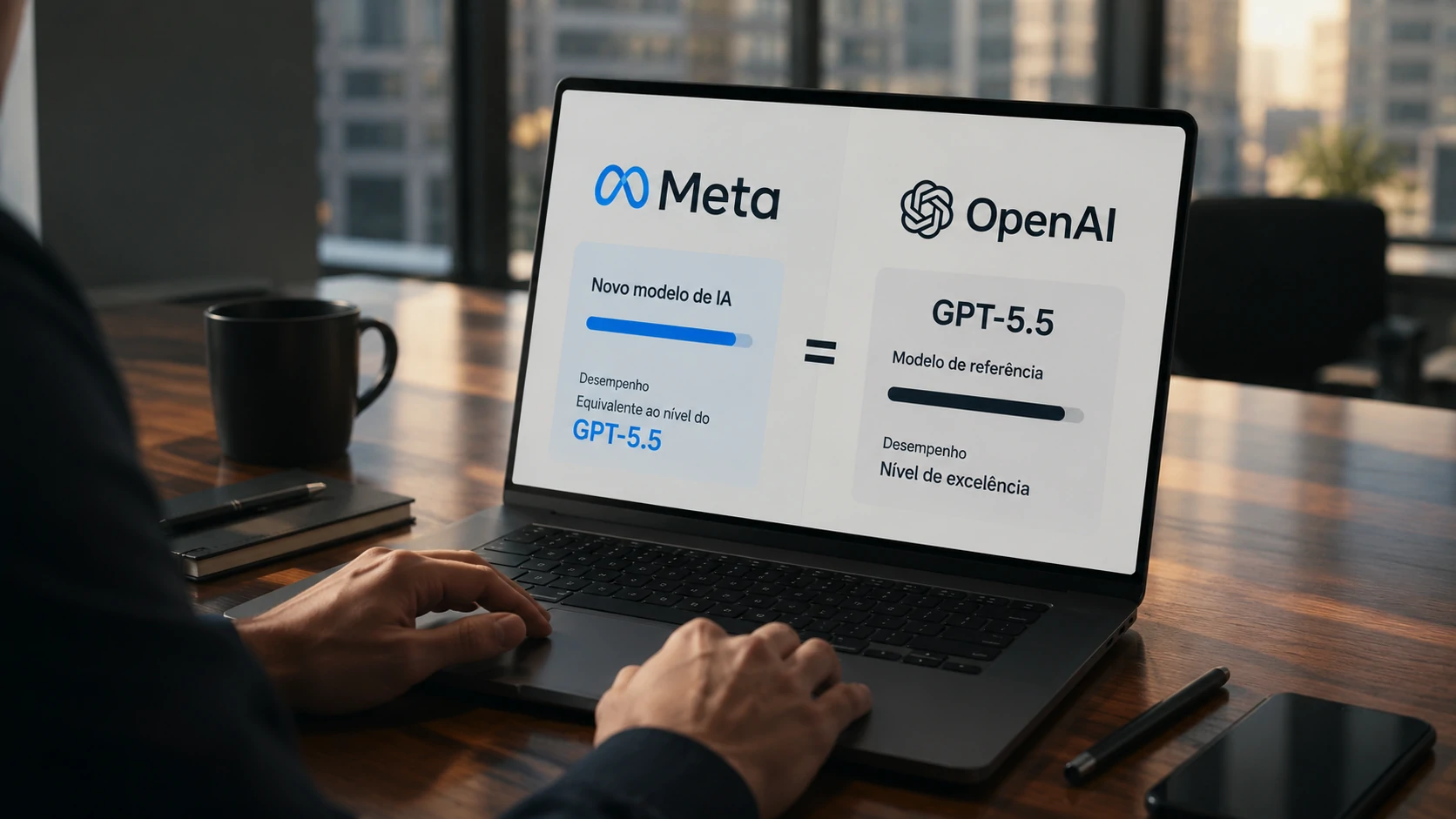
Just a few months ago, OpenAI appeared to have a comfortable lead in the generative AI market. Now, a new statement from Meta suggests that advantage may be shrinking rapidly. More than a technical milestone, this development represents a strategic shift that could reshape technology investments, platform selection and the future of enterprise artificial intelligence.
Meta is aiming for leadership in enterprise AI
Meta has made it clear that its ambition is no longer simply to keep pace with artificial intelligence. The company now wants to become one of the industry’s leading players, claiming internally that its next-generation models have reached performance comparable to GPT-5.5 across multiple benchmarks.
Meta accelerates investments in infrastructure and next-generation AI models to compete for industry leadership.
The announcement carries significant weight because it follows billions of dollars in investments in computing infrastructure, AI research teams and expanded development capacity.
Rather than competing solely in social media, Meta intends to transform its AI models into a platform for enterprise applications, intelligent agents and products used daily by billions of people worldwide.
A strategic shift
For years, Meta focused primarily on open AI models.
Today, its priorities include frontier-level performance, advanced coding capabilities, complex reasoning and enterprise-ready AI solutions.
The goal goes beyond benchmark scores
Surpassing competitors in technical evaluations is only part of the strategy.
The larger objective is winning the confidence of organizations searching for stable, scalable AI platforms capable of supporting long-term business applications.
This approach increasingly aligns Meta with the strategies pursued by OpenAI, Google and Anthropic.
Billion-dollar investments show the AI race is only beginning
Today’s competition extends far beyond language models.
It now revolves around infrastructure, advanced chips, hyperscale data centers, engineering talent and financial resources.
Companies capable of sustaining these massive investments will gain an important advantage in developing faster, more capable and increasingly specialized AI models.
This explains why nearly every major technology company has announced substantial expansions of its computing infrastructure over the past several months.
Within this environment, Meta is attempting to regain lost ground by leveraging its enormous financial resources to accelerate AI development at an unprecedented pace.
The company’s strategy also reflects a broader industry trend already visible among competitors such as Mistral AI, which recently shifted toward a full-stack infrastructure strategy focused on enterprise artificial intelligence.
For additional context, read Notícia Tech’s previous analysis covering Mistral’s infrastructure strategy:
Infrastructure has become the new competitive advantage
Every new generation of AI models demands dramatically more computing power.
As a result, competitive advantage increasingly depends not only on algorithms but also on the ability to build hyperscale data centers and secure cutting-edge GPU capacity.
Enterprise AI has become the industry’s primary battleground
The largest long-term revenue opportunities now lie within enterprise software.
That is precisely why Meta, OpenAI, Google and Anthropic continue concentrating billions of dollars on enterprise-focused AI infrastructure and platform development.
Competition Between Meta, OpenAI and Google Benefits Businesses
Meta’s growing momentum expands the range of options available to organizations investing in artificial intelligence. The more companies compete for leadership, the faster innovation advances, the richer the feature sets become and the more competitive enterprise AI pricing is likely to be.

Growing competition among the industry’s leading AI companies is accelerating innovation across the enterprise AI market.
This is especially important for organizations that are still deciding which AI platform will support their long-term digital transformation strategy.
Choosing an AI platform is no longer simply about selecting the best chatbot. Businesses must now evaluate ecosystem integration, security, governance, autonomous agents, operating costs and the availability of specialized foundation models.
Platform selection has become a strategic decision
Over the next several years, many organizations will standardize their AI initiatives around one or two primary platforms.
Those decisions will influence productivity, operational efficiency, software development and innovation capacity for years to come.
Following the evolution of leading AI providers has therefore become an essential part of enterprise technology planning.
The market is moving toward a new balance
Until recently, OpenAI stood largely alone at the forefront of frontier AI models.
Today, Meta, Google, Anthropic and other major players are steadily narrowing the gap, creating a far more competitive landscape and reducing dependence on a single provider.
Organizations comparing today’s leading AI platforms can also explore Notícia Tech’s in-depth comparison:
https://noticiatech.com.br/en/tools/chatgpt-gemini-or-claude-best-ai-comparison-2026/
What comes next in the AI leadership race
Competition for artificial intelligence leadership is expected to intensify throughout the coming months. The industry is entering a phase where innovation speed, computing infrastructure and enterprise delivery capabilities will become just as important as raw model performance.

The next phase of the AI race will be defined by infrastructure, intelligent agents and enterprise applications.
At the same time, demand continues to grow for AI agents, enterprise automation, software engineering assistants and intelligent business workflows.
Within this context, announcements such as Meta’s extend well beyond corporate messaging. They influence investor expectations, enterprise technology strategies and purchasing decisions across multiple industries.
The leadership battle remains open
Although Meta claims its latest models have reached GPT-5.5-level performance, the market will continue to rely on independent benchmarks, real-world enterprise adoption and production results before recognizing any definitive shift in leadership.
Benchmark performance alone is only one factor enterprises consider when selecting an AI platform.
A stronger competitive landscape benefits the entire ecosystem
Regardless of which company ultimately leads the next generation of artificial intelligence, stronger competition is likely to accelerate technological progress across the industry.
More investment translates into more capable models, richer enterprise platforms and broader access to advanced AI technologies for organizations of every size.
For technology leaders and business decision-makers, the key takeaway is clear: the competition is no longer centered solely on language models. It now revolves around complete AI ecosystems, global infrastructure and enterprise platforms capable of supporting the next generation of intelligent business applications.
Comentários
Os comentários utilizam autenticação via GitHub para manter um ambiente mais qualificado, seguro e livre de spam.
Entrar ou criar conta no GitHub