For years, the artificial intelligence race has been defined by increasingly large models and data centers capable of processing them at scale. Meta’s launch of Muse Glimmer adds a new variable to that competition: how much AI processing really needs to remain in the cloud?
The model arrives as AI agents begin handling more complex tasks while businesses look for ways to reduce costs, maintain control over data and limit dependence on a small number of providers. If this combination works, the personal computer could regain importance as part of the AI infrastructure.
Meta is bringing AI agents directly onto the computer
Muse Glimmer is an artificial intelligence model with approximately 30 billion parameters, developed by Meta for agentic tasks and local execution on personal computers.
Parameters are the internal values a model learns during training to recognize patterns and generate responses. In general, larger models require more computing power to run. Meta’s challenge was to fit enough capability into a model that can operate on significantly more accessible hardware.
The proposal is to run Muse Glimmer on a Mac or PC with a single consumer GPU. A GPU is a processor specialized in parallel mathematical operations that has become fundamental to artificial intelligence. In this case, Meta is trying to bring a technology that normally depends on data centers onto a machine that a business or developer can operate locally.
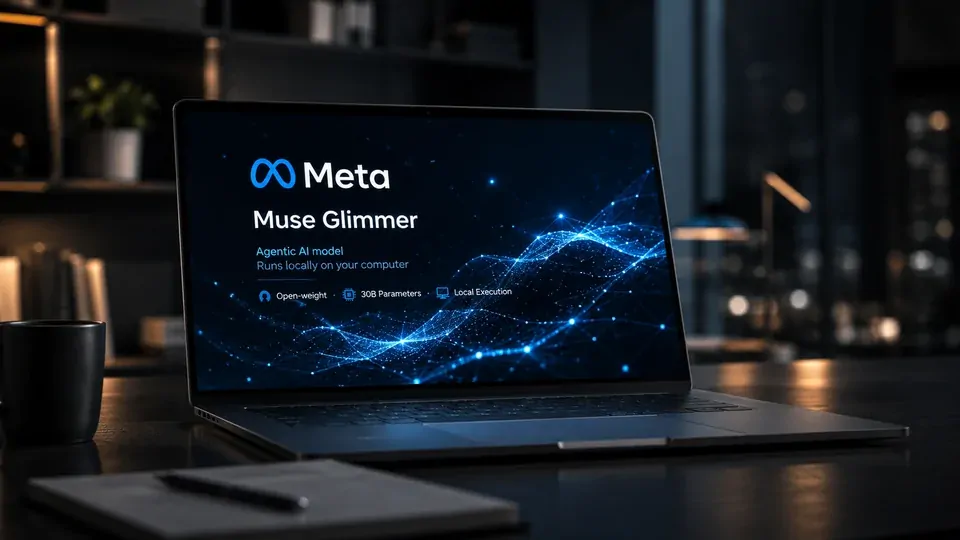
Muse Glimmer was designed to bring agentic capabilities closer to personal computer infrastructure.
What does it mean to run AI locally?
Running AI locally means that the model can perform its processing directly on a computer or within infrastructure controlled by the user.
With traditional AI services, a request is sent over the internet to the provider’s servers. Those servers perform inference, which is the process of using a trained model to generate a response or complete a task.
With a local model, part of that processing happens on the machine itself. This can reduce dependence on an external connection and provide greater control over the data used by the application.
For a business, that distinction can be significant. Internal documents, source code, operational information and other sensitive data can, depending on the implementation, remain within the organization’s own infrastructure.
Why does the focus on agents matter?
Muse Glimmer was not presented simply as another option for chatting with an AI assistant. Meta positioned the model for agentic tasks.
An AI agent is a system capable of interpreting a goal, planning steps and using tools or taking actions to achieve an outcome. That makes it different from an application that simply receives a question and returns an answer.
This makes local execution more important. An agent can perform multiple operations during a single task, and each operation sent to an external API can introduce cost, latency and dependence on third-party infrastructure.
Meta had already been moving in this direction with Muse Spark, its family of models focused on reasoning, tool use and agentic workflows. The launch of Glimmer expands that strategy with a much smaller model designed for local execution.
The launch changes Meta’s strategy in the battle against OpenAI and Anthropic
Muse Glimmer matters less because it is simply “another AI model” and more because it represents a strategic choice by Meta: distribute AI capabilities rather than concentrate them exclusively in closed services.
The company launched the model as open-weight, giving developers access to its weights so they can work with the system on their own infrastructure, within the terms of the license. This approach can create a different relationship between the model provider and the developers building applications on top of it.
The move also comes as Meta, OpenAI and Anthropic compete across different parts of the AI agent market. For Meta, local execution adds another front to that competition: having a capable model is not enough; companies also need to decide where that capability will run.
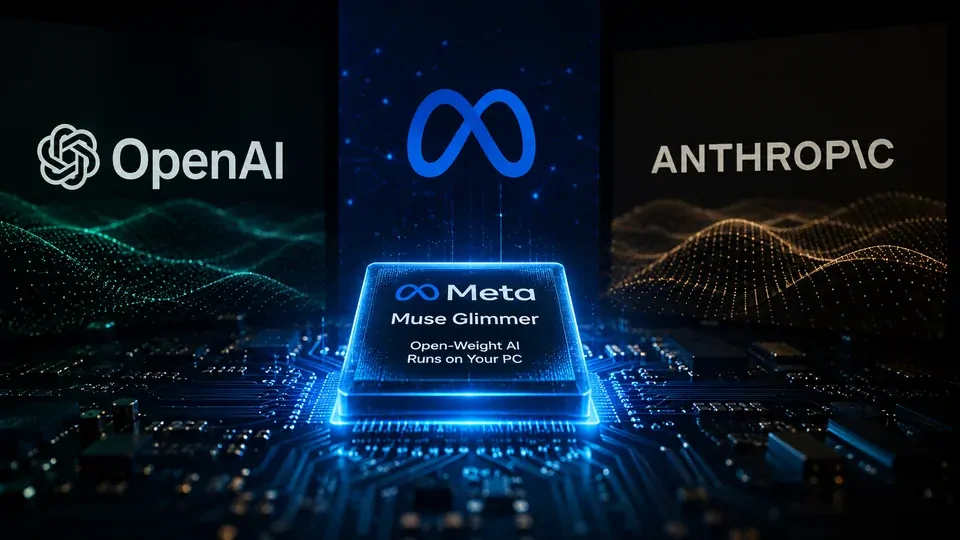
Muse Glimmer puts Meta’s open-weight strategy on a new front in the competition over AI infrastructure.
The race is no longer only about who has the biggest model
OpenAI and Anthropic have built strong positions around models primarily accessed through cloud services. Meta is pursuing a complementary strategy based on models that can reach developers’ and users’ machines directly.
That may look like a technical difference, but it has economic consequences. When a company depends on an API for every AI operation, costs generally scale with usage. With a local model, part of that cost shifts to the user’s hardware and infrastructure.
The result could be a new division of labor: larger models remain in the cloud for complex workloads, while smaller models handle frequent, private or less demanding tasks locally.
That logic helps explain why the Muse Glimmer launch comes alongside an increasingly intense race for AI hardware. The Notícia Tech has already examined how Anthropic is developing its own chips to reduce its dependence on traditional AI infrastructure in Anthropic Develops Custom AI Chips for Claude, Challenging OpenAI and Nvidia.
Meta is also entering the race over where AI runs
The strategy becomes even clearer when viewed alongside the moves of Meta’s competitors.
OpenAI is also moving into the device market, seeking to bring ChatGPT closer to everyday computing. The Notícia Tech has already covered how the company entered the hardware race for the next generation of AI-powered devices in OpenAI Enters the Hardware Race for the Next Generation of ChatGPT Devices.
The difference is that Muse Glimmer approaches the problem from another direction. Rather than creating a new device first, Meta is trying to put agentic capabilities directly onto hardware users already own.
That choice could accelerate adoption by removing an important barrier. Users do not need to wait for a new category of computer to experience local AI. If they have compatible hardware, the infrastructure is already in their hands.
The move also reinforces a trend worth watching in the coming months: artificial intelligence could increasingly be divided among the cloud, personal computers and specialized devices, with each environment handling the tasks for which it offers the best balance of cost, privacy and performance.
Local AI could change the economics of artificial intelligence
Local execution could change the economics of artificial intelligence because it shifts part of the processing workload from the servers of major AI companies to the user’s own hardware. This does not eliminate the cost of AI, but it changes who provides the computing capacity required for each task.
When a company uses an artificial intelligence API, it generally pays for the service while the provider maintains the servers, GPUs and infrastructure required to run the model. With a local model such as Muse Glimmer, part of that cost moves to the machine running the system.
That difference could become increasingly important as AI agents begin operating continuously. An agent that analyzes information, writes code, checks files and verifies results may perform many operations during a single task. If every operation depends on an external service, costs and latency can increase as usage grows.
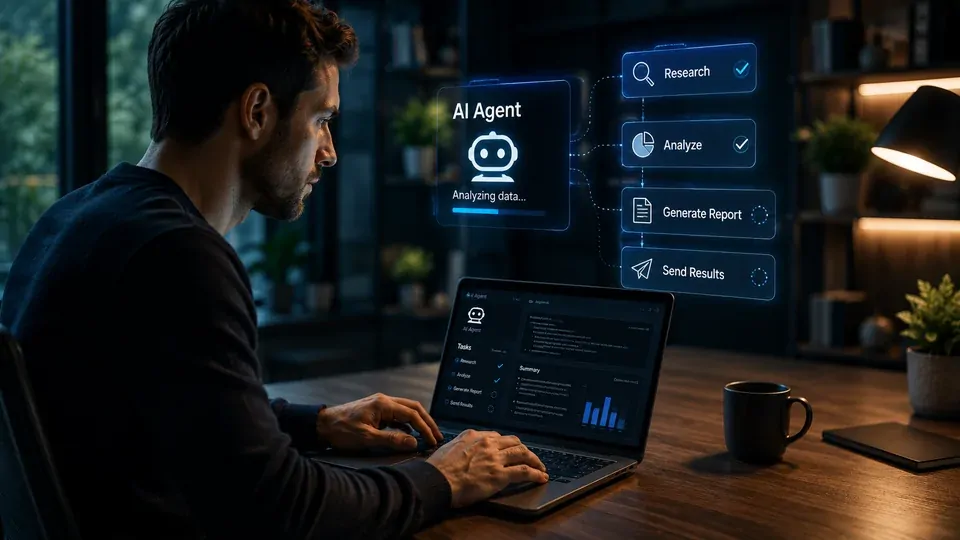
Local models can shift part of AI processing from the cloud to computers controlled by users or businesses.
What do businesses gain from processing data locally?
The first potential benefit is control. When an application runs inside a company’s own infrastructure, certain information does not necessarily have to be sent to an external provider.
That can be particularly relevant for organizations working with internal documents, proprietary source code, financial information or other data subject to specific security requirements.
However, local execution does not automatically make an AI application more secure. Security still depends on how the system is implemented, what permissions the agent receives, which model is used and how the underlying device is protected.
The second potential benefit is greater control over part of the cost structure. A company can size the hardware required for its applications instead of relying entirely on the pricing and commercial conditions of an external API.
The cost does not disappear. It moves
There is an important distinction: local AI does not mean free AI.
A company that reduces certain API expenses may need to invest in GPUs, memory, storage, electricity, maintenance and professionals capable of managing the infrastructure.
The right comparison, therefore, is not “cloud versus free.” It is the total cost of running inference in the cloud versus the total cost of maintaining local inference.
The answer will depend on workload volume, hardware prices, required performance and the model’s ability to complete tasks with minimal human intervention.
Muse Glimmer could accelerate the adoption of always-on AI agents
Muse Glimmer was designed for local agentic workflows, making the launch more significant than simply adding another open-weight model to the market.
An AI agent can interpret a goal, break the work into multiple steps and use tools to perform actions. When that process happens directly on a computer, AI can move closer to becoming an operational layer of the working environment.
This changes the relationship between users and artificial intelligence. Instead of opening a chatbot for every individual task, a professional could delegate an objective and allow an agent to execute an authorized sequence of actions.
A local agent is different from a traditional chatbot
A traditional chatbot depends largely on direct interaction with the user. The person asks a question, receives an answer and decides what to do next.
An agent works differently. It receives a goal and can break that goal into multiple actions, using tools and checking results throughout the process.
For example, a professional could ask an agent to analyze a collection of files, identify relevant information and organize the results. The value would not come only from the answer generated by the model, but from its ability to execute the entire workflow.
That is where local execution can become particularly important. An agent that remains active for long periods may generate many interactions with the underlying model. Running part of that workload directly on the computer could reduce dependence on external API calls.
Hardware is becoming part of the AI strategy
The requirement for a GPU capable of running Muse Glimmer also shows how closely AI software and hardware are becoming connected.
During the first phase of the generative AI race, users mainly needed an internet connection. The heavy processing happened inside the data centers operated by AI companies.
Now, smaller and more efficient models are making it possible to move more computing capacity directly onto the device. Meta is trying to take advantage of that opportunity with a model designed to run on a single consumer GPU.
This could benefit computer and GPU manufacturers capable of providing more memory and processing power while creating new demand for machines designed to run AI agents locally.
Businesses could begin splitting workloads between local AI and the cloud
Businesses could increasingly divide their AI workloads between local models and cloud services because each environment offers different advantages.
An application could handle simple, frequent or sensitive tasks locally and send only workloads requiring larger models to the cloud. This hybrid architecture allows processing to be distributed according to cost, privacy, speed and capability.
For businesses already using multiple AI systems, that approach could also reduce dependence on a single provider.
What changes for professionals?
For professionals, the biggest change could be the number of tasks they can delegate to AI agents directly on their computers.
A programmer could use a local model for certain coding tasks without sending every file to an external service. An analyst could work with selected documents internally. An operations professional could automate routines that require continuous access to local files and applications.
The value is not limited to text generation. The larger opportunity is turning AI into an execution layer inside the working environment.
What changes for everyday users?
For everyday users, the shift is likely to appear first through features integrated into personal computers.
Assistants capable of analyzing files, organizing information, executing commands and completing tasks without sending every step to the cloud could become more common as local hardware improves.
That could also change how people think about privacy. Instead of asking only “Which AI is better?”, users may increasingly ask where their information is being processed.
That question will become more important as AI agents gain access to more files, applications and functions on personal computers.
The next AI battle could be over who controls the execution layer
The next phase of the AI race may be defined less by the existence of a single dominant model and more by the question of where artificial intelligence actually runs.
OpenAI, Anthropic, Google and Meta are advancing across different parts of this stack. While some companies remain heavily focused on models and cloud services, others are also investing in hardware, chips, agents and devices.
Muse Glimmer adds an important piece to that landscape because it turns the personal computer itself into part of the AI infrastructure.
The market could move toward a hybrid AI architecture
The most likely outcome is not the disappearance of the cloud.
Frontier models will remain important for workloads that require enormous computing resources, while local models could handle more frequent, private and specialized tasks.
The result could be a hybrid architecture in which users do not even need to know which model is handling a particular request. The system could automatically choose between a local model and a hosted AI service based on the complexity and requirements of the task.
This could be particularly important for businesses because model selection becomes an infrastructure decision, not simply a software decision.
Meta’s advantage could be distribution
If the strategy works, Meta could gain influence without controlling every application built around Muse Glimmer.
Every developer who installs the model, every tool that supports it and every application that incorporates local execution could expand the technology’s presence across the ecosystem.
That is a different strategy from simply convincing users to open another chatbot.
Meta is trying to make its model available inside the environment where work actually happens.
And that may be the most important part of the launch. Artificial intelligence is beginning to move beyond being a service accessed through the internet and toward becoming part of the computer’s underlying infrastructure.
If local models continue becoming smaller, more efficient and more capable, the next battle between Meta, OpenAI and Anthropic may not be fought only over who produces the best answer.
It could increasingly be fought over where AI actually does the work.
Comentários
Os comentários utilizam autenticação via GitHub para manter um ambiente mais qualificado, seguro e livre de spam.
Entrar ou criar conta no GitHub