
After spending months investing heavily in large language models, Meta has officially entered one of the most competitive segments in artificial intelligence: AI coding agents. The move places the company in direct competition with ChatGPT, Claude and several other platforms racing to redefine software development.
Meta’s new AI agent raises the stakes in the coding assistant market
Artificial intelligence is rapidly evolving from conversational chatbots into systems capable of writing code, reviewing projects and accelerating the entire software development lifecycle. With its latest announcement, Meta is making a clear move into this strategic market.

Meta’s AI coding agent is designed to accelerate software development and strengthen the company’s position in enterprise artificial intelligence.
According to the company, the new agent is powered by Muse Spark 1.2, a model optimized for software engineering tasks and AI-assisted programming.
The strategy positions Meta alongside established solutions such as Claude Code from Anthropic and OpenAI Codex, which powers advanced coding capabilities within the ChatGPT ecosystem.
The focus is shifting beyond conversational AI
Over the past few years, the AI race has centered primarily on building increasingly capable chatbots.
That landscape is changing.
Technology companies are now investing in AI agents capable of completing real-world tasks instead of simply generating answers, opening a new chapter in enterprise productivity.
Software development has become one of AI’s most valuable markets
AI-powered coding assistants represent a multibillion-dollar opportunity.
They help organizations accelerate development cycles, reduce operational costs, automate testing and improve engineering productivity.
As a result, Meta’s arrival significantly increases competitive pressure across the enterprise AI landscape.
The announcement proves the competition is no longer just about ChatGPT
Meta’s latest move highlights an important shift across the artificial intelligence industry: success is no longer measured only by language model quality but by the ability to solve real business problems with specialized AI agents.
Businesses are moving from conversational AI to specialized AI agents
Meta’s announcement reinforces one of the biggest technology trends of 2026: businesses are shifting away from general-purpose chatbots and investing in AI agents designed to perform specialized tasks.
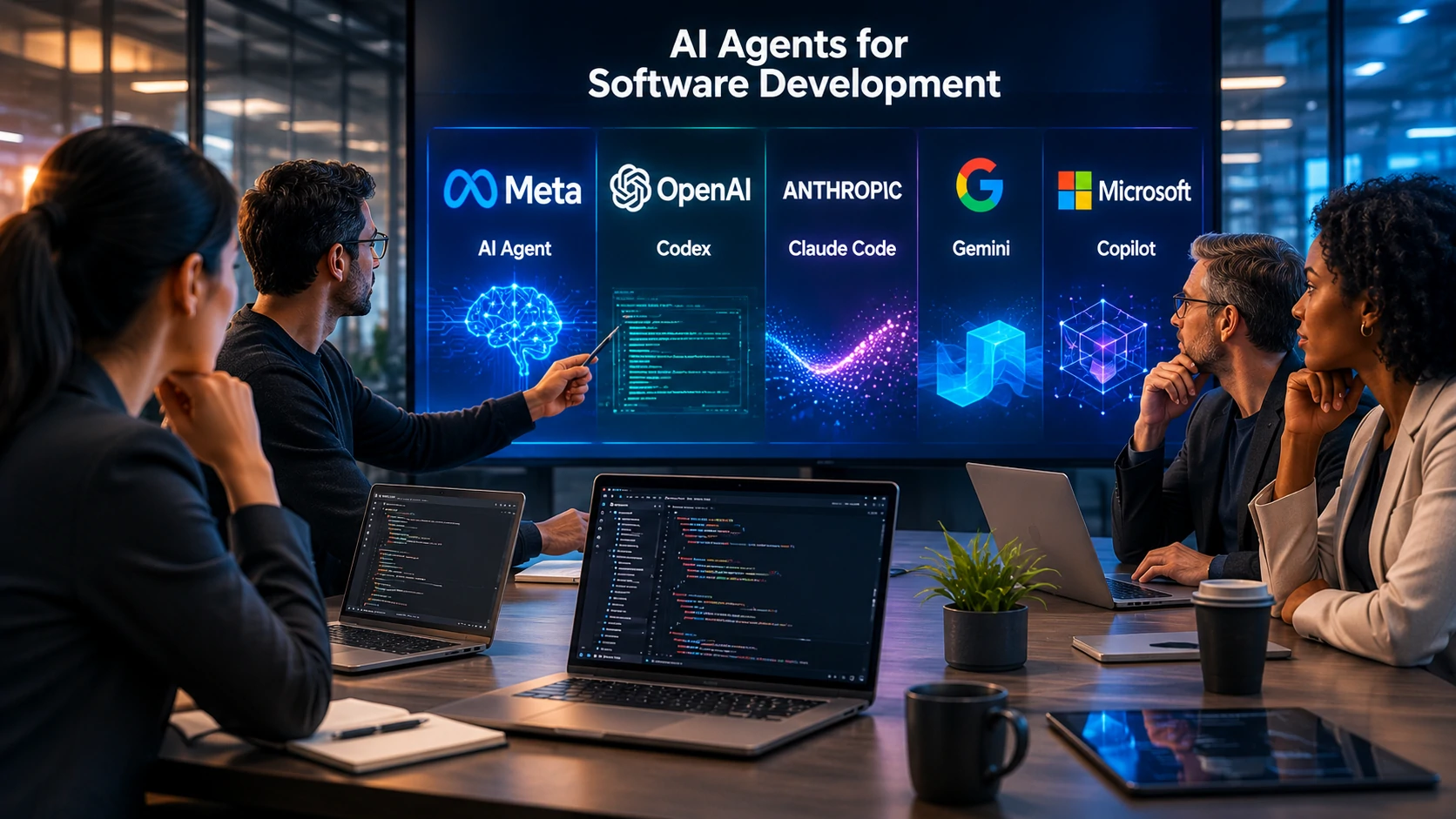
Leading technology companies are investing in specialized AI agents to improve productivity and reduce software development costs.
Over the past few months, nearly every major AI company has introduced products focused on this strategy.
Anthropic continues expanding Claude Code, while OpenAI is enhancing Codex within the ChatGPT ecosystem. At the same time, several Chinese AI companies are accelerating development of enterprise coding agents.
The message is becoming increasingly clear: the next stage of artificial intelligence will focus less on answering questions and more on completing real business tasks.
Readers interested in how organizations coordinate multiple AI systems can also explore our guide to AI Orchestration for Businesses.
The market is entering a new phase
Until recently, having the most capable language model was considered the biggest competitive advantage.
Today, success increasingly depends on integrating AI into real enterprise workflows.
That includes software development, customer service, analytics, automation and enterprise system integration.
Stronger competition benefits enterprise customers
As competition intensifies between Meta, OpenAI, Anthropic and other AI developers, businesses can expect faster innovation.
Greater competition typically results in improved capabilities, lower costs and broader integration options across enterprise software ecosystems.
What this means for businesses and developers
For organizations adopting artificial intelligence, Meta’s entry expands the number of enterprise-grade coding assistants available in the market.

Growing competition among AI leaders is expected to accelerate innovation for enterprise software teams.
Development teams will increasingly evaluate AI agents based on productivity, pricing, security, integration capabilities and overall software quality.
Rather than replacing developers, these systems are expected to automate repetitive programming tasks while allowing engineers to focus on architecture, strategic decisions and software quality.
The impact extends far beyond software development
The rise of specialized AI agents will likely influence many additional business functions.
Marketing, sales, customer support, operations and data analysis are all expected to benefit from AI systems capable of executing increasingly complex workflows.
This evolution aligns with another recent trend covered by Notícia Tech, where OpenAI accelerated its strategy for next-generation AI hardware: OpenAI Enters the Hardware Race With a New Generation of ChatGPT Devices.
The race for AI leadership is far from over
Meta’s latest announcement is unlikely to settle the competition.
Instead, it confirms that no major technology company intends to leave one of artificial intelligence’s fastest-growing markets to its rivals.
For enterprise leaders, that means a future filled with faster innovation, more capable AI assistants and increasingly powerful software development tools.
More than simply launching another AI product, Meta has signaled that the next major battle in artificial intelligence will be won by the companies capable of transforming language models into digital professionals that deliver measurable business value.
Comentários
Os comentários utilizam autenticação via GitHub para manter um ambiente mais qualificado, seguro e livre de spam.
Entrar ou criar conta no GitHub