
While many AI companies continue competing to release increasingly larger models, Microsoft has chosen a different strategy: making artificial intelligence almost invisible within the workplace. By adopting GPT-5.6 as the default model behind Microsoft 365 Copilot, the company reinforces a competition that is no longer taking place solely between AI laboratories, but between complete enterprise productivity ecosystems.
Microsoft Turns Copilot into an Even More Strategic Platform

GPT-5.6 further expands Copilot’s role as the primary interface for AI-powered productivity.
Microsoft’s decision represents far more than a routine technical upgrade. It strengthens a strategy that began with the company’s partnership with OpenAI, aiming to embed artificial intelligence directly into the applications millions of professionals use every day.
By making GPT-5.6 the primary intelligence engine behind Microsoft 365 Copilot, Microsoft significantly improves its ability to deliver more accurate responses, understand complex business contexts, and execute enterprise tasks with greater efficiency.
The focus is no longer just the model
For years, the AI industry concentrated almost exclusively on building larger and more capable language models. Today, the real competitive advantage is shifting toward the overall experience delivered to end users.
AI integrated into everyday workflows
Instead of forcing employees to switch between multiple AI applications, Microsoft continues investing in seamless AI integration across Word, Excel, PowerPoint, Outlook, and Teams, reducing friction and accelerating enterprise adoption.
This strategy complements other recent developments involving intelligent AI agents and enterprise productivity, a trend previously explored by Notícia Tech in:
Why ChatGPT Work Marks the Beginning of the AI Agent Era for Enterprise Productivity
The Enterprise AI Race Enters a New Phase
Microsoft’s latest update also reshapes the competitive landscape involving Microsoft, Google, OpenAI, and Anthropic.
Until recently, the primary selling point across the AI industry was releasing larger, faster, or better-performing language models. Today, organizations are increasingly evaluating which companies can transform those technological advances into measurable productivity gains.
Ecosystems matter more than benchmarks
Few enterprises are willing to replace their entire technology stack simply because another language model performs slightly better in standardized benchmarks.
For this reason, embedding AI directly into existing business workflows is becoming significantly more valuable than launching isolated AI models.
The real competitive advantage
Success increasingly depends on connecting documents, meetings, emails, calendars, enterprise knowledge, and business processes into a unified AI experience.
Within this new landscape, comprehensive productivity ecosystems are likely to outperform fragmented AI solutions.
Integration Could Redefine the Enterprise Software Market
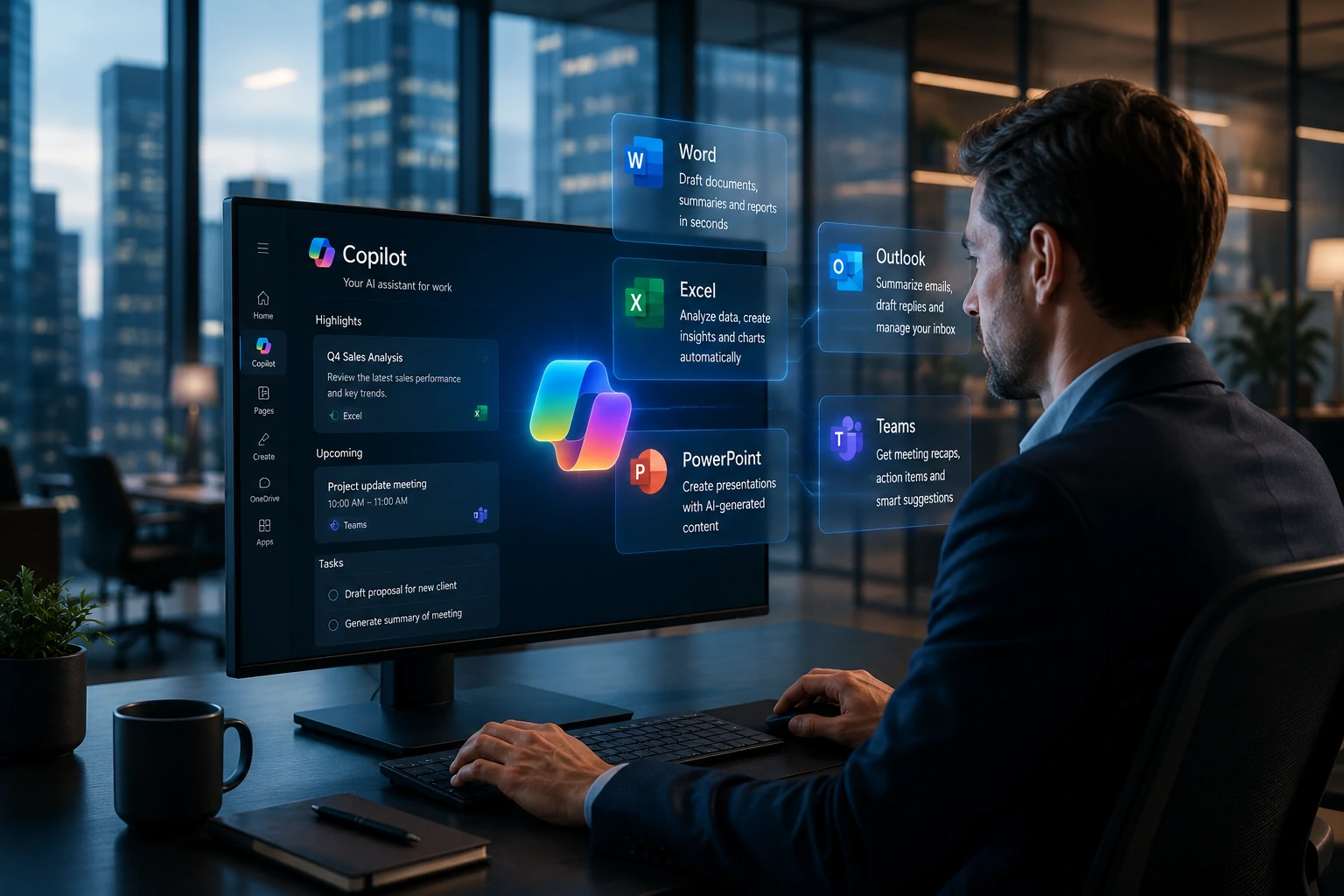
Copilot is evolving beyond an AI assistant to become a strategic layer within enterprise operations.
The evolution of Microsoft 365 Copilot reinforces an important trend across the software industry: artificial intelligence is no longer just another feature. It is becoming part of the core infrastructure that powers modern enterprise software.
As increasingly capable AI models are integrated into existing business platforms, organizations become less dependent on standalone AI tools and more reliant on unified ecosystems capable of connecting information across multiple applications.
More automation throughout Microsoft 365
The adoption of GPT-5.6 is expected to expand a wide range of business activities that previously required continuous human intervention.
These include:
- generating business reports;
- creating presentations;
- analyzing spreadsheets;
- organizing meetings;
- drafting email responses;
- producing executive summaries.
The expected outcome is a significant reduction in time spent on repetitive operational work, allowing professionals to focus on higher-value strategic decisions.
Competition shifts from technology to productivity
Businesses rarely select an AI platform simply because it has the most powerful language model.
Instead, organizations choose the platform that delivers the highest business value through governance, security, integration, scalability, and operational efficiency.
This shift explains why major technology companies are investing heavily in intelligent AI agents and workflow automation. One example is the analysis previously published by Notícia Tech:
What Is AI Orchestration? Why It Is Replacing the Competition Between AI Models in Business
What Comes Next in the Artificial Intelligence Race

The AI market is moving toward competition based on complete platforms, intelligent agents, and deeply integrated enterprise ecosystems.
Microsoft’s decision to make GPT-5.6 the foundation of Microsoft 365 Copilot suggests that the next stage of the artificial intelligence race will be defined less by the announcement of increasingly powerful models and more by the ability to deliver practical business outcomes.
Intelligent AI agents take center stage
More capable AI models make it possible for intelligent agents to execute complete workflows, interact with multiple enterprise applications, and make context-aware decisions with minimal human intervention.
This brings the industry closer to an agent-driven computing model, a trend currently being accelerated by nearly every major AI laboratory.
The impact extends beyond Microsoft
Google, OpenAI, Anthropic, Meta, and other competitors are also moving toward embedding increasingly advanced AI models throughout their enterprise ecosystems.
As a result, competition is no longer centered exclusively on language models. It increasingly revolves around productivity, infrastructure, integration, governance, security, and user experience.
Organizations capable of integrating artificial intelligence into their business processes more quickly are likely to gain meaningful competitive advantages over the coming years.
Microsoft’s latest move demonstrates that the future of enterprise AI will not be determined solely by the companies developing the most sophisticated language models. Instead, leadership will belong to those capable of transforming these models into practical, deeply integrated business tools that deliver measurable productivity at scale. This evolution is expected to intensify competition among major technology ecosystems while accelerating the widespread adoption of intelligent AI agents throughout enterprise operations.
Comentários
Os comentários utilizam autenticação via GitHub para manter um ambiente mais qualificado, seguro e livre de spam.
Entrar ou criar conta no GitHub