
The race for leadership in Artificial Intelligence has entered a new phase. While OpenAI, Google, and Anthropic have dominated headlines over the past two years, French startup Mistral AI has rapidly expanded its enterprise strategy and is now competing for one of the most valuable segments of the AI industry. The company’s latest moves could reshape the competitive landscape for enterprise AI.
Mistral AI has evolved from an emerging startup into a serious enterprise competitor

Executives reinforce Mistral AI’s growing focus on enterprise artificial intelligence.
Mistral AI has significantly expanded its enterprise presence by introducing new capabilities designed for productivity, secure deployment, and integration with private business environments.
Rather than competing solely on language model performance, the company is positioning itself as a complete enterprise AI platform capable of supporting organizations throughout their digital transformation journey.
This strategy places Mistral AI in more direct competition with OpenAI’s ChatGPT Work, while emphasizing deployment flexibility, infrastructure control, and enterprise customization.
Competition is no longer centered only on AI models
The AI industry has shifted beyond benchmark comparisons.
Today, organizations evaluate complete enterprise ecosystems that combine governance, scalability, security, integration, and operational efficiency.
As adoption accelerates, these capabilities increasingly influence enterprise purchasing decisions.
Enterprise customers expect more than powerful AI models
Business leaders now prioritize factors such as:
- enterprise-grade security;
- infrastructure flexibility;
- lower operational costs;
- seamless integration with existing systems;
- stronger governance over proprietary data.
These requirements favor vendors capable of delivering comprehensive enterprise platforms instead of standalone AI models.
A similar trend can be observed in the growing adoption of AI agents, as discussed in Notícia Tech’s analysis:
How ChatGPT Work Is Changing Enterprise Software for Businesses
Mistral AI’s expansion increases pressure on OpenAI, Google, and Anthropic
Mistral AI’s aggressive enterprise expansion is increasing competitive pressure across the AI industry.
Although OpenAI remains the dominant player in several market segments, competition has shifted away from individual language models toward complete enterprise AI ecosystems.
This transformation is expected to accelerate innovation while giving organizations more choices when selecting long-term AI partners.
How the enterprise AI race is likely to evolve
Competition between Mistral AI, OpenAI, Google, Anthropic, and other AI developers is expected to benefit organizations that are beginning their artificial intelligence journey.
The stronger the competition becomes, the greater the pressure to deliver innovation, lower costs, and practical enterprise solutions.
In this environment, offering a complete AI platform may prove more valuable than simply releasing the most capable language model.
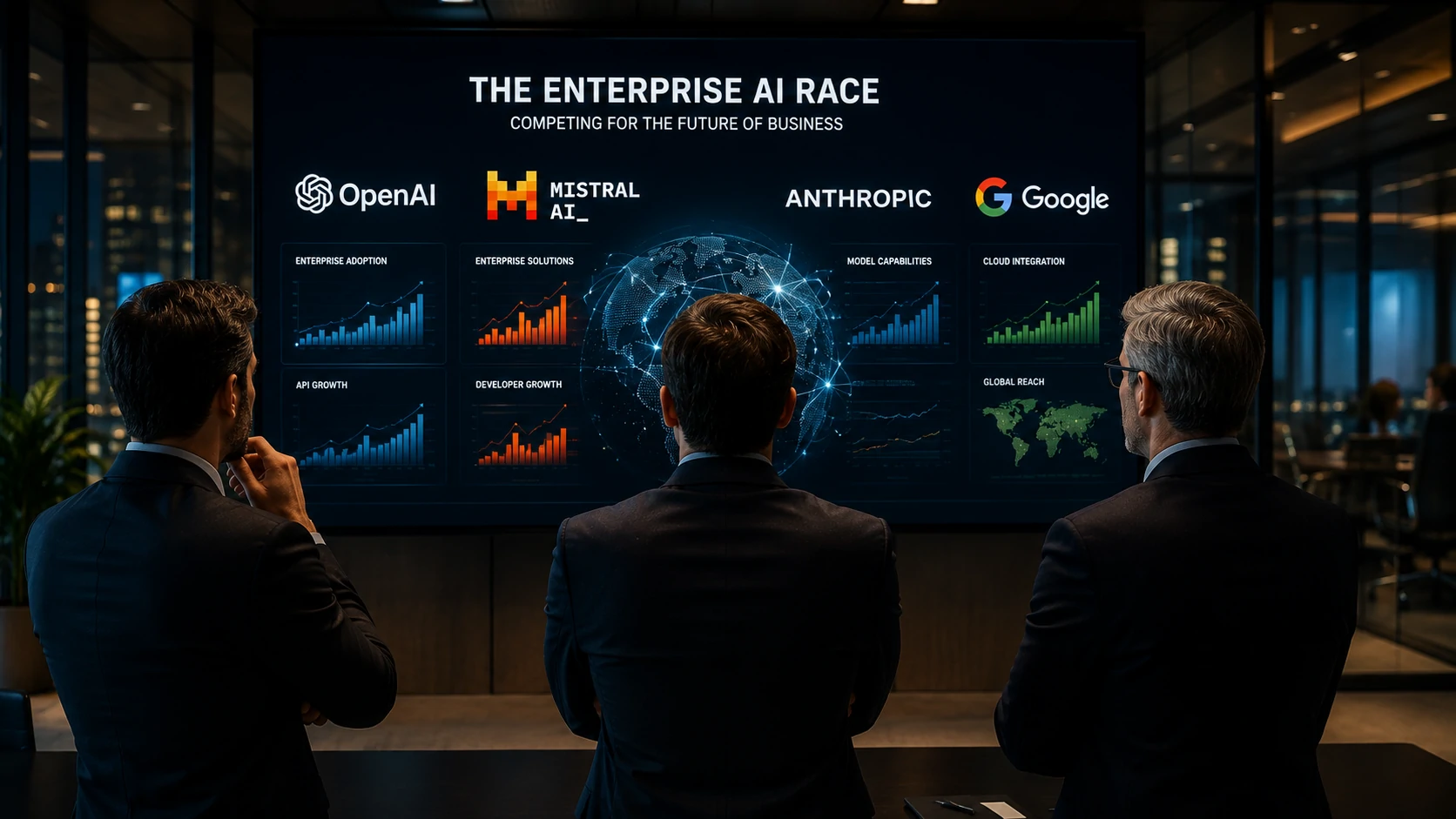
Enterprise AI has become the primary battleground among the world’s leading artificial intelligence companies.
Enterprise AI is becoming a strategic priority
Organizations are no longer evaluating AI platforms solely by response quality.
Decision-makers are increasingly considering:
- integration with enterprise systems;
- data governance;
- regulatory compliance;
- operational costs;
- deployment flexibility.
This reflects the evolution of modern enterprise AI architectures, which combine RAG, MCP, intelligent agents, and workflow automation into unified business platforms.
To better understand this transformation, read Notícia Tech’s complete guide:
Enterprise AI Architecture: The Complete Guide to MCP, RAG, AI Agents, Workflows, Copilots, and APIs
Europe may emerge as a stronger AI powerhouse
The rise of Mistral AI also signals growing momentum for Europe’s artificial intelligence ecosystem.
While many of today’s leading AI companies are headquartered in the United States, the French startup demonstrates that European innovators can still compete globally by focusing on enterprise value rather than consumer popularity.
This shift could encourage additional investment, accelerate AI research, and diversify the competitive landscape.
What businesses should consider before choosing an AI platform
Selecting an Artificial Intelligence platform now requires much more than comparing model performance.
Organizations should evaluate which vendor provides the best combination of security, scalability, governance, operational efficiency, and long-term strategic alignment.

Selecting an enterprise AI platform requires balancing long-term strategy, integration capabilities, and governance.
The lowest price does not always deliver the highest value
Enterprise AI initiatives typically remain active for many years.
As a result, choosing a platform based solely on initial pricing can create expensive migration challenges, integration limitations, or future scalability issues.
Evaluating a vendor’s long-term strategy has become just as important as evaluating model performance.
The enterprise AI market is becoming increasingly competitive
Industry analysts expect the next wave of competition to focus on:
- AI agents;
- enterprise AI platforms;
- open-weight foundation models;
- enterprise AI infrastructure;
- AI-powered productivity solutions.
For organizations, this means greater flexibility when selecting AI providers and stronger incentives for vendors to innovate.
While OpenAI continues to lead several areas of the AI industry, Mistral AI’s latest enterprise strategy demonstrates that the race for enterprise artificial intelligence is far from over. The next phase of competition will likely be determined not by who builds the most powerful language model, but by who delivers the most complete, secure, and business-ready AI ecosystem. For executives and technology leaders, closely monitoring these developments will be essential for making informed strategic decisions in the years ahead.
Comentários
Os comentários utilizam autenticação via GitHub para manter um ambiente mais qualificado, seguro e livre de spam.
Entrar ou criar conta no GitHub