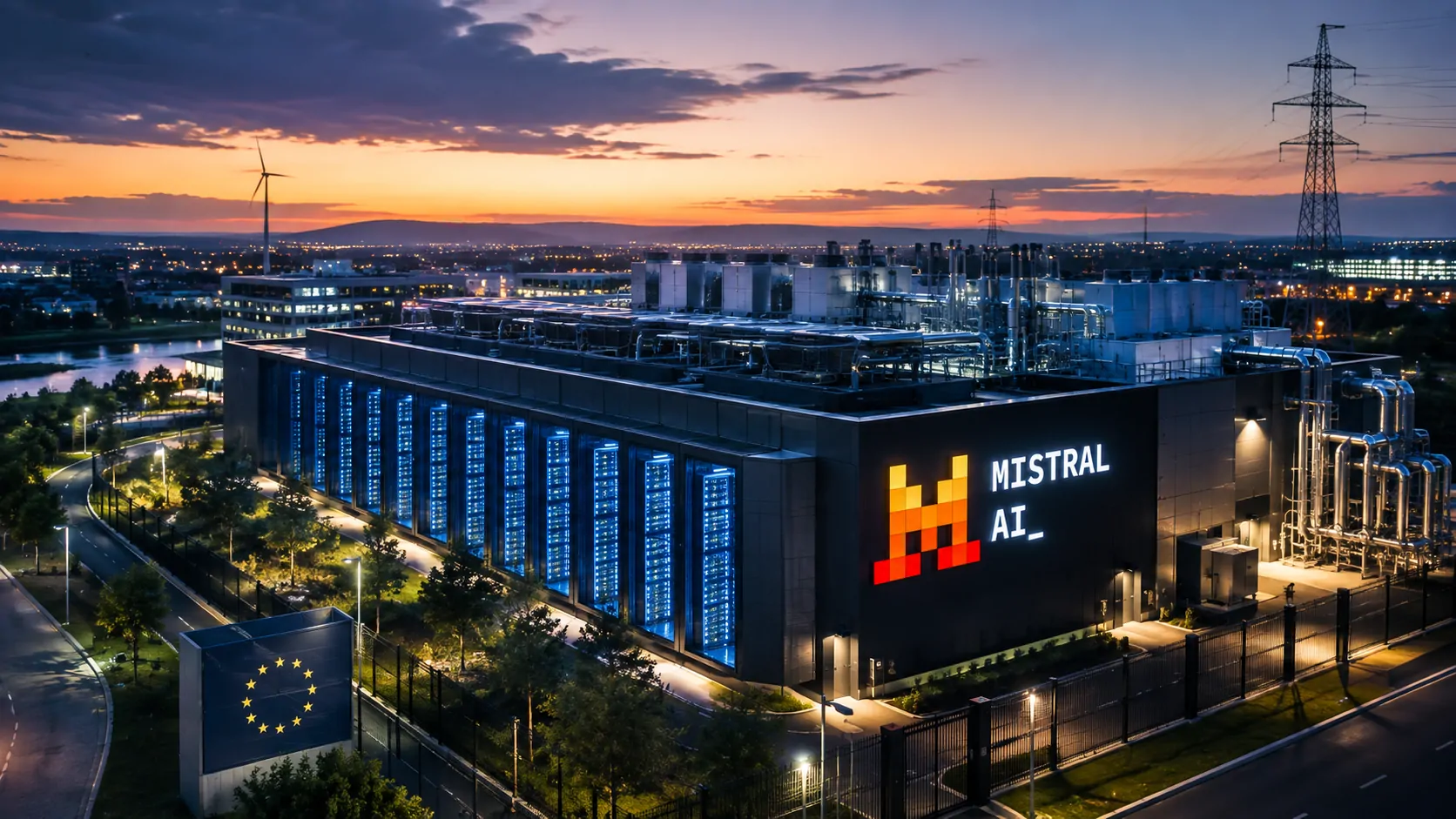
For years, the artificial intelligence race was presented as a competition to build increasingly advanced models. Now, the infrastructure required to train and run those models is becoming just as strategic as the technology itself. That is where Mistral AI is trying to change its position in Europe.
Mistral AI is turning infrastructure into a core part of its strategy
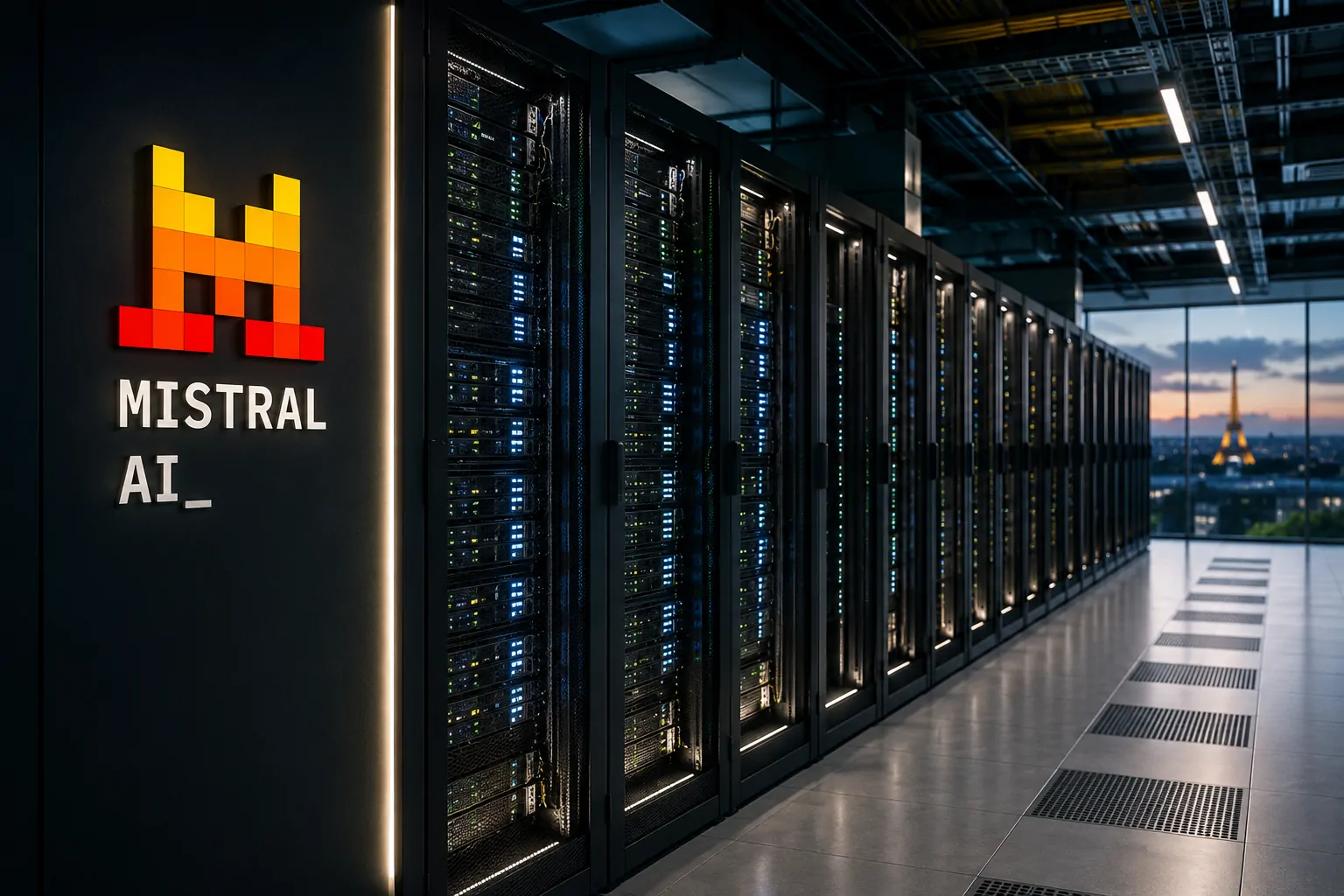
Computing infrastructure for AI is becoming a strategic piece of Europe’s technology race.
Infrastructure is becoming part of the strategy
Mistral AI is turning computing infrastructure into a core part of its growth strategy in Europe. The French company is expanding its computing infrastructure across the continent and has set a goal of reaching 1 GW of computing capacity by 2030.
The target puts the company in a race that goes far beyond AI models: the competition for energy, GPUs, data centers and computing capacity.
What sits behind an AI model
To understand why this matters, it is important to separate the AI model from the infrastructure that runs it. A model used in an AI assistant needs thousands of specialized processors to learn during training and later respond to user requests during what is known as inference.
These processors are mainly GPUs, chips designed to perform many mathematical operations in parallel. The more advanced the model becomes and the more users it serves, the greater its computing requirements tend to be.
Mistral AI is already moving in this direction with Mistral Compute, its GPU infrastructure for large-scale training and inference. The company says it is targeting 200 MW of sovereign capacity in the European Union by 2027, showing that the 1 GW goal is not starting from zero.
Why could 1 GW be so important for European AI?
A much larger scale of computing
1 GW represents a massive scale of AI computing infrastructure, because it involves much more than servers. It requires energy, cooling systems, high-speed networks, storage and facilities capable of keeping thousands of GPUs running continuously.
The difference from a conventional data center lies in computing density. Large AI systems concentrate enormous amounts of processing power into relatively compact spaces, increasing the demand for electricity and advanced cooling systems.
Why data centers need to change
Mistral AI argues that Europe needs infrastructure specifically designed for AI. In its strategy for European technological sovereignty, the company highlights that traditional data centers were not designed for the extremely dense workloads generated by frontier AI models.
That is why the discussion around 1 GW should not be understood simply as an amount of electricity. In practice, the target represents an attempt to build a computing base capable of supporting large-scale AI training, inference and enterprise services.
Europe wants to reduce its dependence on foreign infrastructure
The issue of technological sovereignty
The main strategic reason behind this expansion is to reduce Europe’s dependence on infrastructure controlled by foreign companies. Europe has universities, researchers, companies and a huge consumer market, but a significant share of the advanced computing used by AI applications is connected to major technology providers from the United States.
The problem became more visible as AI moved from an experimental technology to an economic infrastructure. Banks, manufacturers, software companies, governments and defense organizations increasingly rely on models capable of processing large amounts of data.
The risk of depending on external capacity
In this environment, relying exclusively on external infrastructure can create risks involving cost, availability, data governance and even operational continuity.
Mistral AI’s strategy also needs to be understood within a broader shift across the market. AI companies are trying to control more parts of the technology stack, from the models themselves to the infrastructure required to run them.
The shift is taking different forms. While Mistral expands its computing capacity, other companies are increasing investments in data centers and chips. The race is no longer simply about who has the best model. It is increasingly about who can secure enough computing power to support millions or billions of operations.
This context helps explain why Mistral had already been adopting a broader infrastructure and enterprise-services strategy, a move previously analyzed by Notícia Tech in its coverage of the company’s full-stack strategy: Mistral AI is trying to control more of the infrastructure needed for AI agents and applications.
The infrastructure race could be as important as the model race
Computing has become a strategic asset
The major shift is that computing has become a strategic asset for the AI industry. Having a competitive model is not enough if a company cannot deliver that model with the required speed, scale and cost efficiency.
For companies using AI, this has a direct consequence: the quality of an AI service also depends on the infrastructure behind it.
A company may choose an excellent model, but it still needs to consider where that model will run, how much each operation costs, how much computing capacity is available and which rules apply to the data being processed.
The impact goes beyond Mistral AI
That is why Mistral AI’s expansion matters to the enterprise market even for companies that have never used its models. If more competitive computing capacity becomes available in Europe, European companies could gain additional options for running AI workloads without relying exclusively on the same global providers.
The impact could also reach the data center industry. AI expansion is increasing demand for land, electricity, power grids, cooling systems and specialized components. Digital infrastructure is therefore beginning to compete directly with other industrial and energy priorities.
Amazon’s strategy, for example, shows how energy scale has already become part of the AI strategy of major companies. Building infrastructure to power data centers is no longer a secondary issue; it has become part of the technology race itself. Amazon’s infrastructure expansion shows why energy is becoming one of AI’s biggest bottlenecks.
What changes for companies and users in the coming years
More options for European companies
For companies, the most important consequence could be a broader range of AI infrastructure options within Europe. This could matter to organizations that need to balance performance, data location, regulatory requirements and operational continuity.
For technology professionals, the shift means that knowledge of AI models will increasingly be accompanied by decisions involving GPUs, cloud computing, data centers, inference and computing architecture.
The impact on people using AI
For end users, the impact will be less visible, but it could appear through more available AI services, new regional providers and greater competition between platforms.
The central point is that infrastructure is becoming harder to treat as an invisible layer. As models grow larger and AI agents perform more tasks continuously, computing capacity increasingly determines how much a company can offer, how quickly it can deliver it and at what price.
Mistral AI is betting that this shift will create room for a European alternative. The question now is whether the company can turn its 1 GW by 2030 target into infrastructure that is actually built, connected to the power grid and used by enough AI workloads to justify the investment.
The 1 GW target also reveals AI’s new problem: energy
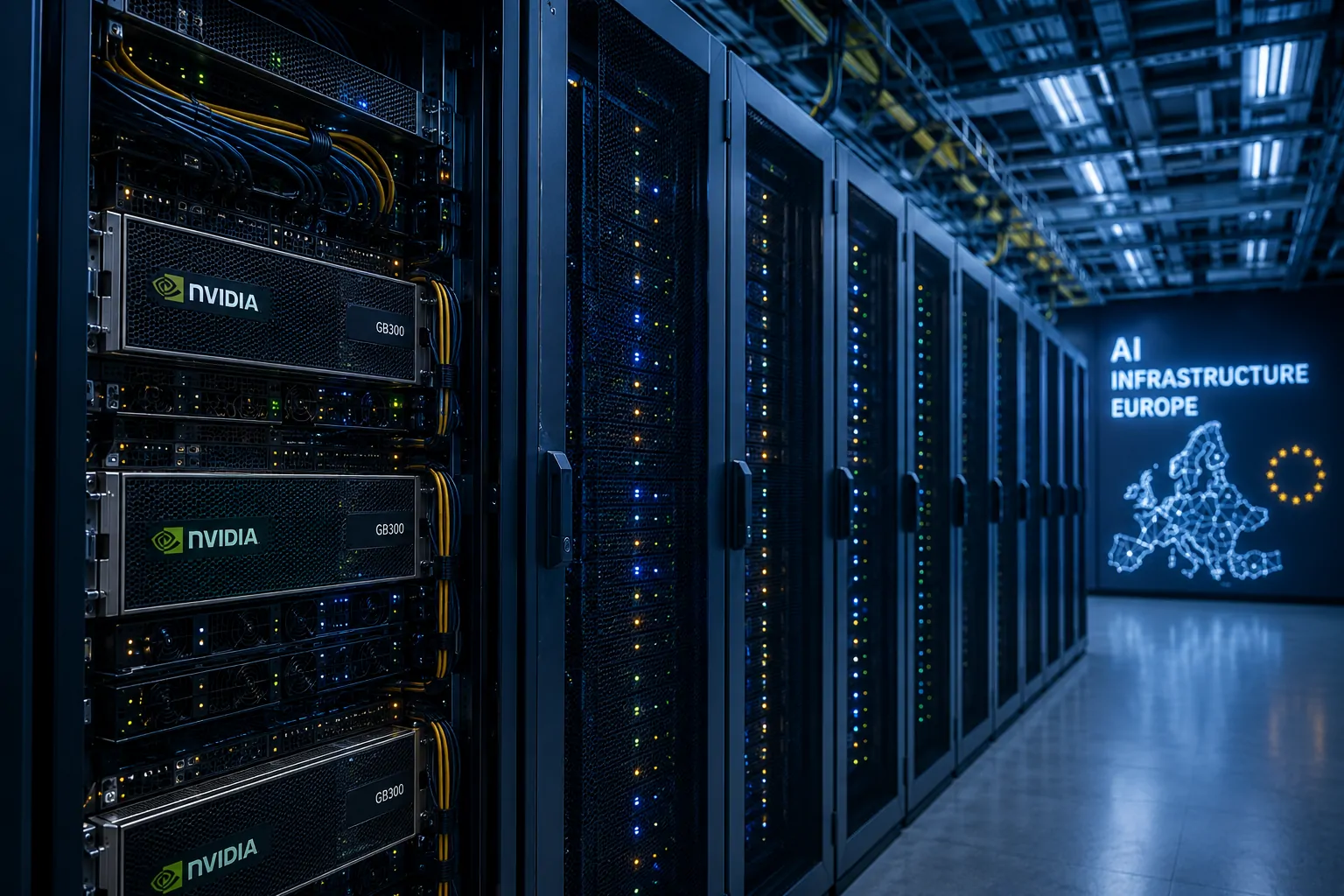
AI GPU clusters require substantial power capacity, advanced cooling and high-speed networking.
Energy is becoming a limit to expansion
Mistral AI’s expansion shows that the next stage of the artificial intelligence race will be constrained not only by chips, but also by the ability to supply energy and operate data centers designed for AI.
That puts the 1 GW by 2030 target into perspective.
This is not simply about installing more computers. An AI cluster needs a stable power supply, systems capable of removing the enormous amount of heat generated by processors, high-speed connections between thousands of GPUs and the ability to keep everything operating continuously.
Infrastructure requires capital and scale
Mistral AI is already moving in this direction. In June 2026, the company announced a partnership with Campus AI in France to secure an initial 96 MW and eventually reach up to 200 MW of computing capacity. The infrastructure is expected to support both Mistral’s model training and inference services for customers.
The company also revealed a data center near Paris with 13,800 NVIDIA GB300 GPUs, associated with 44 MW of power capacity. The project was financed through an $830 million debt transaction.
That shows the financial scale of the challenge.
Building AI infrastructure requires investments long before enough revenue exists to recover the capital. Mistral’s expansion is therefore not only a technology decision. It is also a long-term financial bet on the continued growth of demand for AI computing.
The infrastructure race also changes the competitive landscape
Mistral AI is entering a part of the AI market where scale can determine competitive advantage. Companies with access to large amounts of computing capacity can train models faster, serve more users and experiment with new products without depending entirely on external infrastructure.
This creates a different kind of competition from the one seen during the first phase of generative AI.
OpenAI, Google, Anthropic, Meta and other major players are investing heavily in computing infrastructure because model performance increasingly depends on access to enormous amounts of compute.
Mistral AI’s approach is different in one important respect: the company is positioning European infrastructure as part of its competitive identity.
That could become especially relevant for governments and companies that want AI services operating under European jurisdiction.
Mistral AI is betting on a European AI ecosystem
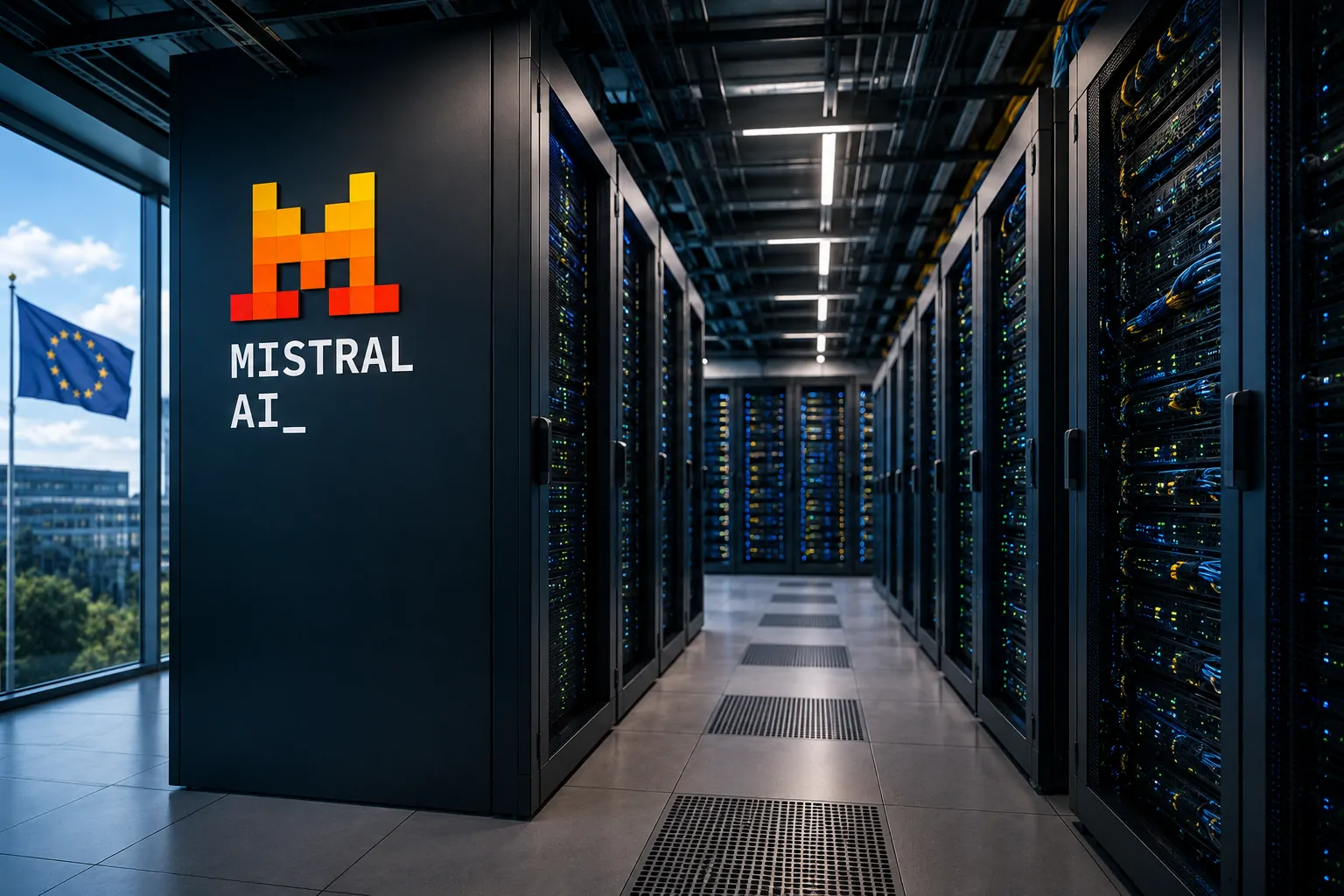
Building computing capacity in Europe could strengthen the region’s position in the global AI race.
The strategy goes beyond selling AI models
Mistral AI is no longer simply competing to create another alternative to OpenAI, Anthropic or Google. Its strategy increasingly connects models, infrastructure and enterprise services.
That matters because businesses do not buy an AI model in isolation.
They need infrastructure, security, data governance, APIs, integration capabilities and predictable performance. The provider capable of delivering more of this stack can potentially become more important to enterprise customers.
This is also why the company’s strategy connects with the broader movement toward AI agents and enterprise AI infrastructure.
As AI agents begin interacting with business systems, companies need architectures capable of connecting models with internal applications, databases and workflows. The infrastructure underneath those systems becomes part of the overall value proposition.
This transformation is already visible in the enterprise market, where AI is moving from isolated assistants toward more integrated systems capable of performing tasks across business processes. AI orchestration is becoming an important layer for companies deploying AI agents.
Europe wants more control over strategic AI infrastructure
For Europe, the discussion has an additional dimension.
Technological sovereignty is becoming a strategic objective as artificial intelligence becomes critical infrastructure.
If European companies depend almost entirely on computing capacity controlled by foreign technology companies, Europe may have less control over an increasingly important layer of its digital economy.
That does not mean Europe needs to build every component of the AI stack domestically. The semiconductor industry itself remains global, and advanced GPUs are produced through complex international supply chains.
Instead, the objective is to ensure that Europe has enough computing capacity, data centers, cloud infrastructure and AI companies to avoid becoming entirely dependent on external providers.
Mistral AI’s infrastructure strategy fits directly into that objective.
What could prevent Mistral AI from reaching 1 GW?
The biggest challenge is execution
A 1 GW target is ambitious, but announcing computing capacity is not the same as putting it into operation.
The company must secure financing, electricity, land, data center facilities, networking equipment, GPUs and cooling systems. It must also ensure that the infrastructure can operate at high utilization rates.
The economics are particularly important.
AI infrastructure can require billions of dollars in capital expenditure. If demand grows more slowly than expected, expensive computing capacity can become an inefficient asset.
On the other hand, if AI demand continues expanding rapidly, companies with access to large infrastructure reserves could gain a significant advantage.
Electricity could become the real bottleneck
The availability of power may ultimately be more restrictive than the availability of GPUs.
AI data centers are consuming increasing amounts of electricity, and connecting large facilities to the power grid can take years in some markets.
This creates a strategic problem for companies such as Mistral AI: building a new AI cluster is not simply a matter of purchasing servers.
The infrastructure needs an energy ecosystem capable of supporting it.
That makes Europe’s energy policy increasingly connected to its AI strategy.
If Europe wants to compete with the United States and Asia in artificial intelligence, it will need not only advanced models and startups but also enough electricity and data center capacity to run them at scale.
What this means for the AI market
Mistral AI’s infrastructure expansion points to a broader change in the artificial intelligence industry: compute is becoming a competitive moat.
During the early generative AI boom, much of the attention was focused on model benchmarks, chatbot features and new applications.
Now the strategic questions are becoming different:
- Who controls the GPUs?
- Who has access to enough electricity?
- Who can build data centers quickly?
- Who can operate large AI clusters efficiently?
- Who can offer enterprise customers regional infrastructure?
- Who can reduce dependence on external cloud providers?
The companies capable of answering those questions may have an advantage even when their models are not always the most powerful in every benchmark.
For European companies, this could eventually mean more choice.
Instead of relying on a small number of US-based technology giants for advanced AI infrastructure, organizations could have access to a larger European ecosystem of models, cloud services and computing capacity.
Mistral AI’s bet is bigger than 1 GW
The 1 GW target is therefore more than an infrastructure expansion plan. It represents a bet on where the AI industry is heading.
Mistral AI is betting that future competition will depend on controlling more of the infrastructure required to build and operate artificial intelligence.
That strategy could strengthen the company’s position against larger rivals if European demand for sovereign AI infrastructure grows quickly.
But the opposite is also possible.
The capital required to build large-scale AI infrastructure is enormous, and the company will have to demonstrate that the capacity it builds can generate enough economic value to justify the investment.
For now, the strategic direction is clear: Mistral AI wants to become not only a European AI model company, but also a major infrastructure player.
What changes now for companies?
For businesses evaluating AI providers, the development means that the decision is becoming broader than simply asking which model performs best.
Companies will increasingly need to evaluate:
Model performance: how well the AI handles their specific workloads.
Infrastructure availability: whether enough computing capacity exists to support production use.
Data governance: where information is processed and under which jurisdiction.
Cost: how much training and inference will cost at scale.
Reliability: whether the provider can maintain consistent service as demand grows.
Strategic independence: how much the company depends on a single cloud or infrastructure provider.
This shift is particularly important for organizations deploying AI agents, because autonomous systems can generate continuous workloads rather than occasional chatbot requests.
As AI becomes embedded into business operations, infrastructure decisions will increasingly become technology strategy decisions.
The bigger AI race is moving underneath the models
The most important takeaway from Mistral AI’s expansion is that the AI race is moving beneath the application layer.
The public may see chatbots, AI agents and new model releases. Behind those products, however, companies are competing for GPUs, electricity, data centers, networking capacity and capital.
That infrastructure determines how quickly AI companies can scale.
Mistral AI’s decision to target 1 GW of computing capacity by 2030 shows that the company believes Europe cannot compete in artificial intelligence by focusing only on software.
It also needs the physical infrastructure capable of running the next generation of AI.
And that could become one of the most important battles in the European technology market over the next few years.
FAQ
What is Mistral AI building in Europe?
Mistral AI is expanding its own artificial intelligence computing infrastructure in Europe, including large GPU clusters designed for AI training and inference.
What does 1 GW of AI capacity mean?
A gigawatt represents a very large power and computing scale. For Mistral AI, the target represents the infrastructure capacity it aims to build to support large-scale AI workloads by 2030.
Why does Mistral AI want its own infrastructure?
The strategy gives the company greater control over computing capacity, performance and infrastructure availability while reducing part of its dependence on external cloud providers.
Why is AI infrastructure important for Europe?
Because access to computing capacity is becoming strategically important. More European infrastructure could reduce dependence on foreign providers and strengthen the continent’s technological sovereignty.
Will Mistral AI stop depending on Nvidia chips?
Not necessarily. Building its own infrastructure does not mean manufacturing the processors used inside that infrastructure. A company can control data centers and computing clusters while still relying on chips supplied by other companies.
Could the 1 GW target change the AI race in Europe?
It could contribute to a more competitive European AI ecosystem by increasing the continent’s available computing capacity. However, the impact will depend on execution, financing, energy availability and actual demand for the infrastructure.
Mistral AI is making a clear strategic statement: Europe’s AI ambitions will require more than competitive models.
They will require computing capacity.
The company’s plan to expand toward 1 GW by 2030 places infrastructure, energy and technological sovereignty at the center of its strategy.
For the European market, that could create more options for companies seeking AI services with regional infrastructure and stronger control over data and operations.
For Mistral AI, however, the challenge is much larger.
It must prove that it can finance, build and efficiently operate infrastructure at a scale normally associated with the world’s largest technology companies.
If it succeeds, Mistral AI could become an important part of Europe’s emerging AI infrastructure layer.
If demand, financing or energy availability become obstacles, the 1 GW target could prove much harder to achieve than it looks on paper.
Either way, one thing is becoming increasingly clear: the next phase of the AI race will be fought not only in models and software, but also inside data centers.
Comentários
Os comentários utilizam autenticação via GitHub para manter um ambiente mais qualificado, seguro e livre de spam.
Entrar ou criar conta no GitHub