
While much of the market’s attention remains focused on OpenAI, Anthropic, and Google, a European company has been quietly accelerating its expansion. The recent surge in search interest for Mistral AI suggests that businesses and technology professionals increasingly view the French startup as one of the strongest alternatives in the enterprise artificial intelligence race.
Mistral AI has evolved from a promising startup into a serious competitor in enterprise AI
Mistral AI is no longer seen as an emerging player. It is becoming a credible enterprise alternative by combining efficient language models, deployment flexibility, and a strategy designed specifically for business customers.

The rapid growth of the French company is attracting organizations looking for alternatives to the largest artificial intelligence providers.
Throughout most of 2024 and 2025, discussions about enterprise AI were dominated by OpenAI, Google, and Anthropic. In 2026, however, the competitive landscape began to shift.
Mistral AI has emerged as one of the fastest-growing AI companies in terms of market attention, indicating that executives, developers, and enterprise decision-makers are increasingly evaluating its APIs, foundation models, and enterprise solutions.
Search growth reflects genuine business demand
Rising search volume represents far more than simple curiosity.
It often signals that organizations are actively comparing vendors, evaluating AI platforms, and researching technologies before making strategic investment decisions.
Historically, this type of behavior tends to precede broader enterprise adoption.
Companies are looking to reduce vendor dependence
Another major driver is diversification.
Many organizations are no longer comfortable relying exclusively on a single AI provider for mission-critical applications.
This creates opportunities for companies like Mistral AI, which offer additional choices for developing AI agents, enterprise copilots, and large language model applications.
The trend also aligns with broader industry developments, including stronger competition among enterprise AI platforms and the growing adoption of open AI architectures.
To better understand how this market has evolved, read Notícia Tech’s analysis on Mistral AI’s enterprise strategy:
Mistral AI follows a different strategy from the major U.S. AI companies
The biggest differentiator for Mistral AI is its strategic positioning.

The company emphasizes flexibility, efficient models, and greater freedom for enterprise deployment.
While companies such as OpenAI and Google continue expanding their own integrated AI ecosystems, the French startup focuses on providing organizations with greater deployment flexibility.
That approach appeals to enterprises seeking more control over infrastructure, operating costs, governance, and long-term AI strategy.
Strong emphasis on open-weight models
Much of Mistral AI’s reputation has been built around releasing powerful open-weight models.
This allows organizations to customize deployments for specific business requirements without depending entirely on proprietary cloud infrastructures.
That flexibility is especially valuable for highly regulated industries such as finance, healthcare, manufacturing, and government.
A clear enterprise-first strategy
Another defining characteristic is its commercial focus.
Rather than competing primarily for consumer adoption, Mistral AI concentrates on enterprise APIs, business partnerships, and corporate AI integrations.
This strategy places the company directly inside the fastest-growing segment of the artificial intelligence market.
The movement also reflects a broader shift toward architectures such as MCP (Model Context Protocol), which simplify integration between enterprise systems and AI applications. Learn more in Notícia Tech’s guide:
Mistral AI’s rise is increasing competition and accelerating innovation across the enterprise AI market
The expansion of Mistral AI represents more than the growth of a single company. It demonstrates that the enterprise artificial intelligence market is evolving beyond a landscape dominated by only a handful of providers and entering a new phase of stronger competition.
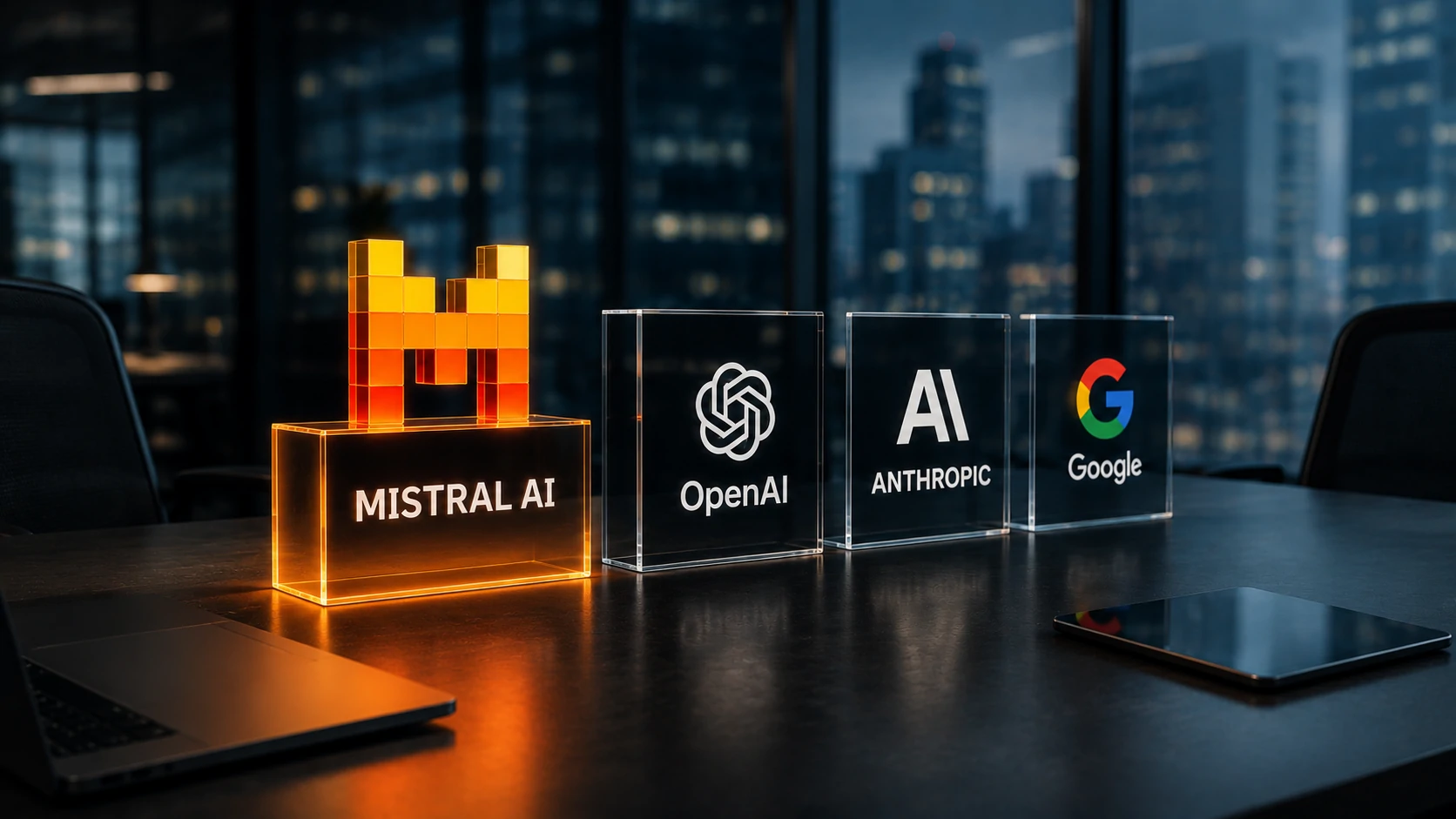
The rapid growth of Mistral AI is intensifying competition among providers of enterprise large language models.
This shift primarily benefits organizations planning to invest in AI over the coming years. As competition increases, companies can expect faster innovation, broader integration options, improved model quality, and a better balance between performance and cost.
Businesses gain more strategic choices
Until recently, many organizations evaluated only solutions from OpenAI, Anthropic, or Google.
With Mistral AI becoming a more credible enterprise option, technology leaders now have additional alternatives when designing AI strategies and selecting foundation models for long-term projects.
Greater competition reduces the risks associated with vendor lock-in while giving enterprises stronger negotiating power during procurement and implementation.
Flexibility is becoming a competitive advantage
Another important trend is the growing demand for adaptable AI platforms.
Organizations operating in regulated industries or managing sensitive corporate data increasingly seek solutions that provide greater control over deployment, governance, security, and infrastructure.
Providers capable of supporting multiple deployment models are therefore likely to gain a stronger position as businesses continue accelerating their digital transformation initiatives.
Mistral AI’s momentum highlights a long-term trend in enterprise artificial intelligence
The rapid rise of Mistral AI demonstrates that the global AI race is far from settled.
While OpenAI, Anthropic, and Google continue expanding their ecosystems, new competitors are winning enterprise contracts, releasing specialized language models, and securing a larger role in increasingly sophisticated business applications.
For enterprise leaders, the most important question is no longer which company leads today’s rankings. Instead, the focus is shifting toward identifying vendors capable of delivering sustained innovation, competitive performance, flexible deployment options, and long-term business value.
In that environment, Mistral AI has moved beyond being viewed simply as an alternative provider. It is now part of the group of companies actively shaping the future of enterprise artificial intelligence.
Organizations planning investments in AI agents, intelligent automation, and large language models throughout 2026 should closely monitor how this competitive landscape evolves, as today’s strategic decisions may define tomorrow’s technological advantage.
Comentários
Os comentários utilizam autenticação via GitHub para manter um ambiente mais qualificado, seguro e livre de spam.
Entrar ou criar conta no GitHub