
Mistral is pushing the enterprise AI race into a less visible but increasingly important layer: the ability to find and verify knowledge inside complex documents. With Agentic Search, the company is betting that AI agents need to do more than retrieve a relevant passage before producing an answer.
Mistral turns search into an investigation process
Mistral launched Agentic Search to allow AI agents to search, navigate and verify information across complex documents. The approach expands on traditional retrieval by allowing an agent to run additional searches when the initial results are not enough.
Search is no longer a single step
In a conventional RAG architecture, the system searches for relevant information in a knowledge base and passes the retrieved passages to the model. The model then uses that context to generate an answer.
Agentic Search adds an investigation layer. The agent can run a search, open a result, navigate through the document, look for specific terms and return to the search process when it determines that more information is needed.
The goal is to find stronger evidence
The distinction matters because enterprise documents rarely contain a complete answer in a single paragraph. A financial figure may depend on both a table and an explanatory note. A contract may establish a rule in one section and define an exception somewhere else.
In these situations, retrieving only the passage that is most semantically similar to a question may not be enough. Agentic search is designed to let the agent continue investigating the source.
Complex documents have become a bottleneck for enterprise AI
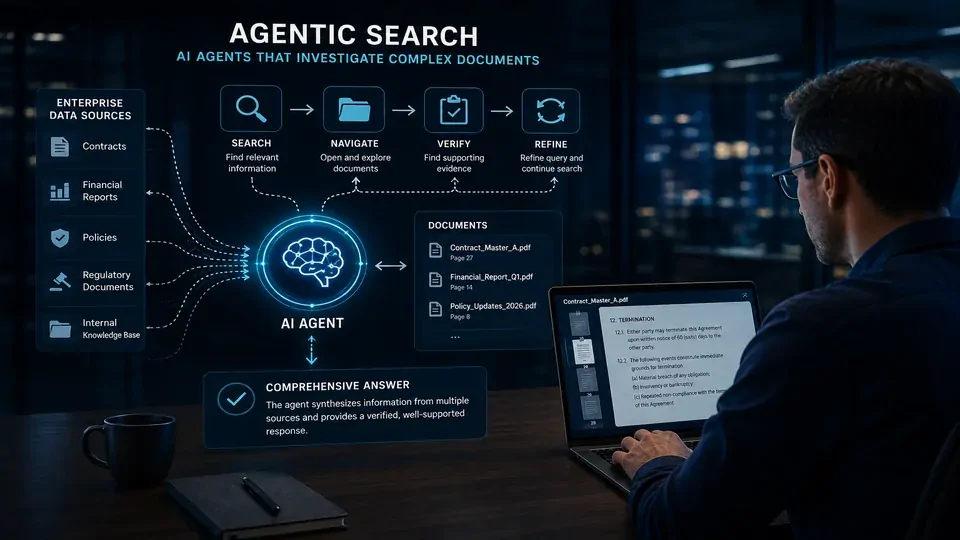
Enterprise documents can require agents to find information distributed across multiple sections before producing an answer.
The problem is not only the model
Companies are deploying AI in processes that depend on contracts, reports, regulatory documents and internal knowledge bases. In these environments, a more capable model does not solve the problem by itself if the context provided to the system is incomplete.
Answer quality also depends on the quality of the information retrieved. If an agent fails to find a relevant exception or overlooks an important section of a document, its reasoning may start from a flawed premise.
Mistral reports gains in its tests
Mistral says Agentic Search delivered improvements in evaluations involving financial documents and document question-answering tasks. In FinanceBench, the company reports an increase from roughly 27% to 86% accuracy in its evaluation.
The figure should be understood as a result reported by Mistral itself, not as a guarantee of performance across every enterprise environment. Still, it illustrates the central thesis behind the product: for certain tasks, improving information retrieval can have a significant effect on the final answer.
The shift places RAG inside a more intelligent architecture
Agentic search does not eliminate RAG. Instead, it adds an orchestration layer capable of deciding how to search and when to continue investigating a source.
Semantic retrieval remains important
Enterprise systems can still use keyword search, semantic retrieval or hybrid strategies. These techniques remain responsible for identifying relevant candidates within knowledge bases.
The difference comes afterward. Rather than assuming that the first results are sufficient, the agent can use the retrieved information to determine its next action.
The agent gains the ability to verify context
This change brings document retrieval closer to the agent’s reasoning process. The question is no longer simply “which passage looks relevant?” but also “what else do I need to find to answer this correctly?”
For enterprise applications, this could reduce situations where an answer appears plausible but was built on incomplete context. Retrieval becomes part of the decision-quality process rather than merely a preliminary technical step.
Mistral expands its bet on enterprise AI infrastructure

Mistral’s strategy places models, tools and knowledge retrieval within an integrated architecture for enterprise applications.
The company is competing beyond models
The launch reinforces Mistral’s broader strategy in the enterprise market. The company has been building an offering that combines AI models, developer tools and infrastructure for enterprise applications.
Agentic Search expands that positioning because it can be incorporated into AI agents rather than depending on a specific chatbot interface.
Retrieval becomes infrastructure
The strategic consequence is that companies need to look at more components of their AI architecture. The model remains important, but it is only one part of a system that also needs to handle documents, knowledge bases, tools, permissions and integrations.
This shift also connects to the growing ecosystem of protocols and tools designed to connect agents with external systems. The goal is moving beyond simply answering questions toward allowing agents to find information and perform tasks inside enterprise environments.
The launch connects to the challenge of turning documents into knowledge
Agentic search solves only part of the problem. Before an agent can search for information, companies need to ensure their documents can be properly processed and used by AI systems.
OCR is an earlier layer
This challenge is already visible in Mistral’s work on document processing. The company has developed OCR technology designed to turn complex documents into information that can be used by AI models and applications.
The Mistral OCR 4.1 effort, for example, addresses an earlier stage of this pipeline. Document processing transforms content into a structure that can subsequently be indexed and retrieved. The Notícia Tech has previously examined how Mistral OCR 4.1 addresses the document bottleneck for enterprise AI.
Agentic Search represents the next stage: after making documents accessible to AI, the system needs to find and verify the right information.
Enterprise knowledge needs context
This increases the importance of knowledge architecture inside companies. Simply storing thousands of documents and connecting them to a chatbot is not enough.
Organizations also need to determine which sources can be queried, how those sources are updated, which users have access and how agents should handle conflicting or incomplete information.
That challenge will become increasingly important as companies adopt AI agents capable of operating across real business processes.
The next challenge will be proving value in enterprise environments
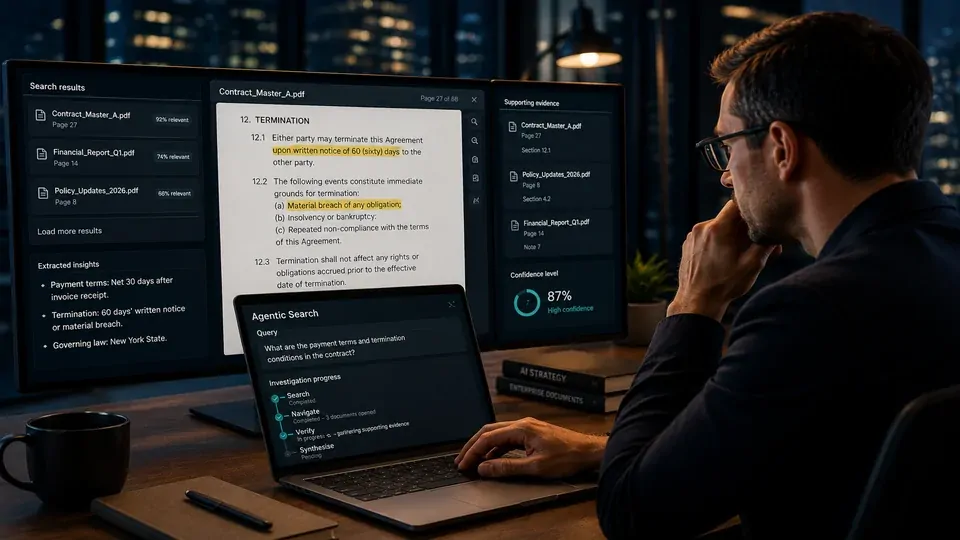
The ability to verify information across multiple steps could become important for agents used in critical enterprise processes.
Benchmarks do not replace real-world operations
The results presented by Mistral help explain the product’s value proposition, but enterprise adoption will depend on factors that benchmarks cannot fully capture.
Cost, latency, security, document quality, integration with existing systems and access controls will determine whether agentic search delivers a meaningful operational advantage.
Retrieval could become a strategic differentiator
Mistral’s move points to an important shift in enterprise AI architecture. As agents begin working with real-world documents, the ability to retrieve information correctly stops being a supporting function and starts directly influencing the quality of responses and decisions.
This also increases the importance of architectures that combine models, data and tools. The discussion around enterprise AI architecture is therefore moving beyond the model itself toward how the overall system accesses and uses an organization’s knowledge. The Notícia Tech has also covered how RAG, MCP, AI agents, automation and copilots fit together in enterprise AI architecture.
Agentic Search is a concrete bet on this direction. If the approach scales, the next major competition in enterprise AI may be less about generating an answer and more about finding, verifying and contextualizing the information that supports it.
Comentários
Os comentários utilizam autenticação via GitHub para manter um ambiente mais qualificado, seguro e livre de spam.
Entrar ou criar conta no GitHub