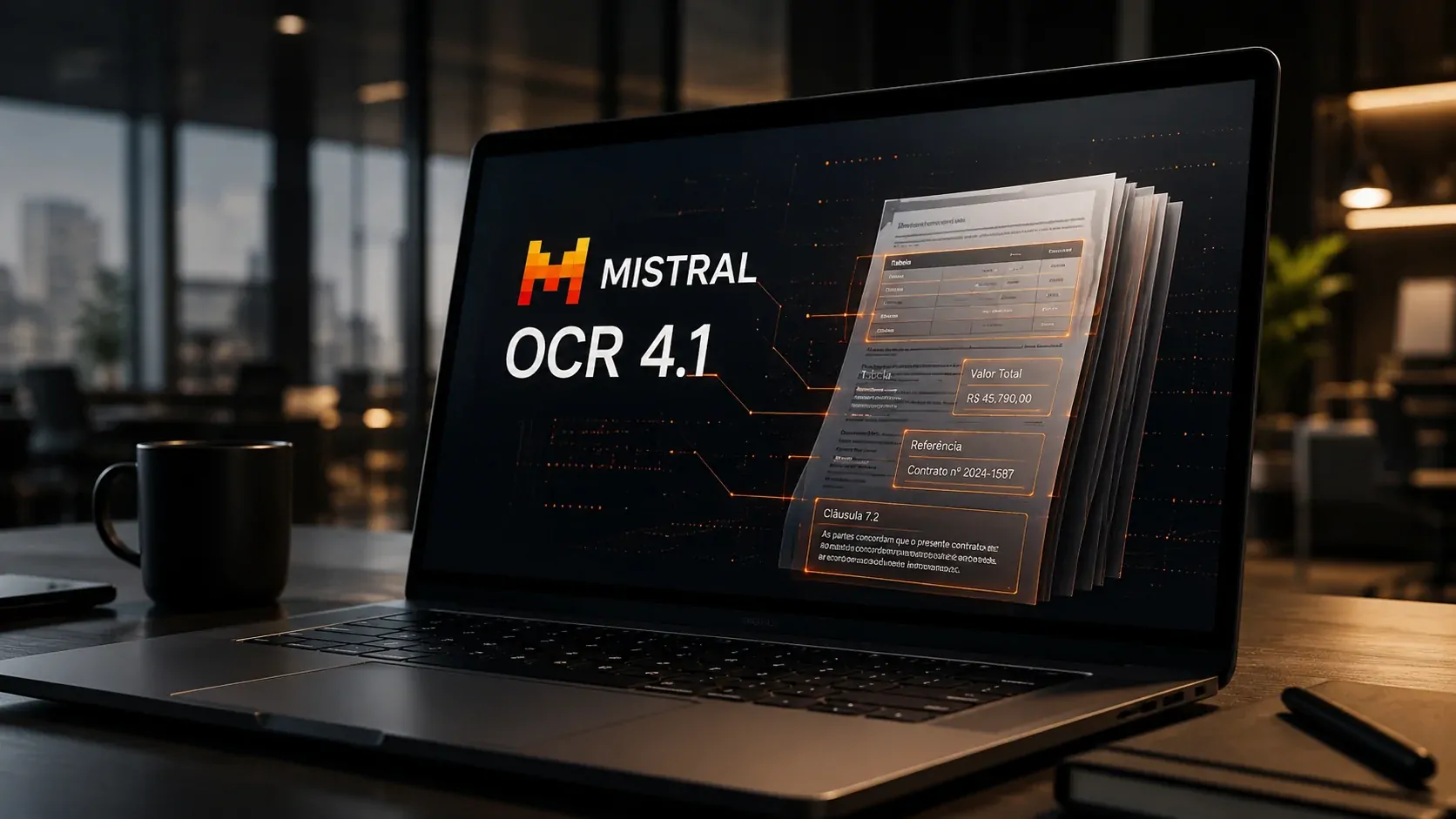
As companies race to bring AI agents and language models into the enterprise, there is a less visible stage that can determine whether those systems actually work: turning real-world documents into data that AI can understand. That is where Mistral AI is making another move.
Mistral OCR 4.1 targets a problem that appears before the AI generates an answer
Mistral OCR 4.1 is an update to OCR 4 launched by Mistral AI on August 13, 2026, with the goal of improving the understanding of complex pages, particularly documents packed with annotations, references, tables, and different visual elements.
OCR stands for optical character recognition. In simple terms, it is the technology that turns information contained in an image or scanned document into data that a computer can interpret.
The problem is that enterprise AI does not work only with clean blocks of text. Contracts, financial reports, invoices, forms, technical documents, and scanned files can combine text, tables, images, signatures, references, and elements positioned in different parts of the same page.
The problem is not just reading the words
A business application needs to know more than simply whether a particular word appears in a document.
It needs to understand where that information is located, which block it belongs to, and whether it is part of a table, reference, heading, or another structural element. That difference may seem minor, but it can determine whether information is retrieved correctly by an AI application.
OCR 4 had already moved in this direction by providing bounding boxes, structural block classification, and confidence levels. A bounding box is an area defined by coordinates that indicates the position of a specific element on a page.
Version 4.1 focuses on improving this type of precision. According to Mistral, the boxes now align more accurately with elements on complex pages, without the shifts seen previously and without nested image structures that could complicate downstream processing.
Why does this matter to a business?
Imagine a company with thousands of digitized contracts. An AI system may be able to extract the text from those files, but that does not mean the information is ready to power enterprise search or an AI agent.
If a table is interpreted incorrectly, a reference is associated with the wrong block, or information contained in an annotation disappears during extraction, the problem can propagate through the rest of the system.
That is why the progress represented by Mistral OCR 4.1 matters more than it may initially appear. Mistral is improving a layer that sits before the language model itself: the transformation of raw content into structured information.
This also helps explain why the company is treating document processing as part of the enterprise AI infrastructure rather than simply as a secondary text-recognition feature.
OCR 4.1 improves the areas where real-world documents often fail
Mistral OCR 4.1 is designed to reduce structural errors in complex documents while preserving the relationship between the different elements on a page.
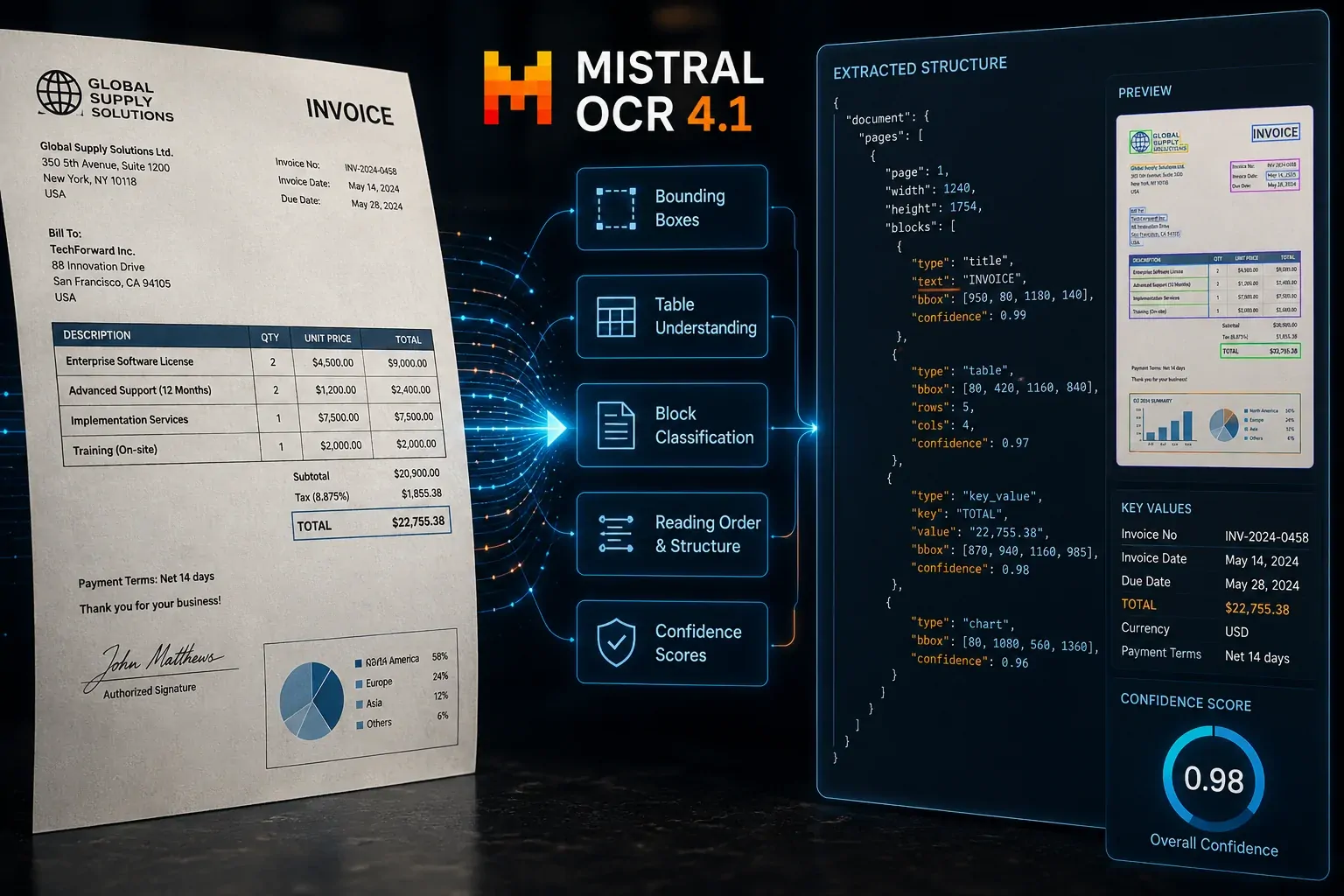
- Mistral OCR 4.1 aims to preserve the structure of complex documents so AI systems can use their information more accurately.*
The launch does not represent a complete departure from OCR 4. The strategy is more targeted: address problems that appear when the model has to process visually dense pages while continuing to evolve the technology for Document AI, enterprise search, and business automation.
References, blocks, and checkboxes come into focus
Among the announced improvements are changes to how reference pages are structured. Instead of treating an entire list as a single block, the system now does a better job of preserving the individual elements of each reference.
The model also loses fewer blocks on complex pages. This matters because an enterprise document may contain information distributed across multiple regions, and losing just one section can compromise later extraction.
Another improvement involves recognizing different checkbox styles, a useful capability for forms, administrative processes, and documents that rely on visually marked fields.
Mistral also says it has improved its handling of right-to-left tables. This type of capability matters for multilingual documents and organizations operating across different regions.
The most important change happens after OCR
The strategic value of modern OCR does not end when the text has been extracted.
The resulting content can be sent to a RAG system, a technology that combines a language model with a search layer over external documents. Within a business, this allows AI systems to answer questions using contracts, internal policies, manuals, reports, or other documents as sources.
The Notícia Tech guide on enterprise AI architecture also explores this relationship between information retrieval, AI agents, and automation.
Mistral itself presented Mistral OCR 4 as an ingestion component for enterprise search, RAG, and agent workflows. The model also introduced block classification, bounding boxes, and confidence levels to make extracted content more useful to the stages that follow in an AI pipeline.
This architecture changes how the problem should be viewed: an AI system can have an excellent language model and still produce poor answers if the information reaching it is incomplete or poorly structured.
The enterprise AI race increasingly starts before the model
The main consequence of the launch is that competition in enterprise AI is moving into a less visible layer: the quality of the information that feeds AI models.
For a long time, market attention focused on which company had the best language model, the largest context window, or the lowest inference cost. Now, as businesses connect AI to their own documents, the ability to turn unstructured data into usable information is becoming nearly as important.
Documents are the fuel for many enterprise AI projects
A company may have a sophisticated language model, but much of the knowledge needed to answer employee questions or execute business processes can still be scattered across PDFs, contracts, spreadsheets, presentations, forms, and scanned documents.
That content has to pass through an ingestion stage before reaching a search system or AI agent. If that stage produces incomplete data, the error may surface later as an apparently convincing answer based on defective information.
That is why OCR improvements are directly connected to the quality of RAG, enterprise search, and AI agents.
Mistral’s move also gains context from the company’s broader strategy around AI infrastructure in Europe. The company has been expanding its focus on infrastructure and computing capacity as it scales its AI services.
The real bottleneck may be at the data entry point
This scenario creates an important shift for technology leaders. When evaluating an AI project, it is no longer enough to ask which model will be used.
They also need to ask how documents will be processed, how much information will be preserved, how tables and structures will be interpreted, and how the extracted data will reach the search system or AI agent.
OCR 4.1 illustrates this change in perspective. Enterprise artificial intelligence is not made up only of the model that generates the answer. There is an entire chain before it involving capture, extraction, structuring, indexing, and retrieval.
Over the coming months, this layer is likely to become even more important as companies move beyond isolated chatbot experiments and begin connecting AI agents to the documents and processes that support their operations.
The launch puts pressure on the enterprise AI data layer
The progress represented by Mistral OCR 4.1 comes at a time when companies are trying to turn their own documents into knowledge sources for artificial intelligence systems.
That changes the importance of OCR. It is no longer just a tool for digitizing documents. It increasingly acts as an entry point for AI applications.
When a contract, report, or form is converted correctly, its content can move into search engines, databases, RAG systems, and AI agents. When structure is lost during that stage, the problems can surface later, including in answers generated by language models.
Mistral’s update reinforces this competition over the quality of document ingestion.
RAG depends on the quality of what it can retrieve
RAG is an architecture in which an AI model retrieves external information before generating an answer. Within a company, those sources can include internal documents, policies, contracts, or knowledge bases.
The process may look simple, but it depends on several stages. First, documents must be processed. Then, the content needs to be structured and indexed. Only after that can the system locate the relevant passages for a particular question.
That means improving OCR can have effects far beyond document reading itself.
If a table is preserved correctly, for example, an application has a better chance of understanding the relationship between its values and their corresponding headers. If references are separated correctly, it becomes easier to retrieve exactly the information that is needed.
OCR 4.1 does not solve every problem in a RAG system, but it operates at a stage that can influence the quality of everything that follows.
Companies could gain a new layer for document automation
The potential impact becomes clearer when looking at where documents appear in business processes.
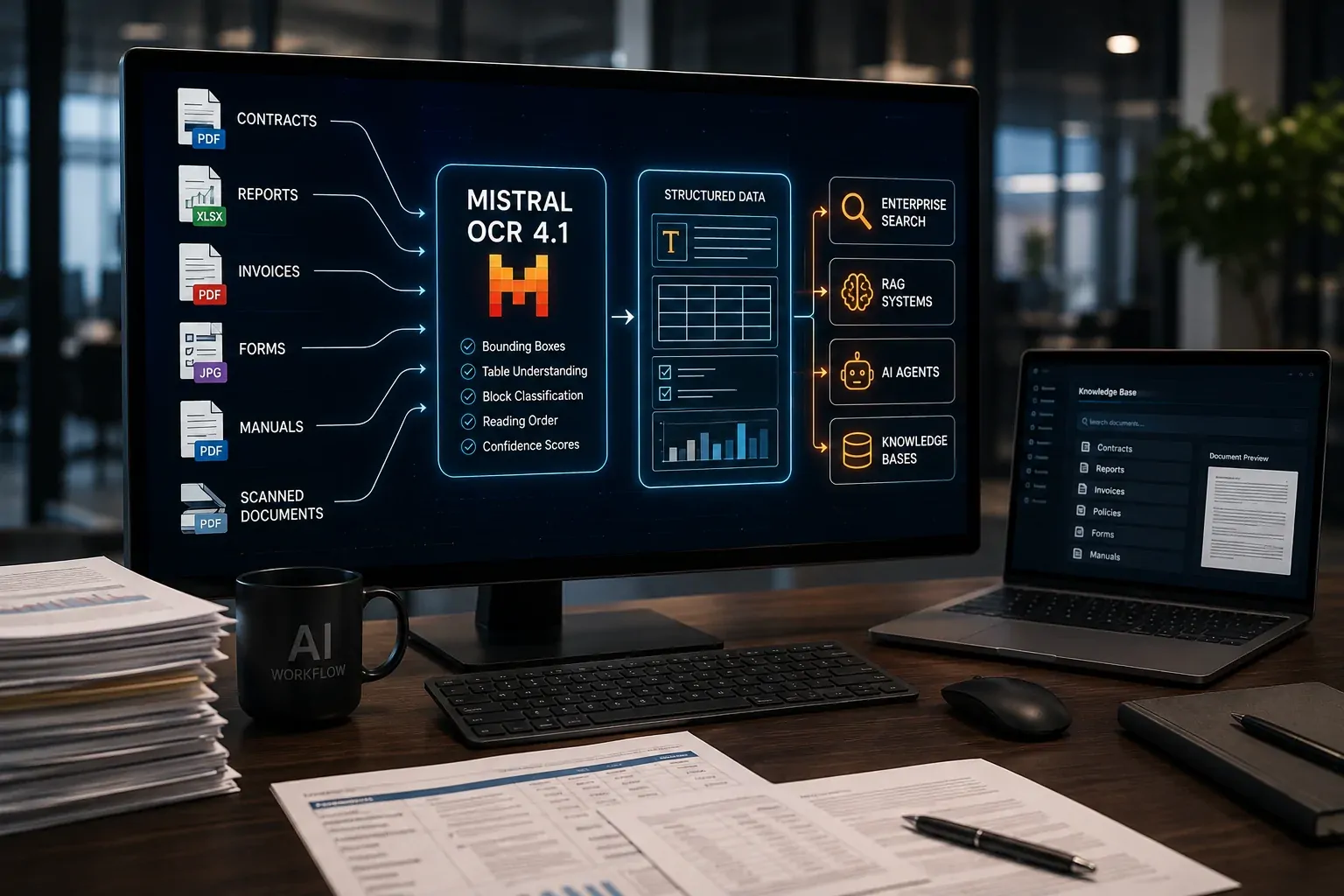
Corporate documents can feed search systems, RAG applications, and AI agents after passing through an extraction and structuring layer.
A company may receive hundreds or thousands of documents every month. Some arrive in digital formats, while others may be scanned, contain complex tables, or use structures that were never originally designed to be interpreted by machines.
Until now, many automation initiatives have needed to combine different tools to handle this problem.
One OCR system identifies the text. Another component attempts to reconstruct the structure. An application then has to organize the resulting data so it can be searched or sent to a language model.
The more stages involved, the greater the possibility of information being lost.
Where the gains could appear in practice
In finance departments, the technology could help transform accounting documents and reports into more structured data.
In legal teams, it could facilitate the ingestion of contracts and documents containing large numbers of references.
In operations, it could help process forms, manuals, and internal records.
In customer support, processed documents could feed a knowledge base used by search systems or AI agents.
This does not mean OCR 4.1 will automate these processes by itself. The technology is one component of a larger architecture.
The potential gain lies in making this first stage more reliable so other tools can work with a representation that stays closer to the original document.
What changes for companies building AI internally
The launch also has a strategic consequence for technology professionals.
Enterprise AI projects often begin with model selection. A company compares performance, context, cost, and reasoning capabilities before deciding which LLM to use.
But when a system depends on internal documents, model selection represents only one part of the architecture.
The complete pipeline can include storage, OCR, classification, indexing, retrieval, a language model, external tools, and increasingly AI agents capable of taking actions.
In this environment, an excellent model cannot indefinitely compensate for a poor data layer.
Evaluation needs to move beyond the model and into the pipeline
Mistral OCR 4.1 reinforces a trend that is likely to become increasingly important: companies will need to evaluate the entire document-processing pipeline.
That means measuring not only the quality of the final answer, but also questions such as:
- how much content was extracted correctly;
- whether tables retained their structure;
- whether references remain associated with the correct elements;
- whether important information was lost;
- whether the position of elements can be traced;
- and whether extracted data can be used safely by the application.
This shift is especially important in sectors where a document-processing error can have financial, legal, or operational consequences.
OCR therefore becomes part of the broader discussion around AI governance. Governance means establishing controls to ensure that artificial intelligence systems are used safely, traceably, and in accordance with an organization’s rules.
Mistral turns an OCR improvement into a broader competitive battle
The OCR 4.1 launch also shows how competition among AI companies is expanding.
The race is no longer limited to models that communicate directly with users. It also involves specialized components that remain largely invisible inside applications.
OCR, embeddings, vector databases, retrieval systems, and AI agent tools are examples of layers that can determine the quality of an enterprise AI solution even when end users never interact with them directly.
Mistral’s strategy is particularly relevant because the company has been positioning its document technologies as components for enterprise applications rather than simply as standalone text-recognition tools.
Cloud platforms are also treating Mistral’s OCR models as components for processing images and PDFs in enterprise applications.
Price remains part of the decision
There is, however, another issue companies will need to consider beyond accuracy.
Processing large volumes of documents costs money. In enterprise applications, OCR costs have to be considered alongside storage, embeddings, search, model inference, and infrastructure.
That means an improvement in accuracy does not automatically make a technology the best choice for every project.
The real calculation will depend on the balance between quality, cost, speed, privacy, and deployment capabilities.
This matters because Mistral’s OCR API pricing has also been a consideration for users evaluating different versions of the technology.
For a small company processing a limited number of documents, that difference may have little impact. For an organization processing millions of pages, the cost per thousand pages can fundamentally change the architecture decision.
The next AI bottleneck may be what models still struggle to read correctly
Mistral OCR 4.1 arrives with a message that goes beyond a technical update: the quality of artificial intelligence increasingly depends on the quality of the data that reaches it.
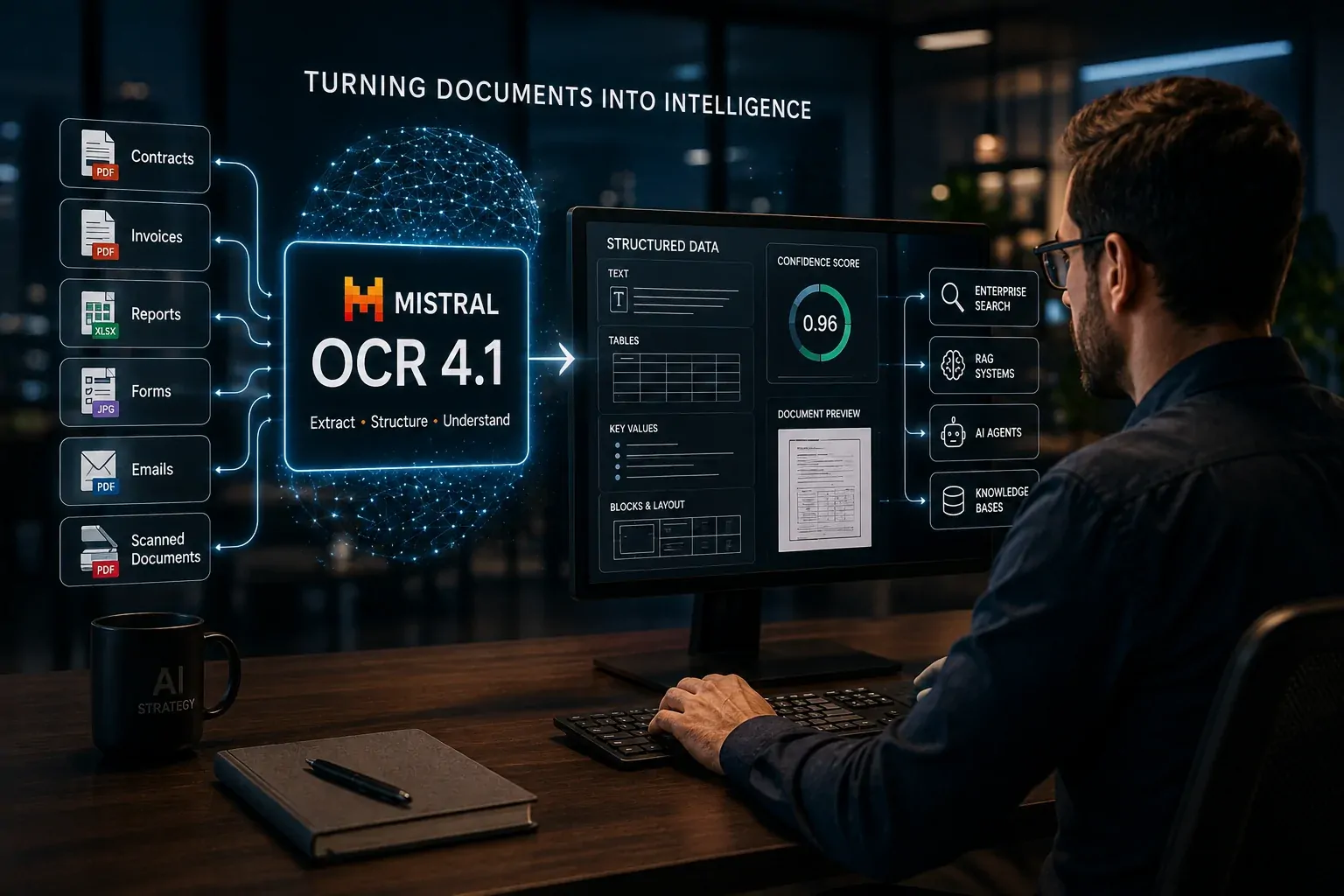
As AI agents begin operating on corporate documents, the quality of the ingestion layer becomes an increasingly important part of system reliability.
This trend is likely to strengthen over the coming months.
Companies that are experimenting with chatbots today may move toward systems capable of querying internal documents. Those systems can then evolve into AI agents that not only find information but also execute tasks based on it.
The greater the autonomy, the greater the impact of an error made at the beginning of the process.
If a chatbot gives an incorrect answer about a document, a user may notice and correct it. If an agent incorrectly interprets a clause, a financial figure, or an operational instruction and then automatically takes an action, the consequences can be much more significant.
That is why OCR progress is connected to a broader transformation in enterprise AI architecture.
The next generation of applications will not depend only on models capable of reasoning. They will depend on systems capable of reading, structuring, retrieving, verifying, and using real-world information.
That is where Mistral OCR 4.1 becomes relevant.
The update does not eliminate the document bottleneck, nor does it mean that enterprise documents can now be understood perfectly by machines. What changes is the attempt to reduce one of the sources of information loss that occurs before the AI itself.
For businesses, the consequence is direct: AI projects increasingly need to look beyond the model itself and focus on the complete path traveled by data.
The enterprise AI race may therefore be entering a phase in which the ability to turn complex documents into reliable information could become as important as having the most powerful model.
Comentários
Os comentários utilizam autenticação via GitHub para manter um ambiente mais qualificado, seguro e livre de spam.
Entrar ou criar conta no GitHub