While the race to build increasingly powerful AI models continues to dominate headlines, a new strategic shift could redefine the industry’s next phase. Nvidia’s decision to launch an international AI security alliance signals that protecting Artificial Intelligence systems is becoming just as important as improving their capabilities, opening a new chapter for businesses, developers and investors.
Nvidia’s new alliance puts Artificial Intelligence security at the center of industry competition
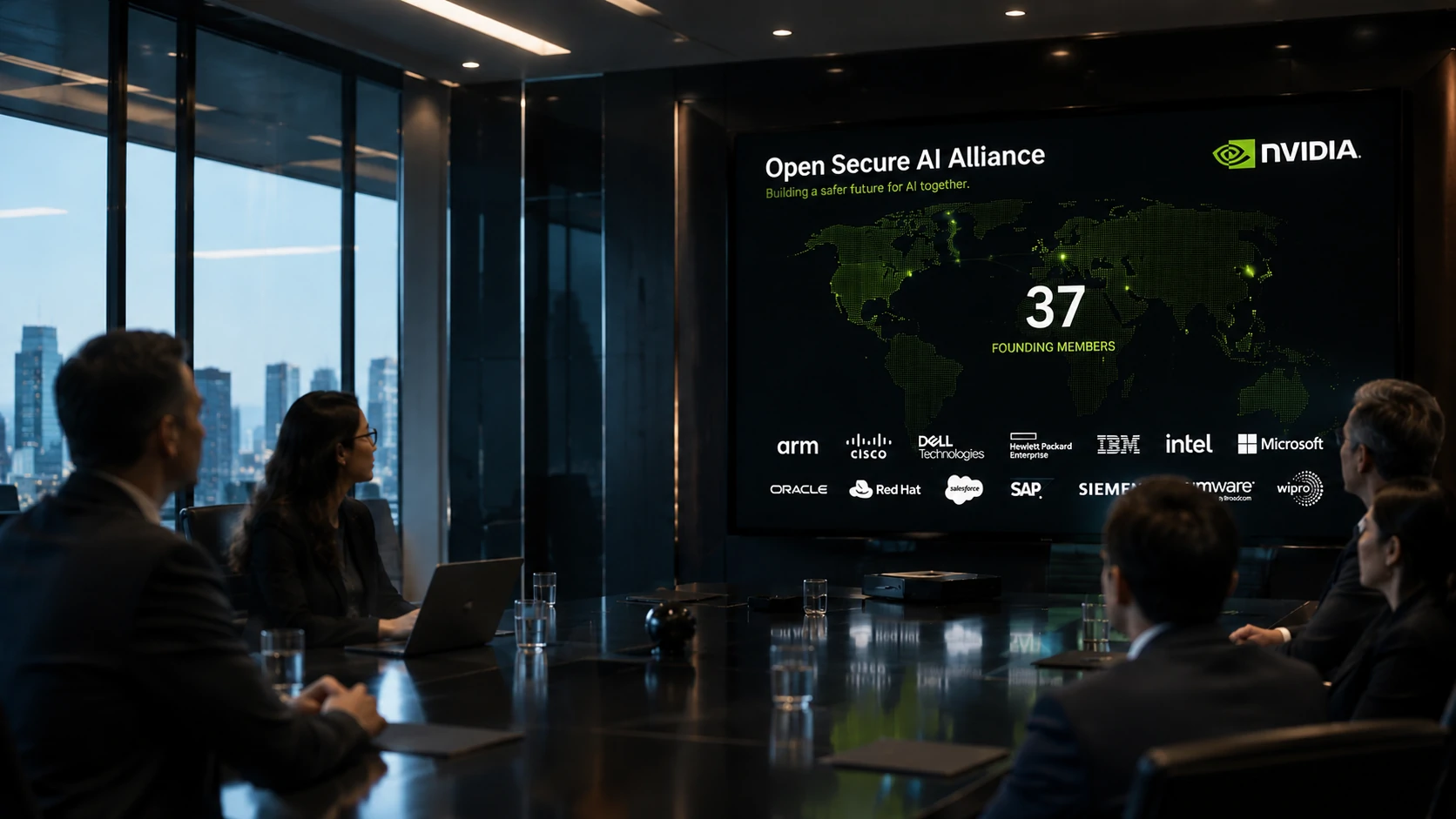
The initiative brings together dozens of organizations to develop open standards and technologies designed to strengthen AI security.
Nvidia has announced a new international initiative focused on developing open technologies for Artificial Intelligence security, bringing together 37 organizations, including technology companies, research institutions and industry groups.
Rather than being just another technical collaboration, the alliance reflects a broader strategic transformation across the AI industry. After years of competing primarily on model performance, multimodal capabilities and intelligent agents, security is rapidly becoming a central business priority.
A new competitive battleground
Until recently, success in Artificial Intelligence depended largely on delivering larger, faster and more capable models.
Today, technology companies are also competing to provide the most trustworthy environments for enterprise AI adoption.
Security is no longer a secondary concern
The rapid growth of AI Agents, enterprise automation platforms and autonomous decision-making systems has significantly increased concerns around vulnerabilities, misuse and targeted cyberattacks.
As AI systems become deeply integrated into business operations, collaborative security initiatives are gaining strategic importance.
The absence of OpenAI Google and Anthropic attracts more attention than the alliance itself
Although the alliance includes dozens of participants, industry observers quickly focused on the companies that were missing.
The absence of OpenAI, Google and Anthropic immediately raised questions about different approaches to Artificial Intelligence security, governance and long-term ecosystem strategy.
Each company already invests heavily in proprietary AI safety research and security initiatives. However, their decision not to join the founding group suggests that the industry has yet to reach a consensus on how global AI security standards should evolve.
As Notícia Tech recently explained in its analysis of OpenAI’s open-weight strategy, the Artificial Intelligence market is entering a period of strategic realignment, with leading companies pursuing increasingly different visions for enterprise AI.
Read also:
Why OpenAI shifts strategy toward open-weight AI models and changes the enterprise AI race
Different strategies pursuing the same objective
The creation of this alliance should not be interpreted as a direct confrontation among AI leaders.
Instead, it highlights how the market is gradually separating into open collaborative initiatives and more tightly controlled proprietary ecosystems.
Nvidia expands its strategic influence
With this initiative, Nvidia moves beyond its traditional role as the world’s leading AI infrastructure provider.
The company is increasingly positioning itself as a key player in defining the future standards for Artificial Intelligence security, governance and enterprise trust.
The alliance could accelerate secure AI adoption across enterprises

Organizations are placing greater emphasis on trust, governance and security as AI becomes part of critical business operations.
For businesses, the most significant outcome of Nvidia’s initiative is the potential to increase confidence in adopting Artificial Intelligence across enterprise environments. The broader the availability of trusted security standards, the easier it becomes for organizations to deploy autonomous AI systems in mission-critical workflows.
This shift is particularly relevant because AI is no longer limited to chat assistants. Modern enterprise platforms already rely on AI for financial analysis, customer service, software development, process automation and operational decision-making.
AI Agents require stronger security frameworks
Modern AI Agents can independently execute tasks, access enterprise systems and interact with multiple software platforms.
While these capabilities significantly improve productivity, they also expand the potential attack surface for cybercriminals.
As a result, security is no longer viewed as a purely technical requirement. It has become a strategic business priority.
Enterprise expectations will continue to rise
Over the coming years, organizations are expected to demand increasingly advanced capabilities, including:
- AI auditing mechanisms;
- protection against model manipulation;
- continuous monitoring;
- decision traceability;
- enterprise AI governance.
This trend reinforces the strategic importance of modern AI architectures previously discussed by Notícia Tech.
Read also:
The Complete Guide to Enterprise AI Architecture: MCP, RAG, AI Agents, Workflows, Copilots and APIs
The AI race is entering a new phase where trust may determine future market leaders

Competition among AI leaders is shifting beyond model performance toward trust, governance and long-term security.
Competition between Nvidia, OpenAI, Google, Anthropic, Microsoft and other Artificial Intelligence leaders remains intense.
However, delivering increasingly powerful AI models alone may no longer be enough to secure long-term leadership.
Trust becomes the next competitive advantage
Companies capable of demonstrating stronger security, governance and operational reliability will likely gain a significant advantage in the enterprise market.
This evolution is expected to influence investment decisions, software procurement strategies and future regulatory frameworks around Artificial Intelligence.
In practical terms, the AI race is expanding beyond technological capability into institutional credibility.
Better security could accelerate enterprise AI investment
As organizations reduce operational risk, they are likely to increase investments in enterprise-scale Artificial Intelligence initiatives.
This creates opportunities not only for infrastructure providers but also for cybersecurity companies, enterprise software vendors, automation platforms and AI developers.
At the same time, it places growing pressure on the industry to adopt more transparent, accountable and collaborative security practices.
Nvidia’s initiative could reshape priorities across the Artificial Intelligence industry
The launch of this global alliance signals that the Artificial Intelligence industry is entering a more mature stage of development.
Following years of competition centered primarily on model performance, the conversation is increasingly shifting toward governance, security, reliability and enterprise adoption.
Whether OpenAI, Google and Anthropic eventually decide to participate or continue pursuing independent strategies, one message is becoming increasingly clear: future AI leaders will need to deliver far more than intelligent models.
Organizations seeking long-term success in the enterprise market must also demonstrate trust, resilience and secure deployment capabilities. In the next stage of Artificial Intelligence, security is evolving from a technical requirement into one of the industry’s most valuable strategic assets.
Comentários
Os comentários utilizam autenticação via GitHub para manter um ambiente mais qualificado, seguro e livre de spam.
Entrar ou criar conta no GitHub