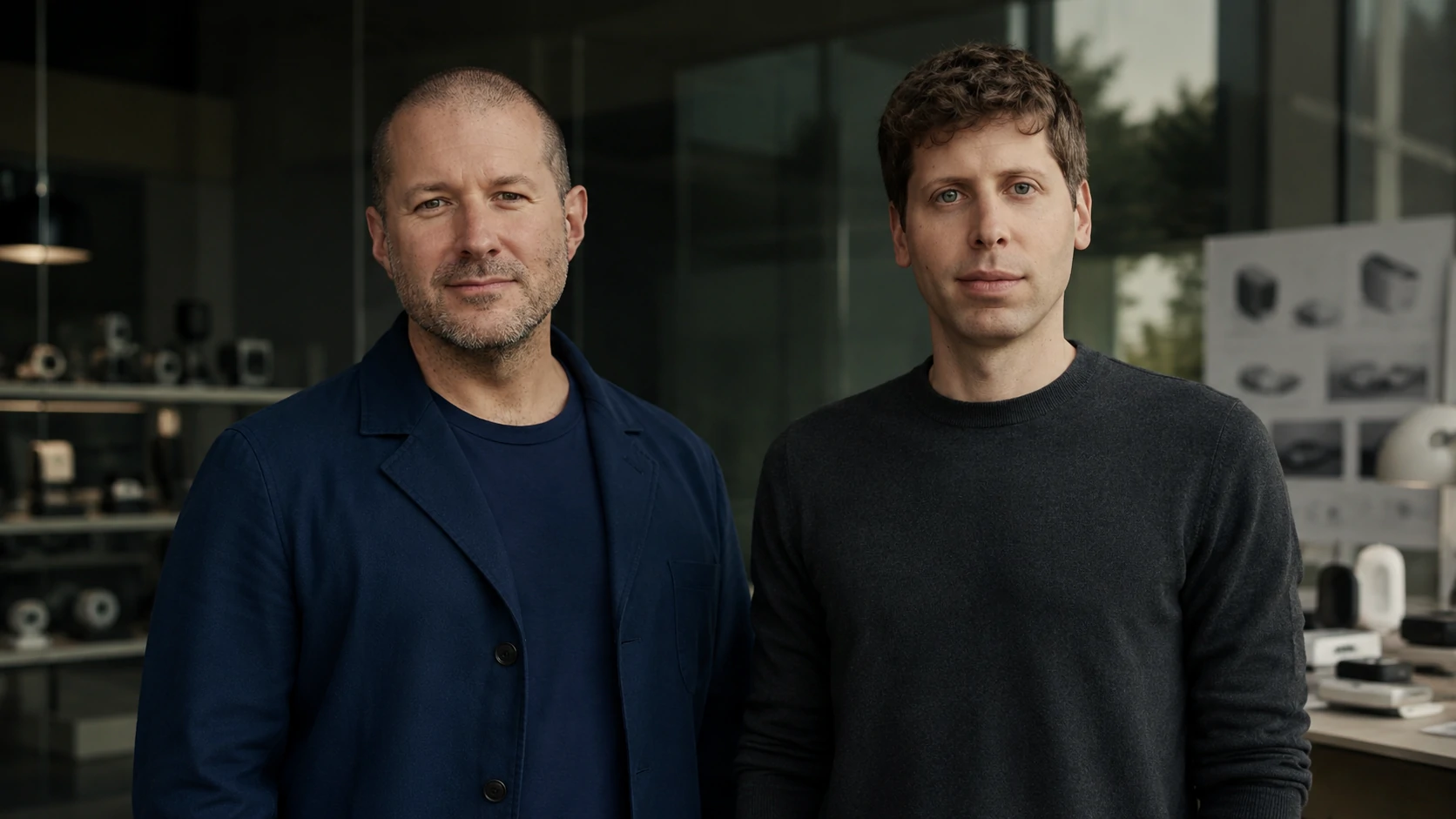
Few companies have the capacity to create a new category of hardware. When OpenAI, creator of ChatGPT, joins forces with Jony Ive, responsible for the design of the iPhone, the market naturally begins to look beyond generative artificial intelligence and begins to discuss the future of personal computing. Recent statements from company executives show that this future may be closer than many imagined.
OpenAI’s secret project is becoming one of the most watched bets in the technology market

The project led by Sam Altman and Jony Ive seeks to create a new interaction experience with AI.
OpenAI returned to the spotlight after new statements from executives about the hardware developed in partnership with Jony Ive, former head of design at Apple.
Although the company continues to maintain secrecy about the product, the organization’s CFO recently confirmed that she has already used the device and described the experience as something “natural” and “lovely”, further increasing the market’s curiosity.
The move comes after the acquisition of the startup io, founded by Jony Ive, in an operation valued at approximately US$6.5 billion, considered the largest acquisition in the history of OpenAI.
Why does the market follow this project?
The answer is simple: a new technological platform rarely emerges.
Over the past 40 years, the industry has witnessed few truly structural changes:
- personal computers;
- internet;
- smartphones;
- cloud computing;
- generative artificial intelligence.
Now, investors are trying to figure out whether native AI devices will be the next stage in this evolution.
Jony Ive’s weight in the narrative
When Jony Ive’s name appears, the market pays attention.
The designer participated in the creation of iconic Apple products, including:
- iPhone;
- iPad;
- iMac;
- Apple Watch.
Its deep entry into the OpenAI framework signals that the company is not just building software, but trying to redesign the interaction experience between humans and artificial intelligence.
The Race for AI Hardware Could Become the Next Tech War

Tech giants vie to lead the next generation of smart devices.
The dispute for AI leadership no longer happens only in language models.
Companies are beginning to realize that controlling the interface also means controlling the distribution of technology.
Today, Apple, Google, Microsoft, Meta and OpenAI compete for different layers of the digital ecosystem.
Hardware could become the next strategic frontier.
Why did the smartphone become a target?
The smartphone has become the main access point to the internet.
However, much of its structure was created for an era before generative artificial intelligence.
Applications function as intermediaries between users and services.
AI agents promise to reduce this dependence.
Instead of opening dozens of applications, users can simply request tasks directly from an intelligent agent.
The impact of AI agents
This change is in line with trends already observed in corporate agent initiatives.
The market itself has been discussing the rise of agent-centric architectures, as shown in analyzes of Context Engineering and AI agents in companies and how MCP connects AI agents to systems corporate.
The logic is similar: reduce traditional interfaces and increase contextual automation.
OpenAI device could represent a new category of computing

The industry seeks to create digital experiences centered on contextual artificial intelligence.
The main hypothesis defended by analysts is that OpenAI does not intend to launch just another gadget.
The objective would be to create a new layer of interaction based on contextual artificial intelligence.
This means the device would understand:
- location;
- history;
- preferences;
- objectives;
- context of the current activity.
Instead of navigating menus, the user would simply talk to the technology.
What differentiates a native AI device?
The difference is in the architecture.
Today:
- humans adapt to interfaces.
In the future:
- interfaces adapt to humans.
This inversion may seem simple, but it represents a profound change in the way software is consumed.
The challenge of adoption
Creating technology is not the biggest problem.
Convincing billions of people to change habits is much more difficult.
Even though OpenAI’s hardware makes significant advances, it will need to contend with:
- consolidated ecosystems;
- consumer behavior;
- privacy issues;
- regulatory limitations.
OpenAI’s real movement may go beyond the product
The most important answer may not lie in the device itself.
She’s in the strategy.
By investing billions in hardware, OpenAI signals that it does not intend to remain just a provider of language models.
The company seeks to control larger parts of the digital experience.
This vision already appears in initiatives focused on infrastructure, agents and new forms of interaction with AI.
The central question is not whether the device will immediately replace the smartphone.
The question is whether it represents the first step in a broader transformation in the way people and companies access technology.
If this happens, the partnership between Sam Altman and Jony Ive could be remembered as one of the most important moves in the transition from the era of applications to the era of intelligent agents.
Comentários
Os comentários utilizam autenticação via GitHub para manter um ambiente mais qualificado, seguro e livre de spam.
Entrar ou criar conta no GitHub