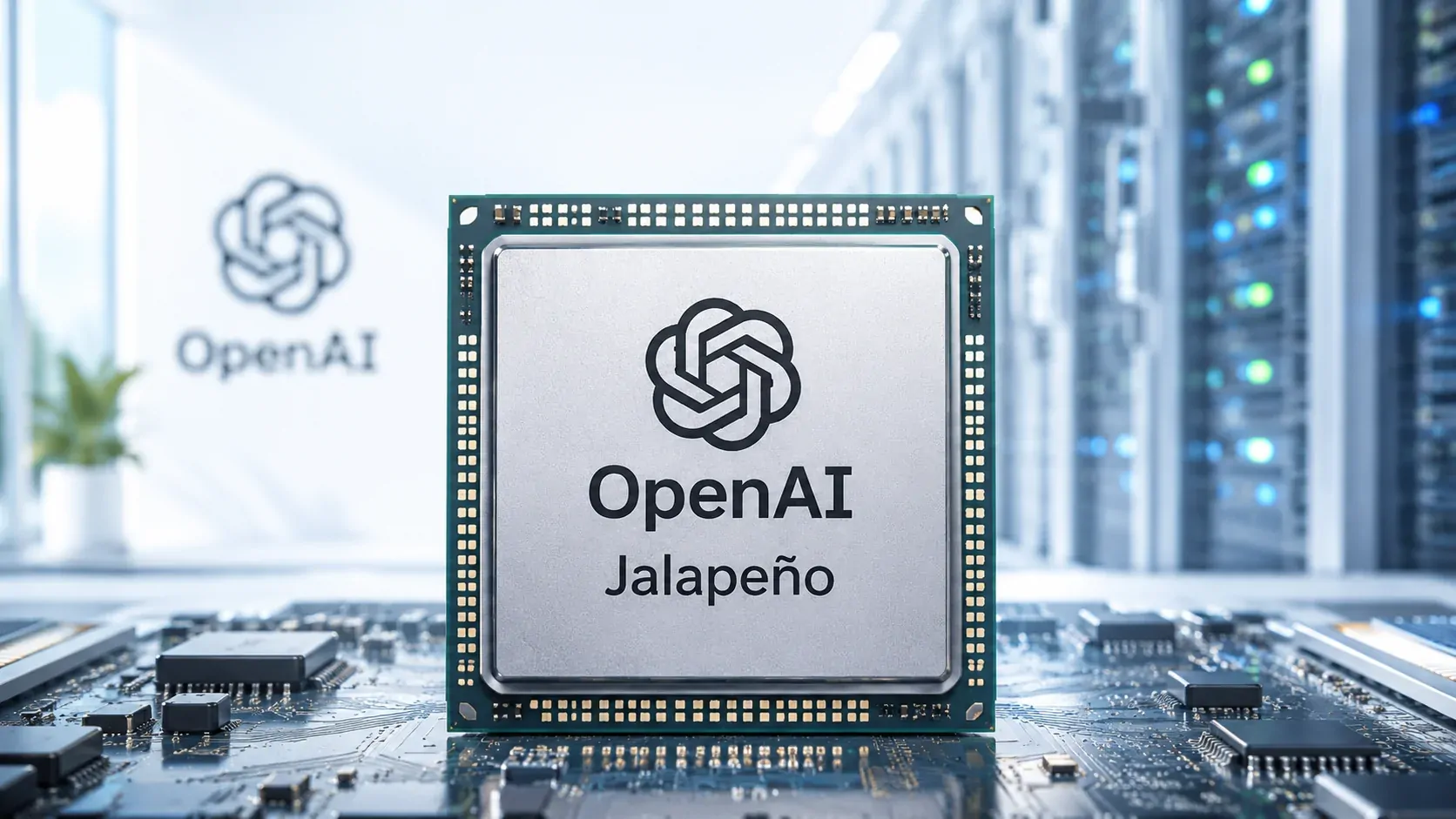
OpenAI is moving beyond being a company that develops artificial intelligence models and is increasingly seeking control over the infrastructure that runs them. The first results from Jalapeño show that the AI race is entering a new phase: alongside more capable models, processing efficiency, energy consumption, and cost are becoming strategic factors.
What OpenAI Is Doing With Its Own Chip
OpenAI has presented the first measured results from Jalapeño, its first custom chip specifically developed to run language models. The company says the accelerator was able to combine more AI work per unit of energy with lower latency than the commercial systems used in the comparison.
The Chip Was Built to Run AI Models
The central point of the project is not to create a processor that replaces all of the computers used by OpenAI. Jalapeño was designed from the beginning for language model workloads, taking into account memory, processing, and communication requirements that emerge when an AI system needs to respond to users.
This allows the company to optimize different parts of its infrastructure together. Instead of adapting a more general-purpose accelerator to the needs of its models, OpenAI can design hardware, memory, networking, and software around the type of processing its products require.
The Goal Is Greater Speed and Efficiency
In the tests disclosed by the company, Jalapeño delivered between 1.5 and 1.9 times more AI work per watt at peak processing and between 1.7 and 3.6 times lower latency than the systems used for comparison, depending on the model and configuration evaluated.
These figures were disclosed by OpenAI itself and should be interpreted within the specific conditions of the tests. Even so, they show why the company considers the chip important to its infrastructure strategy.
What Inference Means and Why It Matters
The word inference comes up constantly when discussing Jalapeño, but the concept is simpler than it sounds. In artificial intelligence, inference is the process through which an already-trained model receives a request and generates a response.
It Is When AI Actually Responds to the User
When someone asks ChatGPT a question, the model needs to process that request and generate an answer. This happens after the model has been trained and is called inference.
A simple analogy helps: training is like teaching someone how to solve problems; inference is the moment when that person receives a question and uses what they have learned to answer it.
That means every conversation with an AI service requires computing power. The more users there are and the more complex the tasks performed by AI agents become, the more processing capacity is required.
More Users Mean More Pressure on Infrastructure
The growth of artificial intelligence is turning inference efficiency into an economic issue. A small improvement in the cost or energy consumption of each response can make an enormous difference when a system needs to handle millions of requests.
This effect becomes even more important for AI agents. A chatbot may answer a question in a relatively short sequence, while an agent may need to perform several steps to complete a task. OpenAI itself highlights that delays can accumulate when a system needs to perform many steps in sequence.
That is where a specialized chip can make a difference: not necessarily because it performs simpler tasks, but because it is designed to execute this specific type of processing more efficiently.
Why OpenAI Wants to Depend Less on Nvidia
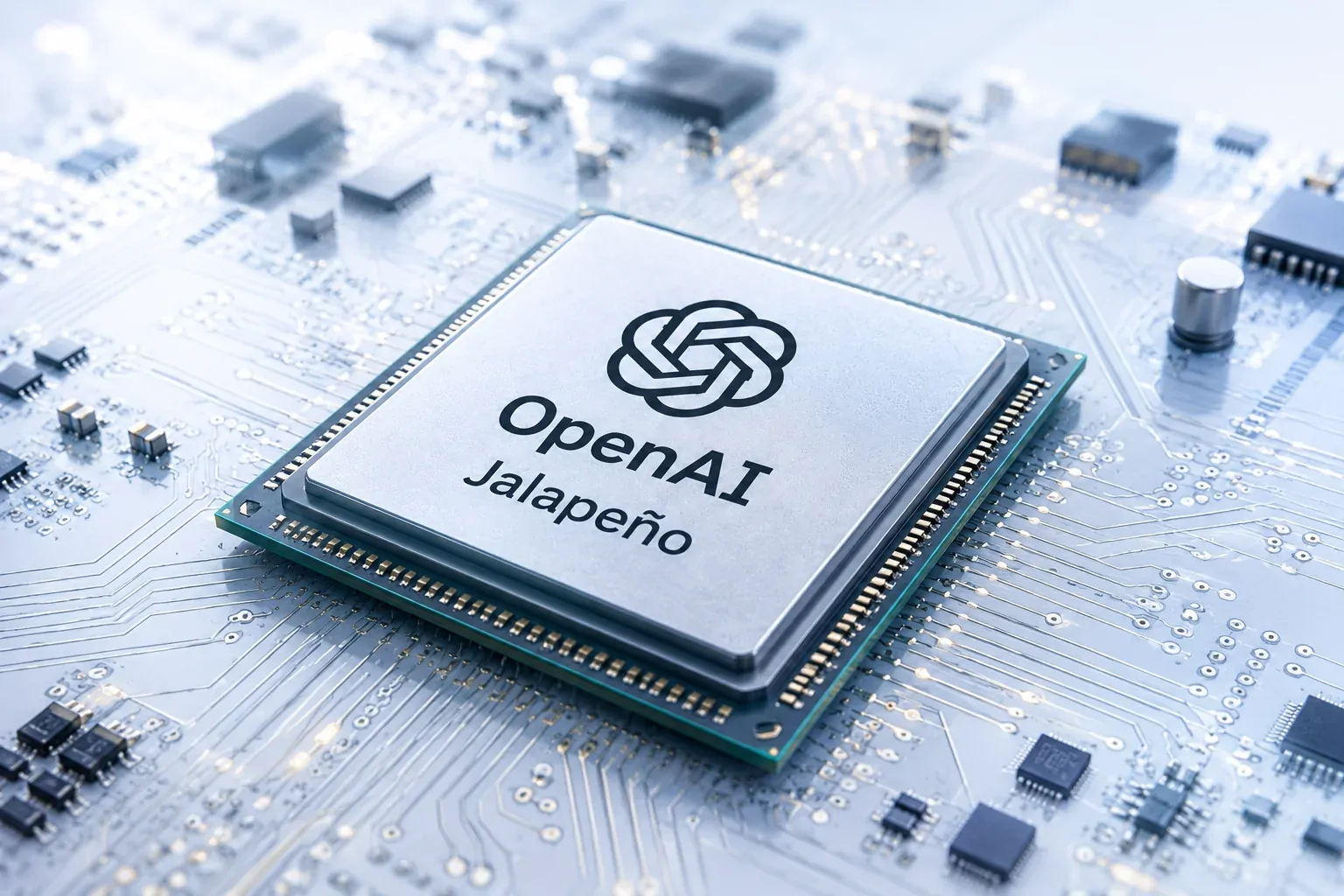
Jalapeño is part of a broader OpenAI strategy to integrate hardware, software, and models within the same architecture.
The creation of Jalapeño does not mean Nvidia will stop supplying hardware to OpenAI. On the contrary, the company explicitly says it will continue deploying accelerators from Nvidia and other partners for both training and inference.
The Strategy Is to Diversify Infrastructure
The relationship between OpenAI and Nvidia is therefore undergoing a more subtle change. OpenAI wants to have different types of accelerators available and choose the most appropriate infrastructure for each workload.
This reduces the risk of depending on a single hardware architecture and gives the company greater ability to control costs, energy consumption, and performance.
The strategy also follows a broader industry trend. Major technology companies are developing custom accelerators because the amount of computing required for AI has made hardware a central part of their business strategy.
Anthropic is following a similar path. Notícia Tech has already analyzed this competition in Anthropic Develops Custom AI Chips for Claude and Threatens to Reduce Nvidia Dependence.
Hardware Has Become Part of the Competition Among AI Companies
For much of the current artificial intelligence race, attention was focused on models: who had the most capable model, the best chatbot, or the most advanced agent.
Now, infrastructure is beginning to carry the same weight.
OpenAI is attempting to control a larger part of the so-called full AI stack, including models, software, products, chips, memory, networking, and deployment systems. The company describes this as a full-stack approach in which each layer can be optimized together.
This does not eliminate Nvidia. But it creates a strategic alternative for certain types of processing.
What Changes for ChatGPT and Businesses
The most noticeable impact for users could be faster responses. But the potentially more important business consequence is the cost of running artificial intelligence at scale.

Greater processing efficiency can translate into faster responses and more capacity to handle demand for AI.
Faster Responses Could Improve AI Agents
OpenAI says Jalapeño was developed with interactive products in mind, including ChatGPT, Codex, the API, and future agent-based products.
For users, this could appear as less waiting time between a request and a response. For businesses, the effect could be broader.
An agent that needs to execute ten or twenty steps to complete a task can benefit from every reduction in latency. When those gains are multiplied across millions of tasks, hardware efficiency can have a direct impact on the service’s operational capacity.
Efficiency Could Also Affect AI Pricing
Infrastructure represents a significant portion of the cost of operating artificial intelligence services. If a company can produce more useful work using the same amount of energy and computing capacity, it can handle more demand without increasing costs at the same rate.
OpenAI says Jalapeño can improve its operational efficiency by allowing useful work to grow faster than the cost of serving it.
That does not automatically mean ChatGPT will become cheaper for consumers. The gains could instead be used to expand capacity, fund new models, improve products, or support margins. The commercial impact will depend on the company’s decisions.
OpenAI Is Building Its Own AI Infrastructure
Jalapeño also represents a shift in OpenAI’s positioning. OpenAI does not want to rely exclusively on components available on the market to support the growth of its products.
The Project Goes Beyond a Single Chip
The company says Jalapeño is the first step toward a multigenerational computing platform. Initial deployment is planned to begin by the end of 2026, while subsequent generations are already in development.
This means OpenAI is not treating the project as an isolated experiment.
The goal is to create successive generations of hardware that can keep pace with the evolution of the company’s models and products. The more the company learns about how its systems process workloads, the greater its ability may become to adapt hardware to future needs.
OpenAI Is Also Moving Into Consumer Hardware
OpenAI’s hardware push is not limited to server infrastructure. The company has also moved toward developing its own consumer devices.
Notícia Tech has already analyzed this move in OpenAI Enters the Hardware Race With Next-Generation ChatGPT Devices.
In that case, the competition takes place at a different layer: while Jalapeño operates within the infrastructure that runs AI, the devices aim to bring ChatGPT closer to everyday computing.
Nvidia Remains Part of the Strategy
This point needs to be preserved to properly understand the news. OpenAI is not abandoning Nvidia.
The company itself says it will continue deploying accelerators from Nvidia and other partners for training and inference workloads.
The change is that OpenAI now has another option under its own control. Instead of relying exclusively on hardware purchased from third parties, it can combine different architectures based on performance, cost, availability, and the characteristics of each task.
What This Change Reveals About the Future of AI
The importance of Jalapeño goes beyond a chip benchmark. The project shows that the artificial intelligence race is becoming a competition over the entire infrastructure required to turn models into products used at scale.

As demand for AI grows, controlling processing, energy, and infrastructure is becoming an increasingly important competitive advantage.
The Next Battle Could Be Over Processing Costs
More intelligent models require more computing power. Agents capable of performing long tasks also increase the amount of processing required.
In this scenario, simply developing a more capable model is not enough. Companies need to run those models quickly, reliably, and at a cost that allows them to be used at scale.
That is why custom chips could become increasingly important for companies operating large-scale AI services.
The Race Now Involves the Entire System
OpenAI’s move also brings the company closer to a strategy already being adopted by other technology giants: developing custom components to gain greater control over critical infrastructure.
The differentiator is integration. If OpenAI can use its own models to help design chips, optimize software, and understand the actual usage patterns of its products, it can create a cycle in which each layer improves the next.
Jalapeño is still only the first generation of this strategy. OpenAI plans to begin deployment by the end of 2026 and is already working on subsequent generations.
The most important question, therefore, is not whether the custom chip will replace Nvidia. OpenAI itself says it will continue using Nvidia accelerators. The strategic issue is different: the more control OpenAI gains over the infrastructure that runs its models, the greater its ability to determine how, where, and at what cost artificial intelligence is processed.
Comentários
Os comentários utilizam autenticação via GitHub para manter um ambiente mais qualificado, seguro e livre de spam.
Entrar ou criar conta no GitHub