The launch of OpenAI’s commercial operation in Brazil marks a major shift in the company’s relationship with the country. After nearly doubling its user base in one year and recording approximately 215 million messages sent to ChatGPT every day, the company is now treating the Brazilian market as a strategic growth front.
OpenAI turns Brazil into a commercial operation
OpenAI announced on August 27 that it was launching commercial operations in Brazil, with a team based in São Paulo. The local operation will focus on businesses, developers, researchers, and public institutions, expanding the company’s presence beyond access to ChatGPT.
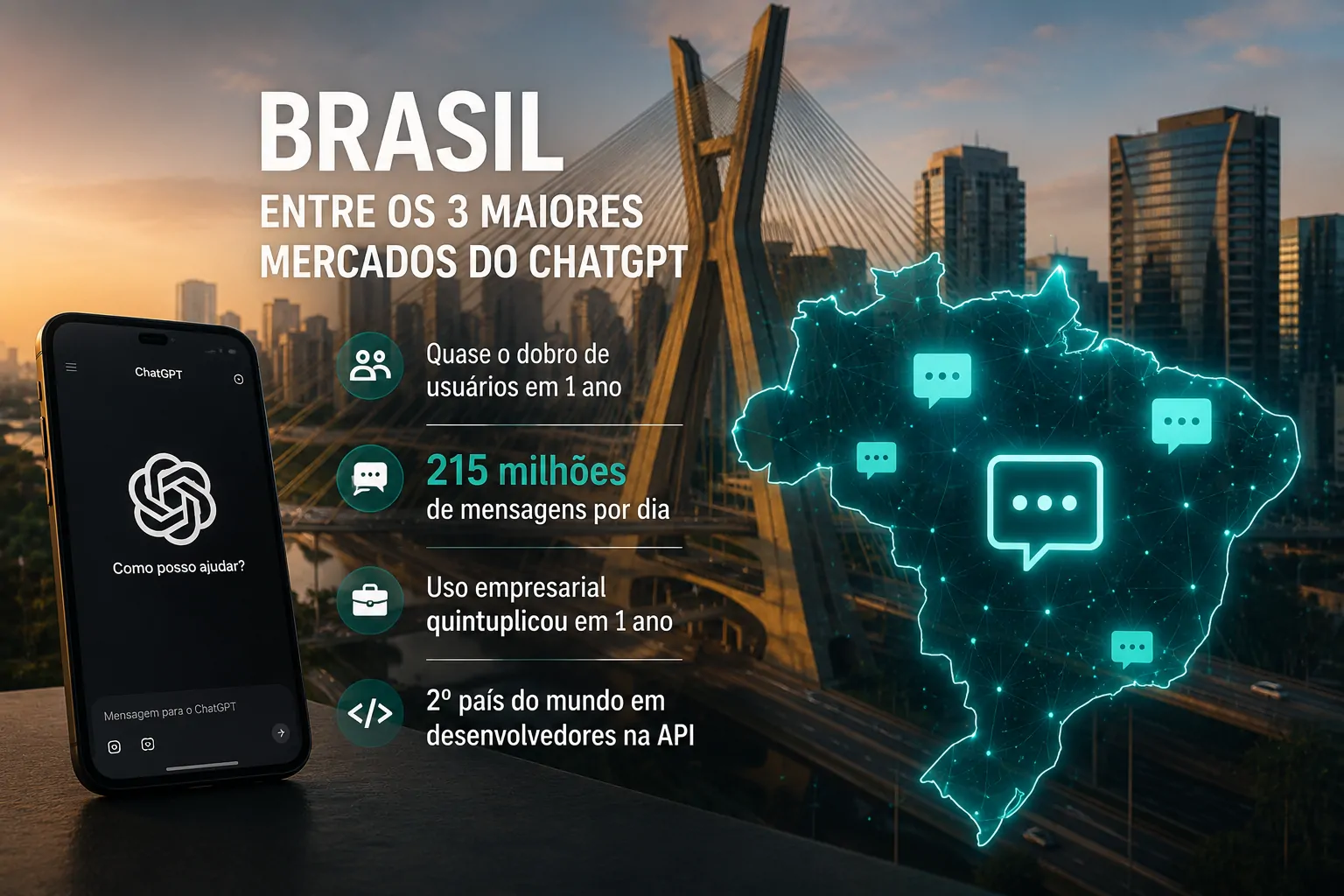
The move comes as the Brazilian market has rapidly gained importance within the company’s ecosystem. According to OpenAI, Brazil is among the three largest markets for ChatGPT by weekly active users, while the number of Brazilian users has nearly doubled over the past 12 months.
The clearest indication of this scale is usage volume. Brazilians send approximately 215 million messages to ChatGPT every day, showing that the tool has moved beyond being a technological novelty and has become part of the regular activities of a significant share of users.
A presence that follows adoption
Launching a local commercial operation is about more than opening an office. It brings OpenAI closer to organizations that need to turn experimental AI use into practical applications.
This is particularly relevant because the company itself has identified a shift in how Brazilians use the technology. In June 2026, 35% of messages classified from individual accounts in Brazil were related to work, compared with 30% globally.
Usage is moving beyond experimentation
Among work-related messages, 53% asked ChatGPT to perform a task or produce an outcome. The examples disclosed by the company include preparing proposals, analyzing information, programming, and creating marketing materials.
This helps explain why the commercial expansion is happening now. The Brazilian market is not only increasing its number of users but also incorporating AI into activities that can have a direct impact on productivity and operations.
The numbers show why Brazil has become a priority
The growth in ChatGPT usage has turned Brazil into one of the most important markets for OpenAI’s expansion.
Brazil’s growth also extends beyond individual usage. OpenAI said the number of ChatGPT Enterprise seats in Brazil has quintupled in one year. The country is also among the company’s ten largest markets by number of enterprise customers.
This growth changes the nature of the opportunity. As AI becomes more deeply embedded in organizations, demand is likely to increase for integration, security, governance, training, and clearly defined use cases capable of delivering measurable returns.
Developers are also becoming central to the strategy
The developer ecosystem is another important factor. Brazil ranks second worldwide in the number of developers using OpenAI’s API, according to data released by the company.
The country is also the largest market for Codex in Latin America. Since the beginning of 2026, OpenAI says the number of weekly Codex users in Brazil has grown more than 11-fold, while daily interactions have increased nearly 30-fold.
This creates a second layer to the Brazilian operation. In addition to selling and supporting AI products, the company is moving closer to a community capable of building its own applications on top of its technology.
Corporate demand could be the next stage
The difference between using an AI tool and embedding it into a business operation is significant. Companies need to connect systems, establish usage policies, protect information, and determine which processes should actually be automated.
This is where the local expansion becomes important. The Brazilian operation could bring OpenAI closer to organizations that are already experimenting with ChatGPT and now need to move toward more structured projects.
OpenAI wants to turn adoption into economic impact
The move is also connected to a broader discussion about productivity. OpenAI says an independent study by RegLab, funded by the company, estimates that AI could add nearly R$1 trillion to Brazil’s economy by 2030.
That figure is an estimate, not an economic result that has already been achieved. OpenAI itself emphasizes that turning technological potential into economic impact requires training, research, responsible implementation, and collaboration with Brazilian institutions.
That distinction matters because it prevents ChatGPT’s growth from being interpreted as an automatic equivalent of productivity gains. Having a large number of users does not, by itself, mean companies are capturing equivalent benefits.
The challenge is shifting to implementation
For the enterprise market, the next step is less about simply making a chatbot available and more about determining where the technology can create value.
Companies can use AI to produce documents, analyze information, support sales teams, automate tasks, and accelerate software development. But each application requires consideration of data, security, costs, and human oversight.
The growth in work-related usage indicates that this transition has already begun. OpenAI’s commercial operation puts the company closer to organizations that are trying to turn this usage into permanent business processes.
The Brazilian market is gaining strategic importance
The decision also signals that Brazil has become relevant not only because of its large connected population but because of the intensity and diversity of AI usage.
The combination of users, businesses, and developers creates a broader ecosystem. For OpenAI, this means a market capable of consuming products, building applications, and generating new use cases at the same time.
This combination could become especially important as AI companies compete not only on model quality but also on their ability to bring those models into customers’ real-world operations.
What the Brazilian operation could change for businesses

The commercial expansion brings OpenAI closer to Brazilian companies seeking to turn experimental AI use into corporate applications.
A local presence could reduce the distance between the technology offered by OpenAI and the specific needs of Brazilian organizations. This does not mean that all adoption challenges will disappear, but it creates conditions for closer engagement with the market.
For business leaders, the main change is not necessarily the ChatGPT they already use. The potential impact lies in expanding opportunities for enterprise implementation, partnerships, and projects developed directly in Brazil.
Companies could accelerate AI projects
A dedicated commercial operation could help expand relationships with enterprise customers and identify applications tailored to different industries.
This comes as OpenAI continues to expand products designed for work. Notícia Tech has already covered how OpenAI launched a plugin for managing businesses in ChatGPT, a development that becomes even more relevant as corporate AI adoption grows in Brazil.
The central question for Brazilian companies is becoming less “should we test AI?” and more “which processes can AI improve in a measurable way?” The answer will depend on each organization, but OpenAI’s commercial infrastructure is likely to make that conversation increasingly relevant in the market.
Developers could gain more opportunities
The growth of the API and Codex also points to an opportunity for Brazilian companies to build their own applications instead of relying exclusively on ready-made interfaces.
This model makes it possible to build products and workflows tailored to specific industries, departments, or business needs. At the same time, it increases the importance of architecture, governance, and integration with existing systems.
For anyone following the evolution of enterprise AI, this shift is significant because it expands the discussion from tools to AI-powered business infrastructure.
The expansion comes alongside other initiatives in Brazil
The commercial operation is not happening in isolation. OpenAI announced initiatives involving the Aeronautics Institute of Technology (ITA), legal startup Enter, and Prodam, showing that its Brazilian strategy also includes education, the public sector, and businesses.
These initiatives help illustrate how the company intends to build a local presence. Rather than focusing solely on selling ChatGPT, OpenAI is seeking different points of contact with Brazil’s broader ecosystem.
Education and research are part of the strategy
Closer engagement with educational and research institutions could help expand professional training and experimentation with AI applications.
This component matters because the expansion of advanced technology also depends on people who can use it effectively. Access to models does not eliminate the need for technical knowledge and implementation capabilities.
The public sector is also on the radar
The collaboration with Prodam shows that the company’s interest is not limited to the private sector. Public institutions could also become important environments for AI applications, particularly in services, data analysis, and process automation.
It is still too early to measure the impact of these initiatives. What has been confirmed is the intention to build a presence closer to different sectors of the Brazilian economy.
Brazil is becoming more than just an AI consumer market
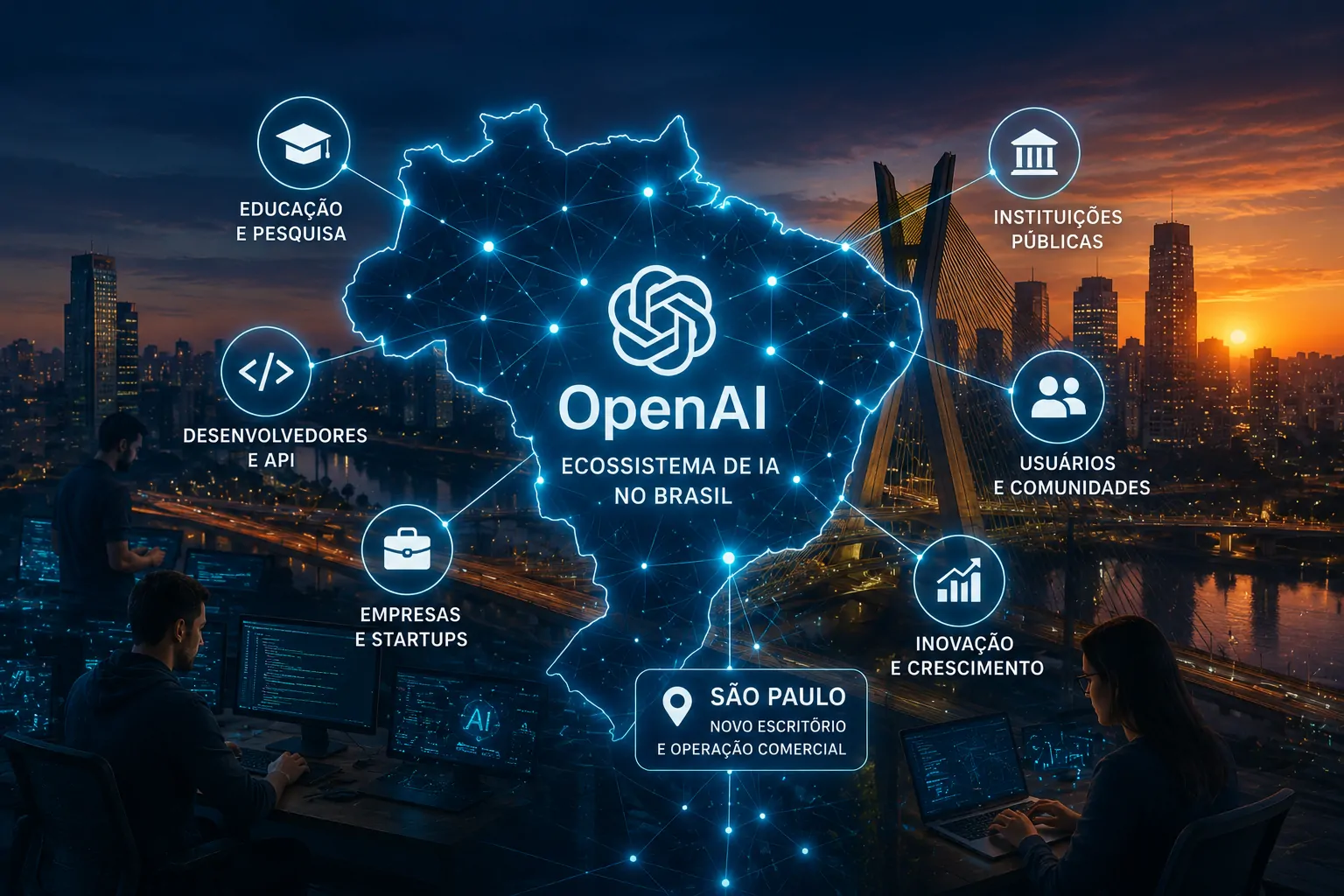
The new operation brings OpenAI closer to a Brazilian ecosystem that includes users, businesses, developers, researchers, and public institutions.
The main change brought by the announcement is Brazil’s position within OpenAI’s broader strategy. Usage figures, enterprise growth, and developer adoption show a market that has reached a scale significant enough to justify its own commercial operation.
This also changes how Brazilian companies should view the evolution of AI. OpenAI’s expansion is happening alongside the growth of other platforms and models, increasing competition for enterprise customers and developers.
The company’s strategy also involves the infrastructure required to support this expansion. Notícia Tech has already covered how OpenAI is preparing its own chip to accelerate ChatGPT responses, a move that helps illustrate the scale of the company’s efforts to expand its technological capacity.
The next important development will be whether the local presence can turn the enormous use of ChatGPT into deeper enterprise projects, new applications, and measurable productivity gains.
For the Brazilian market, this is probably the most important aspect of the announcement. Opening the office did not create demand for AI. To a large extent, it is a response to the fact that this demand has already reached a scale that OpenAI considers strategic.
Brazil, therefore, is not simply receiving a commercial operation. It is becoming one of the environments where the company can test, develop, and expand new forms of artificial intelligence adoption across businesses, government institutions, and developer communities.
Comentários
Os comentários utilizam autenticação via GitHub para manter um ambiente mais qualificado, seguro e livre de spam.
Entrar ou criar conta no GitHub