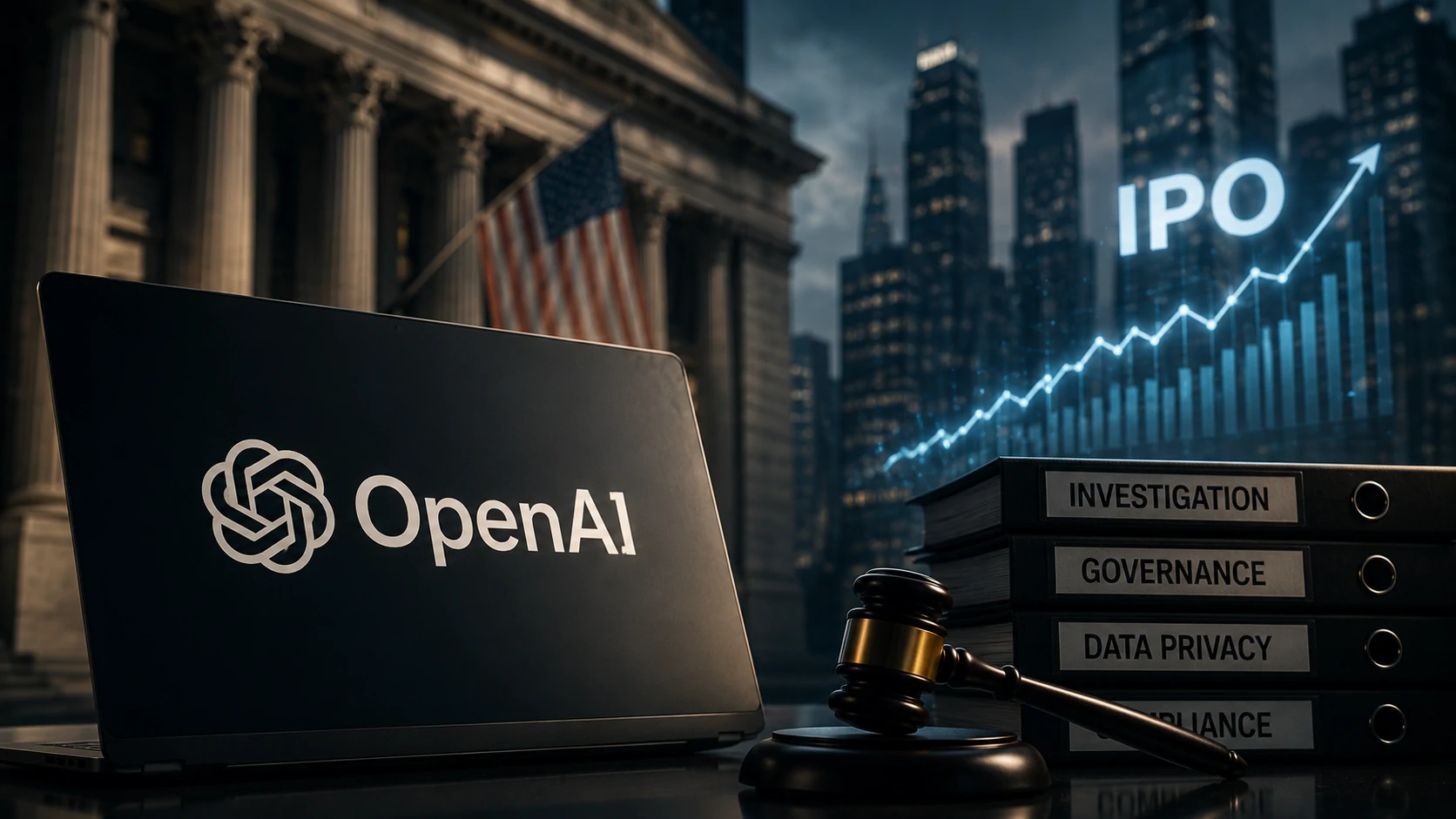
Over the past two years, the artificial intelligence race has been dominated by model launches, multi-billion-dollar investments, and increasingly sophisticated AI agents. Now, a new factor is moving to the forefront: governance. The investigation involving OpenAI comes precisely as the company accelerates preparations for a potential public offering while expanding its ambition to turn ChatGPT into a central platform for the next generation of AI-powered software.
The OpenAI investigation signals that the era of AI regulatory oversight has begun

Regulators are beginning to monitor the rapid growth of artificial intelligence platforms more closely.
The investigation involving OpenAI represents a development that extends far beyond a single company. The case suggests that regulators are paying closer attention to how large AI models handle data, user interactions, and engagement mechanisms.
According to reports released this week, U.S. state attorneys general are seeking to better understand issues related to data practices, internal policies, and the impact of AI systems on users.
The timing could hardly be more symbolic. OpenAI has become one of the most influential organizations in the digital economy and plays a major role in shaping the pace of artificial intelligence adoption across businesses, governments, and consumers.
Why are regulators increasing their attention?
The adoption speed of AI has surpassed virtually every major technological wave of recent decades.
Millions of users now rely on generative systems for research, productivity, software development, and decision-making. As these platforms gain influence, pressure for oversight and accountability naturally increases.
The debate goes beyond privacy
The current discussion is not limited to personal data.
Issues such as model transparency, automation risks, user influence, and corporate accountability are becoming increasingly prominent in regulatory agendas worldwide.
The investigation arrives as OpenAI accelerates its transformation into an AI agent platform

The future of AI competition may be defined less by models and more by the agents that execute tasks.
OpenAI’s current strategy extends far beyond a traditional chatbot.
Recent reports suggest the company is working to transform ChatGPT into a comprehensive platform capable of integrating AI agents, automation workflows, software development, content creation, and large-scale task execution.
This shift reinforces a thesis already explored in previous Notícia Tech analyses: the next AI battle will not be fought solely between models, but between complete ecosystems of intelligent agents.
In this environment, companies such as OpenAI, Google, Microsoft, Anthropic, and Meta are competing to become the primary layer of digital interaction.
ChatGPT is evolving beyond a simple assistant
The strategic objective appears to be transforming the product into an operational interface for digital work.
The more tasks agents perform, the greater users’ dependence on the platform coordinating those actions.
Why does this matter for businesses?
Organizations see AI agents as an opportunity to reduce costs, accelerate processes, and improve productivity.
OpenAI’s IPO plans could turn governance into a competitive advantage

Financial markets tend to demand transparency proportional to the influence of AI companies.
The investigation comes only days after reports regarding the advancement of OpenAI’s IPO plans.
Historically, companies entering public markets face stricter requirements around transparency, auditing, and risk management.
This creates an interesting scenario for the AI sector.
Over the past few years, the primary competitive advantages have been computing infrastructure, model quality, and access to data. Governance may now begin to occupy a similarly strategic position.
The next race is about trust
Institutional investors typically evaluate more than growth alone.
Organizations capable of demonstrating strong controls and governance frameworks may gain an advantage in an increasingly regulated environment.
What are investors watching right now?
Markets are closely monitoring:
- sustainable growth potential;
- regulatory risks;
- corporate governance;
- infrastructure dependence;
- AI agent monetization capabilities.
The combination of these factors could shape the next phase of the artificial intelligence economy.
The greatest impact may be felt across the entire AI agent market
The most significant consequence of the investigation may not be confined to OpenAI itself.
Its broader effect could be the establishment of new standards for the entire industry.
As AI agents assume increasingly complex responsibilities within organizations, the need for auditing, traceability, and clear accountability mechanisms continues to grow.
This trend directly connects with themes previously explored by Notícia Tech in articles such as MCP Could Become the Invisible Infrastructure That Connects AI Agents to Enterprise Systems and Context Engineering The New Silent Race That Could Define Which AI Agents Really Work in Companies.
The message for the market is clear.
The next phase of artificial intelligence will not be defined solely by those building the most advanced models. It will also be determined by those capable of balancing innovation, governance, transparency, and trust at global scale.
Comentários
Os comentários utilizam autenticação via GitHub para manter um ambiente mais qualificado, seguro e livre de spam.
Entrar ou criar conta no GitHub