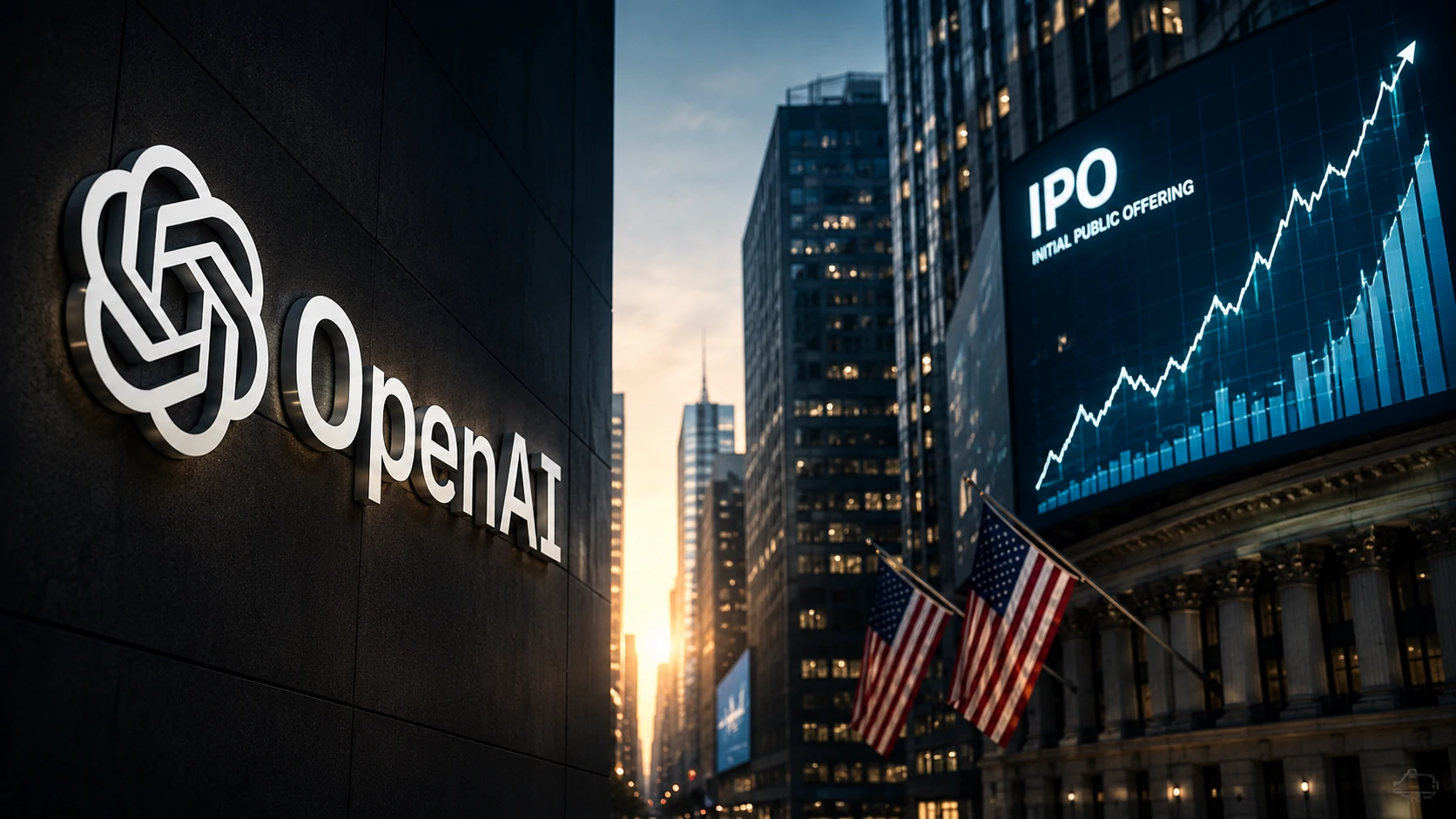
The artificial intelligence industry has entered a new phase. Over the past few years, competition centered on building more capable AI models, expanding computing infrastructure, and attracting the world’s top researchers. Today, another strategic factor is reshaping the industry: access to public capital markets. OpenAI’s confidential IPO filing suggests that the next major battle will be fought not only through technological innovation but also through the ability to raise billions of dollars to sustain long-term growth.
This move comes as demand for enterprise generative AI solutions continues to accelerate, while companies such as Microsoft, Google, Anthropic, and Meta expand investments in foundation models, AI agents, and large-scale infrastructure.
More than a financial milestone, the IPO process signals a structural transformation in how the global AI industry is likely to evolve over the coming years.
OpenAI’s IPO Filing Signals That the AI Race Has Reached a New Level
The confidential filing indicates that OpenAI is seeking greater financial flexibility to keep pace with one of the fastest-moving industries in history.
Until recently, private fundraising rounds provided sufficient resources to develop increasingly powerful large language models. However, the soaring costs of training frontier models, purchasing advanced GPUs, building hyperscale data centers, and developing autonomous AI agents have dramatically increased capital requirements.
![imagem-1.webp]
Capital markets are becoming as strategically important as technological innovation in the race for AI leadership.
AI Infrastructure Has Become the Industry’s Most Valuable Asset
Training next-generation AI systems requires billions of dollars in specialized hardware, energy infrastructure, high-speed networking, and distributed computing resources.
As competition among AI laboratories intensifies, so does the need for continuous access to capital.
In this environment, public markets become more than a financing option—they become a competitive advantage capable of shaping long-term industry leadership.
Investors Are Looking Beyond Technology
Technical excellence alone is no longer enough.
Investors increasingly evaluate sustainable revenue growth, enterprise adoption, operational efficiency, execution capabilities, and long-term scalability.
As a result, AI companies must now demonstrate commercial maturity alongside technological leadership.
This evolution positions artificial intelligence firms alongside the world’s largest technology corporations rather than treating them solely as research organizations.
The IPO Race Raises Competitive Pressure Across the Entire AI Ecosystem
A potential OpenAI public offering is likely to intensify competitive pressure throughout the artificial intelligence market.
Independent AI labs will need to strengthen their technological differentiation, while established technology companies are expected to accelerate investments to defend their market positions.
![imagem-2.webp]
Investment capacity is becoming just as important as technological capability in determining the next generation of AI leaders.
More Capital Means Faster Innovation
Additional funding could support:
- next-generation multimodal AI models;
- global infrastructure expansion;
- recruitment of top AI researchers;
- enterprise AI agent development;
- strategic acquisitions of emerging AI startups.
In practice, this shortens the innovation cycle and accelerates the pace at which new AI capabilities reach businesses worldwide.
Enterprise Customers Are Part of This Competition Too
Organizations deploying artificial intelligence will also experience the effects of this financial race.
The greater the investment available to AI providers, the faster businesses can expect improvements in automation platforms, software development tools, customer service systems, and enterprise data intelligence.
This trend reinforces themes previously explored by Notícia Tech, including Google’s enterprise AI strategy with Gemini Spark:
Another closely related topic is the growing importance of Model Context Protocol (MCP) for enterprise AI agent integration:
OpenAI’s IPO Could Reshape the Competitive Landscape of Artificial Intelligence
An OpenAI public offering represents far more than a financial event. It has the potential to reshape how the entire artificial intelligence industry finances innovation, research, and global infrastructure.
Companies that currently compete primarily through technology may soon find themselves competing equally for investor confidence.
This shift is expected to influence investment decisions, product development cycles, and the ability to scale worldwide.
![imagem-3.webp]
Access to public capital markets may become just as strategically important as building the world’s most capable AI models.
Google, Microsoft, and Anthropic Face New Competitive Challenges
Microsoft remains OpenAI’s largest strategic partner while simultaneously expanding its own enterprise AI ecosystem.
Meanwhile, Google continues accelerating initiatives such as Gemini Spark, reinforcing its strategy of transforming AI agents into enterprise productivity platforms.
At the same time, Anthropic continues gaining momentum in the corporate market through the Claude family of models, attracting organizations that prioritize security, governance, and reliability.
Every strategic move made by one of these companies increases pressure on competitors to respond with new products, larger investments, or acquisitions.
This broader trend aligns with Notícia Tech’s previous analysis of Mistral AI’s enterprise expansion strategy:
It also complements our coverage of enterprise Retrieval-Augmented Generation (RAG) architectures designed for corporate knowledge systems:
Technology Alone Is No Longer Enough
During the first wave of generative AI, model quality served as the industry’s primary benchmark.
Today, additional business metrics have become equally important:
- recurring revenue growth;
- international expansion;
- operational efficiency;
- enterprise customer adoption;
- long-term infrastructure investment capacity.
As a result, AI companies are increasingly being evaluated like mature global technology businesses rather than research-focused laboratories.
What Businesses Should Watch as This New Phase Begins
For organizations adopting artificial intelligence, the most immediate consequence will likely be a faster pace of innovation.
The greater the availability of investment capital, the faster vendors can release new foundation models, enterprise AI agents, and business platforms.
While this creates significant opportunities, it also increases the importance of strategic planning and technology selection.
Infrastructure Will Become a Decisive Competitive Factor
Over the coming years, the companies most likely to lead the AI industry will combine:
- world-class infrastructure;
- competitive AI models;
- strong partner ecosystems;
- enterprise-grade governance;
- sustainable financial resources.
Building the best AI model alone will no longer guarantee leadership.
Success will increasingly depend on maintaining continuous investment in research, hyperscale computing infrastructure, semiconductor resources, and top engineering talent.
The Race for AI Leadership Is Only Beginning
OpenAI’s confidential IPO filing represents a much broader transformation than a traditional public offering.
It demonstrates that artificial intelligence has entered an era where technology, infrastructure, financial strength, and corporate strategy are inseparable.
For businesses, this means faster access to increasingly sophisticated AI solutions.
For investors, it marks the beginning of a new competitive cycle among some of the world’s most influential technology companies.
For the industry as a whole, one conclusion is becoming increasingly clear: the artificial intelligence race is no longer defined solely by who builds the smartest model. It is now equally about who can secure the capital, scale, and operational resilience required to sustain innovation for the next decade.
FAQ
Why is OpenAI’s IPO considered such an important milestone?
Because it could provide the company with substantially greater financial resources to expand AI research, build new infrastructure, and accelerate global growth, increasing competitive pressure across the industry.
How could this affect companies already using artificial intelligence?
Greater investment typically accelerates product innovation, leading to more capable AI models, enterprise platforms, and automation tools becoming available more quickly.
Could other AI companies eventually pursue similar strategies?
While future decisions remain uncertain, industry leaders such as Google, Anthropic, and other major AI developers are expected to continue strengthening their financial strategies, infrastructure investments, and enterprise offerings to remain competitive.
Why is infrastructure becoming as important as AI models?
Modern frontier AI systems require enormous computing resources, specialized chips, advanced networking, and massive data center capacity. Companies capable of sustaining these investments are likely to maintain a long-term competitive advantage.
What is the biggest takeaway from OpenAI’s IPO filing?
The AI industry is entering a new phase where technological innovation alone is no longer enough. Long-term leadership will increasingly depend on combining breakthrough AI capabilities with financial strength, scalable infrastructure, and sustainable business execution.
Comentários
Os comentários utilizam autenticação via GitHub para manter um ambiente mais qualificado, seguro e livre de spam.
Entrar ou criar conta no GitHub