For years, presentations, documents and spreadsheets have been treated as tasks performed inside separate software applications. Now, OpenAI is bringing those activities closer to ChatGPT, and the acquisition of a small startup could reveal a much broader shift in the company’s strategy.
What OpenAI bought and why the news matters
OpenAI acquired NextSlide, a startup specializing in AI-powered presentation creation, and brought its team into ChatGPT development. The deal took place in early 2026 but was only disclosed publicly now. The financial terms were not revealed.
NextSlide had built a tool capable of turning prompts, notes, documents or research into editable presentations. In practice, the goal was to reduce one of the most time-consuming tasks in corporate knowledge work: taking scattered information and turning it into a structured presentation.
That detail matters more than the size of the startup itself. The acquisition brings into OpenAI a team specialized in a task that sits at the core of business work. Presentations are used to sell projects, report results, justify investments, train teams and communicate decisions.
The NextSlide acquisition brings ChatGPT closer to one of the most common activities in corporate work: turning information into presentations.
A small acquisition with broader implications
NextSlide had been operating for just over a year when it was acquired by OpenAI. Founder Ahmed Beshry said the team is now working at the company and will continue developing products focused on creation, communication and turning ideas into work.
That helps explain why the acquisition deserves attention even without a disclosed financial figure. The most valuable asset may not be the startup’s brand, but the team’s accumulated expertise in solving a specific problem.
For OpenAI, acquiring a team already working on AI-generated presentations could be a faster way to accelerate that capability inside ChatGPT than building everything internally from scratch.
The move also comes as ChatGPT moves beyond being a simple question-and-answer tool. OpenAI has already positioned ChatGPT Work as an agent capable of researching and analyzing information, working with connected files and applications, and producing documents, spreadsheets, presentations, reports and websites.
Why NextSlide puts OpenAI in Microsoft’s territory
The acquisition takes on another dimension when viewed through the enterprise software market. Presentations are one of the historical strongholds of Microsoft PowerPoint, while Microsoft maintains a deep strategic and financial relationship with OpenAI.
The key point is not to claim that ChatGPT will immediately replace PowerPoint. There has been no announcement to that effect. What is changing is the strategic direction: OpenAI is adding capabilities to ChatGPT that belong to the set of tools traditionally used to perform business work.
The distinction matters. Instead of starting with a presentation editor and adding AI, OpenAI is starting with artificial intelligence and progressively adding tools capable of producing the final deliverable.
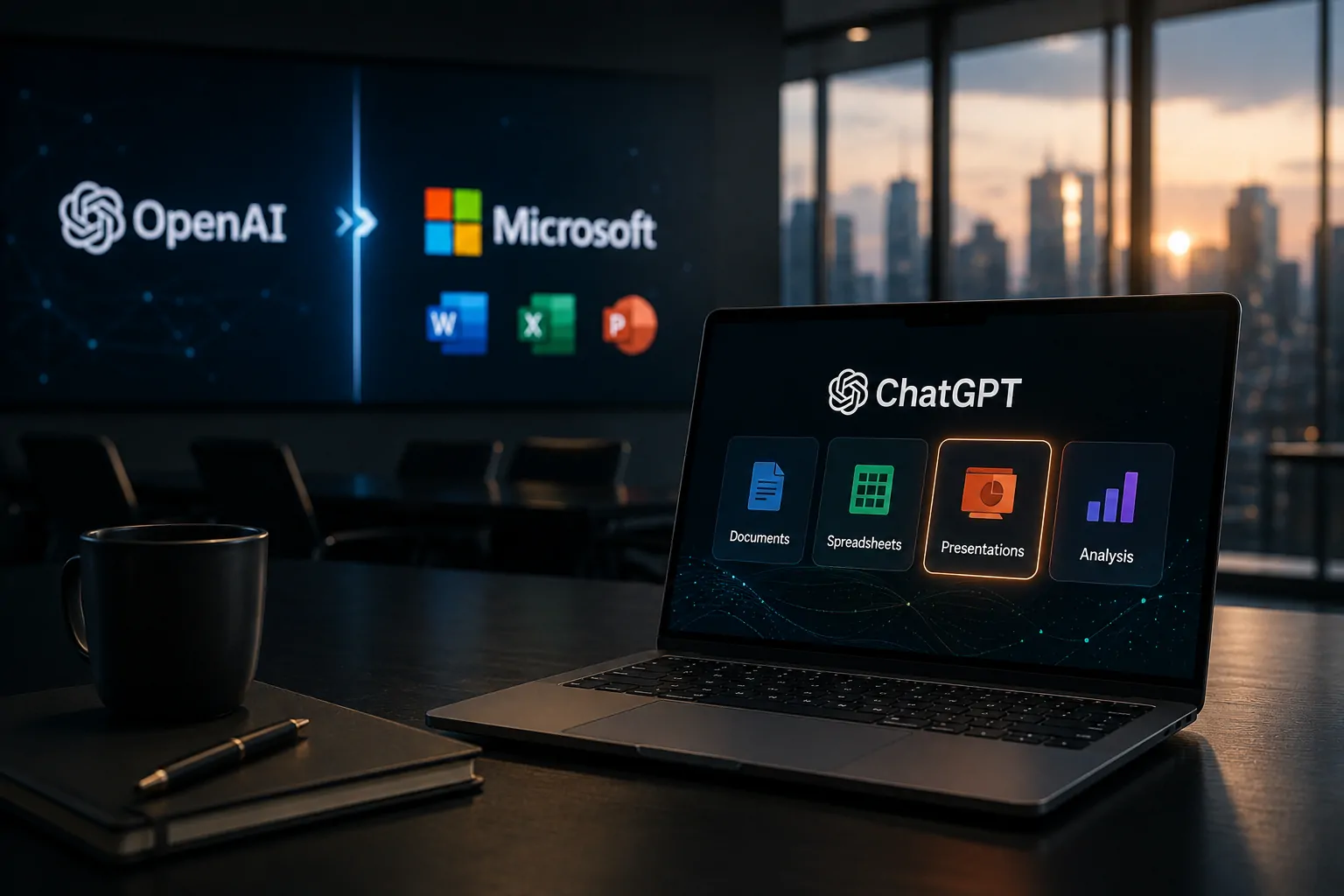
The move puts artificial intelligence at the center of tasks that traditionally depended on specialized software.
The competition is not simply between two products
The more interesting battle is not simply ChatGPT versus PowerPoint. It is a competition over where the digital workplace begins and ends.
Microsoft has operating systems, enterprise applications, cloud storage, collaboration platforms and productivity tools. OpenAI has one of the world’s most recognized AI products and is expanding ChatGPT to perform increasingly complex tasks.
That difference creates two possible strategies.
On one side, companies such as Microsoft can maintain the software that already dominates the corporate environment and embed artificial intelligence into it. On the other, OpenAI can take the opposite path: put AI at the center and progressively add the tools needed to complete the work.
ChatGPT’s recent evolution shows that this expansion is already underway. The platform has moved into projects, files and longer-running tasks, while ChatGPT Work has been positioned as a way to execute complete workflows rather than simply answer an isolated question.
The OpenAI strategy is beginning to form a work platform
The NextSlide acquisition makes more sense when viewed alongside these other capabilities. On its own, presentation creation may look like just another feature. Combined with documents, files, research and task execution, it could become part of a broader work platform.
That is the strategic point of the news.
A presentation rarely exists on its own. It typically starts with research, incorporates documents, numbers, customer information and internal data, and ends as a deliverable that needs to be reviewed and presented. If an AI can participate in several of those stages, the value of the tool extends beyond text generation.
ChatGPT Work has already been presented by OpenAI as capable of researching and analyzing information, working with connected applications and files, and producing deliverables such as documents, spreadsheets and presentations. The NextSlide acquisition adds a team specialized in precisely one of those stages.
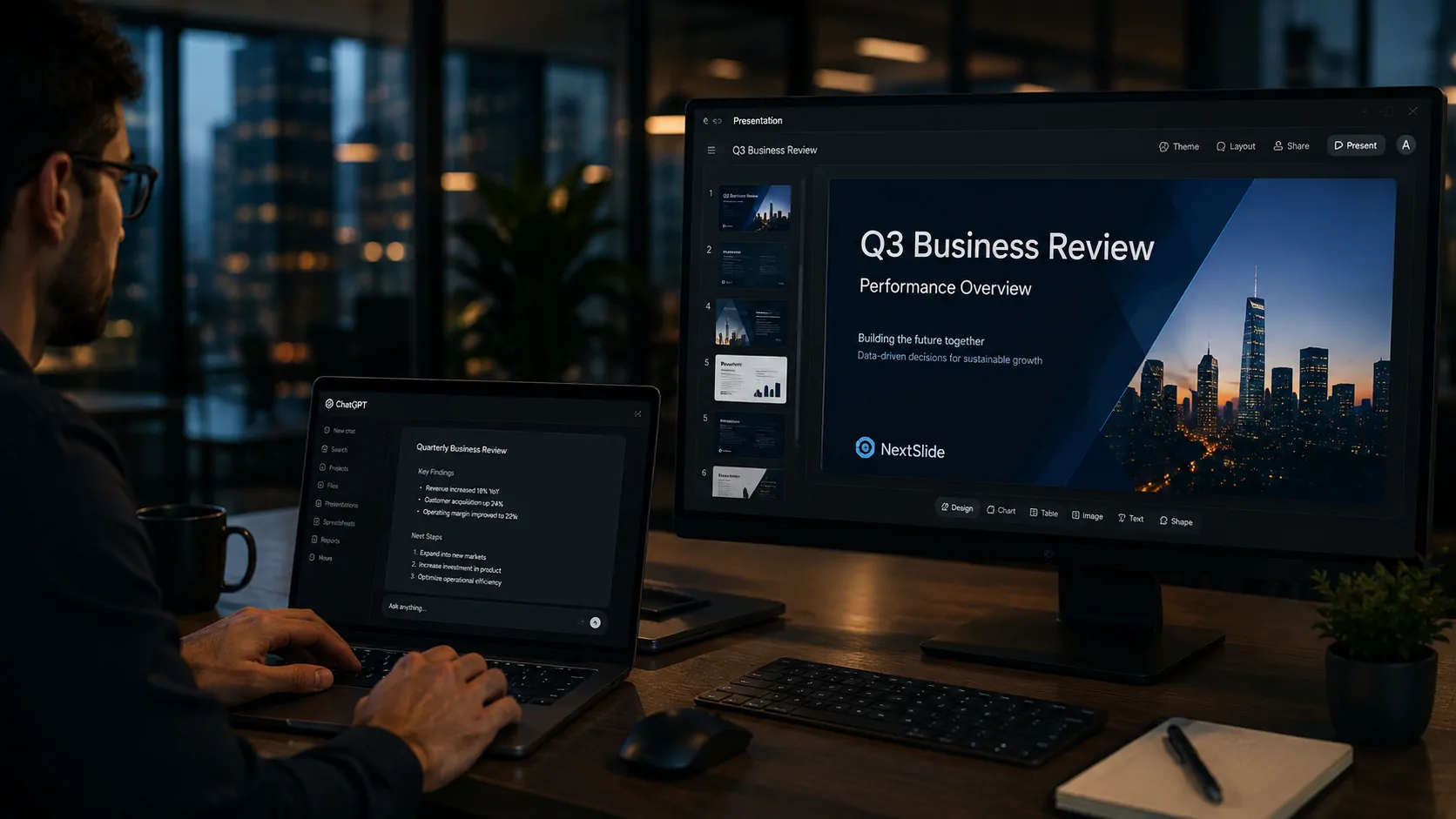
The next competitive battleground may be less about which application people use and more about which platform controls the entire workflow.
What changes for businesses and professionals using AI
For businesses, the biggest potential change is how work gets done. If ChatGPT can combine research, analysis, documents and presentations within the same workflow, tasks that currently require several applications could increasingly be handled through a single interface.
That does not mean PowerPoint, document editors or other enterprise software will disappear. Their role could change instead. Rather than being the starting point for the work, these applications could increasingly become tools for reviewing, refining and finalizing what an AI has already produced.
This scenario is particularly relevant to professionals working in reporting, sales, consulting, marketing, finance and management. A sales presentation, for example, could start with customer data, move through automated analysis and end with a visual presentation prepared for a meeting.
Less manual creation, more review and decision-making
The most important effect of generative AI on productivity is not necessarily eliminating the professional. It is shifting human work toward higher-value activities.
When a tool can structure information, create a first draft and organize a presentation, professionals spend less time formatting content and more time checking whether the information is accurate, whether the argument makes sense and whether the presentation actually supports a decision.
That shift also makes human review more important. An automatically generated presentation can look polished while still containing incorrect interpretations, outdated data or conclusions that should not be presented to customers.
That is why ChatGPT’s expansion into corporate work should not be viewed solely as a race for productivity. It also increases the need for governance, data controls and clearly defined responsibilities.
Businesses looking to adopt this model will need to think not only about which AI to use, but also about how to connect AI to internal processes securely. This makes the discussion around AI governance in business increasingly important as AI systems take on more complex tasks.
The acquisition reveals a shift in how AI competition works
The NextSlide deal shows that competition among major AI companies is moving beyond the question of which company has the best model.
During the first phase of the AI race, the main measures were model capabilities: reasoning, coding, text generation, image understanding and benchmark performance. The competition is now moving up another layer: which company can turn that intelligence into a platform capable of executing complete workflows.
That is where OpenAI’s strategy becomes clearer. ChatGPT does not necessarily need to replace every existing software product. It can instead become the environment through which users access and coordinate those capabilities.
The logic resembles the evolution of operating systems and mobile platforms. The value is not only in an individual feature, but in the ability to bring multiple activities together within a single ecosystem.
Software may no longer be the center of the experience
If this trend continues, users could eventually start their work by describing the outcome they want instead of first deciding which application they need.
In a hypothetical scenario, a manager could ask ChatGPT to analyze a dataset, identify the main problems, prepare an executive report and turn the findings into a presentation for the board.
The difference may seem subtle, but it is strategic. Today, professionals typically think in terms of a sequence of tools: spreadsheet, word processor, presentation software and storage system. In an AI-driven architecture, they could start with the objective and let the platform determine which tools are required.
This direction is already visible in OpenAI’s broader strategy. The company’s approach to ChatGPT Work and enterprise software points toward a similar shift: AI is moving from being a layer added to software to competing for control of the overall user experience.
Why Microsoft needs to respond to this shift
Microsoft has an advantage that is difficult to replicate: millions of businesses already use Word, Excel, PowerPoint, Teams and other enterprise services every day. The company does not need to persuade those organizations to adopt an entirely new platform.
OpenAI’s advantage is different. ChatGPT starts with a conversational interface that has already become familiar to millions of users and can turn that interface into an entry point for increasingly complex tasks.
The NextSlide acquisition brings these two strategies closer together.
Microsoft can continue bringing AI into the tools that already dominate the corporate environment. OpenAI can continue bringing enterprise capabilities into AI. The further both strategies advance, the greater the overlap between the two ecosystems.
That makes it increasingly relevant to follow Microsoft’s enterprise AI strategy, particularly because Copilot already occupies a strategic position inside business software.
The paradox of the OpenAI-Microsoft partnership
There is another important dimension to this competition: OpenAI and Microsoft maintain a strategic relationship built over several years, while their products are increasingly competing for some of the same tasks.
That creates an unusual dynamic in the technology market. Two companies can be strategic partners while simultaneously competing at specific layers of the product stack.
The NextSlide acquisition does not change that relationship by itself. But it adds another piece to the battle over the future of productivity software.
The key question will be how far ChatGPT advances into tasks traditionally associated with enterprise software and how far Microsoft can embed artificial intelligence without losing the central role of its own applications.
The next step could be turning ChatGPT into a workplace
The NextSlide acquisition does not guarantee that all of these changes will happen, but it provides a concrete signal of the direction OpenAI is pursuing.
The company is not simply trying to make ChatGPT better at conversation. It is bringing in teams and technologies that can turn AI responses into deliverables used directly in professional workflows.
That helps explain why small acquisitions can have strategic importance disproportionate to the size of the companies being acquired. The objective may be to acquire specialized expertise, accelerate product development and reduce the time needed to turn an experimental capability into a commercial feature.
Over the next few months, the market will be watching three developments in particular: how presentation creation evolves inside ChatGPT, how those capabilities connect with other types of files and tasks, and how traditional productivity platforms respond.
What businesses should watch now
For executives, the main signal is not to immediately abandon existing software. It is to watch how AI begins crossing the boundaries between applications.
If ChatGPT can research, analyze, write, organize data and create presentations within a single workflow, the question for businesses will no longer be simply which application offers the best individual feature.
The question will become which platform can coordinate the work most effectively.
This shift also helps explain the growing importance of AI agents and enterprise productivity. An AI agent is a system capable of carrying out a sequence of actions toward a goal rather than simply generating a single response.
As these capabilities become more integrated, competitive advantage could increasingly move away from individual software products and toward platforms capable of connecting context, data, tools and execution.
That is where the NextSlide acquisition takes on its real strategic weight. The startup does not simply represent a tool for making slides. It gives OpenAI another piece of a much larger market: the market for controlling how people and businesses turn information into work.
And if ChatGPT continues moving in this direction, the next OpenAI-Microsoft battle may happen less inside a specific presentation and more around the question that comes before it: which platform will people choose to do the entire job?
Comentários
Os comentários utilizam autenticação via GitHub para manter um ambiente mais qualificado, seguro e livre de spam.
Entrar ou criar conta no GitHub