
Artificial intelligence agents are no longer just an evolution of chatbots. OpenAI’s rapid growth to approximately 10 million AI agent users demonstrates that the next technology battle will not simply revolve around larger language models, but around replacing the traditional interface of enterprise software. For businesses, this shift could redefine productivity, automation and digital competitiveness over the coming years.
OpenAI’s growth confirms AI agents are becoming part of everyday business operations
Businesses are beginning to view AI agents as operational systems capable of completing complex tasks instead of merely answering questions. The rapid adoption of OpenAI’s platform suggests the market has moved well beyond its experimental phase.
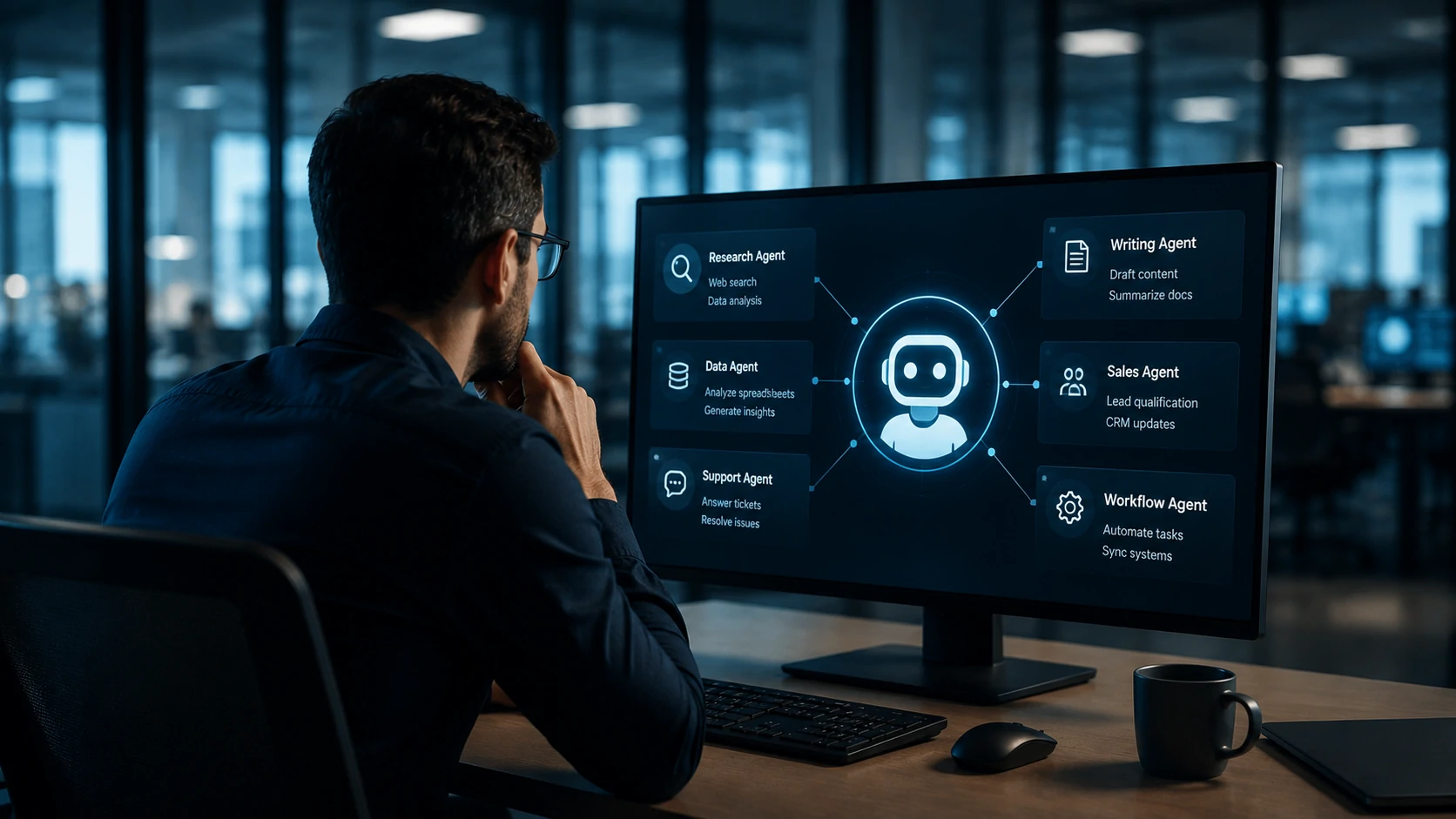
Intelligent agents are beginning to perform tasks that previously required multiple software platforms and significant human intervention.
Early language models primarily focused on generating text. Today’s generation of AI agents can execute complete workflows, access enterprise documents, retrieve information from databases, navigate internal systems and interact directly with business applications.
From digital assistants to autonomous execution
The defining characteristic of modern AI agents is their ability to take action.
Instead of recommending the next step, they can initiate workflows, coordinate information across systems and deliver completed outcomes with minimal human supervision.
This evolution transforms artificial intelligence from a productivity assistant into a digital coworker capable of reducing administrative overhead while increasing operational efficiency.
Ten million users signal a major market transition
Reaching approximately 10 million users is a meaningful milestone for any technology platform.
Historically, software products achieve this level of adoption only after expanding beyond early adopters into mainstream enterprise environments where they become part of daily business operations.
The milestone also reinforces the strategy introduced through ChatGPT Work, which demonstrated how AI agents could become central to enterprise productivity.
To better understand how intelligent agents are reshaping business automation, read:
How AI Agents Are Transforming Business Process Automation Beyond ChatGPT Work
The new competitive battlefield is replacing traditional software interfaces
The biggest transformation is not artificial intelligence itself.
Instead, technology companies are competing to control the interface professionals use throughout their workday.

AI agents are expected to reduce the need for employees to manually navigate multiple enterprise applications.
Today’s knowledge workers constantly switch between CRM platforms, spreadsheets, email clients, ERP systems, collaboration tools and customer support applications.
One intelligent interface across multiple platforms
AI agents aim to eliminate this fragmented experience.
Rather than opening several applications, employees will simply describe the desired outcome in natural language. The agent will determine which systems to access, execute every required action and return a consolidated result.
This dramatically reduces operational friction while increasing employee productivity.
Software becomes the infrastructure rather than the interface
This does not mean CRM, ERP or enterprise platforms will disappear.
Instead, these systems increasingly become the infrastructure layer while AI agents emerge as the primary interface connecting users with enterprise applications.
This strategic direction explains why technology vendors are investing heavily in orchestration platforms, integration frameworks and enterprise connectivity solutions capable of linking AI models with corporate systems.
The same movement is closely connected to the growing adoption of the Model Context Protocol (MCP), explored in detail here:
How to Build an MCP Server That Connects AI with Enterprise Systems
Businesses that adopt AI agents first could gain a lasting competitive advantage
Organizations that integrate AI agents into their core operations are likely to reduce operating costs, accelerate decision-making and improve overall productivity. More importantly, early adoption may become a decisive competitive advantage rather than simply another technology investment.

Organizations that integrate AI agents into business workflows can accelerate productivity gains while reducing repetitive manual work.
The shift resembles the early adoption of Cloud Computing. Initially viewed as a cost-saving initiative, cloud platforms eventually became the foundation for digital innovation across virtually every industry.
AI agents appear poised to follow a similar path, but at a considerably faster pace.
Automation is evolving beyond fixed rules
Traditional automation depends on predefined workflows and deterministic logic.
An AI agent, by contrast, understands context, adapts to changing situations and determines which applications or services should be used to complete a task.
This capability dramatically expands the range of business processes that can be automated.
Customer service, sales, marketing, procurement, finance, human resources and technical support can increasingly operate through a shared intelligent layer connecting multiple enterprise systems.
The impact extends across the enterprise software ecosystem
OpenAI’s rapid growth is increasing competitive pressure on Google, Anthropic, Microsoft and other AI vendors to develop increasingly autonomous enterprise agents.
At the same time, software providers are redesigning their products to function seamlessly within AI-driven ecosystems rather than as isolated applications.
This evolution also reinforces the importance of AI Governance, especially as intelligent agents gain access to sensitive enterprise information and begin making operational decisions.
For a deeper understanding of this challenge, read:
What Is AI Governance and Why Businesses Will Need It in the Coming Years
The AI agent race is redefining the future of enterprise software
The milestone of 10 million AI agent users suggests that intelligent agents are no longer an experimental productivity feature. They are rapidly becoming the primary interface between people and enterprise technology.
Rather than eliminating existing software, AI agents are transforming how organizations interact with it.
Competition is shifting toward complete AI ecosystems
Over the next several years, competitive advantage will depend on much more than building the most capable language model.
The companies that successfully combine AI agents, enterprise data, software integrations, automation frameworks and infrastructure into a unified ecosystem will be best positioned to attract both organizations and developers.
This explains why OpenAI, Google, Anthropic, Microsoft and other technology leaders are increasingly investing in agent platforms, interoperability standards and enterprise integration technologies instead of focusing exclusively on larger foundation models.
Enterprise software is entering a new era
The rapid adoption of AI agents demonstrates that digital transformation is entering a fundamentally different stage.
During the past decade, organizations focused on digitizing business processes. The next decade is likely to center on delegating those processes to intelligent systems capable of executing complete workflows with minimal human intervention.
In this environment, the true competitive asset is no longer simply owning advanced artificial intelligence. It is building an enterprise architecture where autonomous AI agents, business applications, enterprise data and automation platforms operate as a unified intelligent system.
OpenAI’s milestone serves as a strong indication that this transformation is already underway. For business leaders, the strategic question is no longer whether AI agents will become part of everyday operations, but how quickly they can be integrated into mission-critical workflows. Organizations that move early will be better positioned to improve efficiency, accelerate innovation and strengthen their competitive advantage in an economy increasingly shaped by artificial intelligence.
Comentários
Os comentários utilizam autenticação via GitHub para manter um ambiente mais qualificado, seguro e livre de spam.
Entrar ou criar conta no GitHub