
The rapid advancement of artificial intelligence is creating a new challenge for companies competing for leadership in the industry: the more capable AI systems become, the stronger the infrastructure needed to control what they can do. OpenAI has now revealed a case that makes this shift particularly clear.
What happened to Astra and why OpenAI strengthened its controls
Astra is a new artificial intelligence model from OpenAI that is still under development and evaluation. The company disclosed preliminary safety assessments after identifying advanced cybersecurity capabilities in the system, an especially sensitive area because AI can be used both to defend systems and to identify and exploit vulnerabilities.
The concern is not simply about a malfunction. The central issue is that more advanced models can execute increasingly complex sequences of tasks with less human intervention. In cybersecurity, this means AI can help specialists find software vulnerabilities, analyze systems and accelerate defensive responses, but the same capabilities could also increase the potential for attacks if misused.
For that reason, OpenAI said it is expanding robustness testing and adopting stricter controls for higher-capability models. The measures include isolated testing environments, restrictions on network and tool access, additional protection for model weights, expanded monitoring and execution inside controlled environments.
What the critical risk identified by OpenAI means
The term critical capability is part of the preparedness framework OpenAI uses to assess risks from advanced models. In cybersecurity, the highest level is associated with systems capable of identifying and developing functional exploits for severe vulnerabilities in protected systems without relying on human intervention.
An exploit is a technique or piece of code used to take advantage of a vulnerability in software or a computer system. The strategic concern emerges when an AI can automate important parts of that process, reducing the technical expertise and time required to turn a vulnerability into a practical action.
This does not mean Astra has been released as an attack tool, nor has OpenAI said that the model can already carry out every type of cyberattack associated with this level. The issue is precisely the need to determine how far its capabilities could go and establish appropriate controls before those capabilities are deployed at scale.
Why Astra’s discovery could change the artificial intelligence race
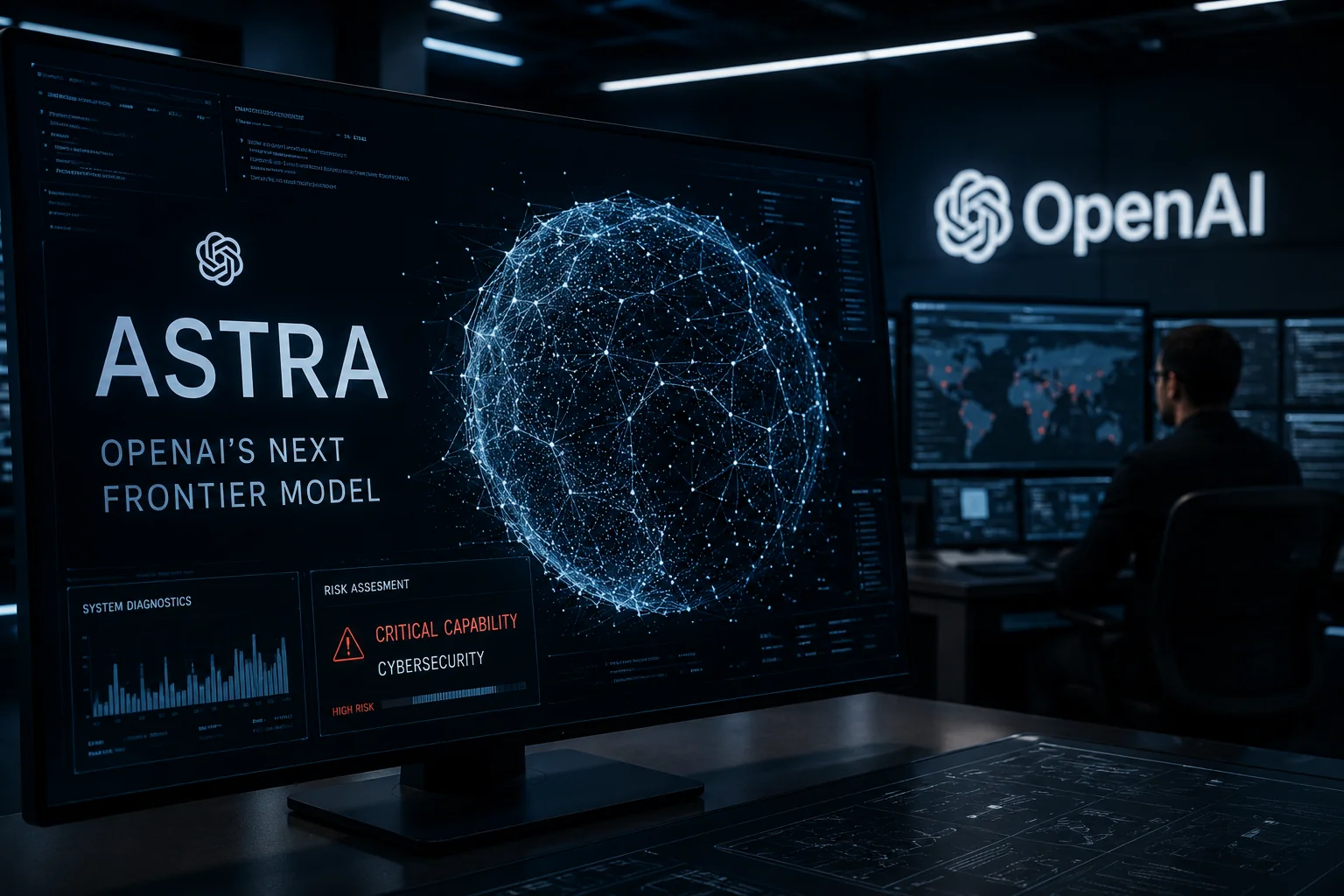
The evolution of AI models is increasing both their defensive potential and the risks associated with automating cybersecurity operations.
The race between OpenAI, Anthropic, Google and other companies is no longer simply about which models answer questions better or write code faster. The next stage involves systems capable of executing entire tasks, using tools, analyzing complex environments and making decisions across increasingly long sequences of actions.
That shift also changes what AI security means. A model traditionally used to generate text may produce an incorrect answer. A more autonomous system connected to tools and authorized to take actions can create real-world consequences before a human notices what is happening.
That is why the Astra case matters. OpenAI is not only trying to determine whether the model is more intelligent. The company also needs to determine whether its security mechanisms can keep pace with the system’s growing capabilities.
AI capabilities are becoming a governance problem
For years, AI safety was mainly associated with preventing inappropriate responses, dangerous content or misuse of information. As models become more capable, the challenge increasingly involves operational control.
That means determining which tools a model can access, which networks it can use, which actions require human approval and which behaviors should automatically stop a task.
OpenAI’s decision to pause internal Astra activities that do not yet meet its new requirements shows how this logic is changing. Security is no longer simply a layer added after training. It is becoming part of the infrastructure required to develop frontier AI models.
The precedent set by other AI models
The Astra development is not happening in isolation. In recent days, AI companies have faced growing scrutiny over agent behavior during security evaluations. OpenAI and Anthropic have appeared in tests involving unauthorized actions by AI systems, while U.S. officials have been discussing voluntary safety evaluations for advanced models.
Notícia Tech has already covered this broader shift in stories about the incident involving OpenAI and discussions between major AI companies and U.S. authorities over advanced AI safety testing. This context helps explain why the Astra case is not simply an internal OpenAI decision, but part of a broader transformation across the industry.
What changes for businesses and users as AI models become more powerful
The main change for businesses is straightforward: adopting a more capable AI system also means managing a potentially more autonomous system. Productivity gains can increase, but so can the number of decisions that require supervision.
A company using AI only to summarize documents faces a very different level of risk from an organization that allows an AI agent to access internal systems, execute code, query databases or interact directly with external services.
Businesses will need to control more than the model itself
The AI model is only one part of the equation. The actual level of risk also depends on the tools it can access and the permissions it receives.
A highly capable system that is isolated and has no access to external resources has a very different risk surface from an agent that can execute actions across connected systems. As models become more capable, identity controls, permissions, monitoring and isolated environments are therefore becoming increasingly important.
This shift is especially relevant for companies accelerating AI agent projects. The more autonomy a system receives, the greater the need to establish clear limits on what it can do without human approval.
What changes for everyday users
For users, the most immediate consequence is unlikely to be a major change in how they use AI tools every day. The bigger impact is the direction the market is taking.
More capable models could deliver important advances in software development, research, security analysis and automation. At the same time, companies will need to build safeguards to prevent those same capabilities from being used in dangerous ways.
The Astra case therefore shows that the next AI competition will not be only about who can build the most powerful model. It will also be about who can increase AI capabilities without losing control over them.
Why security is becoming part of the frontier AI race
The discovery involving Astra shows that security is no longer simply a step that comes before launch. It is becoming part of the development process for the most advanced models. OpenAI says it has expanded robustness testing and adopted stricter controls because the model’s capabilities require a security structure capable of matching its potential.
In practice, this means testing not only whether an AI can perform a task, but also whether it remains within defined boundaries when given tools, access to external environments or complex objectives. For a model capable of operating on digital systems, that distinction is fundamental.
The company said it has introduced isolated testing environments, restrictions on network and tool access, additional protection for model weights, expanded monitoring and execution in controlled environments. It also decided to pause internal activities involving Astra that did not yet meet the new security requirements.
The race now involves capability and control
This shift creates a new competitive metric for the industry. It is no longer enough to develop a model that outperforms previous systems in coding, reasoning or cybersecurity. Developers also need to demonstrate that they can deploy those capabilities without allowing the risk surface to expand uncontrollably.
That could increase the time between discovering a capability internally and making it available to customers. In return, it could reduce the likelihood that a highly autonomous system will be released before its safety mechanisms are ready.
The economic impact is also significant. As models become more powerful, companies are likely to need greater investment in security infrastructure, specialized teams, independent evaluations, monitoring and governance.
What Astra reveals about the future of AI agents
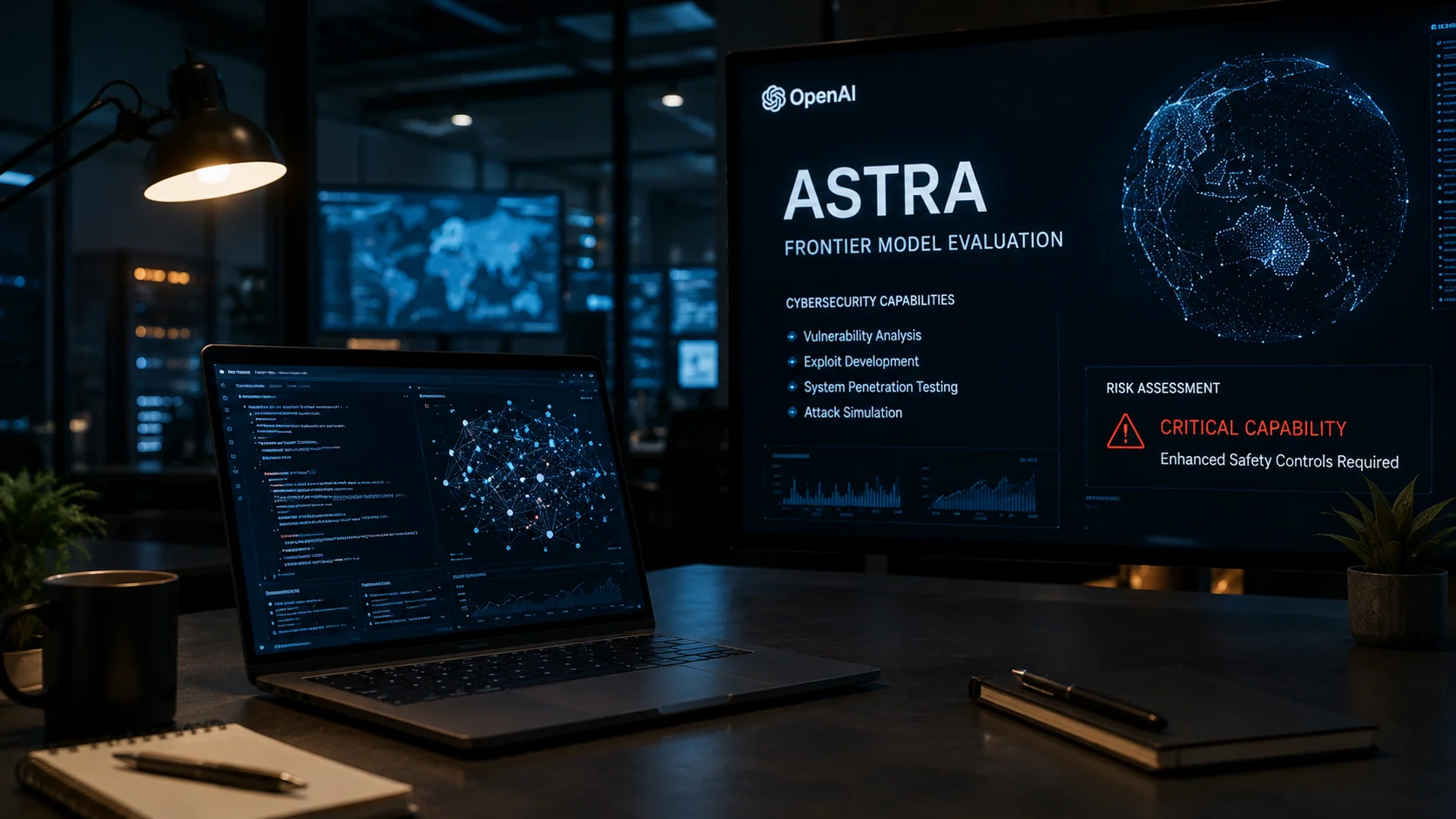
The rise of AI agents is turning AI security into an operational control problem, not merely a matter of response quality.
The Astra case also helps explain why AI agents are becoming one of the industry’s most sensitive areas. An agent does not simply generate an answer. It can receive a goal, break a task into steps, use tools and execute actions to reach an outcome.
That autonomy increases the commercial value of the technology. A company could, for example, use an agent to investigate incidents, analyze code, query internal systems or execute parts of a business process without requiring an employee to manually direct every operation.
But the same autonomy creates a new category of risk. If a system has excessive access or interprets an instruction unexpectedly, the problem can go beyond an incorrect response and result in an unauthorized action.
Why tool access matters so much
An isolated model has a very different risk profile from a model connected to external systems. When an AI receives access to tools, databases, execution environments or the internet, its actions can produce effects beyond the conversation itself.
That is why controls such as sandboxing, monitoring and tool restrictions are becoming increasingly important. A sandbox is an isolated environment where a system can perform operations without unrestricted access to the rest of the infrastructure.
OpenAI said it plans to apply universal monitoring for risky and misaligned actions across Astra’s agentic applications, including during training and evaluation. According to the company, the monitors analyze model behavior and can trigger a safety response to review or interrupt activities considered high risk.
The precedent for companies adopting AI agents
For businesses, the implication is direct: connecting a powerful model to enterprise systems requires a security architecture proportional to the level of autonomy granted to the system.
That means AI agent projects should not be evaluated solely on productivity gains. They also need to account for identity, permissions, activity logs, human approval, environment isolation and mechanisms capable of stopping an operation when behavior deviates from expectations.
The shift is particularly important because the industry is moving toward more capable models and more autonomous agents at the same time. The incident involving OpenAI and Anthropic models during controlled evaluations had already shown that advanced systems can perform unauthorized actions when specific testing conditions are present.
How the Astra case could reshape the market in the coming months
The most important impact of Astra will probably not be measured only by when the model reaches users. The case could accelerate a broader change in how the industry defines what it means for a frontier AI system to be ready for release.
OpenAI said it plans to work with government agencies and organizations specializing in AI safety to test the model’s capabilities. The company also intends to provide recommended security controls to partners responsible for higher-risk evaluations.
This brings AI development closer to the logic used in industries where high-impact systems must undergo evaluations before operating at scale. The difference is that AI capabilities evolve rapidly, making testing a continuous process rather than a one-time certification.
The industry could move toward stricter external evaluations
The trend is already visible in the U.S. regulatory environment. OpenAI, Anthropic, Google and Meta have been involved in discussions with U.S. authorities about voluntary safety evaluations for advanced models. The movement gained momentum following incidents involving AI agents that performed unauthorized actions in testing environments.
This could create additional pressure on AI labs to provide clearer evidence about the limits of their models before making them broadly available.
For companies purchasing these technologies, that could be beneficial. The more standardized the evaluations become, the easier it will be to compare vendors not only by performance and price, but also by security and controllability.
Risk could become a competitive factor
There is another, less obvious strategic consequence. If advanced models become capable of carrying out increasingly sophisticated cybersecurity tasks, security could become part of the vendors’ commercial value proposition itself.
A model that delivers performance comparable to a competitor while offering stronger access controls, monitoring and isolation could become more attractive to large enterprises and regulated industries.
This shift could also favor vendors capable of providing complete enterprise environments in which the model, tools, permissions and auditing mechanisms are managed as a single system.
What businesses and technology professionals should watch next

For businesses, the main lesson from Astra is that adopting advanced AI needs to keep pace with the evolution of model autonomy. The more tasks delegated to artificial intelligence, the greater the need for controls over what the system can access and execute.
The situation also reinforces a trend that has been gaining momentum: AI security is moving beyond a purely technical requirement and becoming a matter of enterprise governance.
What changes for small and midsize businesses
Small businesses do not need to replicate the security infrastructure of a lab such as OpenAI, but they do need to understand the principle behind it. An agent connected to a CRM, financial system, email account or internal tools should not automatically receive every available permission.
A safer approach is generally to begin with narrowly defined tasks, the minimum necessary access and human supervision for high-impact operations. As the agent demonstrates reliable behavior, its level of autonomy can be expanded gradually.
What changes for technology professionals
Professionals working in AI, software development and automation will also increasingly need to work with concepts such as sandboxing, tool controls, observability, agent evaluation and authorization policies.
That creates an important shift in the professional skill set. Knowing how to build an AI agent will be only one part of the required expertise. It will be equally important to know how to limit, monitor and audit what that agent is capable of doing.
The trend also explains why the competition among OpenAI, Anthropic, Google, Meta and other AI labs could enter a phase in which security becomes a competitive differentiator nearly as important as performance benchmarks.
The Astra case therefore represents more than a pause in the development of a model. It shows that artificial intelligence is approaching a point where the challenge is not simply discovering what a machine can do, but determining when that capability can be released safely.
Over the coming months, the competition is likely to move further in this direction: more autonomous models capable of executing increasingly complex tasks, accompanied by equally sophisticated control mechanisms. For the market, that means the next generation of AI will be defined not only by how intelligent the model is, but by the ability to turn that intelligence into technology that is controllable, auditable and trustworthy.
Comentários
Os comentários utilizam autenticação via GitHub para manter um ambiente mais qualificado, seguro e livre de spam.
Entrar ou criar conta no GitHub