The partnership between Perplexity and Intuit brings Perplexity Computer closer to the operational core of businesses. By connecting QuickBooks and Mailchimp through MCP, the AI can turn information into financial, administrative and marketing actions, signaling a significant shift in how AI agents interact with enterprise software.
Perplexity brings AI directly into business systems
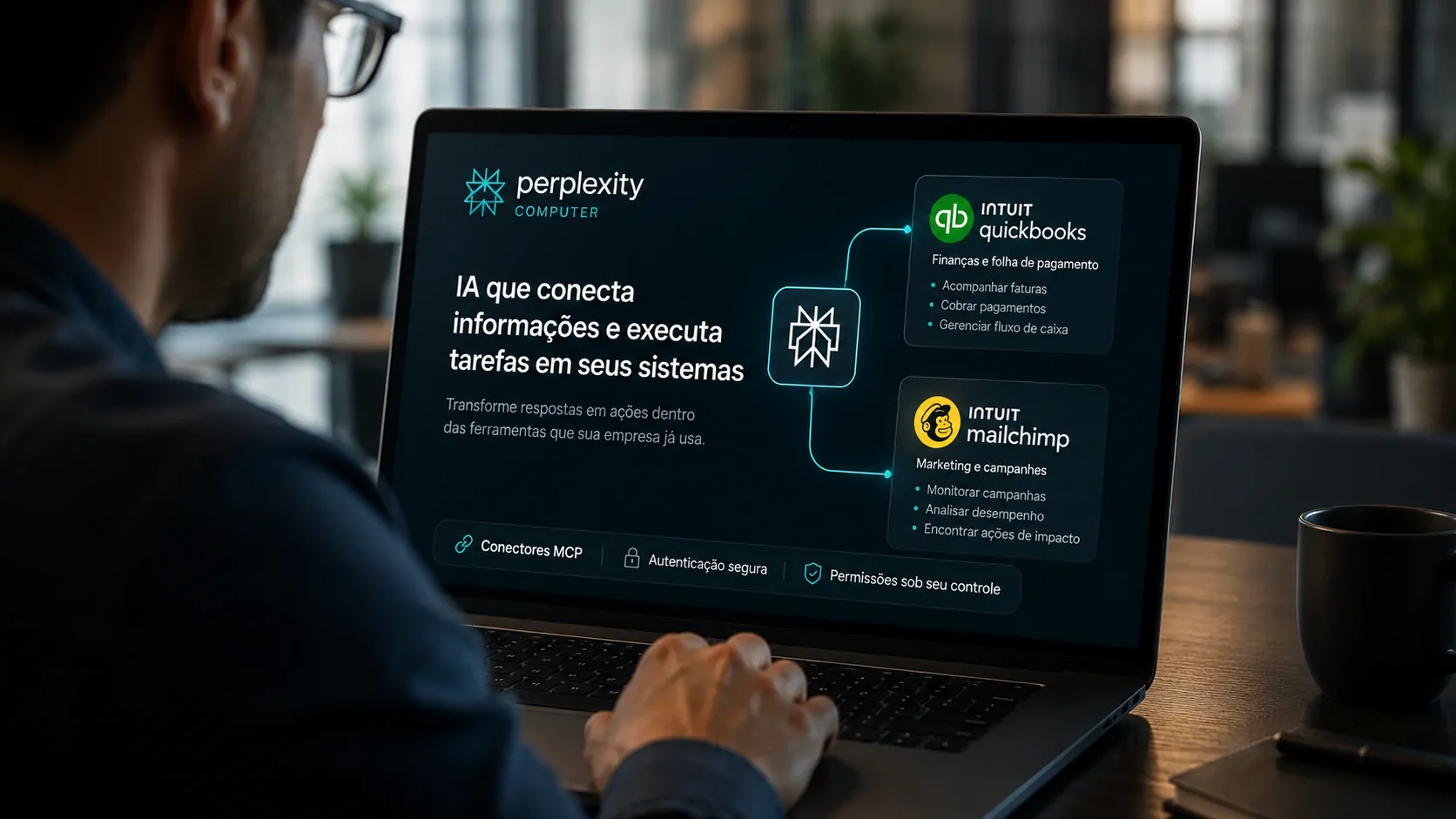
Perplexity Computer expands from answering questions to interacting with systems used in day-to-day business operations.
Perplexity has integrated QuickBooks and Mailchimp into Perplexity Computer, allowing users to turn information obtained through AI into actions inside business systems. Intuit announced the partnership on August 31, 2026, with MCP connectors providing the connection between the platforms.
The move matters because it changes the role of Perplexity Computer. Instead of functioning only as an interface for searching information, analyzing data and producing answers, Computer can now operate on tools directly involved in business operations.
Perplexity has already positioned Computer as an agent capable of executing workflows across different platforms. The integration with Intuit products expands that model into areas that are particularly important for businesses, including finance, payroll and marketing.
What is behind the integration
MCP, or Model Context Protocol, provides a standardized way for AI applications to connect with external tools and data sources. In practice, it allows an AI system to interact with compatible services while operating within authentication and permission controls.
In this case, the connection brings QuickBooks and Mailchimp capabilities into the Perplexity Computer workflow, bringing research, analysis and execution closer together within a single interface.
QuickBooks and Mailchimp turn AI responses into actions

The integrations connect AI-driven analysis with financial and marketing workflows.
The key development is that Perplexity Computer can perform tasks that previously required users to access separate business systems. With QuickBooks, this includes activities related to cash flow and accounts receivable.
Finance moves beyond information retrieval
Examples highlighted by Intuit include tracking overdue invoices, setting up recurring invoices and sending payment links. Computer can also retrieve paychecks and employee information related to payroll.
This creates an important distinction between an AI that simply answers a question such as “which customers have overdue payments?” and an AI that can access the relevant data and move toward an action inside the financial system, provided it has the necessary authorization.
The model is increasingly aligned with the concept of an AI agent, in which the technology does not simply interpret a request but also uses external tools to complete parts of a task.
Marketing becomes part of the same workflow
With Mailchimp, the integration allows users to track campaign performance and identify actions that may have greater impact. The goal is to reduce the distance between analysis and execution.
For a business, that means a question about marketing performance does not necessarily have to end with a report. The same workflow can connect data interpretation with actions available inside the marketing platform.
This direction is already emerging across major AI platforms. Google Gemini is moving toward executing tasks through AI agents, showing that competition is increasingly shifting from generating answers to executing activities.
What changes when AI can operate business systems
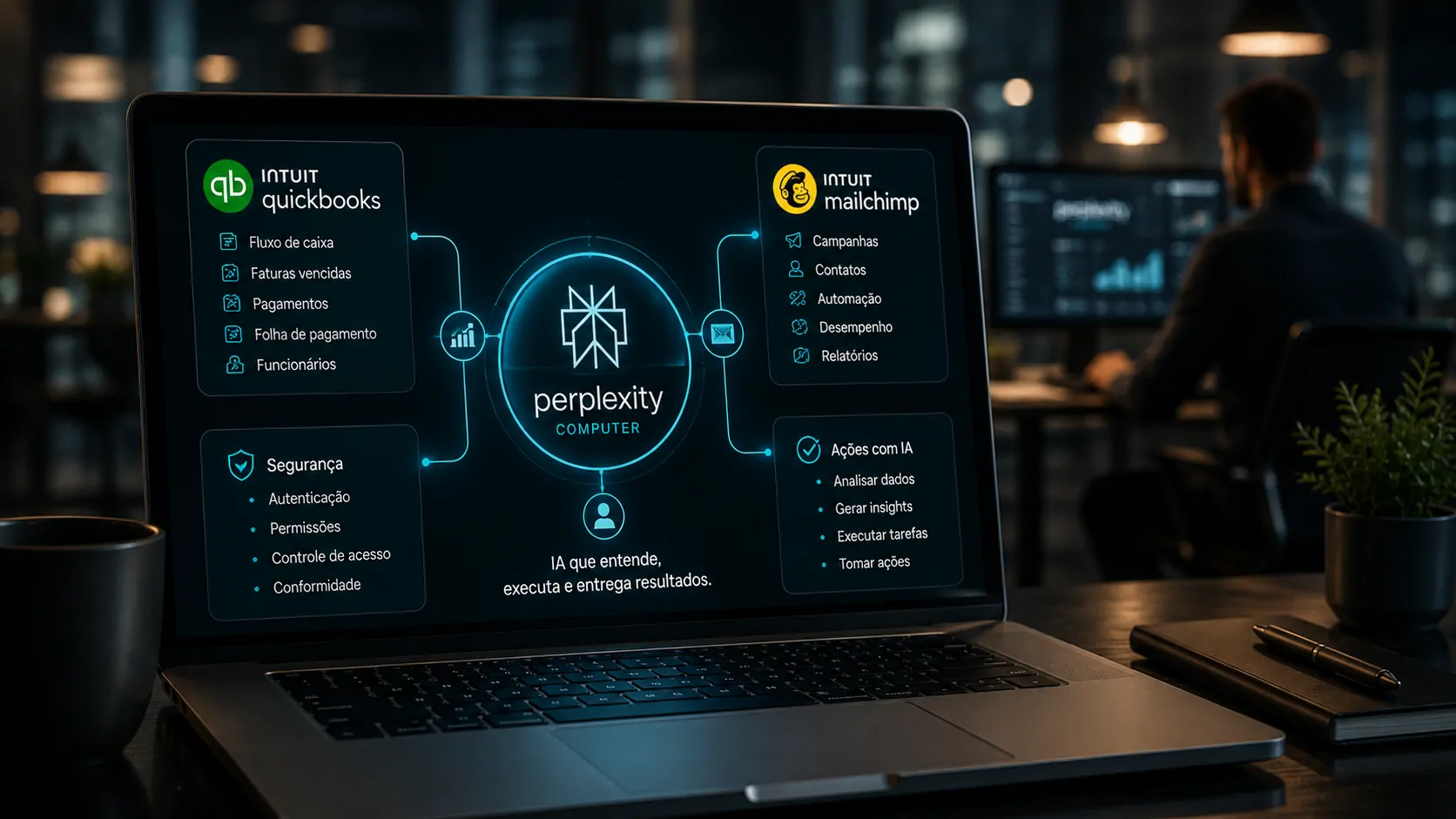
The new model brings AI closer to the systems where business decisions become operational actions.
The most important change is the shift from answer-oriented AI to execution-oriented AI. Users can continue making requests in natural language, but the result can involve actions across multiple connected systems.
This can reduce the need to switch between platforms. A person can use an AI interface to retrieve information, interpret the data and initiate tasks that previously required a sequence of manual interactions.
The value is in the integration, not just the model
The advance does not depend solely on the capability of the language model. Tool access, data quality, permissions and security mechanisms become equally important.
That is why the connection between Perplexity, QuickBooks and Mailchimp is more significant than a simple software integration. It demonstrates an architecture in which AI can operate as a layer over software that businesses already use.
This also helps explain why AI agents are gaining relevance in corporate environments. Their potential value is not limited to producing content faster. It is also about reducing the number of steps between a decision and its execution.
Security becomes a central part of the strategy
The more autonomy an AI system receives inside business software, the more important security, permissions and governance become. In the Intuit integration, users must authenticate their existing accounts before allowing Computer to access connected services.
Authorized access limits autonomy
The integration does not mean that Perplexity Computer receives unrestricted access to a company’s accounts. Usage depends on authentication and the permissions associated with the connected services.
That distinction becomes critical when AI systems begin handling financial information, employee data or marketing metrics. The risk is no longer limited to an incorrect answer. An incorrect action inside a live business system can have operational consequences.
As enterprise agents become more capable, companies will need clearer controls over which tools an agent can access, which actions it can perform and when human approval should be required.
Autonomy creates a new layer of responsibility
The discussion around AI agents and responsibility for autonomous actions in businesses illustrates why this transition deserves attention. When AI moves from observing to acting, mistakes can produce concrete operational consequences.
In this environment, governance is no longer only a matter of privacy or compliance. It also involves defining the limits of an agent’s authority and maintaining traceability for the actions it performs.
The enterprise AI race is entering a new phase
The integration shows that competition among AI platforms is moving into the systems where businesses actually work. Having a model that can answer questions remains important, but controlling a layer that connects research, data and execution can create a different kind of competitive advantage.
Perplexity Computer is already moving toward this position by combining research, tool execution and workflows. The arrival of QuickBooks and Mailchimp adds two important areas of business operations: finance and marketing.
The interface may change more than the software
For decades, businesses have organized their operations around specific applications. Employees learned to open a financial system to review accounts, a marketing platform to track campaigns and other tools to perform separate tasks.
The agent model can reverse that relationship. Instead of users navigating through every application themselves, AI can become the interface that coordinates multiple systems.
That does not mean traditional business software will disappear. What may change is how people interact with it. The software can continue to store and process data while AI becomes an additional layer for interpretation and execution.
Perplexity is betting on AI that does not stop at the answer
The partnership between Perplexity and Intuit suggests that the next stage of enterprise AI will be defined less by its ability to answer and more by its ability to execute safely. QuickBooks and Mailchimp provide concrete examples of how this shift can reach financial and marketing workflows.
The difference will be the ability to act
An AI system that identifies an overdue invoice provides information. An AI system connected to the financial platform and authorized to initiate an action can participate in the operational process. The difference may appear small at the interface level, but it is significant for a company’s architecture.
The same applies to marketing. Analyzing campaign performance is an intelligence task. Connecting that analysis to the platform that manages campaigns brings AI closer to execution.
That is the boundary Perplexity is beginning to explore with this integration. The company is no longer competing only on the quality of its answers. It is also competing for a position in the layer connecting artificial intelligence to the tools businesses use every day.
The next challenge will be trust
The new QuickBooks and Mailchimp experiences were announced for users in the United States. Wider adoption will depend not only on the usefulness of the integrations but also on whether businesses are comfortable allowing AI agents to operate inside critical systems.
The central point, therefore, is not simply that Perplexity Computer gained two new connectors. It is that AI is beginning to cross an important boundary: moving beyond the screen where it answers questions and into the systems where business decisions become real operations.
Comentários
Os comentários utilizam autenticação via GitHub para manter um ambiente mais qualificado, seguro e livre de spam.
Entrar ou criar conta no GitHub