SAP NOW AI Tour Brazil 2026 arrives in São Paulo at a moment when enterprise AI is beginning to change its role: instead of simply answering questions, AI systems are increasingly being designed to execute tasks, coordinate processes and operate inside enterprise systems. SAP’s strategy for the event shows why this transition could become one of the next major battlegrounds in enterprise technology.
SAP brings the enterprise AI debate to São Paulo
SAP NOW AI Tour Brazil 2026 will take place on September 9 and 10 at the Transamerica Expo Center in São Paulo. SAP, a global enterprise software company, expects to bring together around 4,000 participants to discuss artificial intelligence, data, applications and business transformation.
The scale of the event
The agenda will include more than 300 sessions, 73 partner companies and more than 500 business meetings are expected. Customers will also play an important role, with companies such as Copel, Grupo Edson Queiroz, M. Dias Branco, EMS and Claro presenting experiences related to digital transformation.
What is really at stake
The most important part, however, is not the size of the event. It is the shift in focus. SAP wants to show how applications, data and AI agents can work together to transform complete business processes instead of limiting AI to isolated tools.
This approach puts the concept of the Autonomous Enterprise at the center of the discussion. For SAP, an autonomous enterprise is an organization capable of using AI to think, act and adapt, while people remain in control of strategy, priorities and decisions that require judgment.
SAP wants to take AI beyond chatbots
The main shift presented by SAP is the move from conversational AI toward execution-oriented AI. A chatbot can answer a question about a company. An agent connected to enterprise systems can, under the right conditions, turn that intent into a sequence of actions.

AI agents can connect intent, data, applications and execution within business processes.
From answering to acting
This distinction matters because the biggest enterprise gains do not necessarily come from generating text. They can emerge when AI can retrieve information, understand context, trigger systems and follow a task through to completion.
That is precisely the logic behind Joule, SAP’s AI layer that connects users, systems, workflows and agents. The company plans to demonstrate how this integration can work across areas such as finance, human resources, procurement, supply chain and customer experience.
The agent as part of the process
This brings SAP’s strategy closer to a broader shift in the market: AI agents are moving beyond the role of individual assistants and becoming components of business processes.
Notícia Tech has already been following this transition in its analysis of how AI agents are transforming business process automation. SAP’s differentiator is its attempt to bring this logic directly into an integrated enterprise infrastructure.
The Agent Lab shows how SAP wants to accelerate adoption
The Agent Lab will be one of the most relevant experiences at SAP NOW 2026 because it turns the concept of an agent into a hands-on demonstration. The space will feature ten stations equipped with Joule Studio 2.0, allowing participants to create agents using natural language.
Less coding, more configuration
According to SAP, someone without technical programming knowledge will be able to configure an agent designed for a specific business task in approximately 15 minutes, with support from specialists.
That does not mean building complex enterprise systems will be reduced to a few commands. The demonstration points to something else: SAP wants to lower the initial barrier so business teams can participate in creating and adapting agents.
The real challenge starts afterward
The ability to create an agent easily is only one part of the equation. In enterprise environments, value depends on reliable data, permissions, application integration, governance, security and the ability to control what AI is allowed to execute.
That is precisely why the Autonomous Enterprise concept is broader than simply putting agents inside companies. Autonomy needs to operate within structured processes and mechanisms that keep the organization in control.
An autonomous enterprise depends on connected data and systems
SAP’s vision also shows why the next phase of enterprise AI will not be determined solely by the language model being used. An agent needs context to make useful decisions and access to the systems required to turn a decision into action.
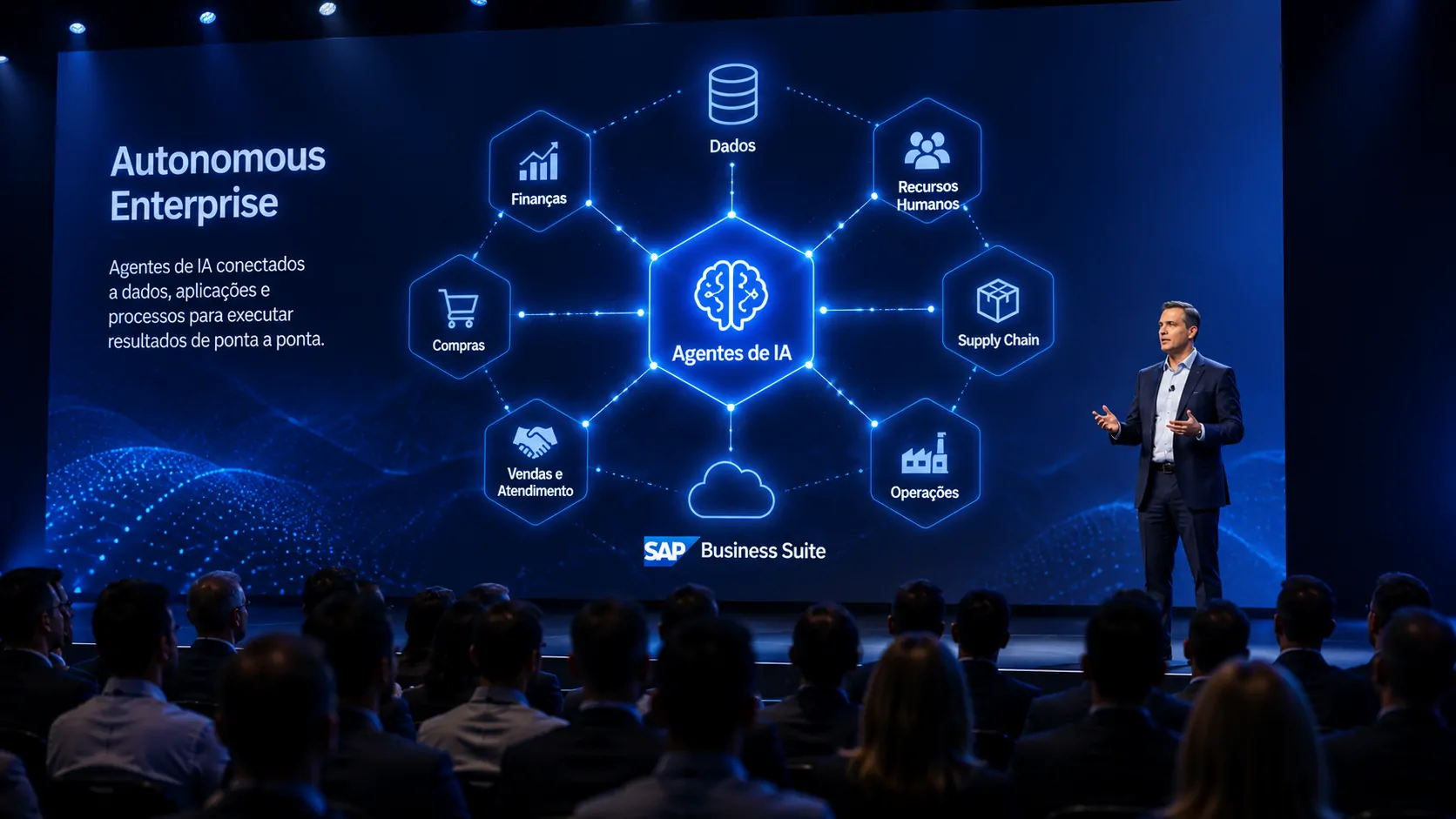
In the autonomous enterprise model, agents need to operate with the data and applications that support business processes.
The role of SAP Business Suite
SAP plans to present SAP Business Suite as part of this architecture, bringing together enterprise applications, data and artificial intelligence. The goal is to create an integrated layer in which agents can operate with business context instead of functioning in isolation.
This approach matters because a company does not operate as a collection of independent departments. A financial decision can affect procurement, inventory, logistics, sales and customer service. The more processes depend on shared information, the more important integration becomes.
Context becomes strategic
For enterprise agents, generating an answer is not enough. They need to understand which company they are operating in, what rules apply, which data is reliable and which actions they are authorized to take.
This helps explain why the growth of AI agents is closely tied to data infrastructure and integration. The discussion around how AI process automation is changing business operations is no longer purely technological. It is also about operational design.
The impact on Brazilian companies may come from execution
The relevance of SAP NOW to the Brazilian market lies precisely in its attempt to showcase concrete applications. The agenda includes cases from companies across different sectors and demonstrations involving finance, HR, procurement, supply chain, customer experience and operations.
Fewer isolated projects
Enterprise AI adoption can take a different path when the technology is no longer treated as an experimental project disconnected from the rest of the organization.
Instead of building an AI tool for a single team, companies can begin identifying where agents can operate within processes that cross multiple departments. This increases the potential impact, but it also raises the requirements for governance.
Productivity is not the only metric
Results should not be measured solely by the number of tasks automated. An agent architecture also needs to preserve control, traceability and decision quality.
For business leaders, the more important question is becoming less about “which AI should we use?” and more about which processes can be executed better with AI integrated into the systems the company already uses?
SAP NOW could preview the next enterprise AI battle
SAP NOW 2026 takes place before the Autonomous Enterprise vision has become established across the market. For that reason, the event should be viewed less as a promise to replace human work and more as a demonstration of a new operational architecture.

The Autonomous Enterprise concept puts AI agents inside business operations while keeping strategy and governance under human responsibility.
The changing interface
For years, the primary interface for enterprise AI was conversation: the professional asks, and the system responds. The next stage could be different.
If agents can interpret an intent, retrieve data, execute actions and coordinate the steps of a process, the interface stops being just a conversation and becomes the operation itself.
What to watch after the event
The decisive question will be how much of this vision can move beyond demonstrations and into real business processes. The cases presented at SAP NOW may show where agents are already capable of generating value and where challenges around integration, governance and adoption remain.
That transition, from demonstration to execution, is what deserves attention. If enterprise AI truly moves in this direction, the competition will not be only about building smarter models, but about creating platforms capable of putting intelligence directly into the processes that make a business work.
Comentários
Os comentários utilizam autenticação via GitHub para manter um ambiente mais qualificado, seguro e livre de spam.
Entrar ou criar conta no GitHub