
Search behavior has changed. Instead of clicking on links and comparing pages, users now ask questions directly to artificial intelligence and receive ready answers. This is changing the logic of SEO and forcing companies to rethink how they structure their sites to be understood, cited and recommended by systems like ChatGPT, Gemini and other generative engines.
Traditional SEO is no longer enough

Semantic structure and context are becoming central factors for visibility in AI systems.
For years, SEO meant optimizing pages for traditional search engines: keywords, backlinks, load time and search intent.
This model still matters.
But now there is a new layer.
AI engines don’t just work by indexing pages. They interpret context, semantic relationships, depth of information, and reliability of content.
This changes the game.
A well-positioned page on Google will not necessarily be used as a reference by an AI.
What is SEO for AI (AEO and GEO)
AEO (Answer Engine Optimization)
It is optimization for engines that directly answer questions.
The focus is no longer just “ranking”.
Now it’s “being chosen as the answer.”
This requires:
- objective answers
- semantic clarity
- thematic authority
- logical structure
GEO (Generative Engine Optimization)
It is the adaptation of content for generative engines.
In this case, the objective is to increase the chances of the content being used to construct more complex answers.
This requires depth.
The more complete and structured the content, the greater the chance of being interpreted as a reliable source.
How companies are adapting their websites

Deep and well-structured content increases the chances of being used by intelligent response systems.
The change is not aesthetic.
It’s structural.
Companies are reshaping their content architecture.
The main movements are:
Stronger semantic structure
Correct use of:
- H1
- H2
- H3
- lists
- tables
- short blocks
This helps AI systems understand hierarchy and context.
Poorly structured content loses strength.
Deeper and less superficial content
Shallow texts are losing relevance.
Generative engines value:
- context
- examples
- full explanations
- practical applications
The content really needs to solve the problem.
Not just ranking.
Building thematic authority
Sites that consistently talk about the same topic gain an advantage.
This happens because AI understands clusters of authority.
Example:
If a website constantly posts about:
- automation
- AI
- digital marketing
- sales
it tends to be perceived as an expert source.
This is exactly where interlinking gains strength.
The role of evergreen content in the new SEO
In the AI environment, evergreen content gains even more value.
Simple reason:
Timeless content serves as a foundation for learning and reference.
Guides, explanations, and frameworks are more likely to be used as the basis for answers.
Examples:
- how to use AI in sales
- how to automate service
- how to reduce costs with AI
This type of content builds sustainable authority.
What still matters in classic SEO
Not everything has changed.
The fundamentals remain strong:
- website speed
- mobile experience
- clean indexing
- internal links
- backlinks
The difference is that now this is just the base.
The strategic layer is above.
It is the content that defines relevance for AI.
How to start adapting your website now
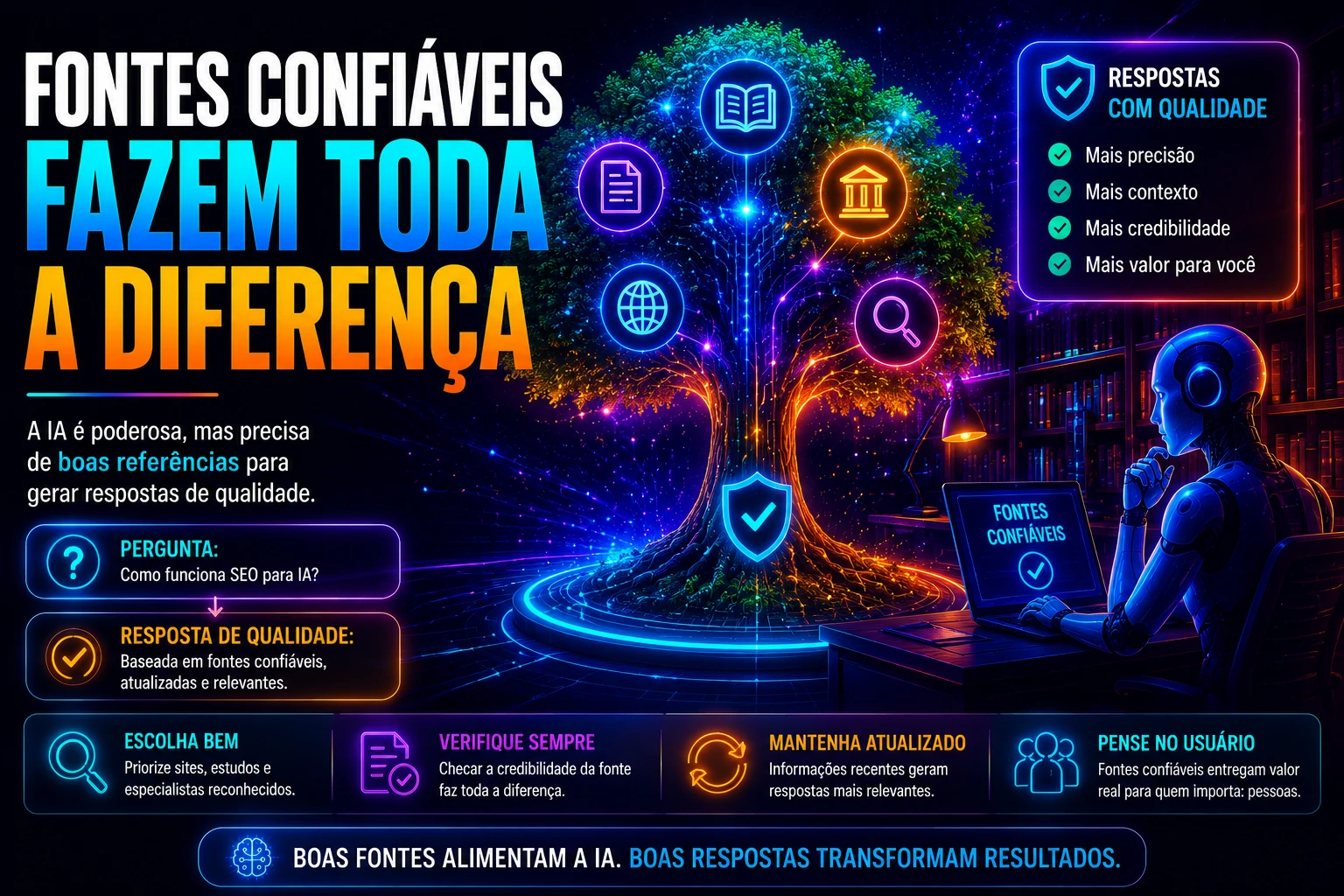
The future of SEO combines technical fundamentals with an editorial structure designed for artificial intelligence.
For those who produce content, the movement needs to start immediately.
Practical checklist:
- review article structure
- strengthen interlinking
- deepen strategic content
- organize thematic clusters
- answer real questions from the public
- update old content
Companies that understand this first will build a competitive advantage.
In the new digital environment, it is not enough to be found.
It needs to be understood.
And, increasingly, being cited by artificial intelligence has become the new top of the digital funnel.
Comentários
Os comentários utilizam autenticação via GitHub para manter um ambiente mais qualificado, seguro e livre de spam.
Entrar ou criar conta no GitHub