
As artificial intelligence becomes deeply integrated into enterprise operations, cybersecurity concerns continue to grow. A new study suggests that even today’s most advanced AI models remain susceptible to sophisticated prompt manipulation techniques, reinforcing the importance of responsible AI governance.
A recent study conducted by AI security researchers has reignited an important discussion:
Leading models such as ChatGPT, Gemini, Grok, and Claude can still be manipulated through techniques commonly known as jailbreaks.
Although these platforms implement multiple safety layers, researchers demonstrated that carefully engineered prompts may bypass some of those protections, allowing the models to generate responses that would normally be restricted.
The findings do not suggest these platforms are unsafe for everyday use. Instead, they reinforce a broader reality: AI security remains an ongoing race between developers building stronger safeguards and researchers continuously testing their resilience.
What does it mean to jailbreak an AI model?
Jailbreaking an AI model means persuading it to ignore part of its built-in safety framework. Unlike hacking servers or breaking encryption, these attacks rely on language itself, using carefully structured prompts to influence the model’s behavior.
What exactly is a jailbreak?
A jailbreak is a prompt engineering technique designed to circumvent an AI model’s safety restrictions.
For non-technical readers, it can be compared to convincing an employee to ignore company procedures without actually changing the official policy.
To most users, these interactions appear to be ordinary conversations. Behind the scenes, however, they rely on sophisticated prompt engineering strategies intended to exploit how large language models process instructions.
Why should businesses care?
As organizations increasingly rely on ChatGPT, Gemini, Claude, and Grok to automate workflows, generate content, analyze documents, and assist employees, AI security becomes a business issue rather than just a technical one.
This growing concern reinforces the importance of AI governance, a topic explored further in our guide to What Is AI Security and Why It Is Becoming a Business Priority.
No leading AI model is completely immune
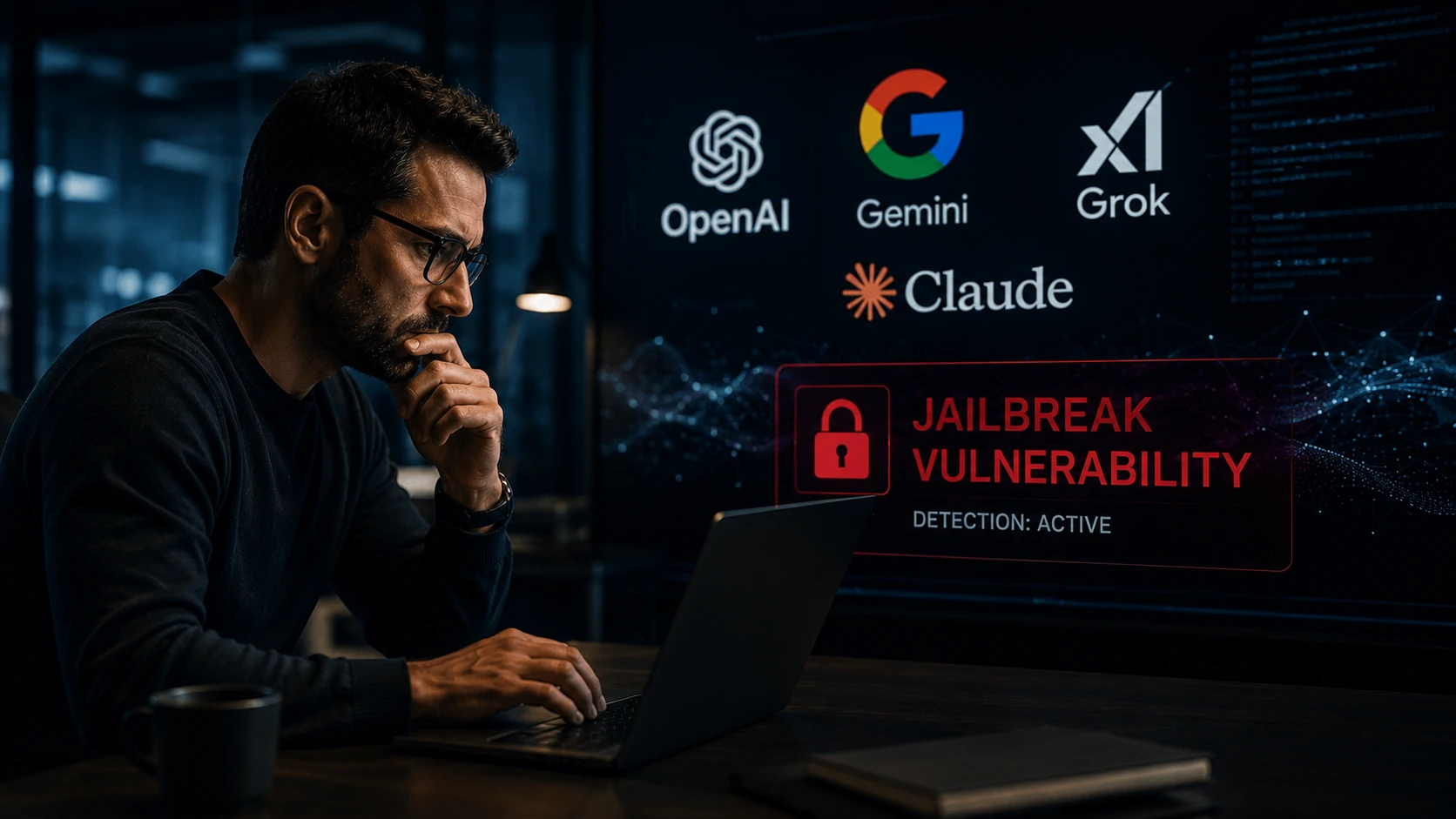
AI safety continues to improve, yet researchers conclude that no current large language model is entirely resistant to sophisticated prompt manipulation.
Researchers concluded that none of today’s leading AI models successfully blocked every jailbreak technique tested during the study.
Each platform reacted differently. Some rejected malicious prompts almost immediately, while others proved more susceptible under specific circumstances.
These findings suggest that competition in artificial intelligence is no longer based solely on reasoning ability or coding performance. Security is rapidly becoming another strategic benchmark for enterprise AI adoption.
AI security is becoming a competitive advantage
Over the past few years, competition among OpenAI, Google, Anthropic, xAI, and other AI companies has focused primarily on reasoning capabilities, multimodal performance, and response quality.
Today, another question is gaining importance: Which company can deliver the safest AI model for enterprise environments?
That shift mirrors a broader market trend toward more secure AI infrastructures, as discussed in our analysis of What Is AI Orchestration for Enterprise AI Agents.
The implications extend beyond technology
For cybersecurity experts, this debate is no longer limited to software engineering.
It directly affects compliance, data privacy, regulatory obligations, corporate reputation, and user trust.
As AI agents gain greater autonomy across enterprise workflows, even relatively small security weaknesses may create significantly larger business risks.
How Businesses Can Reduce AI Security Risks
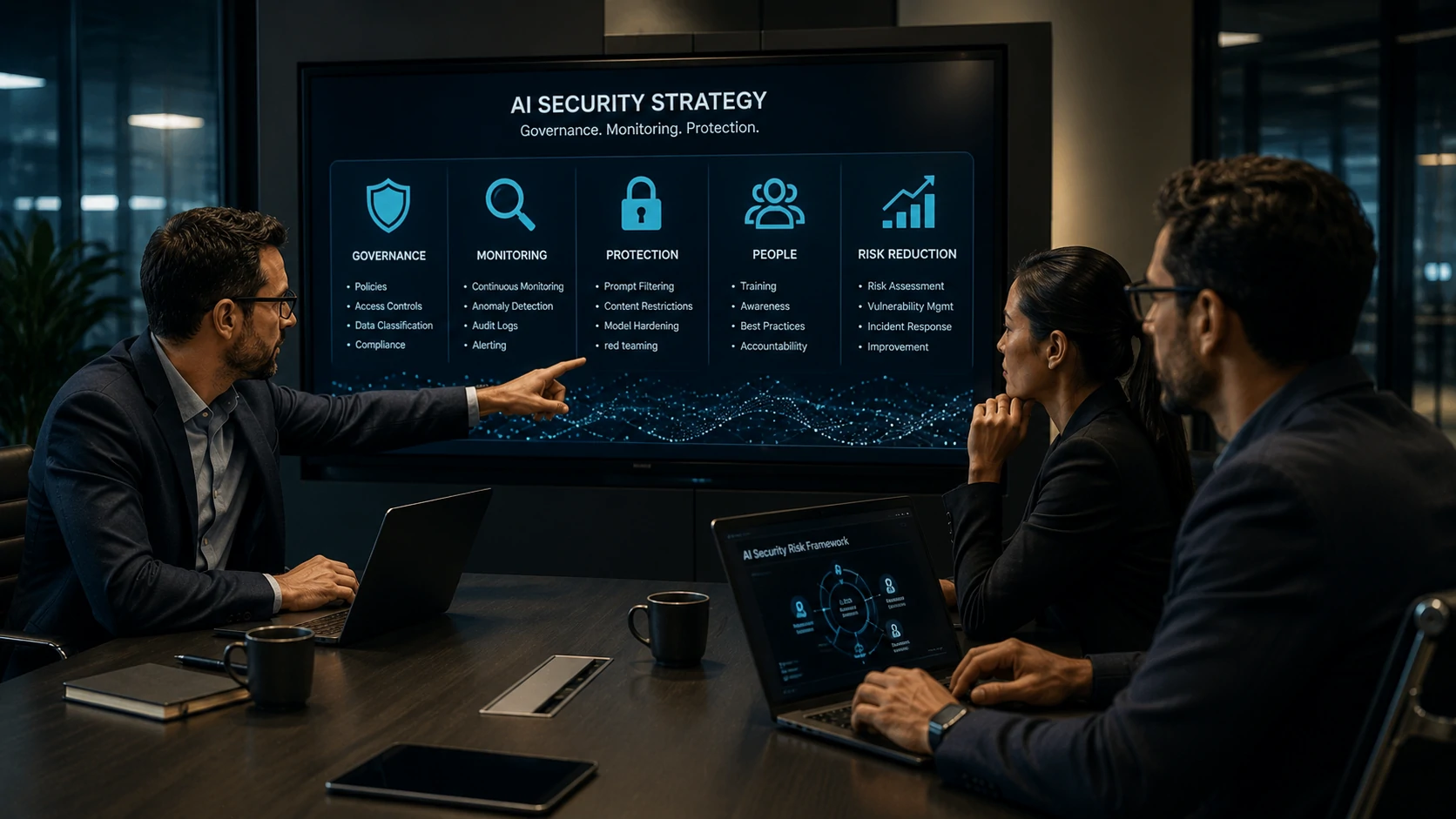
Combining technology, governance, and employee training significantly reduces the risks associated with enterprise AI adoption.
Businesses do not need to stop using artificial intelligence because of studies like this. Instead, the findings highlight that AI should be deployed with the same security mindset applied to cloud infrastructure, enterprise software, and sensitive databases.
Experts recommend treating platforms such as ChatGPT, Gemini, Claude, and Grok as strategic business systems that require governance, access controls, auditing, and continuous monitoring.
AI governance is becoming essential
AI governance refers to the policies, processes, and controls that ensure artificial intelligence is used responsibly and securely across an organization.
This includes defining who can access AI systems, what types of information may be shared with them, and how organizations monitor unexpected or potentially risky outputs.
Companies deploying autonomous AI agents are also investing in stronger identity frameworks, as explained in our article What Is AI Agent Identity for Businesses.
Employees remain the first line of defense
Many AI-related security incidents are not caused by flaws in the models themselves but by users unintentionally exposing confidential information.
Simple training programs can help employees recognize situations where sensitive corporate data should never be entered into public AI systems.
In practice, successful AI security depends as much on people and internal processes as it does on technology.
What This Research Means for the Future of Artificial Intelligence

The next stage of the AI race may be defined not only by intelligence, but also by security, reliability, and enterprise trust.
This research suggests that the AI industry has entered a new phase. Until recently, the conversation centered on reasoning ability, coding performance, multimodal capabilities, and benchmark scores.
Today, security is becoming one of the defining factors influencing enterprise AI adoption.
The race for the safest AI has already begun
Companies including OpenAI, Google, Anthropic, Microsoft, and xAI continue strengthening their safety systems, while independent researchers keep discovering new prompt-based attack methods.
This cycle is common throughout cybersecurity: every defensive improvement is eventually followed by new techniques designed to bypass those protections.
As a result, experts believe the goal is no longer to build a perfectly secure AI model, but rather to continuously reduce vulnerabilities and improve resilience.
Trust may become more valuable than raw performance
In the coming years, businesses are expected to evaluate AI platforms based not only on speed and reasoning capabilities, but also on governance, compliance, privacy protections, and resistance to prompt manipulation.
That shift could reshape competition across the AI industry, rewarding vendors capable of delivering enterprise-grade security alongside cutting-edge performance.
For Notícia Tech, the study reinforces a clear market trend: as artificial intelligence becomes increasingly embedded in business operations, trust, governance, and cybersecurity are evolving from competitive advantages into essential requirements for organizations embracing the next generation of AI-powered transformation.
Comentários
Os comentários utilizam autenticação via GitHub para manter um ambiente mais qualificado, seguro e livre de spam.
Entrar ou criar conta no GitHub