
As Artificial Intelligence becomes increasingly embedded in business decision-making, organizations must focus not only on adopting new technologies but also on managing them responsibly. Building effective governance is emerging as one of the most important competitive advantages for companies entering the AI era.
AI Governance creates the rules that enable Artificial Intelligence to be used safely and strategically

Business leaders establish governance policies to ensure the responsible use of Artificial Intelligence across the organization.
AI Governance is the framework of policies, processes, responsibilities, and controls that guide how Artificial Intelligence is developed, deployed, and managed within an organization.
In practice, it plays a role similar to corporate governance frameworks already established for cybersecurity, privacy, compliance, and enterprise risk management. Its purpose is to ensure AI systems remain transparent, reliable, accountable, and aligned with business objectives.
Without a formal governance framework, different departments may adopt tools such as ChatGPT, Gemini, Claude, or Microsoft Copilot independently, creating operational inconsistencies, compliance challenges, and reputational risks.
AI Governance extends far beyond technology
Although it relies on technical controls, AI Governance is not exclusively an IT responsibility.
Legal, compliance, cybersecurity, risk management, human resources, and executive leadership all contribute to defining how AI should be adopted, monitored, and continuously improved across the business.
The rapid expansion of AI increases the need for governance
The widespread adoption of generative AI, intelligent agents, and enterprise automation has moved Artificial Intelligence from experimental projects to mission-critical business operations.
As AI becomes responsible for increasingly complex decisions, organizations require governance structures capable of defining accountability, monitoring outcomes, and reducing operational risks.
Why AI Governance will become a strategic priority for businesses
The reason is straightforward: the greater an organization’s dependence on AI, the greater the potential impact of poor governance.
Companies already rely on Artificial Intelligence for customer service, recruiting, financial analysis, software development, marketing, cybersecurity, and sales. Errors in any of these areas can result in regulatory penalties, financial losses, or significant damage to customer trust.
At the same time, investors, regulators, enterprise clients, and business partners increasingly evaluate whether organizations have formal governance processes to oversee AI systems.
Transparency is becoming a competitive advantage
Customers want to understand when they are interacting with AI, how their data is being used, and whether automated decisions can be explained.
Organizations capable of demonstrating transparency are likely to strengthen trust and improve long-term business relationships.
Regulation is accelerating AI Governance adoption
Governments around the world continue developing Artificial Intelligence regulations.
Even companies operating outside jurisdictions with dedicated AI legislation may need governance frameworks to satisfy multinational clients, international compliance standards, and future regulatory requirements.
The core pillars of an effective AI Governance strategy
Successful AI Governance depends on aligning technology, business processes, and executive leadership.
A successful AI Governance strategy combines technology, governance processes, and organizational leadership. Its objective is not to restrict the adoption of Artificial Intelligence, but to establish the controls necessary for deploying AI safely, consistently, and at enterprise scale.
Organizations with mature governance programs continuously review their policies as AI models evolve, regulations change, and new operational risks emerge.
Establish clear AI usage policies
The first step is defining which AI platforms employees may use, what types of corporate information can be shared with AI systems, and which activities require human review before decisions are finalized.
These policies significantly reduce the risk of confidential data exposure, inconsistent AI usage, and unintended business consequences.
Monitor risks through continuous oversight
Another essential pillar of AI Governance is continuous monitoring.
Organizations should evaluate model performance, detect bias, assess response quality, document automated decisions, and maintain audit trails for every significant change made to AI systems.
As companies increasingly operate multiple AI models simultaneously, orchestration platforms become equally important for managing complexity. Learn more in What Is AI Orchestration? Replacing AI Model Competition in Business.
How businesses can start implementing AI Governance

AI Governance usually begins with simple internal policies before evolving into a comprehensive enterprise framework.
Implementing AI Governance does not require a massive organizational transformation from day one. Most businesses can begin with practical governance initiatives and gradually expand them as AI adoption increases across departments.
The key objective is establishing a governance foundation before Artificial Intelligence becomes deeply embedded in critical business operations.
Assign governance ownership
Every organization should clearly define who is responsible for AI-related decisions.
Depending on company size, this responsibility may belong to a dedicated AI Governance committee or be shared among technology, compliance, legal, cybersecurity, and executive leadership teams.
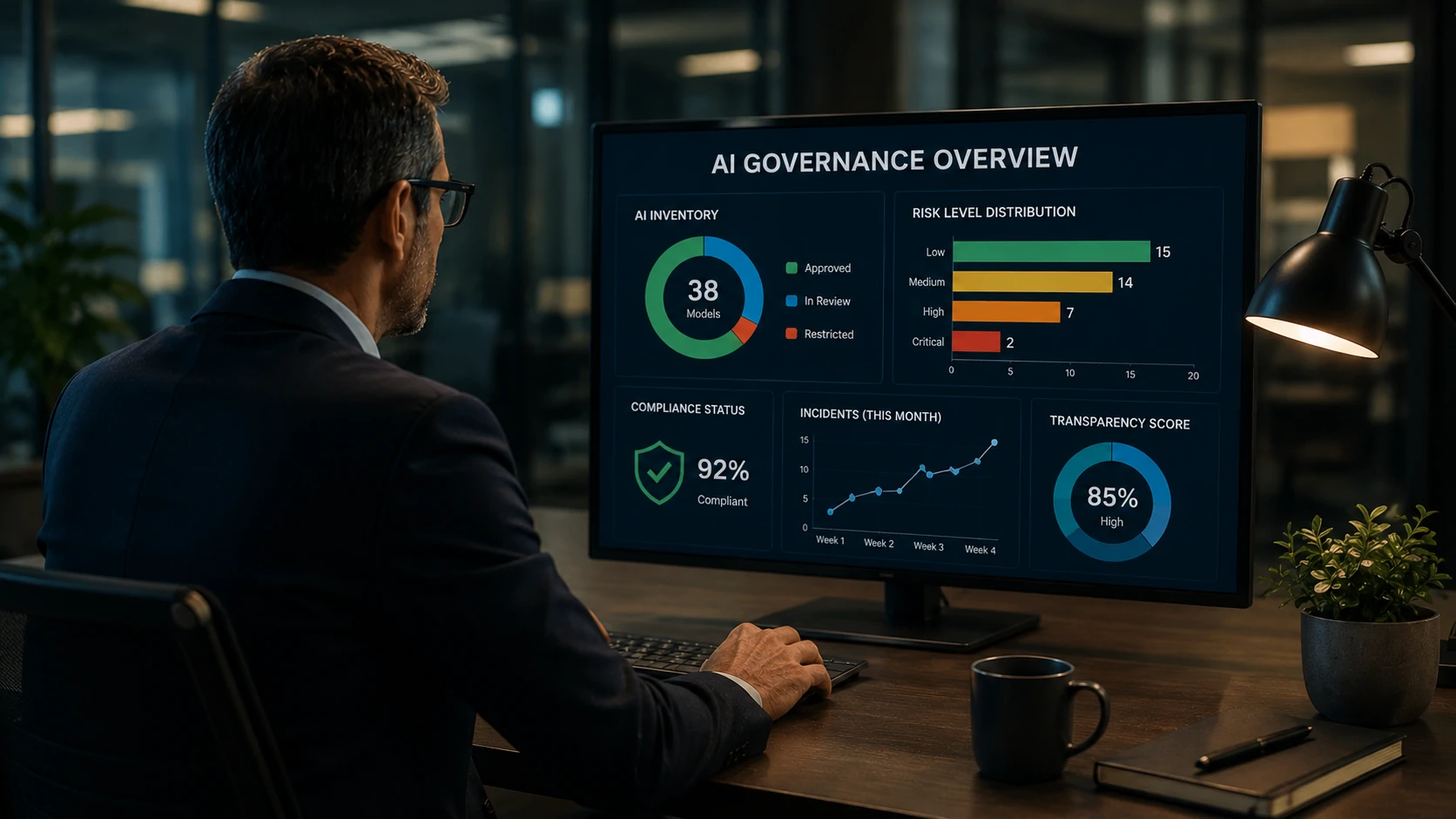
Build an inventory of AI systems
Maintaining an updated inventory of AI tools allows organizations to understand where Artificial Intelligence is being used throughout the business.
This inventory simplifies audits, improves operational visibility, strengthens compliance efforts, and enables faster responses when governance issues arise.
Invest in continuous AI education
Technology alone cannot guarantee responsible AI adoption.
Employees must understand governance principles, organizational policies, acceptable AI usage, ethical considerations, and their individual responsibilities when working with AI-powered tools.
Developing these capabilities is closely connected to improving AI Fluency across the workforce. For a deeper look at this concept, read What Is AI Fluency? The Most Important Skill for Professionals and Businesses.
As Artificial Intelligence becomes an essential layer of enterprise operations, AI Governance will shift from being a specialized compliance initiative to becoming a core business capability. Organizations that establish governance frameworks early will be better positioned to comply with future regulations, strengthen customer trust, reduce operational risks, and unlock the full strategic value of AI while maintaining long-term resilience in an increasingly AI-driven economy.
Comentários
Os comentários utilizam autenticação via GitHub para manter um ambiente mais qualificado, seguro e livre de spam.
Entrar ou criar conta no GitHub