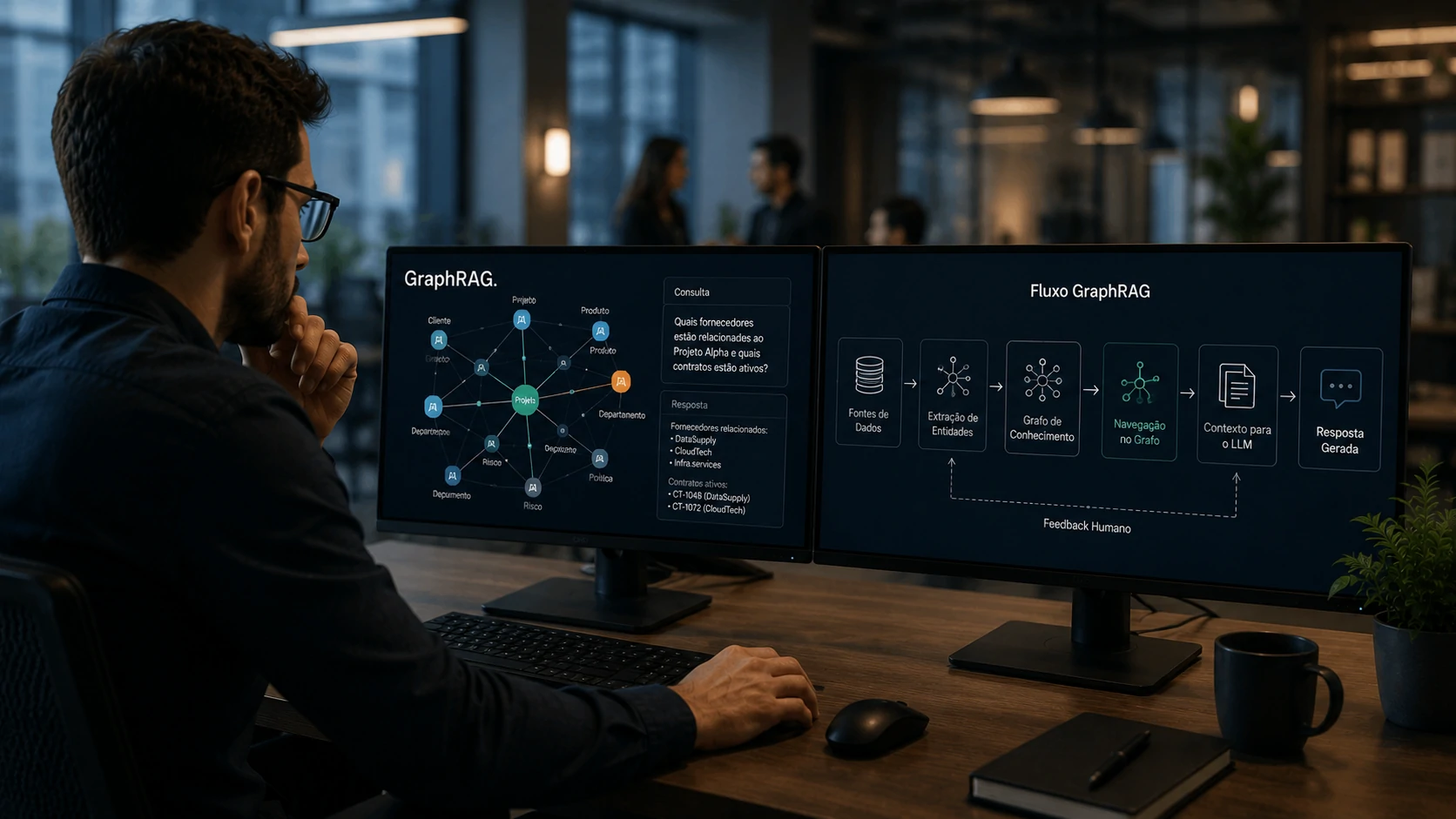
As organizations expand their adoption of Artificial Intelligence, the demand for trustworthy, contextual and explainable responses continues to grow. This is precisely where GraphRAG emerges as the next evolution of traditional Retrieval-Augmented Generation (RAG), enabling AI systems to reason over connected knowledge rather than isolated documents.
Although RAG remains one of the most important technologies behind enterprise generative AI, many specialists now view GraphRAG as the logical next step for business applications that rely on highly interconnected information.
What Is GraphRAG?

GraphRAG connects documents, entities and relationships through a knowledge graph before generating responses.
GraphRAG is an enterprise AI architecture that combines Large Language Models (LLMs), retrieval systems and Knowledge Graphs to deliver responses that are more accurate, contextual and explainable than those generated through vector search alone.
While traditional RAG retrieves documents based primarily on semantic similarity, GraphRAG introduces an additional reasoning layer capable of understanding how people, departments, products, suppliers and business events are connected.
In practice, this allows AI systems to answer complex business questions without relying solely on statistical similarity between documents.
How GraphRAG Works
A typical GraphRAG workflow follows these steps:
- Enterprise documents are ingested.
- Relevant entities are identified.
- Relationships between entities are extracted.
- These relationships form a knowledge graph.
- The query traverses the graph before reaching the LLM, which generates the final answer using richer contextual information.
This additional reasoning layer reduces ambiguity and significantly improves contextual understanding.
Why It Matters
Business knowledge rarely exists in isolation.
A contract may reference a supplier, who supports a project that belongs to a strategic customer and depends on multiple internal teams.
Instead of retrieving a single related document, GraphRAG understands these business relationships before producing a response, making it substantially more effective than traditional RAG for enterprise knowledge management.
To understand how multiple AI components cooperate inside modern organizations, see our related article: What Is AI Orchestration? Why It Is Replacing Competition Between AI Models in Business.
Traditional RAG vs. GraphRAG
Traditional Retrieval-Augmented Generation transformed enterprise AI by allowing language models to retrieve up-to-date corporate knowledge instead of relying exclusively on training data.
However, it also exposes limitations whenever answers depend on multiple relationships across large knowledge bases.
GraphRAG was specifically designed to address this challenge.
How Traditional RAG Operates
The standard workflow is relatively straightforward:
- A user submits a query.
- A vector database retrieves similar documents.
- Relevant passages are provided to the LLM.
- The language model generates a response.
This approach performs exceptionally well for direct information retrieval.
However, questions involving several interconnected entities often require reasoning beyond simple similarity search.
How GraphRAG Improves Retrieval
Rather than retrieving documents immediately, GraphRAG first traverses the enterprise knowledge graph.
This enables the AI system to identify indirect relationships between entities before generating its answer.
Instead of relying on isolated documents, the model receives an interconnected representation of business knowledge, producing responses that are typically more coherent, complete and explainable.
This architecture naturally complements enterprise initiatives such as How to Build an MCP Server That Connects AI to Enterprise Systems, where multiple AI agents must access a shared and consistent knowledge base.
Where GraphRAG Creates the Greatest Business Value

GraphRAG connects knowledge scattered across departments, business systems and enterprise documents.
The biggest advantage of GraphRAG appears when enterprise knowledge is distributed across multiple platforms and depends on relationships between people, business processes and documents.
In these environments, retrieving similar documents alone is rarely enough. AI systems must understand how information is interconnected before producing trustworthy answers.
Enterprise Use Cases
Some of the strongest use cases include:
- Customer support platforms managing thousands of technical articles.
- Legal departments connecting contracts, clients and compliance records.
- Healthcare organizations linking patient records, clinical protocols and medical research.
- Financial institutions relating customers, products, regulations and risk assessments.
- Manufacturing companies integrating maintenance documentation, suppliers and production assets.
The more complex the knowledge ecosystem becomes, the greater the competitive advantage offered by GraphRAG.
AI Agents Also Benefit
Modern AI agents must retrieve reliable knowledge before executing tasks.
For example, an enterprise support agent can consult internal policies, customer contracts, historical interactions and technical documentation before answering a request.
This dramatically improves decision quality while reducing hallucinations and inconsistent outputs.
The same architectural principles are explored in our article How AI Agents Are Transforming Business Process Automation Beyond ChatGPT Work.
How to Implement GraphRAG and the Challenges Businesses Should Expect
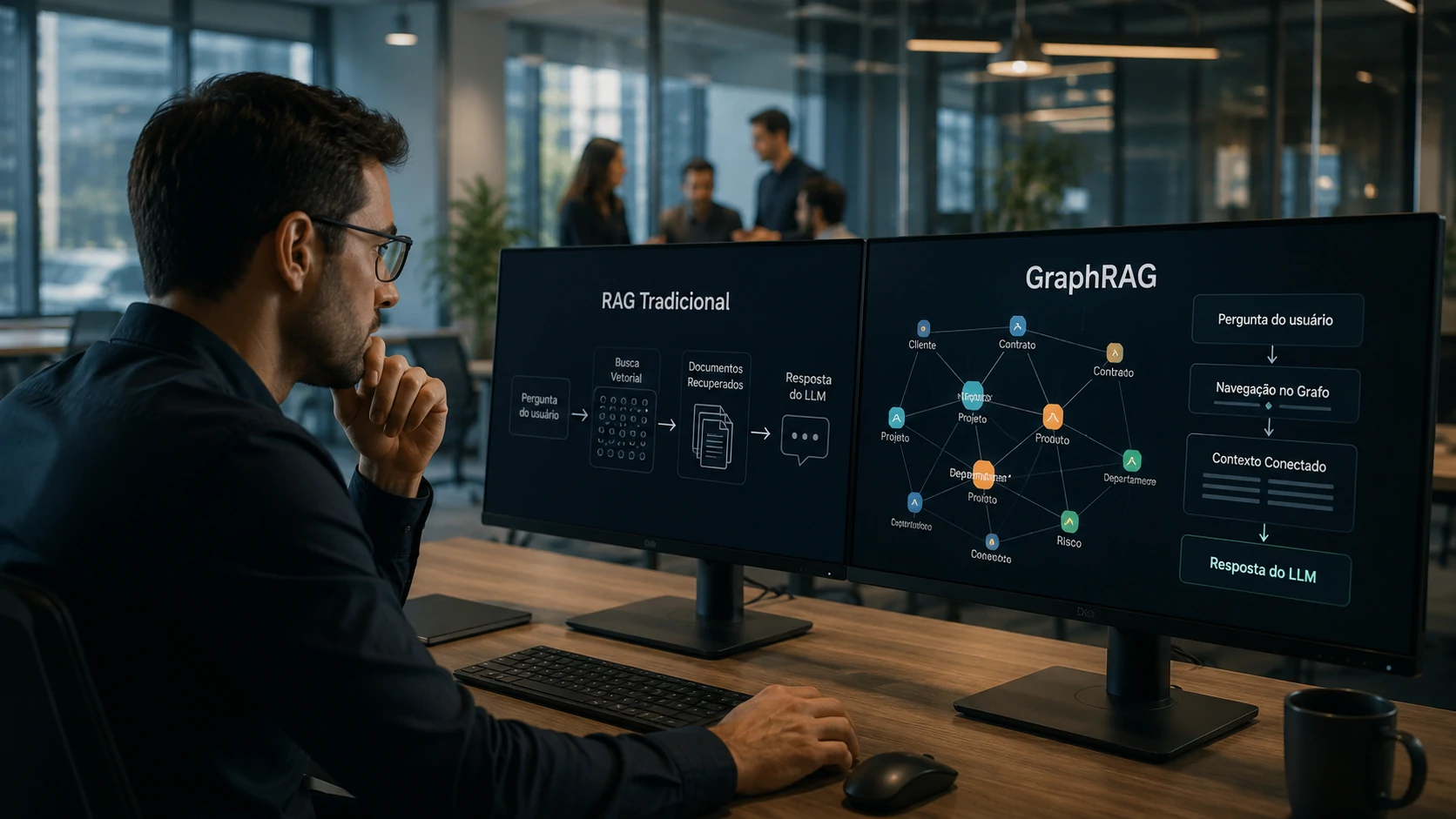
Successful GraphRAG implementations depend as much on high-quality enterprise knowledge as on human supervision.
Contrary to popular belief, the greatest implementation challenge is rarely the language model itself.
Instead, success depends on organizing enterprise knowledge into a structure that accurately represents business relationships.
Organizations with mature documentation and well-governed data typically achieve faster adoption.
Typical Enterprise Workflow
A common GraphRAG implementation follows this logical sequence:
- Documents are collected from SharePoint, CRM, ERP, databases and internal repositories.
- An ingestion pipeline extracts relevant entities.
- Relationships are stored inside a Knowledge Graph.
- User queries traverse the graph to identify contextual information.
- Only the most relevant knowledge is provided to the LLM.
- The model generates a grounded and contextual response.
This architecture reduces irrelevant retrieval, improves reasoning quality and creates a scalable foundation for enterprise AI.
Example Prompt for an Enterprise AI Agent
You are an enterprise AI assistant.

Objective:
Answer questions using only information retrieved by the GraphRAG system.

Priorities:
- Consider relationships between customers, contracts and projects.
- Use only verified information available in the knowledge graph.
- Clearly identify conflicting information whenever detected.
- Never fabricate facts or assumptions.

Output format:
Executive summary followed by supporting evidence.
Providing structured prompts like this makes AI agent behavior more predictable while reinforcing enterprise governance policies.
Human-in-the-Loop Remains Essential
Even with GraphRAG, human oversight remains a critical requirement.
Knowledge graphs can still contain outdated documents, incorrect relationships or incomplete information.
For that reason, mature organizations continuously perform:
- knowledge base validation;
- response auditing;
- relationship updates;
- prompt optimization;
- AI quality monitoring.
GraphRAG significantly improves contextual retrieval, but it does not eliminate the need for enterprise governance and human supervision.
As Large Language Models continue to evolve and AI agents become responsible for increasingly sophisticated business operations, knowledge graph architectures are expected to become a core component of enterprise AI infrastructure. Rather than simply producing better answers, GraphRAG changes how artificial intelligence discovers, connects and reasons over organizational knowledge. For businesses seeking scalable, explainable and trustworthy AI systems, GraphRAG is emerging as one of the most important advances in enterprise generative AI.
Comentários
Os comentários utilizam autenticação via GitHub para manter um ambiente mais qualificado, seguro e livre de spam.
Entrar ou criar conta no GitHub