
As companies accelerate investments in intelligent agents, a new technology layer is emerging as a fundamental component of enterprise AI infrastructure. RAG, short for Retrieval-Augmented Generation, has become one of the most important approaches for connecting language models to real organizational knowledge. More than a technical framework, it is redefining how intelligent systems access information, reduce hallucinations, and generate contextualized responses.
What Is RAG and Why Has It Become So Important?
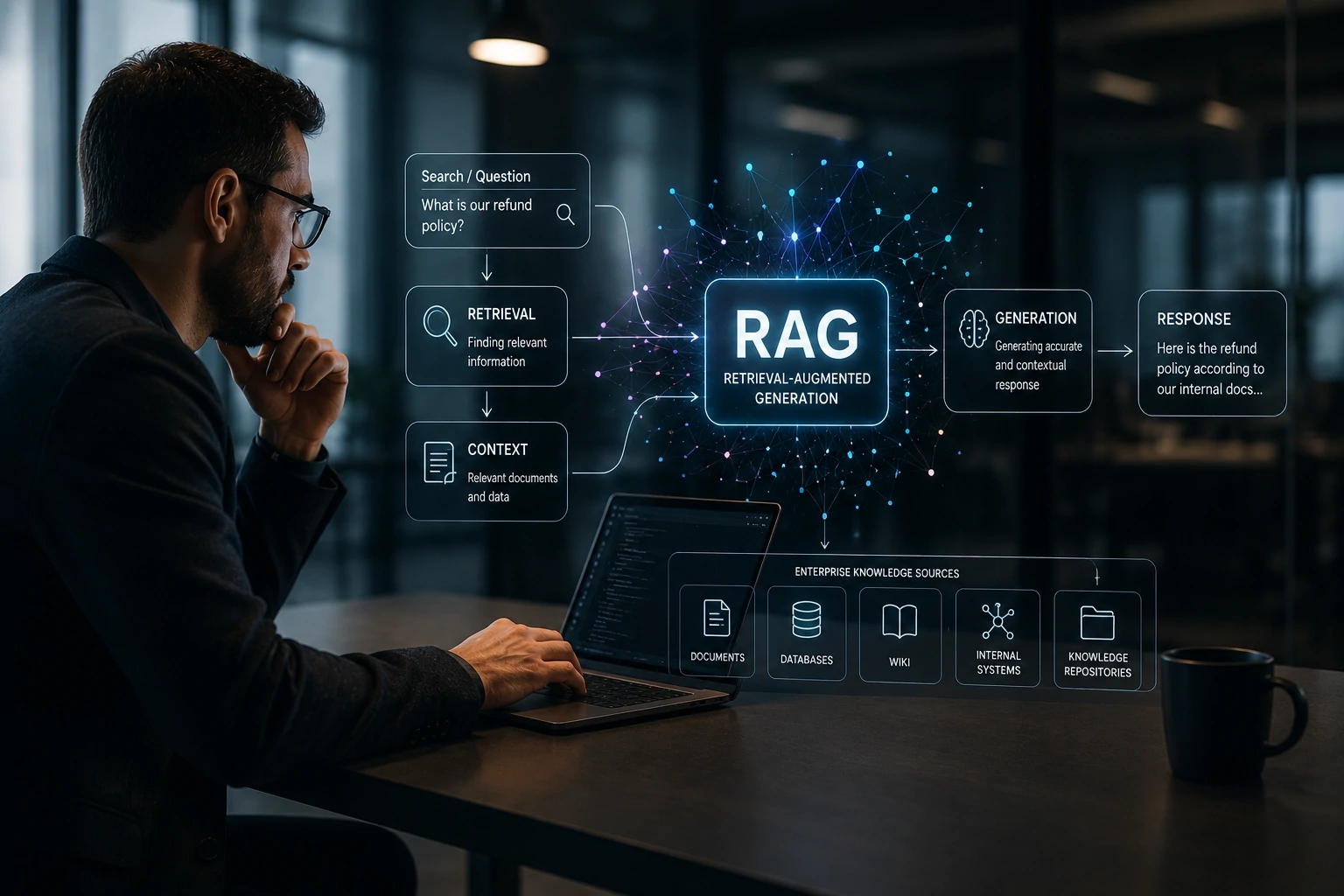
RAG architectures allow AI systems to consult knowledge bases before generating responses.
RAG (Retrieval-Augmented Generation) is an architecture that combines information retrieval with content generation powered by artificial intelligence.
In practice, a RAG-based system does not rely exclusively on the knowledge stored inside a language model. Before generating a response, it searches relevant external sources and uses that information to build a more accurate answer.
This concept has gained enormous relevance because language models have a natural limitation: their knowledge can become outdated after training.
RAG addresses this challenge by enabling dynamic access to documents, databases, corporate wikis, internal systems, and enterprise knowledge repositories.
For businesses, this means transforming scattered information into an operational layer that can be accessed by intelligent agents.
The Problem RAG Solves
Traditional AI models can generate incorrect responses when they lack sufficient information.
This phenomenon is commonly known as hallucination.
By consulting real documents before generating an answer, RAG significantly reduces this risk.
In addition, the technology allows organizations to work with constantly updated information without retraining the underlying model.
Why the Market Is Adopting RAG
The rise of enterprise AI agents has increased the need for secure access to corporate knowledge.
Organizations investing in AI must ensure their systems operate with accurate, auditable, and contextualized information.
This need is closely connected to the evolution of concepts such as MCP and the infrastructure connecting AI agents to enterprise systems.
How a RAG Architecture Works
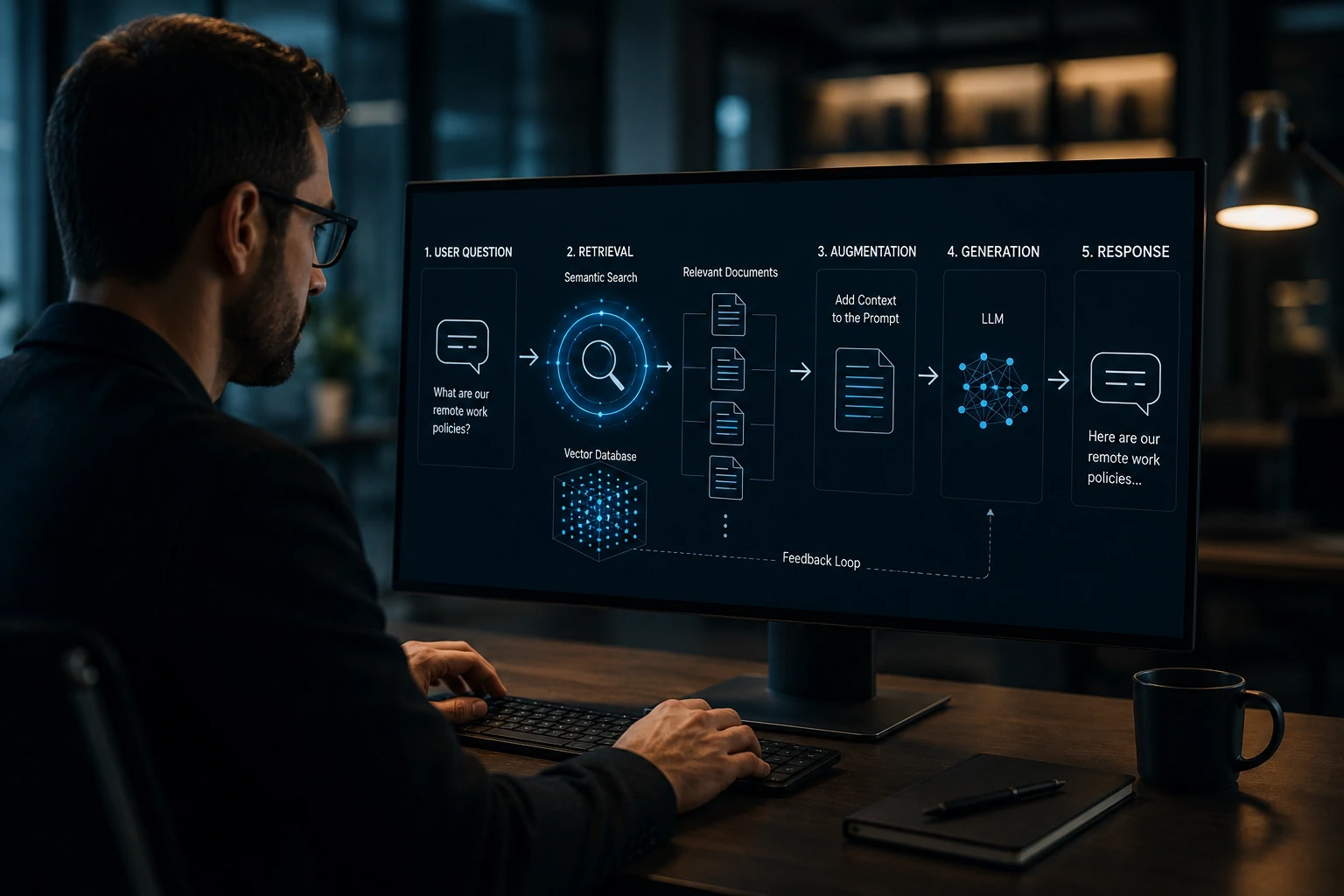
The process combines contextual search with response generation using information retrieved in real time.
RAG operates through two primary stages: retrieval and generation.
First, the system receives a user query.
Next, semantic search mechanisms locate relevant documents within a knowledge base.
Those documents are then provided to the language model as additional context.
Only after that process does the model generate its final response.
Step 1: Information Retrieval
The first layer uses vector-based search mechanisms to identify relevant content.
Documents are converted into embeddings, mathematical representations that capture meaning and context.
When a query is submitted, the system identifies the documents that are semantically closest to the user’s request.
This stage ensures that only relevant information is used during response generation.
Step 2: Response Generation
After retrieving the appropriate documents, the AI model receives that contextual information.
The response no longer depends solely on the model’s original training.
Instead, it incorporates updated, specific, and contextually relevant information.
This process improves quality, accuracy, and reliability.
The Role of Vector Databases
Most RAG projects rely on vector databases to store embeddings.
These systems enable extremely fast searches even across knowledge bases containing millions of documents.
As a result, vector databases have become a core component of modern AI infrastructure.
How Companies Are Using RAG in Practice
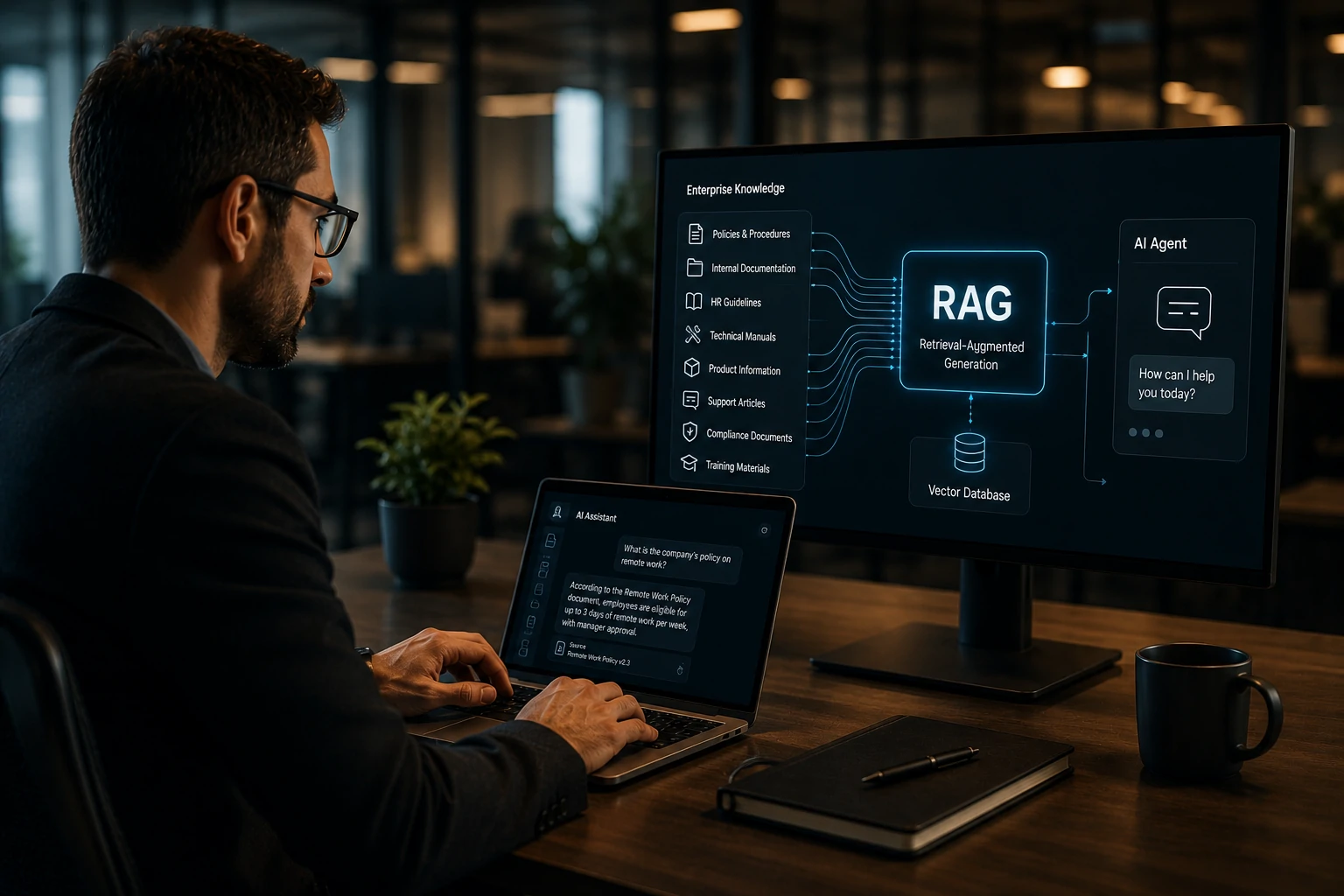
Organizations use RAG to connect AI agents to internal documents, procedures, and enterprise data.
Companies are increasingly adopting RAG to transform corporate knowledge into a competitive advantage.
The technology enables intelligent agents to access the most relevant organizational information directly.
This reduces search time, improves productivity, and increases the reliability of decision-making.
Internal Support and Assistance
One of the most common applications involves enterprise assistants.
Employees can query internal policies, operational procedures, and technical documentation using natural language.
The system identifies the correct documents and generates contextualized answers.
Knowledge Management
Many organizations maintain thousands of documents distributed across multiple platforms.
RAG creates a unified access layer.
This transforms fragmented knowledge into a strategic asset.
This trend is closely related to the evolution of Corporate Memory with AI.
Autonomous Agents
Intelligent agents depend on context to operate effectively.
Without access to current information, their decision-making capabilities become limited.
For this reason, many modern architectures combine AI agents with RAG systems.
This trend aligns with the growing importance of areas such as Context Engineering for enterprise AI agents.
RAG Versus Fine-Tuning: What’s the Difference?
RAG and Fine-Tuning are often confused, but they serve different purposes.
Fine-Tuning modifies a model’s behavior through additional training.
RAG, on the other hand, adds external knowledge without changing the model’s underlying weights.
When to Use RAG
RAG is most effective when information changes frequently.
Examples include:
- Document repositories
- Corporate policies
- Financial data
- Internal procedures
- Product catalogs
In these scenarios, constantly retraining a model would be expensive, time-consuming, and inefficient.
RAG provides access to updated information without requiring modifications to the model itself.
When to Use Fine-Tuning
Fine-Tuning is better suited for adapting a model’s style, behavior, tone, or specialized capabilities.
It is not ideal for storing large volumes of constantly changing knowledge.
Instead, it helps organizations customize how a model responds rather than what information it knows.
The Future Will Be Hybrid
Most organizations are moving toward hybrid strategies.
Fine-Tuned models increasingly rely on RAG to access real-time information.
This combination delivers both personalization and continuous knowledge updates.
As enterprise AI ecosystems mature, hybrid architectures are expected to become the standard approach for deploying intelligent agents at scale.
Why RAG Could Become the Invisible Infrastructure of the Agent Economy
RAG is evolving from a technical AI technique into a strategic layer of digital infrastructure.
As intelligent agents begin handling more sophisticated tasks, the demand for reliable access to organizational knowledge continues to grow.
Companies will not compete solely on the quality of their AI models.
They will compete on the quality of their data, the structure of their knowledge systems, and their ability to provide the right context to intelligent agents at the right moment.
In this environment, RAG emerges as a bridge between artificial intelligence and enterprise information.
The technology enables organizations to transform documents, processes, policies, and accumulated expertise into operational resources that intelligent systems can access and use.
This shift represents a fundamental change in how knowledge is managed and consumed inside businesses.
Instead of searching through countless documents or relying on disconnected information repositories, employees and AI agents can interact with enterprise knowledge through natural language.
As a result, information becomes more accessible, more actionable, and significantly more valuable.
The implications extend far beyond productivity gains.
RAG is enabling a new generation of enterprise systems capable of reasoning with organizational context, reducing operational friction, and accelerating decision-making.
In many ways, it is laying the foundation for the next wave of enterprise intelligence.
Just as databases powered the software era and cloud computing redefined digital infrastructure, RAG has the potential to become one of the invisible foundations supporting the next generation of enterprise AI agents.
Organizations that invest early in building structured, accessible, and AI-ready knowledge ecosystems may gain a significant competitive advantage as the agent economy continues to expand.
Comentários
Os comentários utilizam autenticação via GitHub para manter um ambiente mais qualificado, seguro e livre de spam.
Entrar ou criar conta no GitHub