
People who switch between different artificial intelligence assistants often feel like they are talking to completely different personalities. That impression is understandable, but it does not mean these models possess identities of their own. Their distinctive behavior is the result of engineering decisions made during training, alignment, and deployment.
What makes an AI model appear to have a personality?

Each foundation model follows a different alignment strategy, producing a unique conversational experience for users.
Anyone who alternates between ChatGPT, Gemini, and Claude usually notices differences in tone long before identifying differences in technical capability.
ChatGPT often feels conversational and flexible, Claude tends to deliver more cautious and detailed explanations, while Gemini frequently reflects the strengths of Google’s broader ecosystem.
These recurring behaviors lead many users to believe that each model has its own personality.
In reality, these differences stem from deliberate design choices made by the companies that develop them.
Personality is not consciousness
Large language models do not possess emotions, beliefs, intentions, or self-awareness.
Instead, they generate responses by predicting the most appropriate sequence of words based on statistical patterns learned during training.
Those patterns are later refined to produce responses that are more useful, safer, and better aligned with human expectations.
The importance of AI alignment
After pre-training is completed, developers perform a process known as alignment.
Its goal is to shape the model’s behavior so it better matches what people expect from an AI assistant.
Alignment influences characteristics such as:
- tone of voice;
- writing style;
- creativity;
- caution;
- willingness to acknowledge uncertainty;
- explanation depth.
The same principle also appears in enterprise technologies such as specialized AI agents discussed in our article about AI Orchestration:
What Is AI Orchestration and Why It Is Replacing AI Model Competition in Business
How training and RLHF shape AI behavior
Training a modern large language model happens in multiple stages.
First, the model learns statistical relationships from massive collections of text.
Afterward, developers refine its behavior so responses better match user expectations and business objectives.
One of the most influential techniques used during this phase is RLHF (Reinforcement Learning from Human Feedback), where human evaluators rank responses according to quality, usefulness, and safety.
What RLHF actually changes
RLHF does not teach the model new facts.
Instead, it changes how the model chooses to respond.
This process directly affects:
- clarity;
- objectivity;
- politeness;
- explanation quality;
- risk tolerance;
- ability to recognize uncertainty.
Every AI company optimizes different goals
OpenAI, Google, and Anthropic all pursue useful AI assistants, but each organization defines different priorities.
Some emphasize creativity and flexibility.
Others prioritize safety, transparency, enterprise adoption, or integration with existing products.
That explains why two models can provide equally accurate answers while sounding remarkably different.
System prompts, temperature, and context explain most of the differences
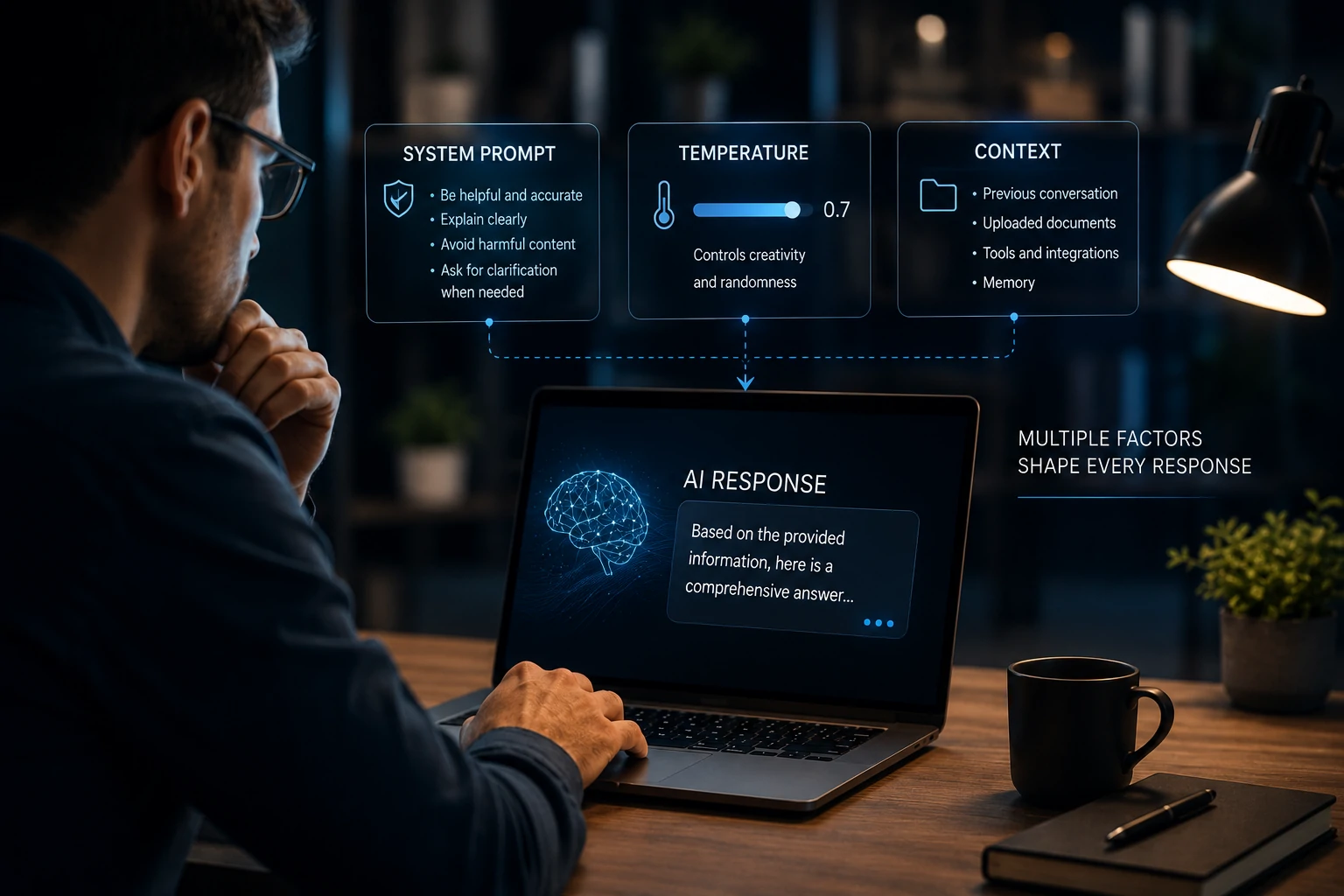
AI responses are shaped not only by what the model has learned but also by invisible instructions and runtime configuration that influence every interaction.
Another major reason AI assistants seem to have different personalities is something known as the system prompt.
A system prompt is a set of hidden instructions created by developers before a user even asks the first question. These instructions define how the model should behave, which safety rules it should follow, and what priorities it should maintain throughout a conversation.
As a result, two highly capable models can answer the same question correctly while sounding completely different.
System prompts establish behavioral guidelines
Although users never see these instructions, they influence decisions such as:
- writing style;
- level of formality;
- response depth;
- handling of sensitive topics;
- willingness to ask clarifying questions;
- treatment of incomplete information.
In practice, the system prompt creates a consistent conversational style that reinforces the impression of a unique personality.
Temperature affects creativity rather than intelligence
Another important concept is temperature.
Temperature controls how predictable or varied an AI model’s responses will be.
Lower temperature settings usually produce more consistent and objective answers.
Higher settings encourage creativity and more diverse wording but may also increase the likelihood of inaccurate or speculative responses.
Many enterprise AI applications automatically adjust this parameter depending on the specific business task.
Context also changes model behavior
Modern language models continuously analyze the context of a conversation.
That means the exact same question can receive different answers depending on what has already been discussed.
Memory, uploaded documents, connected tools, and external integrations further expand an assistant’s ability to adapt its responses.
The same concept can be seen in enterprise AI architectures built around multiple specialized agents, as discussed in our article:
How AI Agents Transform Business Process Automation Beyond ChatGPT Work
What these differences mean for businesses and the future of AI

Enterprise AI is moving toward specialized agents, customized assistants, and orchestration strategies that combine multiple foundation models.
For businesses, understanding these differences goes far beyond curiosity.
Selecting the right AI model can directly influence productivity, customer experience, operational efficiency, and long-term technology strategy.
There is no perfect AI model
Every platform excels in different scenarios.
ChatGPT offers exceptional flexibility for content creation, productivity, automation, and general-purpose assistance.
Claude is often preferred for document analysis, long-form reasoning, and situations where cautious responses are especially valuable.
Gemini integrates naturally with Google’s ecosystem, making it attractive for organizations already invested in Google Workspace and related services.
The best choice depends on business requirements rather than popularity alone.
The future is personalization
The enterprise AI market is rapidly moving beyond generic assistants.
Instead of relying on a single foundation model, organizations are increasingly building specialized AI agents capable of understanding proprietary knowledge, internal documentation, business workflows, and company policies.
Technologies such as RAG, persistent memory, MCP, AI Orchestration, and AI Agents are becoming core building blocks of next-generation enterprise AI systems.
Ultimately, the future of artificial intelligence will not be determined by which model appears the most human.
Success will belong to organizations that can intelligently combine multiple AI models, customize their behavior, and deploy them where they create the greatest business value.
What users perceive as an AI “personality” will increasingly become the product of thoughtful engineering, alignment strategies, and enterprise customization rather than an inherent characteristic of the model itself.
Comentários
Os comentários utilizam autenticação via GitHub para manter um ambiente mais qualificado, seguro e livre de spam.
Entrar ou criar conta no GitHub