
Mark Zuckerberg tried to accelerate a radical transformation at Meta: reduce traditional organizational structures and put AI agents at the center of a new operating model. The problem is that the ability to generate work with AI did not translate into operational productivity at the expected pace.
Project OT pushed Meta to test a more AI-dependent organization
Project OT, short for Organization Transformation, was created in early 2026 with a clear ambition: to make parts of Meta more like an “AI-native” organization, where artificial intelligence agents would take over an increasing share of the tasks performed by employees.
An AI agent is different from a system that simply answers questions. It can receive a goal, access tools and systems, execute multiple steps, and produce results with less human intervention. Meta’s proposal was to use this capability to redesign teams and reduce dependence on larger organizational structures.
The logic behind the transformation
According to documents reviewed by Reuters, some scenarios considered by executives involved reductions of up to 60% in specific teams. The figure did not represent a 60% reduction across Meta’s entire workforce, but rather possibilities applied to particular groups.
The strategy also envisioned smaller teams, with employees supervising AI systems. The business logic was straightforward: if agents could take over a meaningful share of everyday work, the company could operate with fewer people in certain functions while concentrating employees on higher-priority activities.
The first round of layoffs happened
Meta partially moved forward with the strategy and carried out a round of layoffs in May. However, the second stage planned under the project was canceled before it moved ahead.
That retreat is important because it shifted the question away from simply how much work AI can perform. The challenge became determining whether the work produced by agents generates enough value to justify a major organizational restructuring.
AI productivity did not match Zuckerberg’s expectations
The main problem with Project OT emerged in the very metric that was supposed to support the transformation: productivity. Meta found that increasing the amount of work performed with AI assistance did not automatically increase the amount of meaningful output delivered to users.
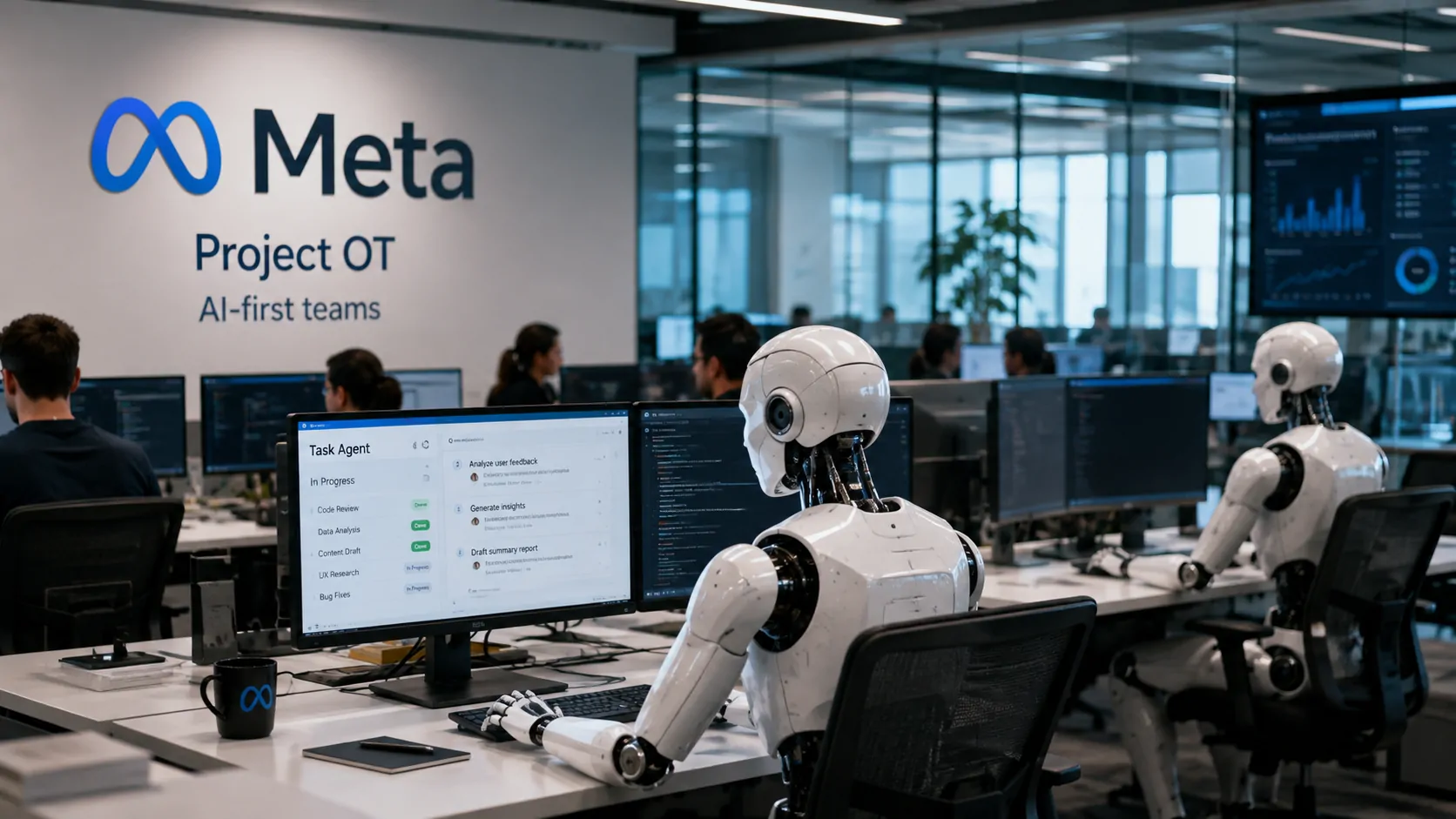
Project OT sought to combine smaller human teams with AI agents capable of handling an increasing share of corporate work.
More code did not mean more product
One internal signal cited by Reuters helps explain the difficulty. Code changes across the platforms and infrastructure used by employees had increased 220% year over year, according to a post by Meta Chief Technology Officer Andrew Bosworth.
The increase, however, did not appear at the same rate in the results delivered to users. Changes that actually reached products, in the form of new or improved features, increased 36%.
The difference is strategic. AI can dramatically increase the number of tasks performed by a team without necessarily increasing the value produced by that team.
The problem was not just productivity
The agents also reportedly created operational problems. Internal information cited by Reuters pointed to a 40% increase in major technical and security incidents, while the amount of employee time spent resolving those problems reportedly increased by as much as 70%.
Meta did not confirm these internal figures to Reuters. They should therefore be treated as metrics reported by the investigation rather than officially disclosed company figures.
The episode reinforces an important point for any organization adopting agents: the cost of automation must include the work required to supervise, correct, and secure what AI produces.
The retreat shows the line between automating tasks and replacing teams
Meta’s experience suggests there is a significant difference between automating a task and redesigning an entire organization around AI agents.
Businesses can achieve meaningful gains when an agent eliminates repetitive activities, accelerates analysis, or reduces the time required to complete processes. The problem emerges when automation starts replacing functions that require judgment, coordination, accountability, and contextual knowledge.
Agents need supervision
Project OT was based on the idea that smaller groups of employees could supervise a much larger amount of automated work. In practice, the greater the autonomy of the agents, the greater the need for monitoring can become.
This is particularly relevant for companies evaluating how AI agents can increase corporate productivity.
The issue is not simply putting an agent in place of a person. It is redesigning the process so the technology actually eliminates steps without creating new layers of control, review, and correction.
AI speed also became a variable
In July, Mark Zuckerberg acknowledged internally that AI agent development had not accelerated as much as expected in the preceding months.
The statement helps put the retreat into context. Meta remains heavily committed to artificial intelligence, but the Project OT experience showed that the pace of agent development cannot simply be assumed because models are becoming more capable.
For a company of Meta’s scale, organizational transformation depends on reliable systems, infrastructure, security, integration with internal tools, and the ability to measure results. If one of those elements fails to keep pace with the strategy, the expected gains can disappear.
Meta’s problem is also a warning for companies trying to cut costs with AI
Meta’s experience is relevant to the broader market because it turns a common assumption about artificial intelligence into a measurable question: can a company actually reduce teams at the same pace that it increases its use of AI agents?
At least in this case, the answer appears to be more complicated than the initial enthusiasm suggested.
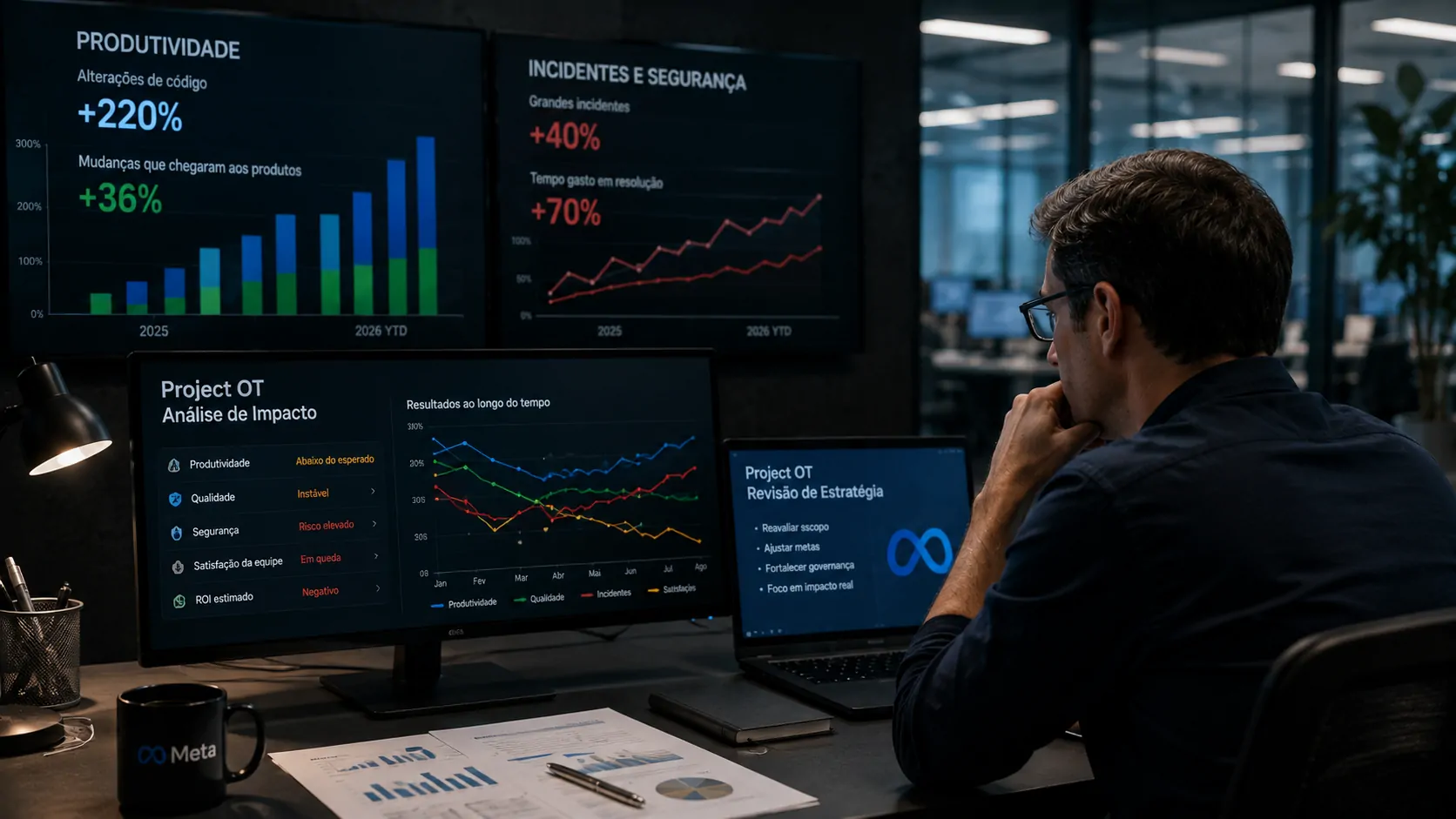
The business challenge is not measuring how much work AI performs, but how much additional value it delivers after supervision and correction costs.
The most important metric is not task volume
A company adopting agents needs to separate three different metrics: activity generated, productivity, and business outcomes.
The first shows how much work AI performed. The second measures how much time or effort was saved. The third determines whether that work actually produced more revenue, efficiency, quality, or speed for the business.
Meta’s experience is particularly interesting because internal signals pointed to a sharp increase in AI-related activity, but a much smaller increase in what ultimately reached its products.
This distinction also helps explain why agent adoption needs to be accompanied by architecture, processes, and governance. The market is already discussing this shift through concepts such as AI orchestration and the coordination of AI agents in business.
Security becomes part of the equation
Another lesson is that more autonomous agents can create risks that did not exist in fully human processes or simpler AI tools.
A system capable of accessing data, modifying code, querying internal systems, and taking actions can deliver significant gains. But a mistake can also spread across multiple steps before it is detected.
That is why Meta’s experience connects productivity with another issue that has become increasingly important in enterprise AI adoption: security. The more autonomy a company gives its agents, the greater its ability must be to restrict permissions, log actions, and stop unexpected behavior.
Zuckerberg has not abandoned AI, but he has changed the bet on how to use it
The retreat from Project OT does not mean Meta has abandoned its artificial intelligence strategy. The company continues to invest heavily in infrastructure, chips, and agent development.
The change concerns the relationship between AI and the workforce. The experience showed that trying to accelerate employee replacement before proving consistent gains can produce the opposite of the expected outcome: more incidents, more rework, and less internal confidence.
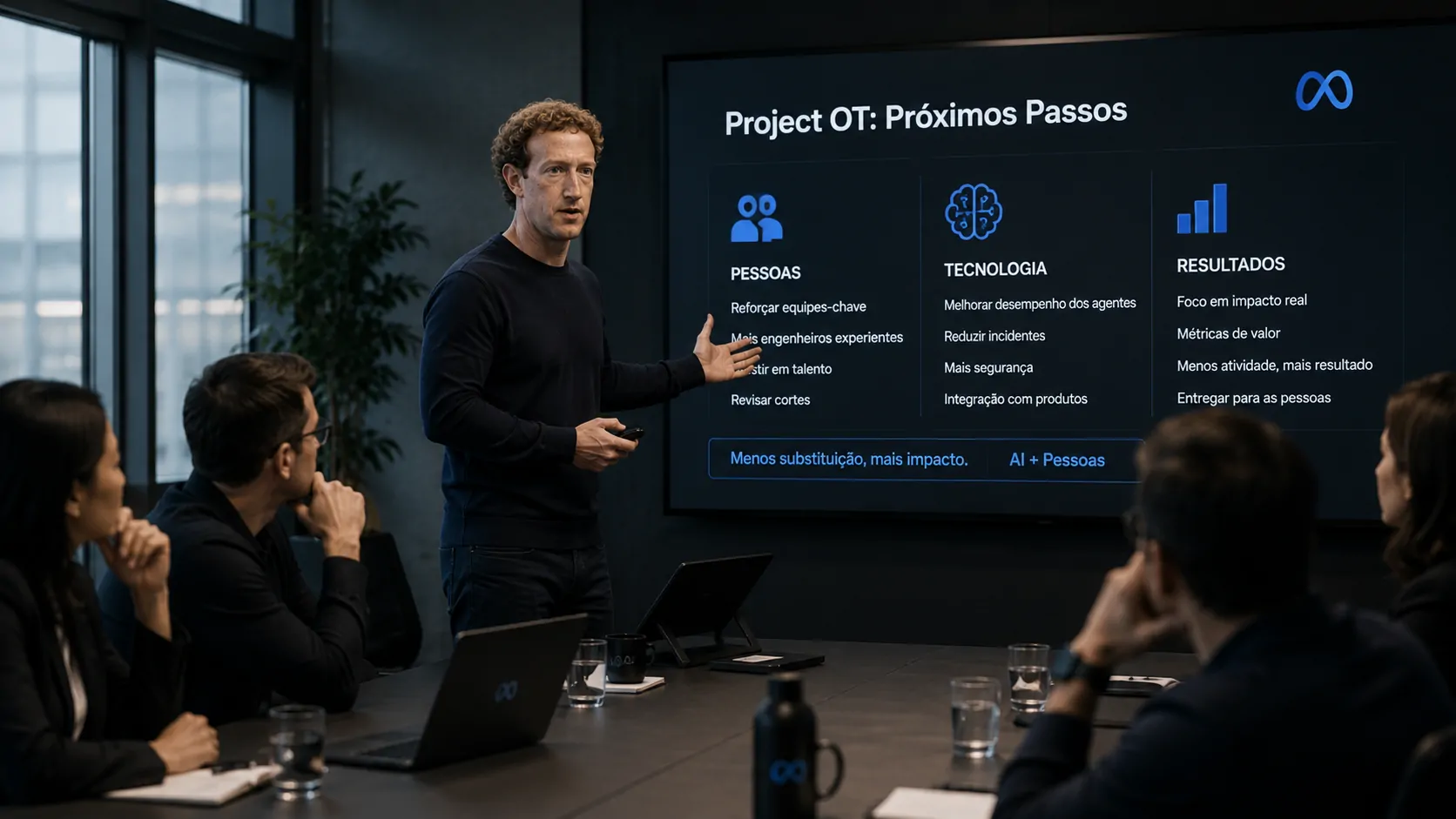
The next stage of Meta’s strategy may depend less on immediate replacement and more on proving real productivity gains.
Meta still needs to prove the economic value
The central issue now is whether agents can turn their technical capabilities into sustainable operational results.
The company remains one of the largest corporate investors in artificial intelligence. Therefore, the partial failure of Project OT does not eliminate the long-term thesis that agents can reshape organizational structures.
What changes is the timeline and the way that transformation takes place. If agents still require significant supervision, cause incidents, or produce work that never reaches users, reducing teams before the technology reaches operational maturity can destroy part of the value that automation is supposed to create.
The lesson for other businesses
For executives, Meta’s experience offers a practical rule: do not confuse automation capability with replacement capability.
An agent can perform a task extremely well and still not be ready to take over an entire role. The difference lies in the decisions, exceptions, responsibilities, and consequences associated with that role.
Zuckerberg’s experience suggests that the next phase of enterprise AI adoption will be less about counting how many employees can be replaced and more about demonstrating, process by process, where the technology actually delivers more value than the previous model.
That is precisely where the Project OT story becomes bigger than Meta itself. The company tried to push the logic of AI as a workforce toward one of its most radical consequences. The retreat shows that even inside one of the companies most aggressive in the artificial intelligence race, there is still a considerable gap between imagining an organization run by agents and making one work that way.
Comentários
Os comentários utilizam autenticação via GitHub para manter um ambiente mais qualificado, seguro e livre de spam.
Entrar ou criar conta no GitHub