
The launch of ChatGPT Work pushed AI agents into the spotlight of enterprise productivity discussions. However, the most significant transformation is not tied to a single platform but to the structural shift in how organizations automate end-to-end business processes. This new phase combines artificial intelligence, system integration and automated decision-making, dramatically expanding the potential of enterprise automation.
The release of ChatGPT Work attracted widespread attention by introducing an experience focused on executing complex business tasks. Yet viewing this transformation solely through the lens of OpenAI’s latest product overlooks a much broader market shift.
The enterprise technology landscape has already been moving toward Agentic AI, where intelligent agents no longer simply answer questions but execute complete workflows involving multiple applications, documents and business users.
This evolution connects several trends that Notícia Tech has been covering extensively, including AI Process Automation, AI Orchestration, MCP, and next-generation automation platforms. Rather than representing the final destination, ChatGPT Work serves as a catalyst for a transformation that has been building across the enterprise AI market.
What Has Changed with the New Generation of AI Agents
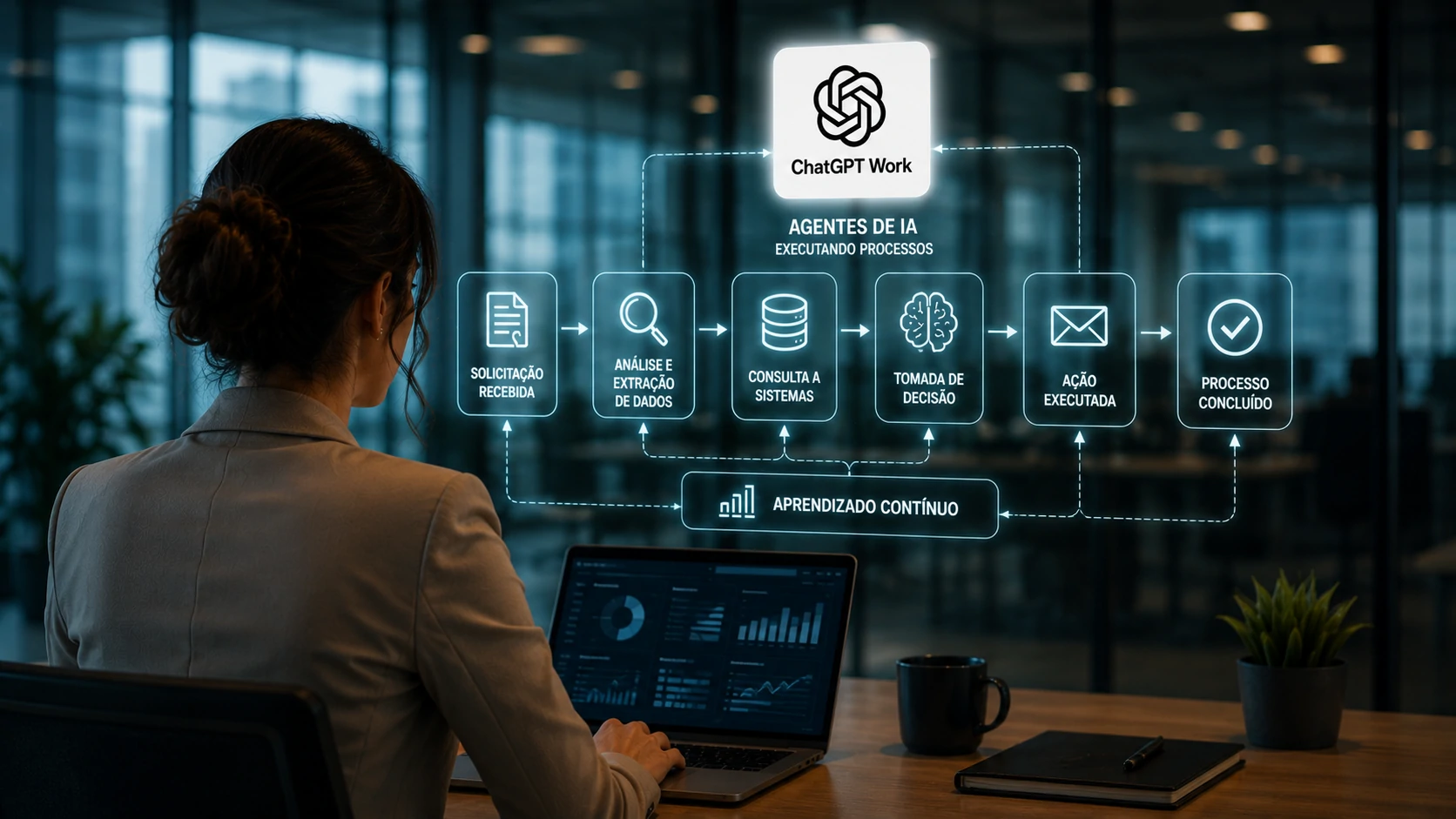
Intelligent agents are beginning to orchestrate complete business workflows by integrating people, enterprise systems and corporate data.
For decades, automation meant executing repetitive tasks through predefined rules. While that approach remains valuable, it struggles whenever business processes require interpretation, contextual understanding or dynamic decision-making.
The arrival of Large Language Models (LLMs) fundamentally changed this equation by enabling software to understand natural language, analyze documents and interact with multiple enterprise applications with far greater flexibility.
From Rule-Based Automation to Intelligent Agents
Traditional automation requires every workflow step to be explicitly programmed. Whenever an unexpected situation occurs, the process typically stops or requires human intervention.
Modern AI agents, on the other hand, can understand context, retrieve additional information, determine the appropriate next action and continue execution while remaining within business-defined governance boundaries.
Why ChatGPT Work Matters
ChatGPT Work made these capabilities far more visible to executives and business leaders by presenting an interface designed specifically around enterprise productivity.
The real breakthrough, however, extends beyond the product itself. It signals the emergence of a new paradigm in which software evolves from being an assistant into an autonomous process executor.
This transition complements other enterprise automation trends previously explored by Notícia Tech, particularly the growing adoption of AI Orchestration.
Read also:
What Is AI Orchestration? Why It Is Replacing Competition Between AI Models in Business
ChatGPT Work Is Only the Beginning
Interest in ChatGPT Work has accelerated at the same time virtually every major technology company is investing heavily in AI agents.
The competitive landscape is no longer defined solely by which model—GPT, Claude or Gemini—produces the best answers. Instead, the race is increasingly focused on building platforms capable of connecting enterprise applications and executing complete business workflows.
Competition Has Moved Beyond AI Models
During the early years of generative AI, vendors primarily competed on response quality and reasoning capabilities.
Today, competitive advantage increasingly depends on how effectively AI platforms integrate enterprise systems, securely access corporate information and perform real business actions across multiple environments.
Enterprise Productivity Is Becoming the Primary Goal
Organizations are looking to reduce operational overhead, eliminate repetitive tasks and improve workforce productivity.
Within this context, intelligent agents become an operational layer capable of connecting CRMs, ERPs, customer service platforms, financial systems and collaboration tools into unified business workflows.
This trend also reinforces concepts previously discussed by Notícia Tech regarding AI Process Automation.
Read also:
How Businesses Are Automating Entire Processes
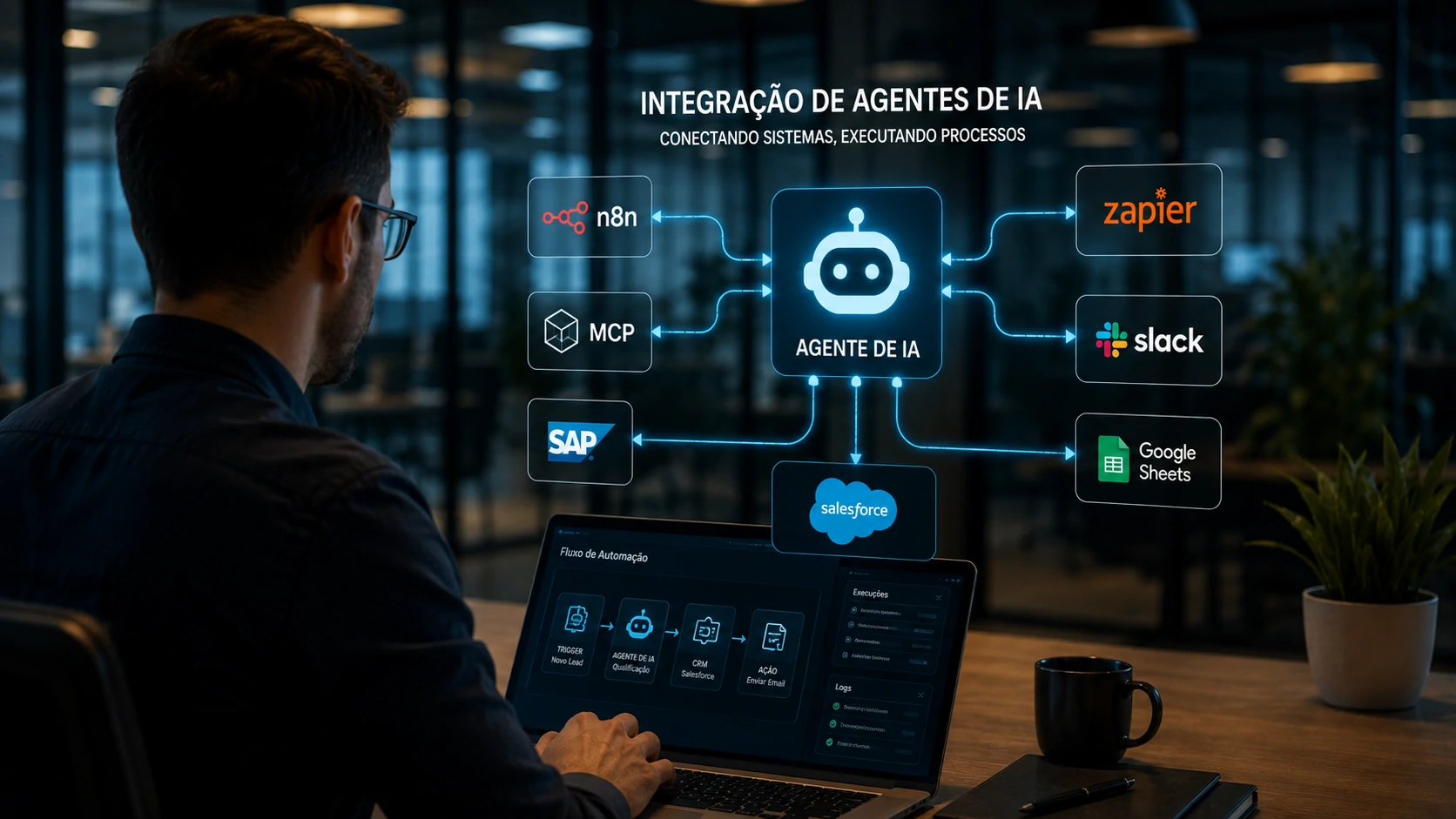
Modern automation platforms connect enterprise systems to execute complete business processes with minimal human intervention.
The most advanced Enterprise AI initiatives are no longer limited to generating text or answering questions. Their primary objective is to automate complete business processes from start to finish.
Instead of employees switching between CRM platforms, ERP systems, spreadsheets, email and customer service tools, AI agents can coordinate these activities automatically, reducing operational bottlenecks while accelerating business decisions.
From Task Automation to Process Execution
Imagine a new sales lead arriving through a company’s website.
In a traditional workflow, multiple employees would validate the information, update the CRM, send follow-up emails, create sales tasks and monitor performance metrics.
With AI agents, nearly the entire process can happen autonomously.
The agent evaluates the lead profile, consults internal knowledge bases, identifies opportunities, updates enterprise systems, schedules meetings and triggers additional workflows whenever necessary.
Where MCP, n8n and Zapier Fit
This evolution depends on technologies capable of connecting multiple enterprise applications.
The Model Context Protocol (MCP) is emerging as a common standard for enabling communication between AI models and business systems while reducing fragmented proprietary integrations.
At the same time, platforms such as n8n, Zapier, Make, and AI Orchestration solutions allow organizations to build intelligent workflows spanning hundreds of business applications without requiring highly complex software development.
In practice, these technologies are becoming the operational infrastructure that enables AI agents to perform meaningful enterprise work.
Which Industries Will Adopt AI Agents First?
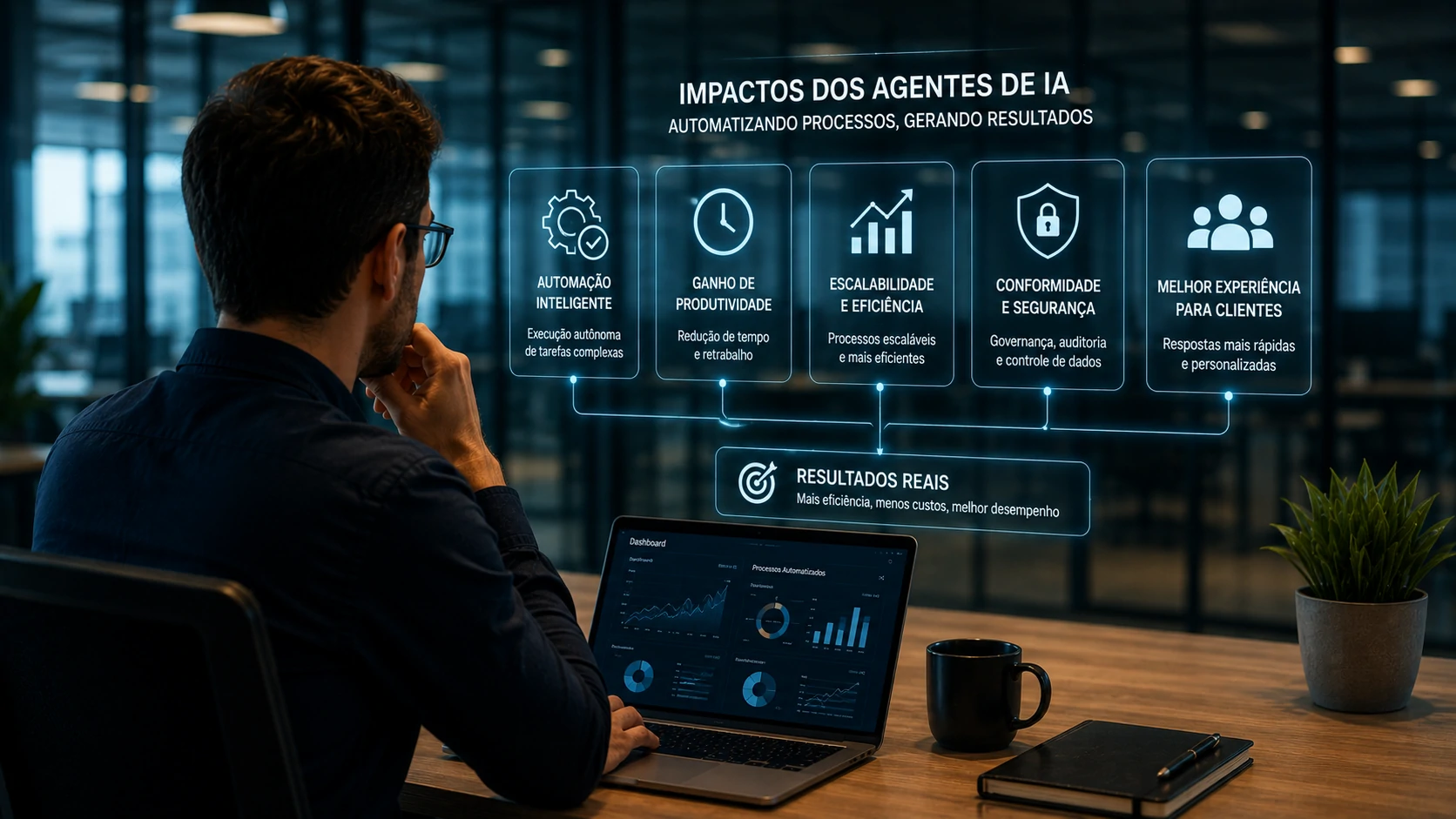
Industries with large volumes of repetitive, data-driven processes are expected to achieve the fastest return on AI agent adoption.
Virtually every organization can benefit from AI agents, but some industries are positioned to capture value much sooner because of their heavy reliance on repetitive information-based processes.
In these environments, even modest reductions in execution time can translate into substantial productivity gains.
Sales and Customer Relationship Management
Sales organizations are expected to remain among the earliest adopters.
AI agents can qualify leads, prepare proposals, update CRMs, respond to customers, organize follow-up activities and recommend business opportunities before a sales representative becomes involved.
This trend complements the evolution of modern AI-powered CRM platforms, which are increasingly moving toward autonomous, agent-driven business operations.
Finance, Human Resources and Operations
Finance departments can deploy AI agents to reconcile documents, analyze contracts, organize payments and generate financial reports.
Human resources teams can automate recruiting workflows, answer employee requests, manage documentation and coordinate internal processes.
Meanwhile, operations teams can leverage AI-driven automation to reduce manual work, improve traceability and accelerate decision-making across supply chains and production environments.
What to Expect Through 2027
The enterprise software market is moving toward a future where AI agents are no longer viewed as competitive differentiators but as a foundational layer of enterprise technology.
Just as ERP and CRM systems became essential over the past several decades, intelligent agents are expected to take responsibility for operational activities that currently consume a significant portion of employees’ time.
This transformation will also increase the importance of AI Governance, enterprise security, automated decision auditing and standardized integration frameworks.
ChatGPT Work will likely be remembered as one of the milestones that accelerated this transition, but it is unlikely to represent its final destination. The market is instead moving toward ecosystems built around multiple specialized AI agents connected through standards such as MCP, coordinated by AI Orchestration platforms and deeply integrated into existing enterprise software.
For businesses, the biggest transformation will not simply be adopting another AI application. It will be fundamentally redefining how entire business processes are executed. That structural shift is expected to shape the next generation of enterprise automation and establish AI agents as one of the most strategic technologies of the coming years.
Comentários
Os comentários utilizam autenticação via GitHub para manter um ambiente mais qualificado, seguro e livre de spam.
Entrar ou criar conta no GitHub